Inspiration · Post Impressionism

The 100 Famous Post Impressionism Paintings That Inspire Our Artists

1877 – 1924

The most famous Post Impressionism paintings are Vincent van Gogh's Starry Night (New York, MoMA) (1889, MOMA - Museum of Modern Art), Vincent van Gogh's Cafe Terrace on the Place du Forum (1888, Kröller-Müller Museum) and Paul Gauguin's Where do we come from what are we where are we going (1897, Museum of Fine Arts). The list runs to 100 paintings by 33 artists, from 1877 to 1924, each with the collection that holds it today.

Starry Night (New York, MoMA) by Vincent van Gogh, 1889, MOMA - Museum of Modern Art — famous Post Impressionism painting
No. 1 · Vincent van GoghStarry Night (New York, MoMA)1889 · MOMA - Museum of Modern Art, New York City
100singular works
33masters · Paul Cézanne – Ferdinand Du Puigaudeau
41homes in 21 cities
6kept at the Musée d'Orsay

Singular works

100 Post Impressionism paintings that exist only once

Every original here is unique and kept in one place. Its story, its home, and the detail that makes it unmistakable.

  1. Starry Night (New York, MoMA) by Vincent van Gogh, 1889, MOMA - Museum of Modern Art
    1

    MOMA - Museum of Modern Art, New York City1889Oil on canvas74 × 92 cm

    The acquisition was secured through the trade of several other works, including: Two works by Cézanne A piece by Toulouse-Lautrec Since its entry into the collection, the work has remained a permanent part of the MoMA holdings. In private correspondence with his brother Theo, the artist expressed dissatisfaction with the result, referring to the work as a failure. It has been held at the Museum of Modern Art in New York City since 1941.

    Its story

  2. Cafe Terrace on the Place du Forum by Vincent van Gogh, 1888, Kröller-Müller Museum
    2

    Kröller-Müller Museum, Otterlo1888Oil on canvas81 × 65 cm

    Most strikingly, the painting demonstrates Van Gogh's ambition to depict night not as a void of black, but as a richly colored experience filled with life and possibility. Created during a period of intense creativity for Van Gogh, this painting reflects his fascination with Japanese prints and their use of bold outlines and flattened perspective.

    The singular detailartificial lightingcafé terrace

    Its story

  3. Where do we come from what are we where are we going by Paul Gauguin, 1897, Museum of Fine Arts
    3

    Museum of Fine Arts, Boston1897Oil on canvas139.1 × 374.6 cm

    Arranged across a lush, dreamlike landscape blending Tahitian scenery with symbolic elements, the composition deliberately defies traditional Western narrative structure, reading from right to left. Rejecting the fleeting impressions of light favored by earlier Impressionists, he employed Synthetism – a technique prioritizing subjective experience and symbolic meaning over realistic representation.

    The singular detailflattened aestheticnon-traditional composition (reads right to left)

    Its story

  4. Harmony in Red by Henri Matisse, 1908, Hermitage Museum
    4

    Henri MatissePost-Impressionism

    Harmony in Red

    Hermitage Museum, Saint Petersburg1908Oil on canvas180 × 220 cm

    Falling squarely within the Post- Impressionist movement – and foreshadowing Matisse’s pivotal role in Fauvism – this piece departs dramatically from traditional representational painting. Instead of striving for photographic realism, Matisse prioritizes the expressive power of color and simplified forms.

    The singular detailstill life arrangementbold color use (red)

    Its story

  5. Skull with Burning Cigarette by Vincent van Gogh, 1886, Van Gogh Museum
    5

    Van Gogh Museum, Amsterdam1886Oil on canvas32 × 25 cm

    Executed in Van Gogh’s emerging Post-Impressionist style, the painting showcases his characteristic expressive brushwork and bold application of paint – an early example of the impasto technique he would later master. The rough rendering of the skull prioritizes form and emotional impact over anatomical precision.

    The singular detaildefiancedark humor

    Its story

  6. The Card Players (Barnes) by Paul Cézanne, 1893, Musée d'Orsay
    6

    Musée d'Orsay, Paris1893Oil on canvas97 × 130 cm

    The painting captures two men engrossed in their card game, their focused expressions hinting at both strategy and perhaps a deeper contemplation of fortune’s fickle hand. The simple setting – a modest table, a bottle of wine, and worn clothing – speaks volumes about the hardships and realities of working-class life in late 19th-century France.

    The singular detailquiet contemplationsomber mood

    Its story

  7. Sleeping Gypsy by Henri Rousseau, 1897, MOMA - Museum of Modern Art
    7

    Henri RousseauPost-Impressionism

    Sleeping Gypsy

    MOMA - Museum of Modern Art, New York City1897Oil on canvas129.5 × 200.7 cm

    Created during the Post-Impressionist era, this painting reflects a growing interest in subjective experience and symbolic representation. The painting's initial reception was mixed, but it quickly gained recognition as a unique and powerful statement within the evolving art landscape.

    The singular detailvibrant colorsjuxtaposition of vulnerability

    Its story

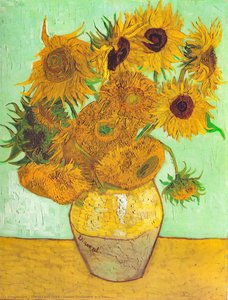
  8. Sunflowers by Vincent van Gogh, 1888, Bayerische Staatsgemaldesammlungen
    8

    Vincent van GoghPost-Impressionism

    Sunflowers

    Bayerische Staatsgemaldesammlungen, Munich1888Oil on canvas91 × 71 cm

    This duality reflects Van Gogh’s own internal struggles and his awareness of life's impermanence. This series of sunflower paintings was created during a particularly hopeful period for Van Gogh, as he prepared his “Yellow House” in Arles to become a haven for artists.

    The singular detailwilting flowersvibrant colors

    Its story

  9. Starry Night Over the Rhone by Vincent van Gogh, 1888, Musée d'Orsay
    9

    Musée d'Orsay, Paris1888Oil on canvas73 × 92 cm

    Van Gogh's Post-Impressionist style is evident in the expressive use of color and bold brushwork. Starry Night Over the Rhone was painted during a prolific period in Van Gogh's life when he was living in Arles.

    The singular detailtwo figures standing by the riverluminous stars and lights

    Its story

  10. Two Women on the Beach by Paul Gauguin, 1891, Musée d'Orsay
    10

    Musée d'Orsay, Paris1891Oil on canvas

    Seated on what appears to be a woven mat, their postures suggest contemplation and quiet connection. This work reflects his fascination with Polynesian culture, though it’s important to acknowledge that his interpretation was filtered through a Western lens.

    The singular detailbold colorssimplified shapes

    Its story

  11. Birch Forest by Gustav Klimt, 1903, Austrian Gallery Belvedere
    11

    Gustav KlimtPost-Impressionism

    Birch Forest

    Austrian Gallery Belvedere, Vienna1903Oil on canvas110 × 110 cm

    Painted during Klimt's early Impressionist phase, this artwork exemplifies his ability to blend realism with atmospheric effects. The loose, expressive brushwork creates a sense of movement and depth, while the play of light and shadow brings the forest scene to life. "Birch Forest" was created in 1903, a pivotal year for Gustav Klimt. This period marked his transition from the decorative styles of the Vienna Secession to a more personal and symbolic approach.

    The singular detailblue flowersvertical birch trees

    Its story

  12. Bañistas en Asnieres by Georges Seurat, 1884, National Gallery
    12

    National Gallery, London1884Oil on canvas201 × 301.5 cm

    The composition is balanced with a horizontal orientation, featuring figures scattered across the foreground and middle ground. "Bañistas en Asnieres" exemplifies Seurat's Post-Impressionist style, characterized by its emphasis on color, expressive brushwork, and a departure from strict realism.

    Its story

  13. Goldfish by Henri Matisse, 1911, Pushkin State Museum
    13

    Henri MatissePost-Impressionism

    Goldfish

    Pushkin State Museum, Moscow1911Oil on canvas140 × 95 cm

    The central focus is a vibrant fishbowl filled with lively red goldfish, surrounded by lush greenery and colorful flowers. This piece is part of a series that includes other notable works like "Goldfish and Sculpture" and "Studio with Goldfish," all of which highlight Matisse's unique ability to blend color, form, and emotion.

    The singular detaillush greenerypatterned wallpaper

    Its story

  14. The Potato Eaters by Vincent van Gogh, 1885, Van Gogh Museum
    14

    Van Gogh Museum, Amsterdam1885Oil on canvas82 × 114 cm

    Van Gogh deliberately eschewed romanticized depictions of rural life, instead choosing to represent the harsh realities faced by working families. Even the act of pouring coffee, performed by the central female figure, suggests not only nourishment but also care and emotional support within the familial unit.

    The singular detailoil lamppotatoes

    Its story

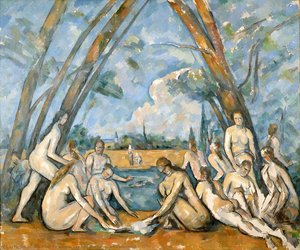
  15. The Large Bathers by Paul Cézanne, 1898–1905, Philadelphia Museum of Art
    15

    Paul CézannePost-Impressionism

    The Large Bathers

    Philadelphia Museum of Art1898–1905Oil on canvas210.5 × 250.8 cm

    The painting presents thirteen nude female figures arranged in a woodland setting, seemingly lost in quiet contemplation near a body of water. Large Bathers (Philadelphia) emerged during a period of radical artistic experimentation.

    The singular detailflattened perspectivenude figures

    Its story

  16. At the moulin rouge by Henri de Toulouse-Lautrec, 1892–1895, Art Institute of Chicago
    16

    Art Institute of Chicago1892–1895Oil on canvas123 × 141 cm

    Created in the Post-Impressionist style, this artwork showcases Henri de Toulouse-Lautrec’s mastery of expressive brushwork and bold color use. The flattened perspective and organic shapes reflect Lautrec’s innovative approach, blending elements of Impressionism with a more personal, abstracted vision that highlights emotional depth and atmospheric richness.

    The singular detailvivid color palettelively social interaction

    Its story

  17. The Night Cafe by Vincent van Gogh, 1888, Yale University Art Gallery
    17

    Vincent van GoghPost-Impressionism

    The Night Cafe

    Yale University Art Gallery, New Haven1888Oil on canvas72 × 92 cm

    This piece exemplifies Van Gogh’s mature Post-Impressionist style. Rejecting the purely optical concerns of Impressionism, he employed color and form to convey inner experience. Created during a period of intense creativity and personal struggle for Van Gogh, this artwork reflects his fascination with capturing the essence of everyday life while simultaneously revealing its underlying anxieties.

    The singular detailsymbolic isolationintense colors

    Its story

  18. Farm Garden with Crucifix by Gustav Klimt, 1911
    18

    1911Oil on canvas110 × 110 cm

    Rejecting the constraints of academic tradition, Klimt and his fellow Secessionists sought to create a “total work of art,” integrating all artistic disciplines. “Farm Garden with Crucifix,” created during his mature period, showcases his independence and ability to seamlessly blend symbolic depth with aesthetic beauty.

    Its story

  19. Yellow Christ by Paul Gauguin, 1889, Buffalo AKG Art Museum
    19

    Paul GauguinPost-Impressionism

    Yellow Christ

    Buffalo AKG Art Museum1889Oil on canvas91 × 73 cm

    Far removed from traditional religious iconography, it is a powerful statement of spiritual questioning and emotional distance, marking a significant departure within Post- Impressionist painting. The figure’s yellowish-green skin tone and elongated form immediately challenge conventional portrayals of Christ's suffering.

    The singular detailbreton figuressymbolic landscape

    Its story

  20. Basket of Apples by Paul Cézanne, 1895, Art Institute of Chicago
    20

    Paul CézannePost-Impressionism

    Basket of Apples

    Art Institute of Chicago1895Oil on canvas62 × 79 cm

    This vibrant composition features a basket brimming with apples and pears, accompanied by bread rolls on a plate and a dark bottle. From living rooms to offices, "Basket of Apples" is a versatile piece that can enhance any decor style.

    The singular detailvibrant contrast between warm fruits and cool backgroundbold colors and loose brushstrokes

    Its story

  21. The Blue Room by Suzanne Valadon, 1923, Centre Pompidou
    21

    Suzanne ValadonPost-Impressionism

    The Blue Room

    Centre Pompidou, Paris1923Oil on canvas90 × 116 cm

    Executed with Valadon’s signature expressive brushwork, this painting exemplifies Post-Impressionism’s emphasis on subjective vision and emotional resonance. Unlike the smooth finishes favored by earlier artists, Valadon embraces visible strokes and a textured surface, lending a tactile quality to the work. Valadon, herself a former model for artists like Renoir and Toulouse-Lautrec, subverts the traditional male gaze.

    The singular detailopen bookfloral motifs

    Its story

  22. Van Gogh's Bedroom in Arles by Vincent van Gogh, 1888, Van Gogh Museum
    22

    Van Gogh Museum, Amsterdam1888Oil on canvas72 × 90 cm

    It offers an extraordinarily intimate glimpse into the artist’s private world – a space conceived as a haven, yet imbued with underlying emotional currents. The two chairs – one yellow, one green – are often interpreted as representing Van Gogh himself and a hoped-for companion, most likely Paul Gauguin.

    Its story

  23. Commerce by Frank Brangwyn
    23

    Frank BrangwynPost-Impressionism

    Commerce

    Oil paint on canvas56 × 48 cm

    The scene known as Commerce by Frank Brangwyn pulses with the heavy, rhythmic energy of trade and prosperity. Commissioned by Thomas Lane Devitt, the work occupies a significant place within the architectural history of the Royal Exchange in London. This work exists alongside The Crucifixion, which dates to about 1911.

    Its story

  24. Avond (Evening): the Red Tree by Piet Mondrian, 1908–1910, Kunstmuseum Den Haag
    24

    Kunstmuseum Den Haag, The Hague1908–1910Oil on canvas70 × 99 cm

    Classifying “Avond (Evening): The Red Tree” as purely Post-Impressionist feels somewhat reductive. This pursuit led him to experiment with Pointillism and Fauvism in his earlier works, ultimately leading him to the rigorous principles of Neoplasticism – a style characterized by primary colors, straight lines, and right angles.

    The singular detailblue backgroundred tree

    Its story

  25. The Street by Vincent van Gogh, 1888, Van Gogh Museum
    25

    Vincent van GoghPost-Impressionism

    The Street

    Van Gogh Museum, Amsterdam1888Oil on canvas72 × 92 cm

    This piece exemplifies Van Gogh's pivotal role in the Post- Impressionist movement. Departing from Impressionism’s focus on fleeting moments of light, Van Gogh employed bold colors and expressive brushstrokes to convey his subjective experience of reality. Notably, the painting showcases “The Yellow House,” where Van Gogh hoped to establish an artist’s colony with Paul Gauguin.

    The singular detailswirling blue skylamppost

    Its story

  26. Mont Sainte-Victoire Seen from Les Lauves by Paul Cézanne, 1897, Baltimore Museum of Art
    26

    Baltimore Museum of Art1897Oil on canvas

    Cézanne's composition centers on a rustic building nestled among lush greenery, with the majestic Mont Sainte-Victoire rising in the background. Mont Sainte-Victoire was one of Cézanne's most repeated themes, with over thirty paintings and watercolors dedicated to the subject.

    The singular detailvibrant color palettedynamic brushstrokes

    Its story

  27. Circus Sideshow by Georges Seurat, 1888, Metropolitan Museum of Art
    27

    Georges SeuratPost-Impressionism

    Circus Sideshow

    Metropolitan Museum of Art, New York1888Oil paint or pastels100 × 155 cm

    Seurat's "Circus Sideshow" is executed in his signature pointillist style, where tiny dots of color are meticulously applied to create a harmonious whole. Created in 1888, "Circus Sideshow" is part of Seurat's exploration of modern life and the urban experience.

    The singular detailvibrant color palette with warm tonesuse of pointillist technique for textured effect

    Its story

  28. Irises by Vincent van Gogh, 1889, J. Paul Getty Museum
    28

    Vincent van GoghPost-Impressionism

    Irises

    J. Paul Getty Museum, Los Angeles1889Oil on canvas71 × 93 cm

    Measuring 71 x 93 cm, “Irises” is a powerful expression of beauty found amidst personal turmoil, and remains one of his most beloved and recognizable works. This painting exemplifies Van Gogh’s distinctive Post- Impressionistic style. Created during a period of intense personal struggle, “Irises” offers a glimpse into Van Gogh's inner world.

    The singular detailswirling brushstrokesvibrant blues

    Its story

  29. Theatre du Chatelet by Edouard Cortès
    29

    Oil

    Theatre du Chatelet is a post-impressionist work by Edouard Cortès. The artist, born in 1882 in Lagny-sur-Marne, France, spent much of his life observing the shifting light and movement of the city. The artist's ability to document these changing environments is further seen in St. Denis, about 1905.

    Its story

  30. Mont Sainte-Victoire by Paul Cézanne, 1892, Barnes Foundation
    30

    Barnes Foundation, Philadelphia1892Oil on canvas73 × 92 cm

    More than simply depicting a geographical feature, Cézanne sought to capture the essence of Mont Sainte-Victoire – its underlying structure, its relationship to space and light, and ultimately, its emotional resonance. Cézanne spent his later years in the hills overlooking Aix-en-Provence, returning repeatedly to Mont Sainte-Victoire as a source of inspiration.

    The singular detailcolorbrushstrokes

    Its story

  31. Menú de ''Els Quatre Gats'' by Pablo Picasso, 1899, Hastings Museum Art Gallery
    31

    Hastings Museum Art Gallery1899Pen and brush and ink, watercolor and pencil

    Els Quatre Gats (The Four Cats) was a café located in Barcelona, Spain, that served as a gathering place for artists and intellectuals. The café was opened by Pere Romeu, who had previously operated a similar establishment in Paris called Le Chat Noir. Picasso was a frequent visitor to the café and even held his first solo exhibition there in 1900. The work exhibits elements of Post-Impressionism, a movement that emerged in the late 19th century as a reaction against Impressionism.

    Its story

  32. Wheatfield with Crows by Vincent van Gogh, 1890, Van Gogh Museum
    32

    Van Gogh Museum, Amsterdam1890Oil on canvas50 × 103 cm

    Painted in July 1890, shortly before Van Gogh’s tragic death, this work has long been associated with his final days. While recent scholarship suggests Tree Roots was likely his last painting, Wheatfield with Crows remains powerfully linked to his emotional state at the time. 50 x 103 cm Date: 1890

    The singular detailcrowswheat field

    Its story

  33. Femme au Chapeau (Woman with Hat) by Henri Matisse, 1905
    33

    1905Oil on canvas

    The painting depicts Madame Matisse, the artist's wife, elegantly adorned with an extravagant hat, becoming a symbol of both personal affection and artistic innovation. Emerging in the early 20th century, Fauvism (“wild beasts” in French) shocked the art world with its radical use of color.

    Its story

  34. The Eiffel Tower by Georges Seurat, 1889, Fine Arts Museums of San Francisco
    34

    Georges SeuratPost-Impressionism

    The Eiffel Tower

    Fine Arts Museums of San Francisco1889Oil on panel24 × 15 cm

    This wasn’t merely an aesthetic choice; Seurat was deeply interested in contemporary color theory – specifically the work of Michel Eugène Chevreul – believing that this method would achieve greater brilliance and accuracy in representing light and atmosphere. The painting presents the Eiffel Tower centrally positioned against a hazy Parisian sky.

    The singular detailpointillist techniqueatmospheric perspective

    Its story

  35. Nafea Faa Ipoipo by Paul Gauguin, 1892, Kunstmuseum Basel
    35

    Paul GauguinPost-Impressionism

    Nafea Faa Ipoipo

    Kunstmuseum Basel1892Oil on canvas101 × 77 cm

    Gauguin's paintings, while celebrating Tahitian culture, are also imbued with a sense of melancholy and a poignant awareness of the loss that accompanied Western contact. Artists like Pablo Picasso and Henri Matisse, deeply impacted by Gauguin’s work, would later build upon his revolutionary techniques and ideas.

    The singular detailsymbolic figures

    Its story

  36. Interior (My dining room) by Wassily Kandinsky, 1909
    36

    1909Oil on cardboard50 × 65 cm

    The painting features a central table draped with a red-and-white checkered cloth, surrounded by various dishes and utensils. This period was marked by his involvement with the Der Blaue Reiter group, which emphasized spiritual and emotional resonance in art.

    The singular detailcentral table with a red-and-white checkered clothlarge wooden cabinet adorned with various objects

    Its story

  37. Curtain, Jug and Fruit by Paul Cézanne, 1894, Whitney Museum of American Art
    37

    Whitney Museum of American Art, New York1894Oil on canvas59 × 72 cm

    Painted in 1894, "Curtain, Jug and Fruit" reflects Cézanne's mature style, which bridged the gap between Impressionism and the avant-garde movements of the early 20th century. The arrangement of fruits in "Curtain, Jug and Fruit" can symbolize prosperity and the cycles of nature, while the jug may represent containment or the passage of time.

    The singular detaileveryday objects arranged casuallyvibrant yet muted color palette

    Its story

  38. Sabartes by Pablo Picasso, 1901, Pushkin State Museum
    38

    Pablo PicassoPost-Impressionism

    Sabartes

    Pushkin State Museum, Moscow1901Oil on canvas82 × 66 cm

    The composition is balanced with the figure positioned slightly off-center to the right, creating a sense of space on the left side. "Sabartes" showcases Picasso's distinctive Post-Impressionist style, characterized by bold outlines, flat planes of color, and expressive brushstrokes.

    The singular detailcontemplative expressionmuted palette

    Its story

  39. Interior with a Girl Reading by Henri Matisse, 1905, MOMA - Museum of Modern Art
    39

    MOMA - Museum of Modern Art, New York City1905Oil on canvas72 × 59 cm

    The year 1905 witnessed a seismic shift in artistic sensibilities. Impressionism’s serene landscapes and subtle tonal gradations were increasingly challenged by artists seeking to express emotion directly through vibrant hues—a reaction against what many perceived as the limitations of naturalistic representation.

    Its story

  40. Mahana no atua (Day of God) by Paul Gauguin, 1894, Art Institute of Chicago
    40

    Art Institute of Chicago1894Oil on canvas66 × 87 cm

    This striking artwork immerses viewers in a vibrant scene rich with cultural and spiritual symbolism.

    The singular detailspiritual symbolismindigenous motifs

    Its story

  41. Carnival Evening by Henri Rousseau, 1886, Philadelphia Museum of Art
    41

    Henri RousseauPost-Impressionism

    Carnival Evening

    Philadelphia Museum of Art1886Oil on canvas

    Carnival Evening is an oil on canvas painting by the French artist Henri Rousseau. The work is dated 1885 or 1886. By 1933, the work was in the possession of Michel and Rose Kikoïne, also in Montrouge. In June 1934, the painting was sold to Louis E. The work remained in private collections until it was bequeathed to the Philadelphia Museum of Art in 1963. Another significant work is The Dream (1910), located at the Museum of Modern Art in New York City.

    Its story

  42. Breton Woman Sitting at the Seashore by Paul Sérusier, 1895, Warsaw National Museum
    42

    Warsaw National Museum1895Oil29 × 45 cm

    Created around 1890, this artwork resides within the esteemed collection of Gabriela Zapolska, offering viewers a glimpse into the artistic sensibilities of a bygone era. Sérusier’s work emerged during the formative years of the Nabis movement, alongside artists like Gauguin and Vuillard.

    Its story

  43. The Regatta by Stanley Cursiter, 1913
    43

    Stanley CursiterPost-Impressionism

    The Regatta

    1913Oil on canvas50 × 61 cm

    The composition is filled with the movement of several boats navigating the water, their sails catching the light and wind. The scene is populated by at least thirteen individuals, each caught in a specific moment of the competition or quiet observation.

    Its story

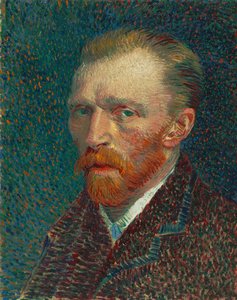
  44. Self Portrait by Vincent van Gogh, 1889, Art Institute of Chicago
    44

    Vincent van GoghPost-Impressionism

    Self Portrait

    Art Institute of Chicago1889Oil on canvas40 × 31 cm

    Van Gogh’s self-portraits are renowned for their emotional depth and introspection. This particular Self-Portrait is notable for its simplicity and directness, with the artist wearing a blue shirt with white trim. The Rijksmuseum Vincent Van Gogh in Amsterdam is dedicated to showcasing the artist’s works and provides invaluable insights into his life and creative process.

    Its story

  45. Still life with apples by Paul Cézanne, 1890, Hermitage Museum
    45

    Hermitage Museum, Saint Petersburg1890Oil on canvas35.2 × 46.2 cm

    " Still Life with Apples " is not only a beautiful piece of art but also an important milestone in the development of modern art. Still life with Apples Paul Cézanne: A pioneering French Post-Impressionist artist. A predominantly French art movement that developed roughly between 1886 and 1905.

    Its story

  46. Tahitian Women on the Beach by Paul Gauguin, 1890, Orsay Museum
    46

    Orsay Museum, Paris1890Oil on canvas69 × 91.5 cm

    Unlike Impressionism's focus on fleeting light effects, Synthetism prioritizes flattened planes of color and simplified forms, creating an illusionistic space that feels both stylized and emotionally resonant. The women's relaxed postures symbolize tranquility and harmony with their surroundings, mirroring Gauguin’s idealized vision of paradise.

    Its story

  47. View of the Street Rivoli and Notre Dame by Edouard Cortès
    47

    Oil45 × 33 cm

    This post-impressionist work depicts a specific urban setting within Paris, France. The composition focuses on the intersection of city life and architectural presence, centering on the activity within the street and the proximity of the Notre Dame structure.

    Its story

  48. Young Man with Cornflower by Vincent van Gogh, 1890
    48

    1890Oil on canvas (presumed)39 × 31 cm

    This work exemplifies Van Gogh's signature Post- Impressionistic style – a departure from strict realism towards subjective expression. While rooted in observation, the painting prioritizes conveying feeling through bold color choices and dynamic brushwork. Created towards the end of Van Gogh's tragically short life, this portrait reflects his ongoing experimentation with color and form.

    Its story

  49. Ia Orana Maria (Hail Mary) by Paul Gauguin, 1891, Metropolitan Museum of Art
    49

    Metropolitan Museum of Art, New York1891Oil on canvas113.7 × 87.6 cm

    This work encapsulates Gauguin’s radical departure from European artistic conventions and his quest to capture spirituality outside the confines of Western tradition. Driven by disillusionment with Parisian society, Gauguin sought refuge in Tahiti, believing its untamed beauty and vibrant culture held the key to a more genuine way of life.

    The singular detailmountainous backgroundapparition of Mary

    Its story

  50. The Return of the Fishing Fleet, Croisic by Ferdinand Du Puigaudeau, 1916
    50

    1916Oil on canvas

    The painting titled The Return of the Fishing Fleet, Croisic is a work by the French artist Ferdinand Du Puigaudeau. Known in its original language as Le Retour de pêche au Croisic, the piece captures a specific maritime scene. The artist, Ferdinand Du Puigaudeau, rendered this composition in 1916.

    Its story

  51. Seated Woman, Back Turned to the Open Window by Henri Matisse, 1922, Eredità Bardini Museum
    51

    Eredità Bardini Museum1922Oil on canvas73 × 92 cm

    In 1905, Woman with a Hat emerges with its own distinct energy, while 1906 brings the rhythmic presence of The Joy of Life. As the years progress, the brushwork shifts through Algerian Woman in 1909 and The Dance in 1910. These works exist alongside the 1911 creation Goldfish, where color and form find new ways to interact on the canvas. Other portraits offer different perspectives on the subject, such as the oil on canvas Madame Yvonne Landsberg from about 1914.

    Its story

  52. Apple Picking at Eragny-sur-Epte by Camille Pissarro, 1888, Dallas Museum of Art
    52

    Dallas Museum of Art1888Oil on canvas73 × 60 cm

    The composition is anchored by a large tree that dominates the background, creating a vertical axis that draws the eye upward. Eragny-sur-Epte, where the artwork is set, was a place of solace for Pissarro, offering him inspiration and a retreat from urban life.

    The singular detaillarge central treefigures engaged in apple picking

    Its story

  53. Portrait of Patience Escalier by Vincent van Gogh, 1888, The Norton Simon Museum of Art
    53

    The Norton Simon Museum of Art, Pasadena1888Oil on canvas64 × 54 cm

    This artwork is a quintessential example of Post-Impressionism, moving beyond the mere depiction of light and form to convey emotional experience. The visible brushstrokes aren’t merely a technique; they are integral to conveying Escalier’s weathered face, full white beard, and the very essence of his life lived outdoors.

    Its story

  54. Manao Tupapau by Paul Gauguin, 1892, Buffalo AKG Art Museum
    54

    Paul GauguinPost-Impressionism

    Manao Tupapau

    Buffalo AKG Art Museum1892Oil on canvas72.4 × 92.4 cm

    Completed in 1892 during his transformative sojourn to Tahiti, this oil on burlap canvas pulsates with a potent blend of Polynesian mythology, Symbolist introspection, and Gauguin’s signature synthetist style. Gauguin’s arrival in Tahiti in 1891 marked a pivotal moment, not just for his personal life but also for his artistic development.

    The singular detailspirit of the dead

    Its story

  55. The toilette, Musee D'Orsay by Henri de Toulouse-Lautrec, 1896, Musée d'Orsay
    55

    Musée d'Orsay, Paris1896Oil67 × 54 cm

    There is no grand theatricality here, only the quiet, unvarnished reality of a domestic moment. Moving away from the fleeting light-studies of his Impressionist predecessors, Toulouse-Lautrec utilized a more expressive and emotive palette to convey psychological depth.

    Its story

  56. At the ''Lapin Agile'' by Pablo Picasso, 1905, Metropolitan Museum of Art
    56

    Metropolitan Museum of Art, New York City1905Oil on canvas99 × 100 cm

    At the ''Lapin Agile'' is an oil on canvas painting by Pablo Picasso, executed in 1905. Frédéric Gérard, the owner of the Lapin Agile cabaret, exhibited the work at the club from 1905 to 1912. It remained in private hands until 1952, when Joan Whitney Payson acquired the piece in New York for $60,000.

    The singular detailgermaine Pichot depicted as the woman in orange dressfrédéric Gérard depicted as the guitarist

    Its story

  57. Standing Odalisque Reflected in a Mirror by Henri Matisse, 1923
    57

    1923Oil painting

    “Standing Odalisque Reflected in a Mirror” succeeds in capturing a moment of quiet contemplation —a glimpse into the inner life of its subject. Created during a period of artistic experimentation following World War I, “Standing Odalisque Reflected in a Mirror” represents a significant step away from Impressionistic conventions.

    Its story

  58. Paradise by Marcel Duchamp, 1918–1927, Philadelphia Museum of Art
    58

    Marcel DuchampPost-Impressionism

    Paradise

    Philadelphia Museum of Art1918–1927Oil on canvas

    While often categorized within Post-Impressionism due to its departure from strict realism, Paradise defies easy categorization. While influenced by artists like Paul Cézanne and Vincent van Gogh – particularly in his use of color and expressive brushwork – Duchamp quickly moved beyond their styles to forge his own unique path.

    The singular detaileveadam

    Its story

  59. Two Cypresses, Mistral, Opus 241 by Paul Signac, 1893, Kröller-Müller Museum
    59

    Kröller-Müller Museum, Otterlo1893Oil on canvas

    The scene captures a specific moment in the Mediterranean landscape, where the fierce Mistral wind sweeps through the trees, adding an invisible layer of movement and energy to the stillness of the canvas. Moving away from the spontaneous, fleeting strokes of traditional Impressionism, Signac embraced a more scientific, disciplined approach to color theory.

    Its story

  60. Mr William Pritchard, ARP Warden, Newport by Stanley Cornwell Lewis
    60

    Oil on canvas60 × 50 cm

    During the early years of the war, Lewis captured the atmosphere of the home front through works such as The Croesyceiliog Blacksmiths and The Doll, both painted in 1940. This period also saw the creation of Wartime Newport, The Home Front between 1940 and 1941.

    Its story

  61. Chateau Noir (Louvre) by Paul Cézanne, 1904, MOMA - Museum of Modern Art
    61

    MOMA - Museum of Modern Art, New York City1904Oil on canvas73 × 92 cm

    Executed in the hallmark style of Post-Impressionism, this painting showcases bold, expressive brushwork and a vibrant color palette. During this era, Post-Impressionist painters like Cézanne sought to move beyond the fleeting impressions of Impressionism, emphasizing structure, volume, and underlying geometric forms.

    The singular detailvibrant colorstextured brushwork

    Its story

  62. Twelve Sunflowers in a Vase by Vincent van Gogh, 1888, Philadelphia Museum of Art
    62

    Philadelphia Museum of Art1888Oil on canvas91 × 72 cm

    Van Gogh's distinctive style is on full display in this artwork. Painted during Van Gogh's time in Arles, France, Twelve Sunflowers in a Vase was part of a series intended to decorate his home, which he hoped would become a shared studio with fellow artist Paul Gauguin.

    The singular detailthick paint applicationvibrant colors

    Its story

  63. Sunset by the Sea, Brittany by Ferdinand Du Puigaudeau, 1924
    63

    1924Oil

    The sun dips low toward the horizon, casting a warm, heavy glow across the Breton coastline. Two figures walk along the edge of the sand, their silhouettes softening as the light fades. In the distance, a solitary boat floats upon the water, a small speck against the shifting colors of the sea.

    Its story

  64. Portrait of Dr. Gachet by Vincent van Gogh, 1890
    64

    1890Oil on canvas67 × 56 cm

    The artwork exemplifies Van Gogh's distinctive Post-Impressionist style, characterized by bold brushstrokes, vibrant colors, and an emphasis on personal expression over realistic depiction. Dr. Gachet, who was also an artist, became a close friend and confidant to Van Gogh during this time, providing both medical care and emotional support.

    The singular detailvivid color paletteswirling background patterns

    Its story

  65. Gabriele Münter painting in Kallmunz by Wassily Kandinsky, 1903, Lenbachhaus
    65

    Lenbachhaus, Munich1903Oil on canvas59 × 59 cm

    The composition beautifully balances the figure of Münter with the surrounding landscape, creating a harmonious blend of human creativity and natural beauty. " Gabriele Münter painting in Kallmunz" reflects the early stages of this artistic evolution, showcasing Kandinsky’s transition from representational to more experimental styles.

    The singular detailexpressive brushwork creating texture and movementvibrant color palette with earthy tones and bright accents

    Its story

  66. At ''Lapin Agile'' (Harlequin with Glass) by Pablo Picasso, 1905, Metropolitan Museum of Art
    66

    Metropolitan Museum of Art, New York City1905Oil on canvas99 × 100 cm

    This oil on canvas (99 x 100 cm) captures a fleeting moment inside the legendary Le Lapin Agile cabaret, a haven for artists, writers, and musicians in Montmartre. Created in 1905, this painting reflects a period of significant artistic experimentation and social change.

    The singular detailharlequin figureself-portrait (possibly)

    Its story

  67. On the Beach by Henri Lebasque, 1921
    67

    Henri LebasquePost-Impressionism

    On the Beach

    1921Oil on canvas

    On the Beach is an oil on canvas by the French artist Henri Lebasque. Created about 1921, the work reflects the artist's established interest in the interplay of light and leisure. The painting belongs to a period in Lebasque's career following his 1906 transformation in color application.

    Its story

  68. Rue du Chevalier de la Barre by Maurice Utrillo
    68

    Oil painting

    The scene unfolds in the Rue du Chevalier de la Barre, Les coupoles du Sacré-Cœur et le clocher de Saint-Pierre de Montmartre, a work by Maurice Utrillo. This painting captures a specific, atmospheric moment within the Montmartre district of Paris.

    Its story

  69. Olive Trees. Landscape at Cadaques by Salvador Dalí, 1922
    69

    1922Oil on canvas

    Salvador Dalí's "Olive Trees. Painted during Dalí’s formative years in Paris alongside Pablo Picasso, “Olive Trees” reflects the broader artistic currents of the time. In Mediterranean culture, olives represent longevity, peace, and fertility—values that align with Dalí’s preoccupation with mortality and regeneration.

    Its story

  70. The Loss of Virginity (also known as The Awakening of Spring) by Paul Gauguin, 1891, Chrysler Museum of Art
    70

    Chrysler Museum of Art, Norfolk1891Oil on canvas90 × 130 cm

    The central figure in this artwork is a reclining human-like form with an animal head, possibly a lion. Created during Gauguin's time in Tahiti, this artwork reflects his fascination with the island's culture and natural beauty.

    The singular detailvibrant colorsdreamlike atmosphere

    Its story

  71. Still Life with Apples and Peaches by Paul Cézanne, 1905, National Gallery of Art
    71

    National Gallery of Art, Washington1905Oil on canvas81 × 101 cm

    This approach bridges Impressionism’s focus on light and color with the more analytical concerns of Cubism. Created during a pivotal moment in art history, Still Life with Apples and Peaches reflects Cézanne's departure from traditional artistic conventions. Post-Impressionism Key Features: Planes of color, deliberate brushstrokes, geometric forms.

    Its story

  72. Landscape at Blainville by Marcel Duchamp, 1902, Philadelphia Museum of Art
    72

    Philadelphia Museum of Art1902Oil on canvas61 × 50 cm

    Marcel Duchamp, a pioneer of conceptual art, is renowned for his innovative and thought-provoking works. Duchamp’s technique in Landscape at Blainville demonstrates his skill in capturing light and texture, drawing the viewer into the serene world he has created. Experience the tranquility of Marcel Duchamp's 'Landscape at Blainville' with AllPaintingsStore.com.

    Its story

  73. Passion flower by Piet Mondrian, 1908, Gemeentemuseum den Haag
    73

    Piet MondrianPost-Impressionism

    Passion flower

    Gemeentemuseum den Haag, The Hague1908Ink72 × 47 cm

    Post-Impressionism arose as a reaction against Impressionists' preoccupation with capturing fleeting moments of light and color. While color isn't explicitly prominent, Mondrian’s palette during this period favored muted tones that prioritized form over vibrant hues—a characteristic of De Stijl’s aesthetic principles.

    Its story

  74. The Red Vineyard [1888] by Vincent van Gogh, 1888, Pushkin State Museum
    74

    Pushkin State Museum, Moscow1888Oil on canvas75 × 93 cm

    Furthermore, Van Gogh’s artistic development during this period was significantly shaped by Japanese woodblock prints (Ukiyo-e). AllPaintingsStore offers meticulously hand-painted reproductions of “The Red Vineyard,” capturing the essence of Van Gogh’s original vision with exceptional detail and fidelity.

    The singular detailhorsegrapes

    Its story

  75. Nude by Pierre Bonnard, 1906
    75

    Pierre BonnardPost-Impressionism

    Nude

    1906Oil on canvas54.5 × 64.8 cm

    Positioned on the left of an asymmetrical composition, she faces toward the right, caught in a moment of quietude. The scene is defined by a soft, diffused light that catches the curve of her shoulder and back, casting gentle shadows across her skin.

    Its story

  76. Still Life with Skull (Nature Morte au Crane) by Paul Cézanne, 1901, ArtsDot.com
    76

    ArtsDot.com1901Oil on canvas

    The skull, centrally positioned and holding an apple in its skeletal hand, immediately draws the viewer's attention. Still Life with Skull is a quintessential example of Cézanne’s Post- Impressionistic style. Painted in 1901, towards the end of Cézanne's career, Still Life with Skull reflects a growing preoccupation with mortality that characterized his later works.

    Its story

  77. Open Window, Collioure by Henri Matisse, 1905, National Gallery of Art
    77

    National Gallery of Art, Washington1905Oil on canvas

    It was here, amidst the salt air and sun-drenched Mediterranean coast, that Henri Matisse birthed a revolution. Technically, Open Window, Collioure is a triumph of flattened perspective and textural richness. Ultimately, Matisse’s vision remains as potent today as it was over a century ago.

    Its story

  78. Theatre du Vaudeville by Edouard Cortès
    78

    Oil on canvas on board

    Theatre du Vaudeville is an oil painting by the artist Edouard Cortès. The work depicts a Parisian street scene, focusing on the urban landscape and the activity surrounding a theater. Edouard Cortès was born in Lagny-sur-Marne, France, in 1882.

    Its story

  79. Madame Tarkhoff with Her Two Children Jean and Boris by Nicolas Tarkhoff, 1907
    79

    1907Oil paint69 × 105 cm

    The composition centers on a woman reclining within the confines of a bed. The woman’s hand is visible in the lower portion of the scene, making contact with her child. The painting captures a quiet, private moment, a theme present in his other works from this period.

    Its story

  80. A Destroyed Turkish Aerodrome at Rayak, Lebanon, 1919 by Sydney Carline, 1920
    80

    1920Oil76 × 107 cm

    Created about 1920, the painting captures a specific moment of military aftermath in the Middle East. Carline, born in London, United Kingdom, in 1888, brought a unique perspective to the canvas, shaped by his direct experiences during the First World War.

    Its story

  81. Fisherman in Chioggia by Konstantin Gorbatov
    81

    In this scene, a dozen sailboats rest in the harbor, their hulls bobbing against the stillness of the tide. A large white building rises in the background, its pale facade catching the sun. Near the waterfront, three figures move through the salt air, their presence small against the architecture of the town. The brushwork carries the influence of European Post-Impressionism, blending a Russian sensibility with the luminous clarity of the Italian coast.

    Its story

  82. A rocky cove by James Dickson Innes
    82

    James Dickson InnesPost-Impressionism

    A rocky cove

    Oil

    A rocky cove emerges from the canvas, a quiet moment captured by the hand of James Dickson Innes. This work carries the unmistakable touch of an artist who sought to translate the essence of the coast into a visual language of color and light.

    Its story

  83. Leenane by Paul Henry, 1913
    83

    Paul HenryPost-Impressionism

    Leenane

    1913Oil34 × 41 cm

    Sunlight and mist dance across the surface of the water, creating a mirror for the sky. These people appear as quiet witnesses to the vastness of the terrain, their presence adding a sense of scale to the immense, rugged scenery.

    Its story

  84. Farm in Brittany by Paul Gauguin, 1894, Metropolitan Museum of Art
    84

    Paul GauguinPost-Impressionism

    Farm in Brittany

    Metropolitan Museum of Art, New York1894Oil on canvas72.4 × 90.5 cm

    This beautiful oil on canvas painting is housed at the Metropolitan Museum of Art in New York, United States. The painting depicts a peaceful farm scene in Brittany, characterized by red brick houses surrounded by lush green trees. For those who appreciate the beauty of Farm in Brittany, AllPaintingsStore.com offers high-quality, handmade oil painting reproductions.

    Its story

  85. Flowering Garden by Vincent van Gogh, 1888
    85

    1888Oil on canvas92 × 73 cm

    Painted during Van Gogh's prolific period in Arles, France, this artwork exemplifies his Post-Impressionist approach. Unlike the Impressionists who focused on capturing fleeting moments of light, Van Gogh infused his work with emotional intensity and bold, expressive brushstrokes.

    The singular detailbold, expressive linesthick, impasto brushstrokes

    Its story

  86. Mountains in Provence by Paul Cézanne, 1879, National Gallery
    86

    National Gallery, London1879Oil on canvas53.5 × 72.4 cm

    Paul Cezanne was a French artist, often considered the father of modern art. Cezanne's innovative approach to painting laid the groundwork for many 20th-century artistic styles, including Fauvism, Cubism, and Expressionism. Cezanne's unique approach to painting color and form laid the foundation for many 20th-century artistic movements.

    Its story

  87. La Place du Maine, Paris by Nicolas Tarkhoff
    87

    Oil

    A horse-drawn carriage occupies the right side of the composition, moving along a paved road. Two horses are positioned toward the left, one leading the other in a staggered formation. The work reflects the Post-Impressionist style, moving away from strict academic constraints toward a more emotive approach to subject matter.

    Its story

  88. Haystacks in Provence by Vincent van Gogh, 1888, Kröller-Müller Museum
    88

    Kröller-Müller Museum, Otterlo1888Oil on canvas73 × 93 cm

    During his time in Arles, Van Gogh sought refuge and inspiration in the rural landscape, hoping to establish an artist's colony. In Van Gogh's hands, they can also be interpreted as symbols of stability or a longing for peace – themes deeply resonant with his own search for inner tranquility.

    The singular detailrural scenevibrant colors

    Its story

  89. Vision After the Sermon by Paul Gauguin, 1888, Scottish National Gallery
    89

    Scottish National Gallery, Edinburgh1888Oil on canvas72.2 × 91 cm

    Gauguin, a restless spirit driven by a desire to escape European conventions, had already begun to dismantle established artistic norms, seeking inspiration in the art of Japan and the raw energy of his own experiences – particularly those spent in Tahiti.

    The singular detaildistorted shapesbold color

    Its story

  90. Entrance to the Kasbah by Henri Matisse, 1912, Pushkin Museum
    90

    Pushkin Museum1912Oil on canvas

    The artist’s exploration of these themes extends into the Amido-Zorah-Fatma series, which shares a connection to the creative energy of this period. There is also a sense of continuity in Three Sisters, a work where three models are posed to create a specific composition.

    Its story

  91. Landscape by Paul Cézanne, 1890, Ohara Museum of Art
    91

    Paul CézannePost-Impressionism

    Landscape

    Ohara Museum of Art, Kurashiki1890Oil on canvas81 × 65 cm

    Cézanne wasn't interested in merely reproducing what he saw; he sought to understand and reconstruct the underlying structure of nature. Born and largely based in Aix-en-Provence, France, Cézanne held a lifelong fascination with his native landscape.

    The singular detailvibrant colorsthick impasto

    Its story

  92. Winter Landscape by Wassily Kandinsky, 1909, Hermitage Museum
    92

    Hermitage Museum, Saint Petersburg1909Oil on canvas75 × 97 cm

    Winter Landscape depicts a serene winter scene featuring a house in the middle of a snowy field, surrounded by trees. Kandinsky's Winter Landscape is not only a beautiful piece of art but also an important milestone in the development of modern art.

    Its story

  93. The Church at Auvers by Vincent van Gogh, 1890, Musée d'Orsay
    93

    Musée d'Orsay, Paris1890Oil on canvas74 × 94 cm

    In "The Church at Auvers," he employs thick, visible brushstrokes and a vibrant color palette to convey the emotional depth of the scene. Created in the final months of van Gogh's life, "The Church at Auvers" reflects his evolving artistic style and his fascination with rural landscapes.

    The singular detailexpressive brushworkswirling sky patterns

    Its story

  94. Portrait of Victor Chocquet by Paul Cézanne, 1877, Virginia Museum of Fine Arts
    94

    Virginia Museum of Fine Arts, Richmond1877Oil on canvas (presumed)46 × 38 cm

    Painted at a time when Cézanne was striving to establish his artistic identity, this portrait reflects a deep connection between artist and subject. It’s a snapshot of bourgeois life in late 19th-century France, meticulously observed and translated onto canvas.

    The singular detailmuted color paletteformal composition

    Its story

  95. Boulevard de la Madeleine by Edouard Cortès
    95

    Its story

  96. Park von Saint-Cloud, Waldlichtung by Wassily Kandinsky, 1907, Centre Pompidou
    96

    Centre Pompidou, Paris1907Oil24 × 33 cm

    In “Park von Saint-Cloud, Waldlichtung,” these principles are brilliantly applied. “Park von Saint-Cloud, Waldlichtung” was created during a period of significant artistic ferment in Europe. Kandinsky’s work reflects these broader trends while simultaneously forging his own unique path.

    The singular detailforest landscape

    Its story

  97. The White Horse by Paul Gauguin, 1898, Musée d'Orsay
    97

    Paul GauguinPost-Impressionism

    The White Horse

    Musée d'Orsay, Paris1898Oil on canvas140 × 91 cm

    Instead, he employs a Synthetist approach—a technique pioneered by Cézanne and championed by Gauguin himself—that prioritizes flattened planes of color and simplified forms over meticulous detail. Initially drawn to Impressionist techniques through his acquaintance with Camille Pissarro, he swiftly recognized the limitations of this style and embarked on a path toward artistic independence.

    Its story

  98. Interior, Mother and Sister of the Artist by Édouard Vuillard, 1893, MOMA - Museum of Modern Art
    98

    MOMA - Museum of Modern Art, New York City1893Oil on canvas46.3 × 56.5 cm

    The composition is a masterclass in the Post-Impressionist approach to space.

    Its story

  99. Gare du Nord by Auguste Chabaud, 1907
    99

    Auguste ChabaudPost-Impressionism

    Gare du Nord

    1907Oil paints on canvas58 × 78 cm

    The scene is dominated by the heavy, boxy presence of a locomotive, its form partially veiled by a horizontal fence that cuts through the middle ground. There is a certain weight to the composition, a sense of industrial gravity that anchors the viewer to the station floor.

    Its story

  100. The Last Asters by Stanisław Żukowski, 1912
    100

    1912Oil

    In this corner of a garden, the season is making its final, colorful protest. Near the center, a solitary bench sits empty, waiting for a traveler to pause and witness the slow descent of the year.

    Its story

Where they live

The one place you can see each famous Post Impressionism painting

Paris keeps 9 of these originals; the Musée d'Orsay, 6.

The masters

The Post Impressionism masters our artists look to

Portrait of Henri Matisse

Henri Matisse

1869–1954 · France · 8

French Fauvist known for vibrant, non-naturalistic colors and expressive cut-paper collages that transformed his later years of illness.

4. Harmony in Red, 13. Goldfish, 33. Femme au Chapeau (Woman with Hat), 39. Interior with a Girl Reading, 51. Seated Woman, Back Turned to the Open Window, 57. Standing Odalisque Reflected in a Mirror, 77. Open Window, Collioure, 90. Entrance to the Kasbah

Portrait of Pablo Picasso

Pablo Picasso

1881–1973 · Spain · 4

Spanish Cubist who dismantled perspective into geometric shapes and monochromatic blue tones, from somber Blue to vibrant Rose periods.

31. Menú de ''Els Quatre Gats'', 38. Sabartes, 56. At the ''Lapin Agile'', 66. At ''Lapin Agile'' (Harlequin with Glass)

Portrait of Wassily Kandinsky

Wassily Kandinsky

1866–1944 · Russia · 4

Russian pioneer of abstraction and the Blue Rider movement, known for spiritual, colorful forms and the musical interplay of shapes and lines.

36. Interior (My dining room), 65. Gabriele Münter painting in Kallmunz, 92. Winter Landscape, 96. Park von Saint-Cloud, Waldlichtung

+26more masters our artists study Post Impressionism Masters Their stories

In confidence

About these Post Impressionism paintings

Hover gently over a question to read the answer.

What are the 10 most famous Post Impressionism paintings?

How was this list of Post Impressionism paintings ranked?

Each painting is ranked by how widely it is known: the number of Wikipedia language editions with an article on it (Wikidata sitelinks), its place in our catalogue's manual ranking and the visits its page receives. The same painting catalogued several times counts once, and details, copies and studies are left out.

How the selection is made

We went through every Post Impressionism painting in our catalogue and placed the best-known first: those Wikipedia describes in the most languages, those our artists and curators rank highest and those most viewed on our pages. Each original appears once — no details or copies.

Other movements that inspire us

The periods that inspire us