The boy from Málaga
A child's first words in Málaga were “piz, piz,” a small attempt at saying pencil. This early pull toward the lead and paper was nurtured by his father, José Ruiz y Blasco, who taught him the basics of figure drawing and oil painting. The boy learned to copy the masters and draw from plaster casts under a disciplined eye. As he grew, the family moved through A Coruña and Barcelona. These years were marked by the quiet weight of loss, particularly the death of his sister, Conchita, from diphtheria when she was only seven. Such shadows would later find their way into the heavy, blue-green tones of his early work.
By thirteen, he was already taking entrance exams for advanced classes in Barcelona, finishing in a week what took others a month. His hands moved with a precision that even his father noticed, once seeing him paint over an unfinished sketch of a pigeon with such accuracy that the instructor realized the student had surpassed him. He eventually moved to Paris, a city where he would spend much of his adult life, constantly shifting his focus from one way of seeing to another.
Shifting palettes and fractured forms
The early twentieth century saw his work move through distinct phases of color and mood. There was the Blue Period, where the canvases were filled with beggars, the blind, and the lonely, rendered in somber shades of blue. This gave way to the Rose Period, a time when pinks, oranges, and reds appeared, often featuring the figures of circus performers like harlequins and acrobats. These years showed a man reacting to his own life and the world around him through the temperature of his palette.
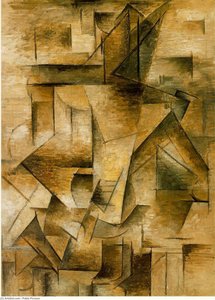
In 1907, the way he handled space changed fundamentally with Les Demoiselles d'Avignon. Influenced by African masks and Iberian sculpture, he began to break objects into geometric shapes. Alongside Georges Braque, he developed Cubism. This involved two main stages:
- Analytic Cubism: A method of fragmenting objects into muted, geometric pieces as if dissecting the form itself.
- Synthetic Cubism: An approach that brought in collage elements like newspaper clippings and fabric scraps to add texture and new layers.
A life of constant change
His work never settled into a single way of being. He explored Neoclassicism with large, monumental figures and later engaged with the imagery of Surrealism, using distorted perspectives to tap into the subconscious. The violence of the Spanish Civil War left its mark on his canvas in 1937 through Guernica. This large oil painting used a stark palette of black, white, and grey to show the suffering of a bombed town, featuring a gored horse, a bull, and screaming women. It remains a heavy, monochromatic response to the chaos of war.
In his later years, he continued to experiment with ceramics, sculpture, and printmaking. He even created large-scale public works, such as the 1967 steel sculpture in Chicago, which was inspired by the head of his Afghan Hound, Kabul. He died in Mougins, France, leaving behind a massive collection of work that spans over seventy-six years of experimentation.
Questions & Answers
What are the birthplace and birth year of Pablo Picasso?
Pablo Picasso was born in Malaga in 1881.
What aliases or alternate names does Pablo Picasso have?
Pablo Picasso is also known as Pablo Ruiz Y Picasso.
Can I browse Pablo Picasso's works by movement?
Pablo Picasso's works can be browsed by movement on the artist's All Movements page.