
Inspiration · Surrealism

The 100 Famous Surrealism Paintings That Inspire Our Artists

1913 – 1967

The most famous Surrealism paintings are René Magritte's The Son of Man (1964), Salvador Dalí's The Disintegration of Persistence of Memory (n.d.) and Frida Kahlo's The Two Fridas (1939). This ranking lists the 100 best-known Surrealism paintings, painted between 1913 and 1967 by 28 artists, with the museum where each one hangs today.

The Son of Man by René Magritte, 1964 — famous Surrealism painting
No. 1 · René MagritteThe Son of Man1964
100singular works
28masters · Giorgio de Chirico – Francis Bacon
39homes in 18 cities
8kept at the MOMA - Museum of Modern Art

Singular works

100 Surrealism paintings that exist only once

Every original here is unique and kept in one place. Its story, its home, and the detail that makes it unmistakable.

  1. The Son of Man by René Magritte, 1964
    1

    1964Oil on canvas116 × 89 cm

    This compelling piece presents a formally dressed man, complete with dark coat, suit, and bowler hat, yet obscures his face with a vibrant green apple. At its heart, this artwork is rich in symbolism.

    The singular detailapple obscuring the face

    Its story

  2. The Disintegration of Persistence of Memory by Salvador Dalí
    2

    Oil on canvas

    Soft, melting clocks drape themselves over a rigid tree branch and a geometric block, their surfaces losing the strength to hold a shape. These symbols do not offer answers; they only present the reality of loss and the way memory fragments over time.

    Its story

  3. The Two Fridas by Frida Kahlo, 1939
    3

    1939Oil on canvas173.5 × 173 cm

    Though often categorized as a Surrealist, she rejected the label, asserting that her work stemmed directly from her reality – a deeply personal and often painful one. One Frida, adorned in traditional Tehuana attire – representing her connection to Mexican culture and Rivera's preference – appears resolute.

    The singular detailbloodstainsstormy backdrop

    Its story

  4. False Mirror by René Magritte, 1928
    4

    1928Oil on canvas (presumed)

    Emerging from the post-World War I artistic landscape, Surrealism sought to unlock the power of the subconscious mind. Executed with exceptional skill, likely using oil paints on canvas, the artwork showcases Magritte’s mastery of realism.

    The singular detaildark circular shapeeye reflecting a landscape

    Its story

  5. The Elephants by Salvador Dalí, 1948
    5

    1948Oil on canvas

    Dalí quickly became its most recognizable proponent, employing meticulous technique to depict illogical scenes and bizarre juxtapositions. This painting exemplifies that approach, created during a period where Dalí was deeply influenced by Freudian psychoanalysis and exploring themes of sexuality, death, and transformation.

    The singular detaillong-legged elephants carrying obelisksbarren landscape

    Its story

  6. Self-Portrait with Monkeys by Frida Kahlo, 1943, Collection of Jacques - Natasha Gelman
    6

    Collection of Jacques - Natasha Gelman, Mexico City1943Oil on canvas82 × 63 cm

    This artwork exemplifies Kahlo's signature style—a compelling blend of realism, surrealist undertones, and vibrant Mexican folk art traditions. The 1940s also saw increasing recognition of Mexicanidad – a nationalistic movement celebrating indigenous culture – which deeply influenced Kahlo’s artistic identity.

    The singular detailmonkeysbird of paradise flower

    Its story

  7. Catalan Landscape (The Hunter) by Joan Miró, 1924, MOMA - Museum of Modern Art
    7

    MOMA - Museum of Modern Art, New York City1924Oil on canvas65 × 100 cm

    Emerging during a pivotal moment in art history, this piece exemplifies the burgeoning Surrealist movement’s exploration of the subconscious. Miró, alongside artists like Dalí and Magritte, sought to liberate art from rational constraints, embracing automatism and intuitive creation.

    The singular detailabstract shapessymbolic imagery

    Its story

  8. Self-Portrait with Thorn Necklace and Hummingbird by Frida Kahlo, 1940
    8

    1940Oil on canvas

    Kahlo presents herself frontally, meeting the viewer's gaze with unwavering intensity. Created shortly after her divorce from Diego Rivera, this self-portrait is often interpreted as a reflection on Kahlo's emotional state during that tumultuous period.

    The singular detailmonkeyblack cat

    Its story

  9. Christ of Saint John of the Cross by Salvador Dalí, 1951, Kelvingrove Art Gallery and Museum
    9

    Kelvingrove Art Gallery and Museum, Glasgow1951Oil on canvas

    Dalí's mastery of Surrealism is evident in every detail of this painting. The composition of Christ is based on a triangle and circle, symbolizing the Trinity and Unity respectively. The body of water depicted is the bay of Port Lligat, Dalí's residence at the time, adding a personal touch to the artwork.

    The singular detailgeometric composition with triangle and circleunconventional angle of Christ's crucifixion

    Its story

  10. The Lovers by René Magritte, 1928, Museum of Modern Art
    10

    Museum of Modern Art, New York City1928Oil on canvas (presumed)54 × 73 cm

    Some scholars link it to a childhood trauma Magritte experienced witnessing his mother's body after her drowning, shrouded in wet cloth. Created in Paris during a period of artistic experimentation and societal upheaval, “The Lovers” reflects the anxieties and uncertainties of the interwar years.

    The singular detailveiled facesanonymous figures

    Its story

  11. Over the town by Marc Chagall, 1918
    11

    1918Oil on canvas45 × 56 cm

    Rejecting strict representation, Chagall employs a flattened perspective and simplified forms to create a sense of otherworldly beauty. While echoes of Cubism's fragmentation can be observed, they are softened by flowing lines and a lyrical sensibility that is distinctly Chagall’s. Created during a period of significant upheaval following the Russian Revolution, this painting can be interpreted as an expression of hope and liberation amidst turmoil.

    The singular detaildreamlike qualityflight

    Its story

  12. Time Transfixed by René Magritte, 1938, Art Institute of Chicago
    12

    Art Institute of Chicago1938Oil on canvas147 × 99 cm

    Created in a period leading up to World War II, this artwork can be interpreted as reflecting anxieties about encroaching modernity and impending upheaval. The mirror reflecting only fragments of the room adds to the sense of disorientation and fractured reality.

    The singular detailclockmirror

    Its story

  13. The Elephant Celebes by Max Ernst, 1921, Tate Modern
    13

    Tate Modern, London1921Painting125 × 107 cm

    The central figure, seated on a stool and holding a red baton or conductor's stick, dominates the composition, creating a sense of intrigue and wonder. The central figure's round body was modeled after a photograph of a three-legged clay guinea corn bin from West African culture, suggesting ritual and totemic sculpture.

    The singular detailsurreal and whimsical scene with vintage aesthetic

    Its story

  14. The Burning Giraffe by Salvador Dalí, 1937, Kunstmuseum Basel
    14

    Kunstmuseum Basel1937Oil painting

    The opened drawers in the blue female figure, known as "Femme-coccyx," are inspired by Sigmund Freud's psychoanalytical methods, which Dalí admired. This painting is part of a series that includes "The Invention of Monsters," where Dalí explores themes of transformation and destruction.

    The singular detailfemale figures with drawersphallic shapes

    Its story

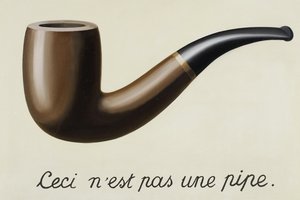
  15. The treachery of images (This is not a pipe) by René Magritte, 1948, Los Angeles County Museum of Art
    15

    Los Angeles County Museum of Art1948Oil on canvas60.3 × 81.1 cm

    Magritte's style in this piece is a unique blend of realism and surrealism. The symbolism in "The Treachery of Images" lies in its exploration of the gap between an object and its representation.

    The singular detailits representation

    Its story

  16. Harlequin's Carnival by Joan Miró, 1924–1925, Buffalo AKG Art Museum
    16

    Buffalo AKG Art Museum1924–1925Oil painting66 × 93 cm

    The composition is densely packed with numerous elements scattered across the canvas, drawing the viewer's eye to different areas due to vivid colors and unusual shapes. The carnival theme may refer to Mardi Gras, the celebration that occurs before the fasting of Lent begins.

    The singular detailanthropomorphized objects like a ladder with an ear and eyegreen sphere representing the globe

    Its story

  17. The Broken Column by Frida Kahlo, 1944, Museo Dolores Olmedo
    17

    Museo Dolores Olmedo, Mexico City1944Oil on masonite33 × 43 cm

    Following a near-fatal bus accident in her youth, Kahlo endured lifelong health challenges and numerous surgeries. This piece blends elements of Surrealist imagery – the fractured body, symbolic landscape – with a distinctly Mexican folk art sensibility.

    The singular detailbarren landscapebroken spinal column

    Its story

  18. Swans Reflecting Elephants by Salvador Dalí, 1937
    18

    1937Oil on canvas

    The painting features three swans gracefully gliding on a tranquil body of water, their elegant forms mirrored below. Created in 1937, Swans Reflecting Elephants is part of Dalí's paranoiac-critical period, a time when he was at the height of his creative powers.

    The singular detaildistorted formssurreal landscape

    Its story

  19. The seductive by René Magritte, 1953
    19

    1953Oil on canvas (presumed)38 × 46 cm

    Though firmly rooted in Surrealism, this piece displays elements reminiscent of naive art – a deliberate simplification of form and a bold application of color. Following World War II, many artists grappled with themes of alienation and uncertainty; Magritte addressed these concerns through his enigmatic imagery.

    The singular detailmonochromatic blue paletteturbulent sea

    Its story

  20. Tree of Hope by Frida Kahlo, 1946, Collection of Daniel Filipacchi
    20

    Collection of Daniel Filipacchi, Paris1946Oil on canvas56 × 41 cm

    The artwork features intricate patterns, bold outlines, and vivid colors, reflecting the artist's deep connection to her cultural heritage. Created during a period of intense physical and emotional turmoil, "Tree of Hope" reflects Kahlo's ongoing battle with chronic pain and disability.

    The singular detailmoonvibrant colors

    Its story

  21. Breasts by Francis Picabia, 1927
    21

    1927Oil on canvas99 × 75 cm

    At first glance, the viewer is confronted by a striking figure: a woman with skin of an ethereal blue hue, her gaze framed by glasses that lend her an intellectual, yet otherworldly, presence. The technique employed by Picabia serves to heighten this sense of psychological depth. To understand Breasts, one must navigate the turbulent waters of the Dada and Surrealist movements in which Picabia was a central provocateur.

    The singular detaila birdblue skin

    Its story

  22. The Farm by Joan Miró, 1922
    22

    Joan MiróSurrealism

    The Farm

    1922Oil on canvas132 × 147 cm

    While rooted in the simplified forms and vibrant color palettes of Naive art, it simultaneously anticipates the burgeoning Surrealist movement. Created during a period of significant artistic experimentation following World War I, this work reflects Miró’s deep connection to his native Catalonia.

    The singular detailshoeletter 'A')

    Its story

  23. The Entire City by Max Ernst, 1936, Kunsthaus
    23

    Kunsthaus, Zürich1936Oil on canvas60 × 81 cm

    Max Ernst, a pioneer of Dadaism and Surrealism, employs his signature surrealistic style in this artwork. "The Entire City" was created during a tumultuous period in Max Ernst's life. The pyramid in "The Entire City" symbolizes knowledge, mystery, and the passage of time.

    The singular detaildeep blues, warm browns, and vibrant greensstepped pyramid-like structure

    Its story

  24. Painting, 1946 by Francis Bacon, 1946, MOMA - Museum of Modern Art
    24

    MOMA - Museum of Modern Art, New York City1946Oil on linen

    This powerful artwork presents a haunting reinterpretation of religious symbolism through a modern, surreal lens. Surrounding these figures are abstracted, insect-like or mechanical forms, suggesting intrusion, decay, or transformation. The work’s raw, unfiltered style captures the anxieties of a fractured world, making it a significant piece within mid-20th-century modern art.

    The singular detailsymbolic motifscrucifixion scene

    Its story

  25. The Menaced Assassin by René Magritte, 1927, MOMA - Museum of Modern Art
    25

    MOMA - Museum of Modern Art, New York City1927Oil on canvas150 × 195 cm

    Emerging in the aftermath of World War I, Surrealism sought to liberate thought, language, and human experience from the constraints of reason. Inspired by the psychoanalytic theories of Sigmund Freud, artists like Magritte explored the realm of dreams, the subconscious, and the irrational.

    The singular detailshadowy figureswoman on chaise lounge

    Its story

  26. Crucifixion (Corpus Hypercubus) by Salvador Dalí, 1954
    26

    1954Oil on canvas

    Following World War II and the dawn of the atomic age, Dalí sought to reconcile spirituality with the complexities of the universe. Executed with Dalí's signature technical brilliance, the painting showcases his mastery of oil on canvas.

    The singular detailgeometric abstractiondeconstruction of traditional iconography

    Its story

  27. The Sleeping Venus by Paul Delvaux, 1944, Tate Gallery
    27

    Tate Gallery, London1944Oil on canvas173 × 199 cm

    A reclining nude – evoking the traditional Venus motif – dominates the foreground, yet she is far from the idealized beauty of Renaissance predecessors. Executed with oil on canvas (173 x 199 cm), Delvaux employs a refined technique characterized by smooth blending and meticulous detail.

    The singular detailskeletonred-dressed figure

    Its story

  28. Of This Men Shall Know Nothing by Max Ernst, 1923, Tate Gallery
    28

    Tate Gallery, London1923Oil on canvas81 × 64 cm

    Created in 1923, "Of This Men Shall Know Nothing" reflects the influence of Giorgio de Chirico and mail-order catalogues on Ernst's work. The painting shares features with Silberer's diagram, including a landscape setting and alchemical motifs. This period marked Ernst's transition from Dada to Surrealism, characterized by his use of symbolic imagery.

    The singular detailuse of vertical lines and organic shapesfigure lying on the ground

    Its story

  29. Forever Always by Octavio Ocampo
    29

    Oil

    Surrealism is an art movement that emerged in the early 20th century, characterized by its exploration of the unconscious mind and dreamlike imagery. In between them is the Cup of Life and above it, the Crown of Fidelity, both serving as symbols of a life that they have shared.

    Its story

  30. Hr giger passage XXIV by H.R. Giger
    30

    Oil painting

    hr giger passage XXIV is a work by H.R. Giger, who died in 2014, utilized a distinctive biomechanical aesthetic.

    Its story

  31. The Green Violinist by Marc Chagall, 1924
    31

    1924Oil on canvas198 × 108 cm

    The central figure of the painting is a fiddler, a recurring motif in Chagall's work that symbolizes the artist's deep connection to his Jewish roots. The violinist, with his green face, appears to float or dance above the rooftops of a misty village, creating a sense of weightlessness and otherworldliness. The Green Violinist was completed following Chagall's return to Paris after a long visit to his homeland of Russia.

    The singular detailfloating figuresvillage rooftops

    Its story

  32. Hector and Andromache by Giorgio de Chirico, 1917
    32

    1917Oil on canvas90 × 60 cm

    The central focus is the elongated human form, which dominates the vertical space of the canvas. This period was marked by haunting moods and dreamlike scenarios, exemplified in de Chirico's works.

    The singular detailfusion of organic and inorganic formsearthy tones with muted highlights

    Its story

  33. One Second Before Awakening from a Dream Caused by the Flight of a Bee Around a Pomegranate by Salvador Dalí, 1944, Museo Thyssen-Bornemisza
    33

    Museo Thyssen-Bornemisza, Madrid1944Oil on wood

    Created in 1944, the work features a central figure of Gala Dalí, the artist's wife and muse. This work is part of a larger output that includes The Metamorphosis of Narcissus, which was created in 1937. Additionally, the artist produced The Temptation Of Saint Anthony, which dates to about 1946.

    Its story

  34. Still Life with Old Shoe by Joan Miró, 1937, MOMA - Museum of Modern Art
    34

    MOMA - Museum of Modern Art, New York City1937Oil on canvas81 × 117 cm

    However, these familiar forms are far from traditionally rendered. This artwork exemplifies Miró’s unique position within 20th-century art. The colors aren't blended smoothly; instead, they exist as distinct patches, creating visual tension and a sense of unrest. 1937 was a pivotal year for Miró and for Spain.

    The singular detailvibrant colorsdistorted forms

    Its story

  35. Chestnut Waters by Paul Nash, 1923, National Gallery of Canada
    35

    National Gallery of Canada, Ottawa1923Oil on canvas102.5 × 153.2 cm

    The scene captures a specific, still moment where a pond rests at the heart of the composition. These elements exist within a landscape defined by abstract geometric forms that settle over the terrain and the surrounding vegetation.

    Its story

  36. The Suicide of Dorothy Hale by Frida Kahlo, 1938
    36

    1938Oil on masonite60 × 49 cm

    This oil on masonite (60 x 49 cm) captures the tragic end of American socialite Dorothy Hale, who took her own life by jumping from the Hampshire House building in New York City. Kahlo's distinctive style blends elements of Surrealism with her signature folk art influences.

    The singular detaildreamlike imageryarchitectural elements

    Its story

  37. The Metamorphosis of Narcissus by Salvador Dalí, 1937, Tate Gallery
    37

    Tate Gallery, London1937Oil on canvas51 × 78 cm

    In the mid-ground, spectral figures representing Narcissus's rejected suitors stand as silent witnesses to his self-absorption. Executed in oil on canvas (51 x 78 cm), the work showcases Dalí's exceptional technical skill. Created during Dalí’s “paranoiac-critical period,” The Metamorphosis of Narcissus reflects his deep engagement with the psychoanalytic theories of Sigmund Freud.

    Its story

  38. Second Version of Triptych by Francis Bacon, 1944
    38

    Francis BaconExpressionist Surrealism

    Second Version of Triptych

    1944Oil paint on 3 canvases

    In second version of triptych 3, Francis Bacon centers the composition on a grotesque canine figure. He produced 28 known large triptychs between 1944 and 1985–86. The artist's output also encompasses single canvas works, such as three studies of isabel rawsthorne, about 1967.

    Its story

  39. The Uncertainty of the Poet by Giorgio de Chirico, 1913, Tate Gallery
    39

    Tate Gallery, London1913Oil paint106 × 94 cm

    De Chirico's unique style blends elements of classical art with the avant-garde, creating a composition that is both visually striking and intellectually stimulating. The central figure of the painting is a classical-style statue with a blank, circular head placed on a green surface.

    The singular detailarchitectural elements and landscape backgroundstatue of a woman with a blank circular head

    Its story

  40. Abaporu by Tarsila do Amaral, 1928
    40

    1928Oil on canvas

    Tarsila do Amaral produced the oil on canvas work Abaporu in 1928. Following the death of the artist in 1973, the painting passed to the art gallery of Pietro Maria Bardi. The ownership changed again in 1995 when the painting was auctioned at Christie's in New York City.

    Its story

  41. The Human Condition by René Magritte, 1933–1945, National Gallery of Art
    41

    National Gallery of Art, Washington1933–1945Oil on canvas100 × 81 cm

    This enigmatic painting presents a dreamlike scene of an open window revealing a serene landscape beyond. The central focus of the artwork is a large, arched window that dominates the image.

    The singular detailmuted yet vibrant color palettelarge arched window as the central focus

    Its story

  42. Goethe or the metamorphosis of plants by André Masson, 1940
    42

    1940Oil and tempera on canvas

    The canvas titled Goethe or the metamorphosis of plants was brought into being by the hand of André Masson. This work exists now within the walls of The Israel Museum in Jerusalem, Israel. André Masson sought to map the unseen rhythms of growth.

    Its story

  43. Night Fishing at Antibes by Pablo Picasso, 1939, MoMA
    43

    MoMA, New York City1939Oil on canvas205 × 345 cm

    Night Fishing at Antibes is an oil on canvas painting from 1939. The scene depicts a fishing activity in a harbor under moonlight, set below the twin towers of the Chateau Grimaldi and town buildings. An acetylene light is used to draw fish to the surface.

    Its story

  44. Dutch Interior I by Joan Miró, 1928, MOMA - Museum of Modern Art
    44

    MOMA - Museum of Modern Art, New York City1928Oil on canvas92 × 73 cm

    Painted in 1928, this artwork exemplifies Miró's unique ability to merge bold colors, intricate shapes, and imaginative symbolism into a cohesive and emotionally resonant composition. The artwork is a vibrant and complex composition that exudes movement and energy.

    The singular detailinterplay of organic and geometric formsvibrant color palette

    Its story

  45. The Love Embrace of the Universe by Frida Kahlo, 1949
    45

    1949

    Created during a period of personal turmoil for Kahlo —marked by physical pain and a complex relationship with Diego Rivera —this painting reflects her lifelong exploration of identity, the female body, and Mexican national identity.

    The singular detailcelestial bodies (moon & sun)hands

    Its story

  46. Song of Songs III by Marc Chagall, 1960
    46

    Marc ChagallSurrealism Surrealism

    Song of Songs III

    1960Oil on canvas48 × 59 cm

    In the vast landscape of twentieth-century modernism, few artists possessed the ability to weave the fabric of memory and myth as seamlessly as Marc Chagall. Rooted in the Surrealist movement championed by André Breton, the painting utilizes elements of automatism—the spontaneous creation of imagery to access the subconscious.

    Its story

  47. The Angel of Hearth & Home by Max Ernst, 1937
    47

    1937Oil on canvas114 × 146 cm

    Measuring 114 x 146 cm, the expansive scale of “The Angel of Hearth and Home” contributes to its dramatic impact and reinforces Ernst’s desire to convey a sense of overwhelming presence. The painting reflects Ernst’s fervent belief in Communism and his frustration at Surrealists' inability to effectively resist fascism.

    Its story

  48. The Enigma of Hitler by Salvador Dalí, 1938
    48

    1938Oil on canvas51 × 79 cm

    Dalí's signature surrealist style is evident in this piece, blending realistic elements with fantastical ones to challenge perception. The painting employs meticulous detail and precise draftsmanship, characteristic of Dalí's technique.

    The singular detailfluid lines and organic shapessoft and diffused lighting

    Its story

  49. Personal Values by René Magritte, 1952, San Francisco Museum of Modern Art
    49

    San Francisco Museum of Modern Art1952Oil on canvas80 × 100 cm

    The ceiling is painted with a sky filled with fluffy clouds, creating an open-air effect that defies reality. René Magritte, a Belgian Surrealist artist born in 1898, was renowned for his thought-provoking paintings that challenged reality. "Personal Values" is a prime example of Magritte's ability to transform ordinary objects into extraordinary compositions.

    The singular detailbrush resting on top of the mirrorsky-filled ceiling with clouds

    Its story

  50. Embroidering the Earth's Mantle by Remedios Varo
    50

    Oil on fiberboard

    To stand before Remedios Varo's work is to step across a threshold into a meticulously crafted dreamscape.

    Its story

  51. The Child's Brain by Giorgio de Chirico, 1917, Moderna Museum
    51

    Moderna Museum, Stockholm1917Oil on canvas

    This artwork exemplifies de Chirico's signature style, blending realism with surrealism to create a scene that is both hauntingly familiar and eerily alien. During this time, de Chirico was deeply influenced by the writings of Friedrich Nietzsche and Arthur Schopenhauer, whose philosophies are reflected in his art.

    The singular detailarchitectural columns and wallsopen book with an orange cover

    Its story

  52. The Smile of the Flamboyant Wings by Joan Miró, 1953, MACBA
    52

    MACBA, Barcelona1953Oil painting reproduction

    The use of bright hues and sinuous lines contributes to the overall feeling of freedom and spontaneity, characteristic of Miró’s surrealist approach. The Birth of Day Maqueta per a la sèrie Els gossos 2 Carota Miró’s artworks are part of several prestigious museum collections, including the Museu d'Art Contemporani de Barcelona (MACBA) in Spain.

    Its story

  53. The Eye of Silence by Max Ernst, 1943
    53

    1943Oil on canvas108 × 141 cm

    Born in 1891, Max Ernst was a pioneering figure in the dada and surrealist movements. Created by pioneering artist Max Ernst, this painting exemplifies the unique style and technique of the surrealist movement. The museum houses an impressive collection of Danish and international art, including works by Max Ernst.

    Its story

  54. Night Train by Paul Delvaux, 1947
    54

    1947Oil on canvas153 × 210 cm

    The scene unfolds within what appears to be a luxurious train station waiting room or parlor car. Delvaux’s style resides at the intersection of Symbolism and Surrealism, yet retains a strong foundation in academic realism.

    The singular detailambiguous atmospheredistorted perspective

    Its story

  55. Viva la Vida by Frida Kahlo, 1954, Frida Kahlo Museum
    55

    Frida Kahlo Museum, Mexico City1954Oil on masonite51 × 60 cm

    Frida Kahlo endured immense suffering throughout her life, most notably following a devastating bus accident in 1925 that left her with severe spinal injuries and chronic pain. Born Magdalena Carmen Frida Kahlo y Calderón in 1907 in Coyoacán, Mexico, Kahlo’s early life was marked by a deep connection to Mexican culture and identity.

    The singular detailwatermelon inscription

    Its story

  56. The Sacrament of the Last Supper by Salvador Dalí, 1955, National Gallery of Art
    56

    National Gallery of Art, Washington1955Oil on canvas167 × 268 cm

    Created in 1955 during Dalí’s post-World War II "Nuclear Mysticism" period, this piece reflects his fascination with science, religion, and the infinite. The landscape in the background, reminiscent of Catalonia, grounds the scene in Dalí’s personal and cultural heritage, adding layers of meaning and emotional resonance.

    The singular detailsymbolic landscapegeometric shapes

    Its story

  57. Military Policeman arresting the spirit by Yannis Tsarouchis
    57

    Oil

    This painting, titled Military Policeman arresting the spirit, is a work by Yannis Tsarouchis. His career spanned several decades until his death in 1989. In the lower right corner of the composition, one can find the artist's mark, which reads "Yiannis Tsarouchis 5-3-4".

    Its story

  58. Reclining Woman by Pablo Picasso, 1929, WikiArt.org
    58

    WikiArt.org1929Oil on canvas46 × 61 cm

    Spearheaded by André Breton and fueled by the theories of Sigmund Freud, Surrealism aimed to tap into the realm of the unconscious mind – exploring dreams, fantasies, and irrational impulses. Picasso’s shift towards Surrealism is evident in Reclining Woman.

    The singular detaileveryday objects

    Its story

  59. Portrait of Isabel Rawsthorne standing in a street in Soho by Francis Bacon, 1967, Neue Nationalgalerie
    59

    Neue Nationalgalerie, Berlin1967Oil on canvas

    It builds upon his earlier explorations of figure-in-space compositions but introduces a new element – a sense of Rawsthorne’s engagement with her surroundings. While Bacon resisted explicit symbolic interpretations, the painting is rich in suggestive imagery.

    The singular detailmuted tonesdistorted figures

    Its story

  60. The other clock 3 by Remedios Varo
    60

    She was born in 1908 in Anglès, Spain, and her hand moved through the world with a precision that suggests a deep understanding of both the mechanical and the mystical.

    Its story

  61. Blue II by Joan Miró, 1961, Musée National d'Art Moderne
    61

    Joan MiróSurrealism

    Blue II

    Musée National d'Art Moderne, Centre Pompidou1961Oil on canvas270 × 355 cm

    The artwork features a striking minimalist composition dominated by a vast expanse of vivid blue background. Against this serene backdrop, an elongated red shape on the left side and a series of black circles create a dynamic interplay of color and form.

    The singular detailelongated red shape on the left sideseries of black circles receding into the distance

    Its story

  62. The Big Family by René Magritte, 1963
    62

    1963Oil on canvas

    The central focus of this artwork is a large bird composed entirely of clouds, set against a backdrop of a gradient green sky and a body of water. In "The Big Family," he employs a technique that appears to involve painting, possibly with oils or acrylics, to achieve smooth blends and textured brushstrokes.

    The singular detailgradient green skytextured waves or ocean foam

    Its story

  63. Temptation of St. Anthony by Max Ernst, 1945
    63

    1945Oil on canvas

    As the viewer's gaze meets the canvas, they are immediately met with an unsettling stillness that masks a brewing storm of fantastical elements. The symbolism within the piece is as potent as it is enigmatic: The Crimson Blanket: Representing both the warmth of life and the visceral, often bloody, nature of human passion and sacrifice.

    Its story

  64. Hr giger pII the great beast p by H.R. Giger
    64

    Painting

    The structure of this entity includes various arms and legs that appear integrated into its primary mass. In the background, smaller figures are visible, though they remain secondary to the central organism.

    Its story

  65. Girl with Cat by Balthus, 1937, Art Institute of Chicago
    65

    Art Institute of Chicago1937Oil on canvas88 × 78 cm

    The meticulous attention to detail in the girl's features and the cat's fur contrasts with the loose, expressive brushwork of the background, creating a dreamlike atmosphere. Created in 1937, "Girl with Cat" reflects Balthus's unique approach to portraiture during a time when European art was undergoing significant transformations.

    The singular detaildirect gazepresence of a cat

    Its story

  66. Diana in the Autumn Wind by Paul Klee, 1934, Kunstmuseum St. Gallen
    66

    Kunstmuseum St. Gallen1934Oil painting62 × 48 cm

    Diana in the Autumn Wind is a painting by the artist Paul Klee. In 1915, the work Woman Knitting was painted, showing an early interest in rhythmic movement. This was followed by Fish Magic in 1925, which utilizes simple shapes to suggest complex forms.

    Its story

  67. Rabbit on a Train by Michael Sowa
    67

    Oil paint on canvas

    A solitary rabbit, dressed in formal attire, sits within a plush armchair. The figure gazes through a window at a distant cityscape.

    Its story

  68. Skull by Octavio Ocampo
    68

    Octavio OcampoSurrealism

    Skull

    Oil on canvas

    A woman sits beneath a massive, circular object, her hands raised as if to shield herself from an unseen force. At first glance, the scene appears to be a quiet, perhaps even festive, gathering.

    Its story

  69. The Great Metaphysician by Giorgio de Chirico, 1917
    69

    1917Oil on canvas

    Created in 1917, during the height of the Metaphysical art movement, this piece reflects the philosophical influences of Arthur Schopenhauer and Friedrich Nietzsche. The artwork's dreamlike quality and symbolic imagery have made it a cornerstone of 20th-century avant-garde art.

    The singular detailurban backdropmuted color palette

    Its story

  70. Soft Construction with Boiled Beans - Premonition of Civil War by Salvador Dalí, 1936, Philadelphia Museum of Art
    70

    Philadelphia Museum of Art1936Oil on canvas

    The central focus of the painting is on two large, distorted human legs that dominate the foreground. Created in 1936, "Soft Construction with Boiled Beans - Premonition of Civil War " reflects Dalí's deep concern about the political turmoil in Spain.

    The singular detailhovering footchaotic arrangement

    Its story

  71. Dancer by Joan Miró, 1925
    71

    Joan MiróSurrealism

    Dancer

    1925Oil on canvas115 × 88 cm

    Created during a period when artists were actively challenging traditional artistic conventions, Dancer reflects the burgeoning Surrealist movement’s interest in exploring the realm of dreams, the unconscious mind, and automatic processes. Miró’s influence extends far beyond Surrealism, impacting generations of artists working in Abstract Expressionism and Color Field painting.

    Its story

  72. The Ribbon of Excess by Yves Tanguy, 1932
    72

    1932Oil on canvas35 × 45 cm

    The painting features a dense arrangement of abstract shapes and forms, creating a sense of clutter and disarray. Despite having no formal training, Tanguy's work quickly gained recognition for its distinctive biomorphic forms and dreamlike worlds. This openness makes "The Ribbon of Excess" a fascinating conversation starter and a source of personal reflection.

    The singular detailchaotic arrangement of abstract shapesearthy tones with splashes of bright colors

    Its story

  73. Dos perfiles by Ricardo Martínez
    73

    Oil on canvas30 × 40 cm

    The composition presents two stylized profiles positioned side-by-side, facing in opposite directions. The background remains indistinct, a muted expanse that pushes the figures toward the viewer, ensuring the focus remains entirely on the tension between the two faces.

    Its story

  74. Portrait de Frida Kahlo by Dora Maar
    74

    Photograph30 × 22 cm

    The artwork titled Portrait de Frida Kahlo is a photographic portrait created by the artist Dora Maar. The image captures the subject in a formal pose, focusing on her upper body and shoulders. The composition is centered, presenting the subject from the waist up against a simple, blurred background.

    Its story

  75. The Robing of the Bride by Max Ernst, 1940, Solomon R. Guggenheim Museum
    75

    Solomon R. Guggenheim Museum, New York City1940Oil on canvas129 × 96 cm

    At its core, two nude women engage in an intimate yet confrontational interaction, their contrasting appearances emphasizing themes of identity, transformation, and societal roles. Max Ernst, a pioneer of Dadaism and Surrealism, crafted this piece amidst the upheavals of the early 20th century, infusing it with symbolic complexity and emotional depth.

    The singular detailmythic birdsymbolic figures

    Its story

  76. Henry Ford Hospital by Frida Kahlo, 1932, Museo Dolores Olmedo
    76

    Museo Dolores Olmedo, Mexico City1932Oil on masonite31 × 38 cm

    At first glance, the scene presents Frida lying naked on a hospital bed, her body contorted in a posture of vulnerability. Painted on a small Masonite board – an unconventional choice at the time – Henry Ford Hospital showcases Kahlo's innovative approach to artistic technique.

    The singular detailfetusmiscarriage

    Its story

  77. The Falling Angel by Marc Chagall, 1947, Kunstmuseum
    77

    Marc ChagallExpressionism/Surrealism

    The Falling Angel

    Kunstmuseum, Basel1947Oil or tempera on canvas148 × 189 cm

    Central to the composition is a fiery, winged figure that appears to be falling or ascending, evoking themes of spiritual conflict, transformation, and divine intervention. The artist, Marc Chagall, was deeply influenced by his Belarusian Jewish heritage, Eastern European folklore, and the tumultuous events of the 20th century.

    The singular detailsymbolic imagerydynamic composition

    Its story

  78. Crucifixion by Pablo Picasso, 1930, Museum Santa Maria del Parto
    78

    Museum Santa Maria del Parto1930Oil on canvas50 × 65 cm

    The family moved to A Coruña and later Barcelona after the tragic loss of Picasso’s sister. In Barcelona, he attended the School of Fine Arts but often clashed with traditional academic instruction, preferring to study masters like Velázquez and Goya independently.

    Its story

  79. Rayograph (The Kiss) by Man Ray, 1922, MOMA - Museum of Modern Art
    79

    MOMA - Museum of Modern Art, New York City1922Photogram

    This striking photogram—a technique pioneered by Ray himself—captures an intimate moment frozen in time, transforming commonplace objects into symbols of desire and connection. The Dada movement, born in Zurich during World War I, vehemently rejected bourgeois values and embraced absurdity as a weapon against societal norms.

    Its story

  80. The Dream by Wifredo Lam, 1947
    80

    1947Oil on canvas77 × 102 cm

    The Dream is a surrealist artwork by Wifredo Lam. Wifredo Lam used this medium to navigate the space between the seen and the felt. The Dream resides within the Hirshhorn Museum and Sculpture Garden. This institution is located in the United States.

    Its story

  81. The Empire of Light by René Magritte
    81

    Oil on canvas, gouache

    This painting exemplifies the surrealist style, characterized by its juxtaposition of ordinary objects in extraordinary contexts. Inspired by the works of John Atkinson Grimshaw and William Degouve de Nuncques, this artwork is part of a series that explores the paradoxical image of a nocturnal landscape beneath a sunlit sky.

    The singular detailbalanced compositioncontrast between light and dark

    Its story

  82. The Birth of the World by Joan Miró, 1925, MOMA - Museum of Modern Art
    82

    MOMA - Museum of Modern Art, New York City1925Oil on canvas251 × 200 cm

    "The Birth of the World" was created during Miró's Surrealist period, a time when he was deeply influenced by the dream-like automatism espoused by the Surrealist group. Miró once described "The Birth of the World" as "a sort of genesis," an amorphous beginning out of which life may take form.

    The singular detailred circleyellow line

    Its story

  83. Indefinite Divisibility by Yves Tanguy, 1942, Albright-Knox Art Gallery
    83

    Albright-Knox Art Gallery, New York City1942Oil on canvas

    Created in 1942, this piece exemplifies the distinctive style of Surrealism, characterized by meticulous detail, sophisticated use of color, and a hyper-realistic finish.

    The singular detaildreamlike compositionbiomorphic forms

    Its story

  84. The Wedding Candles by Marc Chagall, 1945
    84

    1945Oil on canvas122 × 120 cm

    The candles themselves are, of course, a central motif—representing light, hope, and the sacredness of marriage. Chagall’s unique blend of dreamlike imagery, symbolic language, and emotional intensity distinguishes his work from other Surrealists, establishing him as a singular voice within the artistic landscape.

    The singular detailchandelierbirds

    Its story

  85. The Face of War by Salvador Dalí, 1940, Museum Boijmans Van Beuningen
    85

    Museum Boijmans Van Beuningen1940Oil on canvas

    Dalí was deeply influenced by the Spanish Civil War and the impending Second World War. For example, his Autumn Cannibalism (1936) depicts two figures devouring each other on a beach, symbolizing the destructive nature of human relationships during times of war.

    Its story

  86. Surrealism and Painting by Max Ernst, 1942
    86

    1942Oil on canvas195 × 233 cm

    The technique employed by Ernst reflects his lifelong commitment to artistic innovation.

    Its story

  87. My Dress Hangs There by Frida Kahlo, 1933, Hoover Gallery
    87

    Hoover Gallery, San Francisco1933Oil painting and collage46 × 55 cm

    Painted during Kahlo's time in New York City with her husband Diego Rivera, "My Dress Hangs There" reflects her complex feelings about American capitalism and her longing for Mexico. The background features skyscrapers, an overflowing trashcan, the Statue of Liberty, and other symbols of America, critiquing capitalism and industrialization.

    Its story

  88. Le passage du Commerce Saint-Andre Private by Balthus, 1954
    88

    1954Oil on canvas

    Balthus brought this large-scale composition to its completion in 1954. In 1953, as he prepared to move to the Chateau de Chassy, the painting was left standing, paused in its development. The artist's ability to navigate the complexities of the human form and psychological depth is further evidenced in his 1937 painting, The Children.

    Its story

  89. Chocolate Grinder by Marcel Duchamp, 1914
    89

    1914Oil on canvas

    The artwork presents a flattened perspective of a chocolate mill, reduced to its essential geometric components: cylinders and basket-like structures. Created on the eve of World War I, Chocolate Grinder reflects a period of rapid industrialization and societal upheaval.

    The singular detailcylindricalbasket-like forms

    Its story

  90. Painting by Joan Miró, 1933, Fundació Joan Miró
    90

    Joan MiróSurrealism

    Painting

    Fundació Joan Miró, Barcelona1933Oil on canvas130 × 163 cm

    With its emphasis on spontaneous creation and emotional expression, this piece captures the essence of the era's innovative spirit.

    The singular detailgeometric formsdynamic composition

    Its story

  91. The Kiss by Pablo Picasso, 1925, Musée National Picasso
    91

    Musée National Picasso, Paris1925Oil on canvas130 × 97 cm

    The artwork's composition immediately draws attention to the intertwined figures, positioned in close proximity, their faces turned towards each other with palpable tenderness. The influence of Proto- Cubism is evident in the fragmented planes of color and form that characterize “The Kiss,” foreshadowing the fully realized Cubist style that would emerge shortly thereafter. “The Kiss” remains an indelible symbol of love and desire within the annals of 20th-century art.

    Its story

  92. 2nd vers of triptych by Francis Bacon, 1944
    92

    Francis BaconExpressionist Surrealism

    2nd vers of triptych

    1944Oil on canvas

    The presence of these figures, caught in moments of stillness or distortion, heightens the sense of a world stripped of its pretenses, leaving only the raw, visceral pulse of survival.

    Its story

  93. Great Metaphysical Interior by Giorgio de Chirico, 1917, MOMA - Museum of Modern Art
    93

    MOMA - Museum of Modern Art, New York City1917Oil on canvas

    The artwork features multiple layers and frames within the painting, each containing different images and objects. De Chirico's artwork is imbued with symbolic elements that reflect his affinity for the philosophy of Arthur Schopenhauer and Friedrich Nietzsche.

    Its story

  94. Not to Be Reproduced by René Magritte, 1937, Museum Boijmans Van Beuningen
    94

    Museum Boijmans Van Beuningen, Rotterdam1937Oil on canvas81 × 65 cm

    The inclusion of Edgar Allan Poe's “The Narrative of Arthur Gordon Pym” on a table beside James adds another layer of significance. René Magritte firmly established himself as a pivotal figure within the Surrealist movement, spearheaded by André Breton.

    Its story

  95. Geopolitical Child Watching the Birth of the New Man by Salvador Dalí, 1943
    95

    1943Oil on canvas

    The central subject is an egg, cracked open to reveal a nascent figure emerging from within. The figure emerging from the egg is often interpreted as symbolizing America, seen by Dalí as a land of opportunity and growth during this period. Dive deeper into the life and art of Salvador Dalí.

    Its story

  96. Self Portrait with Loose Hair by Frida Kahlo, 1947, Des Moines Art Center
    96

    Des Moines Art Center1947Oil on masonite61 × 45 cm

    Kahlo deliberately eschewed academic conventions, favoring instead a bold simplification of form and color that harkens back to Mexican folk art traditions. Central to “Self Portrait with Loose Hair” is Kahlo’s depiction of her own hair—long, dark, and unbound. I am 37 years old and this is July, 1947.

    Its story

  97. Death and Fire by Paul Klee, 1940, Zentrum Paul Klee
    97

    Paul KleeExpressionist Surrealism

    Death and Fire

    Zentrum Paul Klee, Bern1940Oil44 × 46 cm

    In the twilight of his life, amidst the encroaching shadows of World War II and his own physical decline, Paul Klee produced one of his most hauntingly beautiful masterworks, Death and Fire. The complexity of his earlier years gave way to a raw, essentialist power where every line carries the weight of destiny.

    Its story

  98. Candle by Pablo Picasso, 1938
    98

    Pablo PicassoSurrealism

    Candle

    1938Oil on canvas

    The central figure dominating the canvas is the distorted head of a red bull—a motif Picasso frequently employed as a potent symbol of masculinity and raw power. The Berardo Collection Museum in Lisbon, Portugal, houses an impressive assemblage of modern and contemporary art —a space dedicated to showcasing groundbreaking movements like Cubism.

    Its story

  99. Les dieux obscurs by Max Ernst, Museum Folkwang
    99

    Museum Folkwang, EssenOil on canvas

    The painting exemplifies Ernst's pivotal role in both Dadaism and Surrealism, movements dedicated to challenging artistic conventions and exploring the depths of the unconscious mind. The title itself, “Dark Gods,” hints at primal forces or archetypal figures lurking beneath the surface of consciousness.

    The singular detailgeometricorganic shapes

    Its story

  100. Untitled by Claude Cahun, 1928, Tate Britain
    100

    Tate Britain, London1928Gelatin silver print

    This work emerged from a collaborative practice between the two artists, who shared a life and a commitment to disrupting conventional representations of identity. Through the use of various personae and staged imagery, Cahun interrogated the boundaries of gender and social expectation. This is seen in the photomontage Untitled and the 1926 work Entre nous.

    Its story

Lineages

The famous Surrealism paintings by lineage

Where they live

The one place you can see each famous Surrealism painting

New York City keeps 12 of these originals; the MOMA - Museum of Modern Art, 8.

Glasgow1

Kelvingrove Art Gallery and Museum

Kunstmuseum Basel1

Kunstmuseum Basel

The masters

The Surrealism masters our artists look to

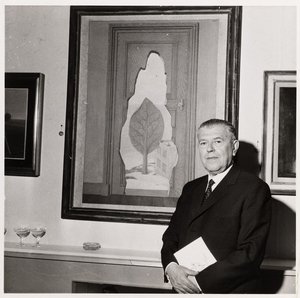
Portrait of René Magritte

René Magritte

1898–1967 · Belgium · 12

Belgian Surrealist known for placing ordinary objects in unexpected contexts, creating dreamlike tension through unsettling juxtapositions.

1. The Son of Man, 4. False Mirror, 10. The Lovers, 12. Time Transfixed, 15. The treachery of images (This is not a pipe), 19. The seductive, 25. The Menaced Assassin, 41. The Human Condition, 49. Personal Values, 62. The Big Family, 81. The Empire of Light, 94. Not to Be Reproduced

Portrait of Joan Miró

Joan Miró

1893–1983 · Spain · 10

Spanish Surrealist known for biomorphic shapes and a symbolic, dreamlike visual language that bridges the gap between the seen and the imagined.

7. Catalan Landscape (The Hunter), 16. Harlequin's Carnival, 22. The Farm, 34. Still Life with Old Shoe, 44. Dutch Interior I, 52. The Smile of the Flamboyant Wings, 61. Blue II, 71. Dancer, 82. The Birth of the World, 90. Painting

Portrait of Max Ernst

Max Ernst

1891–1976 · Germany · 9

German Surrealist pioneer of frottage and collage who used bird-like alter egos and textured rubbings to map the irrational mind.

13. The Elephant Celebes, 23. The Entire City, 28. Of This Men Shall Know Nothing, 47. The Angel of Hearth & Home, 53. The Eye of Silence, 63. Temptation of St. Anthony, 75. The Robing of the Bride, 86. Surrealism and Painting, 99. Les dieux obscurs

Portrait of Marc Chagall

Marc Chagall

1887–1985 · Belarus · 5

Russian-born modernist of dreamlike symbolism and vibrant colors, featuring flying lovers and scenes from Jewish folklore in a poetic style.

11. Over the town, 31. The Green Violinist, 46. Song of Songs III, 77. The Falling Angel, 84. The Wedding Candles

Portrait of Giorgio de Chirico

Giorgio de Chirico

1888–1978 · Greece · 5

Greek-born Italian founder of Metaphysical art, known for haunting, dreamlike town squares, long shadows, and uncanny mannequins.

32. Hector and Andromache, 39. The Uncertainty of the Poet, 51. The Child's Brain, 69. The Great Metaphysician, 93. Great Metaphysical Interior

+21more masters our artists study Surrealism Masters Their stories

In confidence

About these Surrealism paintings

Hover gently over a question to read the answer.

Which 10 Surrealism paintings should everyone know?

How is this ranking made?

Each painting is ranked by how widely it is known: the number of Wikipedia language editions with an article on it (Wikidata sitelinks), its place in our catalogue's manual ranking and the visits its page receives. The same painting catalogued several times counts once, and details, copies and studies are left out.

How the selection is made

We went through every Surrealism painting in our catalogue and placed the best-known first: those Wikipedia describes in the most languages, those our artists and curators rank highest and those most viewed on our pages. Each original appears once — no details or copies.

Other movements that inspire us

The periods that inspire us