The 100 Famous Romanticism Paintings That Inspire Our Artists
1771 – 1895
Selected by OriginalUniqueArt.comUpdated
Ask for the most famous Romanticism paintings and you will hear of Eugène Delacroix's Liberty Leading the People (1830, Musée du Louvre), Francisco Goya's Saturn Devouring His Son (1819–1823, Museo del Prado) and Théodore Géricault's The Raft of the Medusa (1818, The Louvre). Below, all 100 of them — painted from 1771 to 1895 by 54 artists — with their date, their size and the museum that keeps them.
No. 1 · Eugène DelacroixLiberty Leading the People1830 · Musée du Louvre, Paris
100singular works
54masters · Joseph Wright of Derby – Ivan Aivazovsky
45homes in 26 cities
9kept at the The Louvre
Singular works
100 Romanticism paintings that exist only once
Every original here is unique and kept in one place. Its story, its home, and the detail that makes it unmistakable.
Musée du Louvre, Paris1830Oil on canvas260 × 325 cm
Rejecting the cool, calculated precision of Neoclassicism, Delacroix embraced passion, drama, and emotional intensity. The Worker with a Saber: Symbolizing the working class’s vital role in the uprising. The fallen figures at Liberty's feet serve as a stark reminder of the sacrifices made for freedom, while the distant towers of Notre Dame cathedral anchor the scene firmly within Paris. Due to its scale and emotional weight, Liberty Leading the People requires a prominent display.
The singular detailallegorical figure of Libertybarricade
Museo del Prado, Madrid1819–1823Oil on canvas143.5 × 81.4 cm
Created between 1819 and 1823, during a period of intense personal and political turmoil for Goya, this painting was not intended for public display. It adorned the walls of his own home, “Quinta del Sordo” (House of the Deaf Man), reflecting a deeply private and troubled state of mind.
The sinking of the Méduse wasn’t simply a nautical accident. It became a national outrage when it was revealed that the captain, appointed due to political connections rather than naval experience, abandoned 150 passengers and crew on a hastily constructed raft.
The singular detailshipwreck of the Méduse frigatesurvivors adrift
Painted in 1830, this monumental piece commemorates the July Revolution that toppled King Charles X, marking a pivotal moment in French history. The composition is a whirlwind of action, with figures arranged in a dynamic triangular formation that draws the viewer's eye to the central figure—a bare-breasted woman personifying Liberty.
The singular detailred flag of the French Revolutionmixed social classes among revolutionaries
Unlike earlier landscape traditions focused on idealized views, Constable sought to capture the authentic beauty of his native Suffolk, imbuing it with a personal and deeply felt connection. As industrialization rapidly transformed the nation, artists like Constable turned to the countryside as a source of solace and inspiration.
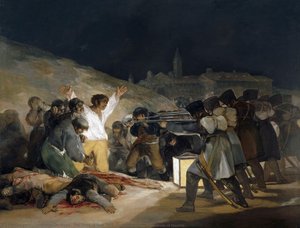
In response to the uprising, the French executed hundreds of Spanish insurgents and civilians. Embracing the tenets of Romanticism, Goya eschews Neoclassical ideals of order and restraint in favor of raw emotion and dramatic intensity. The faceless, robotic French firing squad represents dehumanization and the cold efficiency of military power.
The singular detaildramatic lightingfaceless soldiers
Completed around 1818, this oil on canvas resides prominently within the Hamburger Kunsthalle, cementing its place in art history as a symbol of the movement’s core ideals—a rejection of Enlightenment rationalism in favor of emotion, intuition, and communion with nature.
The painting directly commemorates the aftermath of the Dos de Mayo Uprising in Madrid on May 2nd, 1808. “The Third of May 1808” is a cornerstone of the Romantic movement, prioritizing emotion, individualism, and dramatic intensity over the Neoclassical emphasis on order and reason.
The singular detailcorpsescentral figure with outstretched arms
The painting showcases Aivazovsky's unparalleled ability to convey the sublime beauty and terrifying force of the ocean, making it one of his most celebrated works. The Ninth Wave reflects the Romantic movement's emphasis on emotion, drama, and the sublime power of nature.
The singular detailsmall boat struggling against overwhelming forceschristian metaphor for salvation from earthly sin
The central figure is a woman in deep sleep, her body contorted in an unnatural position that suggests distress or fear. The painting reflects the folkloric beliefs of the time, particularly Germanic tales about demons and witches that tormented sleepers.
The singular detailthe spectral horse emerging from the curtainsthe use of chiaroscuro for dramatic lighting
Interestingly, early versions of the painting incorporated the colors of the French flag – a deliberate reference to the crucial alliance between France and Sardinia that fueled Italy’s unification efforts. Francesco Hayez was a pivotal figure in Italian art, renowned for his ability to seamlessly blend historical narrative with emotional intensity.
This act of defiant destruction forms the core narrative. “The Death of Sardanapalus” is not simply a historical depiction; it's an exploration of human emotion at its most extreme.
This shift reflects the Romantic emphasis on emotion, individualism, and the power of nature—a stark contrast to the rationalism of the Enlightenment. WahooArt is proud to offer meticulously crafted, hand-painted reproductions of Goya’s “The Third of May 1808.” These reproductions capture not only the painting's visual power but also its emotional depth.
Fishermen at Sea, painted in 1796, is one of the earliest oil paintings exhibited by the renowned English artist Joseph Mallord William Turner. Fishermen at Sea is not only an important work in Turner's oeuvre but also a significant piece in the history of British art.
"Man and Woman Contemplating the Moon" (1824) is a quintessential work by Caspar David Friedrich, a leading figure in the German Romantic movement. The artwork depicts two figures standing on a path in a dark, forested landscape under a moonlit sky. Created in 1824, this painting reflects the Romantic era's shift towards spirituality and introspection.
Musée du Louvre, Paris1841Oil on canvas123 × 184 cm
The viewer is immediately confronted by the sheer, terrifying scale of Hell’s capital, where the architecture of a fallen civilization rises amidst a landscape of fire and shadow. At the center of this upheaval stands Satan, a figure of monumental presence surveying his demonic legions against a backdrop of churning lava and crumbling monuments.
The composition centers the figure against a subdued, dark background, which accentuates her luminous flesh tones and enhances the sense of depth and three-dimensionality.
1795Monotype, ink and watercolor on paper46 × 60 cm
The image presents an arresting portrayal of Sir Isaac Newton. Stripped bare and hunched over a rocky outcrop – seemingly submerged in a dark, watery abyss or the vastness of space – Newton is intensely focused on geometric diagrams he meticulously drafts with a compass upon a scroll.
The singular detailmarine life/otherworldly formationscompass
This innovative approach allowed Turner to convey both the tangible presence of the train and the intangible power of nature. The Great Western Railway, engineered by Isambard Kingdom Brunel, symbolized progress and modernity.
The singular detailsymbolic hare running along the trackdynamic composition with diagonal lines
Executed in oil on canvas, “The Sea of Ice” exemplifies Friedrich's signature style: Romantic Realism. While Friedrich never journeyed to the Arctic himself, he drew inspiration from accounts of polar expeditions, transforming factual observation into a powerfully evocative vision.
Delacroix, deeply moved by accounts of the atrocities, sought to capture not just the facts of the battle but also its devastating emotional consequences. “The Massacre at Chios” is a quintessential example of Romantic art. The central image of the Ottoman soldier on horseback, a symbol of imperial oppression and brutality, dominates the scene. However, over time, it has come to be recognized as one of Delacroix's most important works and a cornerstone of Romantic art.
This version met a violent end during the chaos of World War II, when a British bombing raid in 1942 destroyed the work. Visitors traveling to the Metropolitan Museum of Art find this life-sized depiction of the events of 1776 waiting for them.
However, it's not simply technical proficiency that defines Delaroche’s style; it’s his ability to infuse historical scenes with raw emotion. The symbolism within “Young Christian Martyr” is layered and rich. The halo above her head – a common motif in depictions of martyrs – signifies not only her sainthood but also her purity and innocence.
The artist, Johan Christian Dahl, was born in Bergen, Norway, in 1788. The work was acquired by the collection in 1937. The painting remains in the city of Dresden, where it has been part of the institutional holdings since it was acquired in 1937.
Karl Bryullov produced The Last Day of Pompeii between 1830 and 1833. The monumental historical canvas was commissioned by Anatoly Demidov. In 1835, he produced Genserich's Invasion of Rome, a work characterized by Baroque -inspired drama and intense emotion.
Goya's technique in La maja desnuda is characterized by fluid, organic lines that follow the natural contours of the figure's body. Painted around 1797–1800, La maja desnuda was likely commissioned by Manuel de Godoy for his private collection. The painting has been in the Museo del Prado in Madrid since 1901.
The singular detailcontrast with La maja vestidabold gaze of the model
Two Men Contemplating The Moon is not simply a landscape; it is an emotional threshold. The two figures, positioned with their backs to us, act as Rückenfigur —a signature Friedrich device that allows the viewer to project themselves into the scene, sharing in the characters' quiet awe.
The composition is carefully orchestrated to draw the viewer into the scene. The painting reflects a growing appreciation for rural life in 19th-century England, as industrialization began to transform the nation's landscape.
Museo del Prado, Madrid1821Oil on plaster (originally mural)44 × 31 cm
The central figure, dressed in dark robes, commands attention, suggesting themes of power, mystery, and the occult. The artwork is part of Goya's Black Paintings series, which he painted directly onto the walls of his house, the Quinta del Sordo.
The singular detailcoven of witches in a moonlit landscapeinverted symbols and dark atmosphere
High above the architectural silhouettes of Thebes, the heavens split open, releasing a terrifying torrent of thunder, hail, and fire. This is the moment of the seventh plague, a celestial onslaught that turns the sky into a swirling vortex of dark clouds and jagged flashes of light. Moses stands with his staff held high, a conduit for the storm, while his brother Aaron remains by his side.
Fragonard skillfully portrays a scene brimming with youthful exuberance—a woman seated on the ground, her gaze fixed upwards towards a man standing before her.
The painting captures not the fervor of the charge, but the quiet aftermath—a moment suspended between divine calling and human frailty. The overall impression is one of magnificent contradiction: the unyielding strength symbolized by the metal juxtaposed against an expression steeped in melancholy and deep contemplation.
This is not the face of a fool, but that of a visionary—a man who perceives the gathering shadows of political decline while those around him remain lost in the festivities of the moment. The composition is a masterclass in Romantic Grandeur, where every element serves to heighten the emotional tension.
The ocean breathes in deep, rhythmic swells under the watchful eye of a full moon. Around it, the sea is alive with movement; at least thirteen other boats of varying sizes dot the horizon, some drifting near the foreground while others vanish into the misty distance.
The central figure, Maja, is presented with an unprecedented frankness. The painting’s subject, Maja Pia, was a young woman who worked as a model for Goya, and her inclusion in this work sparked considerable controversy upon its exhibition. The Nude Maja remains one of Goya’s most celebrated works, influencing generations of artists.
This mastery of chiaroscuro —a technique heavily influenced by his study of Rembrandt during his travels through the Netherlands and Italy—allows the light to act as a character in its own right.
While the immediate subject appears to be one of individual madness or mourning, the historical context of 1871 adds a layer of national significance. The piece was completed during a period of immense upheaval for France, following the defeat in the Franco-Prussian War.
The canvas captures a moment of suspended terror. The subject is Angelica, a princess of Cathay, caught in the violent intersection of myth and fate. The narrative tension is built upon several specific elements: The physical restraint of the princess against the stone. Jules Louis Machard employs a disciplined technique to render this dramatic episode.
National Trust, Basingstoke1841Oil on canvas112 × 142 cm
The composition focuses on the interplay between the architectural remnants and the natural movement of the water under a nocturnal sky. It is currently located at The Vyne, where it remains part of the permanent collection. The painting is kept in the care of the National Trust in Basingstoke, United Kingdom.
The painting immediately commands attention with its dynamic composition and arresting color palette; a deliberate departure from the more static depictions prevalent in earlier religious art, it pulses with an almost palpable energy. The scene depicts God (or Elohim, as the Hebrew text suggests) reaching out to form Adam from a mound of clay. Blake, along with artists like Turner and Wordsworth, rejected the Enlightenment’s emphasis on reason and embraced emotion, imagination, and individualism.
The painting meticulously recreates the atmosphere of the Second Continental Congress, featuring thirteen delegates—including luminaries such as Benjamin Franklin, Thomas Jefferson, and John Hancock—rendered with palpable presence. While Trumbull’s work possesses a certain neoclassical grandeur in its accuracy, there is an undeniable pulse of Romantic idealism flowing through his brushstrokes.
The painting depicts a stark yet majestic scene: a weathered rock formation crowned by a life-sized crucifix, silhouetted against a dramatic sky. Commissioned by the Duke and Duchess of Thun-Hohenstein for their private chapel at Schloss Tetschen (now Těšín Castle in the Czech Republic), the Tetschen Altar represents a pivotal moment in Friedrich’s career.
It is believed that Turner may have been inspired by the sinking of the Earl of Abergavenny off the coast of Dorset earlier that year. Reflects 19th-century Britain’s significant maritime trade and the inherent risks associated with sea travel.
Sunlight streams through a curtained window, casting a soft glow over a checkered floor that anchors this intimate scene. The scene feels less like a staged portrait and more like a stolen glance into a private, sacred ritual of a royal household.
Doré's illustrations were frequently commissioned for novels and religious texts, reflecting the Victorian obsession with storytelling and moral instruction.
This particular piece, commissioned as part of a larger project illustrating books of the Bible, is not simply a depiction of a scene from Revelation; it’s a complex allegory brimming with potent symbolism and charged with emotional intensity.
Musée du Louvre, Paris1822Oil on canvas189 × 241.5 cm
Delacroix, born amidst the political upheaval following the French Revolution, rejected the rigid order and idealized forms favored by his contemporary Jacques-Louis David. The Barque of Dante was exhibited at the Paris Salon of 1822, immediately establishing Delacroix as a leading figure in the burgeoning Romantic movement.
The work before us is titled The Slave Ship, an oil on canvas by J. It was first exhibited at the Royal Academy in 1840. It specifically references the 1781 Zong massacre, a horrific event where over 130 enslaved Africans were thrown overboard by a ship's captain.
This grand historical work, measuring 322 x 512 cm, depicts the fictionalized scene of Russian envoys kneeling before Polish King Stephen Báthory at Pskov during peace negotiations. The composition is dynamic and crowded, with a central focus on two prominent figures seated at a table covered with documents and objects. The papal legate, Antonio Possevino, is also depicted, highlighting the role of the Catholic Church in these historical events. To see the original painting, visit the Royal Castle in Warsaw, Poland.
The singular detailpresence of papal legate Antonio Possevinoallegorical representation of historical events
In a departure from more monstrous classical interpretations, Etty depicts these creatures as beautiful, naked young women, making their temptation all the more visceral and psychologically complex for the observer.
Romanticism at its Finest: The painting firmly establishes itself within the Romantic movement, prioritizing emotional intensity and subjective experience. Waterhouse's approach aligns with the Pre-Raphaelite Brotherhood’s emphasis on meticulous detail and a return to medieval artistic ideals – a desire for sincerity and beauty over academic convention.
In the foreground, a small group of figures—an aged man, two adults, and two children—are engaged in quiet activity, symbolizing the different stages of human life. The painting’s setting on a Baltic Sea port near Friedrich’s birthplace imbues it with personal significance, blending autobiographical elements with universal themes.
The singular detailallegorical figuresmaritime scene
The man, equally distressed, points towards a distant town atop a mountain, possibly symbolizing Gibraltar, a refuge for Spanish liberals during the aftermath of the Peninsular War. The title "Asmodea" is likely derived from the demon king Asmodeus from the Book of Tobias, suggesting themes of temptation and destruction.
The singular detailred cloak of the female figurefrench soldiers aiming at refugees
Held within the Science Museum in London, this oil on canvas transports us to the heart of the Ironbridge Gorge, a crucible where technological innovation collided with the raw beauty of the English landscape. De Loutherbourg’s style leans heavily into the Romantic aesthetic, evident in his dramatic composition and heightened emotionality.
Eylau represented a pivotal moment in Napoleonic history—a costly victory against Russia that nonetheless underscored Napoleon’s vulnerability and exposed the brutal cost of imperial ambition. Napoleon Bonaparte on the Battlefield of Eylau Napoleon Bonaparte on the Battlefield of Eylau Antoine-Jean Gros Additional Information: Napoleon on the Battlefield of Eylau
Sea view is an oil painting executed by Ivan Aivazovsky in 1895. In 1850, he produced The Ninth Wave, a work focusing on the turbulent energy of the ocean. Travel of Poseidon by sea was created in 1894, followed by Between the waves, which dates from about 1898.
This isn’t a static landscape; it’s imbued with an undeniable sense of energy and life. Born in East Bergholt, Suffolk, he spent his childhood immersed in the rhythms of rural agricultural life along the River Stour.
The singular detailloose brushworkatmospheric depth
Francesca da Rimini and Paolo Malatesta are not presented as serene lovers; instead, they’re caught within a maelstrom of swirling figures – angels, demons, and spectral forms – all contributing to an atmosphere of intense turmoil. The inclusion of figures like Guido da Polenta (Francesca's father) and Giovanni Malatesta (Paolo’s husband) underscores the societal repercussions of their actions, highlighting the tragic consequences of defying social norms and moral boundaries. While painted, “The Lovers’ Whirlwind” reveals Blake's deep connection to printmaking.
Created in 1835, this work belongs to the tradition of genre painting, which focuses on scenes of everyday life. Holden and was previously exhibited in London at the Royal Academy of Arts in 1833. The piece is signed and dated 'W Collins 1835' in the lower right corner.
From the sheltered perspective of a cloister, the eye follows the rhythm of ribbed vaults and slender columns toward a central courtyard. The ground is a white shroud, smoothing the edges of the earth. In 1821, this oil on canvas emerged as a reflection of the German Romantic movement.
The painting presents a breathtakingly complex scene, populated by nude figures caught in a state of divine or perhaps demonic frenzy. As they interact amidst swirling, turbulent clouds, there is an undeniable sense of movement—a rhythmic, almost ritualistic dance that suggests a moment frozen in time during a cosmic upheaval.
Ivanov was born in Saint Petersburg, Russia, in 1806. In the center of the composition, John the Baptist stands upon the banks of the River Jordan. The artist worked on this specific composition over a period of two decades, beginning the process in 1837 and continuing until 1857.
Created in 1805 by the renowned German Romantic artist Philipp Otto Runge, this work exemplifies the meticulous realism and emotional depth characteristic of early 19th-century European painting.
The singular detailfamilial bondsdetailed textures
This technique, honed during Böcklin’s time studying at the Düsseldorf Academy, contributes significantly to the painting's dreamlike quality. The painting can be seen as a visual echo of these Italian vistas, transposed onto a canvas imbued with Symbolist sensibilities.
The mountains rise from the earth with a heavy, silent permanence. The brushwork seeks to translate the raw, elemental nature of the Capel Curig area into a visual reality.
The scene unfolds through William Henry Davis's Prize Sheep, an oil on canvas that captures a quiet moment of agricultural pride. Created about 1838, the work presents a specific slice of rural life from the early 19th century.
The painting immediately draws the viewer into its dramatic scene: a vast expanse of dark water punctuated by the luminous glow of a colossal full moon dominating the sky. This dramatic contrast not only creates visual excitement but also reinforces the painting's thematic concerns – the tension between darkness and light, chaos and order.
National Gallery, London1836Oil on canvas132 × 108 cm
This memorial itself is composed of classical sculptures flanking an urn containing Reynolds ' ashes. Rejecting rigid compositional rules, he favored loose brushstrokes and a vibrant palette—a stylistic hallmark that distinguishes Cenotaph from its contemporaries. This technique is particularly evident in the depiction of the trees, where Constable skillfully captures their intricate bark textures and the rustling movement of the leaves.
Created in 1840, this piece measures 27 x 21 cm and is characterized by its serene and introspective atmosphere. The stone arches add an architectural element, while the man's contemplative pose suggests a deep connection with nature. The Gothic arches symbolize transition, memory, and the passage of time.
In the heart of the nineteenth century, few images could stir the Victorian soul with as much terror and awe as John Martin’s The Great Day of His Wrath. The scene captures the precise moment of biblical apocalypse, where the heavens fracture and the earth itself seems to dissolve into fire and shadow.
This chiaroscuro effect highlights the rich textures of Titania’s flowing gown and the intricate, organic details of the surrounding flora, making the scene feel tangibly present. The style leans toward the ornate elegance of the Rococo, yet it is anchored by a Neoclassical precision in the rendering of form and anatomy.
Robert’s artistic lineage is deeply rooted in the traditions of Roman landscape painting. The scene unfolds within the newly renovated Grande Galerie of the Louvre, a project initiated under Francis II d’Orléans, Duke of Mantua, and completed around 1798.
Pedestrians move through the white landscape, their figures casting soft shadows against the drifts. A dog trots near the center of the scene, its presence adding a touch of domestic life to the cold, wide street.
It's a scene steeped in Roman mourning, yet simultaneously celebrating the legacy of Homer—a potent blend of pathos and grandeur that speaks volumes about Ingres’ artistic vision and his deep engagement with both antiquity and contemporary concerns.
The sea is a restless, heavy thing in this scene, churning with a dark energy that threatens to swallow the light. To its left, a smaller sailing ship maneuvers through the swell, its sails partially furled as it struggles to find its footing amidst the rising waves.
Dressed in formal attire of the period, the man presents a somber, almost severe countenance. The composition focuses heavily on the individual, utilizing a dark, formal palette to emphasize the subject's presence. A hint of a richly upholstered chair and a bench in the background provide a sense of domestic stability and social standing.
Shipping off Greenock is an oil on panel painting by Robert Salmon. The work was created in 1818. This maritime piece depicts several ships sailing in the ocean, with mountains visible in the background. The composition includes boats of various sizes and positions, ranging from large vessels in the foreground to smaller boats scattered throughout the water. This work is currently held at the McLean Museum and Art Gallery in Scotland.
It is an image steeped in tranquility, where the dappled light filtering through the canopy seems to illuminate not just the forest floor, but the very spirit of contemplation. Shishkin, whose career was so deeply intertwined with the depiction of Russian nature, possessed an unparalleled ability to render atmosphere.
The open book held by Hecate suggests access to esoteric learning and perhaps foretelling future events. Blake rejected the prevailing Neoclassical style, favoring instead a deeply personal and symbolic approach to art.
The singular detailthree-faced figure symbolizing the moon's phases
As a work of historical painting, it was designed to stir the soul and remind the viewer of the complexities of the Polish spirit. This emotional resonance is what has allowed the painting to endure as one of Jan Matejko's most celebrated achievements, housed within the prestigious National Museum in Warsaw.
The scene is a somber, snow-covered woodland, where the earth is draped in heavy, white mantles that smooth over the rugged terrain. A muted palette of deep blacks, charcoal grays, and cold whites dominates the view, with only the smallest hints of earthy browns in the tree trunks to ground the scene.
Completed in 1804, this monumental canvas—measuring an impressive 523 x 715 cm—captures a pivotal moment during Napoleon's Egyptian campaign, transforming a potentially damaging rumour into a carefully orchestrated display of imperial benevolence and divine authority.
The biting chill of the Arctic air seems to hang heavy over the scene, where the stark white of the snow meets the jagged, dark edges of the ice. It hunches over its prize, tearing into something with a quiet, predatory focus.
It’s a painting that speaks volumes about Turner’s revolutionary approach to landscape art – his obsession with capturing atmosphere and emotion rather than simply replicating visual reality. Turner, already a celebrated figure in the Romantic movement, was deeply fascinated by Venice. “The Grand Canal” is steeped in symbolism, reflecting Turner's broader artistic concerns.
First exhibited in 1771, the work captures a specific moment of scientific transition. The artist, who lived from 1734 to 1797, utilizes the medium to document a historical phenomenon through a dramatic lens. The subject matter references a real event from 1669, when the German alchemist Hennig Brand discovered phosphorus.
Executed in oil on canvas, “The Blind Girl” exemplifies the Pre-Raphaelite Brotherhood’s commitment to meticulous observation and painstaking technique. Millais's work, alongside those of his contemporaries like Dante Gabriel Rossetti and William Holman Hunt, challenged the prevailing academic style and paved the way for a new era of British art.
The canvas captures a moment of desperate velocity. The composition utilizes a wide horizontal format, with the low line of clouds at sunset emphasizing the deadly speed of the race. The work reflects the influence of French Romanticism, specifically the dramatic energy found in the works of Delacroix. This theme of choosing a quick death over subjugation was a recurring motif in 19th-century Hungarian art, used to express national identity and the struggle for independence.
The early 1800s witnessed the rise of Neoclassicism, inspired by ancient Greek and Roman architecture, yet simultaneously, Romanticism was gaining momentum, emphasizing emotion, imagination, and the sublime. The design’s remarkable symmetry—a hallmark of Schinkel's style—immediately establishes a sense of order and stability.
The ocean stretches out in a muted, grayscale expanse, a vast stage for a sudden and violent encounter. It is a quiet study of movement and stillness, where the only sound one imagines is the creak of timber and the soft slap of water against the hull.
In the foreground, a dirt path winds toward a cluster of grazing cows, their forms rendered with loose, organic shapes. A small stream cuts through the lower terrain, its movement suggested by subtle shifts in color.
The composition focuses on the tension between the two vessels, framed by the vast, indifferent expanse of the sea. The artist utilizes a meticulous approach to detail, characteristic of the British Romantic maritime tradition. This work reflects the naval realities of the mid- 19th century, specifically the era of the Crimean War.
Poppies And Daisies With Carrickfergus Castle, Co. He remained active in the art community until his death on April 16, 1886. The piece measures 35.56 x 50.8 cm (10¼ x 17½in. / 26.6 x 44.4cm.).
A solitary figure in dark robes occupies a low dune at the edge of a vast, sandy shore. The composition follows a stark, horizontal tripartite division: a dark expanse of sea and land at the base, a heavy band of misty atmosphere in the center, and an expansive, overcast sky above.
This oil painting is housed at the National Gallery of Victoria in Melbourne, Australia. According to Homer, there were two sirens on an island in the western sea between Aeaea and the rocks of Scylla. To learn about the Pre-Raphaelite movement, see https://en.wikipedia.org/wiki/Pre-Raphaelite_Brotherhood.
Museo del Prado, Madrid1800Oil on canvas280 × 336 cm
Goya had recently been appointed as the First Court Painter, a prestigious position that granted him access to the royal family and significant patronage. The painting depicts King Charles IV, his wife Queen Maria Luisa of Parma, and their children and relatives.
This oil on canvas work depicts Anna Burnazyan, who was the second wife of Ivan Aivazovsky. The subject is identified in historical records as Anna Burnazyan-Sarkisova. His 1850 work, The Ninth Wave, focuses on the movement of water and the presence of survivors amidst turbulent waves.
How much is a reproduction of a famous Romanticism painting?
Read
Yes: 100 of the 100 can be ordered as a hand-painted oil reproduction, from $200, and 100 as a canvas print, from $58.
How was this list of Romanticism paintings ranked?
Read
By recognition: Wikipedia articles in the most languages (Wikidata sitelinks), our manual ranking and page visits. Several records of one painting count once; details, copies and studies are excluded.
One of a kind
100 of the 100, painted for you alone
100 of these works can be painted by hand for a single owner, from $200.
We went through every Romanticism painting in our catalogue and placed the best-known first: those Wikipedia describes in the most languages, those our artists and curators rank highest and those most viewed on our pages. Each original appears once — no details or copies.