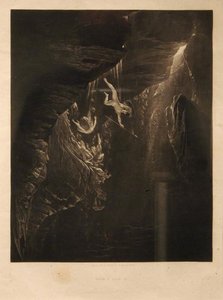
John Martin: A Master of Melodramatic Romanticism
John Martin (1789-1854) was a celebrated English romantic painter, engraver, and illustrator whose dramatic compositions captivated the Victorian public. Born in Haydon Bridge, Northumberland, on July 19, 1789, he rose from humble beginnings to become one of the most popular artists of his day, renowned for his vast landscapes populated by minute figures and depicting biblical scenes and fantastical narratives with a powerful sense of scale and emotion.
Early Life and Artistic Development
Martin's early life was marked by practical pursuits. He was apprenticed to a coachbuilder in Newcastle upon Tyne, where he learned heraldic painting – a skill that would later inform his meticulous attention to detail. In 1806, he moved to London, marrying at the age of nineteen and supporting himself through drawing lessons and commissions for watercolors and decorative work on china and glass. This period honed his technical skills while allowing him to explore various artistic mediums. His early works show a developing interest in dramatic lighting and composition, foreshadowing his later signature style.
Artistic Style and Notable Works
Martin's distinctive style is characterized by its grand scale, melodramatic intensity, and meticulous detail. He frequently depicted biblical subjects, such as The Destruction of Sodom and Gomorrah and Belshazzar’s Feast, with a theatrical flair that resonated deeply with audiences. His landscapes, like Harnham Church, near Salisbury, demonstrated his ability to capture serene countryside scenes while maintaining a sense of grandeur. Key works showcasing his artistic prowess include:
- The Destruction of Sodom and Gomorrah: A monumental depiction of divine retribution, demonstrating Martin’s skill in portraying chaos and destruction on a vast scale.
- Belshazzar's Feast: Illustrating the biblical story with dramatic lighting and intricate detail, highlighting the downfall of Babylon.
- Manfred and the Alpine Witch: Inspired by Byron’s poem, this work exemplifies Martin’s ability to translate literary narratives into visually stunning compositions.
- Satan Arousing the Fallen Angels (from Paradise Lost): A powerful interpretation of Milton's epic poem, showcasing his skill in depicting dramatic scenes from literature.
- Pandemonium: A fantastical depiction of the capital of Hell, demonstrating Martin’s imaginative scope and mastery of perspective.
- The Country of the Iguanodon: An early example of paleoart, reflecting a burgeoning interest in scientific discovery during his time.
Recognition and Legacy
John Martin achieved considerable recognition during his lifetime. He was referred to as "the most popular painter of his day" by Walter Sickert in 1821 and received a gold medal from the Russian Tsar Nicholas I. He was awarded the Order of Leopold from Prince Leopold of Saxe-Coburg and Gotha, becoming the official historical painter to Prince Leopold. His works were exhibited at both the National Gallery and the Tate Gallery, solidifying his place within the British art establishment.
Despite a period of relative obscurity after his death on February 17, 1854, Martin’s work has experienced a resurgence in appreciation. Today, his paintings are recognized for their unique blend of Romantic drama, meticulous detail, and imaginative scope. His influence can be seen in the works of later artists, including James Francis Danby, who was inspired by Martin's dramatic landscapes. John Martin remains an important figure in British art history, celebrated for his ability to transport viewers to epic worlds filled with both awe-inspiring beauty and terrifying power.