Inspiration · Realism

The 100 Famous Realism Paintings That Inspire Our Artists

1793 – 1996

Ask for the most famous Realism paintings and you will hear of Gustave Courbet's The Origin of the World (1866, Musée d'Orsay), Edward Hopper's Nighthawks (1942, Art Institute of Chicago) and Ilya Repin's The Reply of the Zaporozhian Cossacks to Sultan Mahmoud IV (1878, The State Russian Museum). This ranking lists the 100 best-known Realism paintings, painted between 1793 and 1996 by 60 artists, with the museum where each one hangs today.

The Origin of the World by Gustave Courbet, 1866, Musée d'Orsay — famous Realism painting
No. 1 · Gustave CourbetThe Origin of the World1866 · Musée d'Orsay, Paris
100singular works
60masters · Jacques-Louis David – Miguel a Gandert
41homes in 29 cities
11kept at the Musée d'Orsay

Singular works

100 Realism paintings that exist only once

Every original here is unique and kept in one place. Its story, its home, and the detail that makes it unmistakable.

  1. The Origin of the World by Gustave Courbet, 1866, Musée d'Orsay
    1

    Musée d'Orsay, Paris1866Oil on canvas46 × 55 cm

    This strikingly direct depiction of a reclining nude female torso challenges conventional artistic representations, rejecting idealized beauty standards in favor of raw, unapologetic realism. Executed with remarkable skill in oil on canvas (46 x 55 cm), the painting showcases Courbet’s mastery of anatomy, light, and shadow.

    The singular detailrealismunapologetic depiction of pubic hair

    Its story

  2. Nighthawks by Edward Hopper, 1942, Art Institute of Chicago
    2

    Edward HopperAmerican Realism

    Nighthawks

    Art Institute of Chicago1942Oil on canvas84 × 152 cm

    The lack of interaction between the figures – the counterman and three patrons – underscores themes of loneliness and disconnection. Painted shortly after the attack on Pearl Harbor, this artwork reflects the anxieties and uncertainties of wartime America.

    The singular detailisolationstark lighting

    Its story

  3. The Reply of the Zaporozhian Cossacks to Sultan Mahmoud IV by Ilya Repin, 1878, The State Russian Museum
    3

    The State Russian Museum, St. Petersburg1878Oil on canvas217 × 361 cm

    The artwork portrays a chaotic and intense scene of a military gathering, where the Zaporozhian Cossacks are drafting a defiant response to Sultan Mahmoud IV's demand for their submission. The central figure is seated at a table, surrounded by armed soldiers engaged in heated discussion.

    The singular detailchaotic yet focused compositiondramatic use of light and shadow

    Its story

  4. Olympia by Édouard Manet, 1863, Musée d'Orsay
    4

    Édouard ManetImpressionist Realism

    Olympia

    Musée d'Orsay, Paris1863Oil on canvas130.5 × 191 cm

    Olympia, a courtesan, lies on her bed, attended by her black servant, Laure, who presents her with flowers – an act laden with complex social and economic implications. Olympia debuted at the 1863 Salon, Paris's most prestigious art exhibition.

    Its story

  5. The Fog Warning by Winslow Homer, 1885, Museum of Fine Arts
    5

    Museum of Fine Arts, Boston1885Oil on canvas76.83 × 123.19 cm

    Following time spent painting fishermen in England, Homer returned to America and focused on capturing the demanding realities of maritime existence. Originally exhibited under the title “Halibut Fishing,” the renaming to "The Fog Warning" underscores the painting’s central narrative: the looming threat and urgent need for safe return.

    The singular detailapproaching foglone fisherman

    Its story

  6. Man at the Window by Gustave Caillebotte, 1875, J. Paul Getty Museum
    6

    J. Paul Getty Museum, Los Angeles1875Oil on canvas117 × 82 cm

    While often associated with the Impressionist movement – of which he was both a participant and patron – Caillebotte’s style is distinctly rooted in Realism. Created during a period of rapid urban development in Paris under Baron Haussmann, this painting reflects the changing face of the city.

    The singular detailsomber moodintrospection

    Its story

  7. First Steps by Georgios Jakobides, 1892, National Gallery
    7

    Georgios JakobidesContemporary Realism

    First Steps

    National Gallery, Athens1892Oil on canvas140 × 100 cm

    Jakobides was a leading figure in the Greek artistic movement known as the Munich School, which emphasized academic realism and meticulous detail.

    The singular detailwindow with landscape viewwarm color palette

    Its story

  8. Man at the Crossroads/Man, Controller of the Univers by Diego Rivera, 1934, Palace of Fine arts
    8

    Palace of Fine arts, Mexico City1934Fresco480 × 1145 cm

    Rivera’s style is deeply rooted in Social Realism, characterized by its commitment to depicting the lives and struggles of ordinary people. As a leading figure in the Mexican Mural Movement, Rivera aimed to create art that was accessible to all, moving it from exclusive galleries into public spaces.

    The singular detailclassical motifsbotanical imagery

    Its story

  9. Barge Haulers on the Volga by Ilya Repin, 1870–1873, The State Russian Museum
    9

    The State Russian Museum, St. Petersburg1870–1873Oil on canvas131 × 281 cm

    In the vast landscape of nineteenth-century Russian Realism, few canvases command the viewer's attention with such raw, unyielding power as Ilya Yefimovich Repin’s Barge Haulers on the Volga. Technically, the painting is a triumph of the Realist tradition.

    The singular detaildetailed depiction of barge haulers

    Its story

  10. The Gleaners by Jean-François Millet, 1857, Musée d'Orsay
    10

    Jean-François MilletContemporary Realism

    The Gleaners

    Musée d'Orsay, Paris1857Oil on canvas84 × 111 cm

    The history of this work is marked by a series of significant transitions through private hands. It moved through various collections, eventually coming into the possession of the banker Ferdinand Bischoffsheim by 1889. The acquisition of the work by Jeanne-Alexandrine Louise Pommery marked a final chapter in its private history.

    Its story

  11. Freedom from Want by Norman Rockwell, 1942
    11

    Norman RockwellContemporary Realism

    Freedom from Want

    1942Oil on canvas

    The artwork portrays a large family gathered around a bountifully laden dining table. “Freedom from Want” is one of Rockwell’s celebrated “Four Freedoms” series, inspired by Franklin D. Roosevelt's 1941 State of the Union Address. These paintings aimed to galvanize American support for the war effort by illustrating core democratic ideals. The painting’s publication in The Saturday Evening Post alongside an essay addressing domestic hardship further underscored its social relevance.

    The singular detailfamilial warmthroasted turkey

    Its story

  12. Gas by Edward Hopper, 1940
    12

    Edward HopperContemporary Realism

    Gas

    1940Oil on canvas102 × 66 cm

    Hopper's composition is meticulously balanced, with the gas pumps centrally placed along a diagonal line that guides the viewer's eye through the scene. Painted in 1940, "Gas" reflects Edward Hopper's signature style of capturing modern American life with a focus on solitude and introspection.

    The singular detailmuted tonessoft natural light

    Its story

  13. The Angelus by Jean-François Millet, 1858, Musée d'Orsay
    13

    Musée d'Orsay, Paris1858Oil on canvas55.5 × 66 cm

    The scene is set against a vast, open landscape under a soft, diffused sky, evoking a sense of quiet contemplation and hard work. "The Angelus" exemplifies his commitment to portraying the dignity and resilience of rural workers.

    The singular detailtwo peasants praying in a field at duskchurch steeple on the horizon

    Its story

  14. Ivan the Terrible and His Son Ivan on November 16 by Ilya Repin, 1883–1885, Tretyakov Gallery
    14

    Tretyakov Gallery, Moscow1883–1885Oil on canvas199.5 × 254 cm

    The oil-on-canvas work titled Ivan the Terrible and His Son Ivan on November 16, 1885, was executed by the Russian realist artist Ilya Repin. This painting was created between 1883 and 1885. On 1 April 1885, the work became the first painting to be censored in the Russian Empire.

    Its story

  15. Reflection with Two Children (Self-Portrait) by Lucian Freud, 1965, Thyssen-Bornemisza Museum
    15

    Thyssen-Bornemisza Museum, Madrid1965Oil on canvas91 × 91 cm

    The artwork centers around a monumental figure – the artist himself – dominating the canvas space. However, his unique approach – characterized by its intense focus on the physicality and psychological weight of his subjects – firmly establishes him as a distinct voice in modern painting.

    The singular detailscale contrastgolden circular object (mirror/light source)

    Its story

  16. Automat by Edward Hopper, 1927
    16

    Edward HopperContemporary Realism

    Automat

    1927Oil on canvas91 × 71 cm

    This play of light and shadow not only enhances the visual appeal but also contributes to the overall moodiness of the painting. Painted in 1927, "Automat" reflects the social and cultural landscape of early 20th-century America.

    Its story

  17. Benefits Supervisor Sleeping II by Lucian Freud, 1995
    17

    1995Oil on canvas (presumed)

    Emerging from influences like German Expressionism, Freud developed a unique style characterized by thick impasto, muted palettes, and an unwavering commitment to realism – a rejection of idealization that set him apart from many contemporaries. This painting exemplifies his mature style, solidifying his place within the “School of London” group of figurative painters.

    The singular detailrejection of idealized beauty standardslarge scale

    Its story

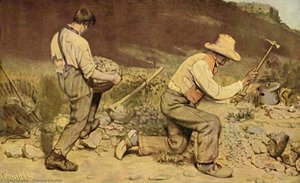
  18. The Stone Breakers by Gustave Courbet, 1849, Staatliche Kunstsammlungen Dresden
    18

    Staatliche Kunstsammlungen Dresden1849Oil on canvas165 × 257 cm

    Gustave Courbet's "The Stone Breakers" captures the raw essence of rural life through its depiction of two laborers engaged in the arduous task of breaking stones. "The Stone Breakers" was first exhibited at the Paris Salon of 1850–1851, where it sparked controversy for its depiction of a subject considered unworthy of high art.

    The singular detaildepiction of rural laborersearthy color palette

    Its story

  19. Sunday by Edward Hopper, 1926, The Phillips Collection
    19

    Edward HopperNew Realism

    Sunday

    The Phillips Collection, Washington, D.C.1926Oil on canvas86 × 74 cm

    The painting features a solitary man sitting on a wooden bench in front of closed storefronts, evoking a sense of solitude and contemplation that is characteristic of Hopper's work. The 1920s saw the early effects of the Great Depression, and Hopper's work reflects the national anxiety and disillusionment of the time.

    The singular detailmuted color palette with subtle pops of colorsolitary figure on a bench

    Its story

  20. Morning in a Pine Forest by Ivan Shishkin, 1889, Tretyakov Gallery
    20

    Tretyakov Gallery, Moscow1889Oil on canvas139 × 213 cm

    Originally conceived as a pure landscape by Shishkin, the painting was later enriched by the addition of the bear family by the renowned Russian Realist Konstantin Savitsky. This blend of Shishkin’s botanical precision and Savitsky’s animalistic vitality creates a balanced harmony between the monumental scale of the trees and the intimate drama of wildlife.

    The singular detailbears added by Konstantin Savitsky

    Its story

  21. The Maria at the Dock by Antonio Pietro Martino, James A. Michener Art Museum
    21

    James A. Michener Art Museum, DoylestownOil

    The Maria at the Dock is an oil painting by Antonio Pietro Martino. He spent his life observing the interplay of light and form, a practice that continued until his death in 1988. Martino’s hand moved with the precision of a man who understood the structure of the world. From his early training in Philadelphia to his later years in California, he sought to render the essence of a moment. The canvas holds a stillness found only at the water's edge.

    Its story

  22. Sorrowing old man ( by Vincent van Gogh, 1890, Kröller-Müller Museum
    22

    Vincent van GoghImpressionistic Realism

    Sorrowing old man (

    Kröller-Müller Museum, Otterlo1890Oil on canvas81.8 × 65.5 cm

    The canvas presents "Sorrowing old man (" by Vincent van Gogh, a work that emerges from a heavy period of personal struggle. This specific composition is a modification of the 1882 drawing At Eternity’s Gate, which itself grew from a motif he had explored in Etten.

    Its story

  23. The Israelites passing through the Wilderness by William West, 1845, Bristol Museum - Art Gallery
    23

    Bristol Museum - Art Gallery1845Oil on canvas76.2 × 63.5 cm

    The painting presents a dramatic nocturnal landscape where the heavens and earth converge under the weight of a miraculous event. West utilizes a vast mountain range in the background, its jagged peaks shrouded in mist and shadow, to emphasize the isolation and the monumental nature of the Exodus.

    The singular detaildramatic night scenepillar of light

    Its story

  24. Dante and Virgil by William-Adolphe Bouguereau, 1850, Musée d'Orsay
    24

    Musée d'Orsay, Paris1850Oil on canvas280.5 × 225.3 cm

    The painting immediately commands attention – not through overt horror, but through an unsettling stillness, a palpable sense of dread that permeates every detail. At first glance, the composition appears deceptively serene.

    The singular detailcombathell scene

    Its story

  25. People in the Sun by Edward Hopper, 1960
    25

    Edward HopperContemporary Realism

    People in the Sun

    1960Oil on canvas153 × 102 cm

    The painting features a strong horizontal orientation, emphasizing the row of seated figures against a vast landscape backdrop. Executed in oil on canvas, "People in the Sun" showcases Hopper's meticulous technique.

    The singular detailnatural, even lightinglinear perspective creating depth

    Its story

  26. A Burial at Ornans by Gustave Courbet, 1849, Musée d'Orsay
    26

    Musée d'Orsay, Paris1849Oil on canvas315 × 668 cm

    Measuring an imposing 315 x 668 cm, this monumental work irrevocably altered the course of French art, ushering in the era of Realism and challenging centuries of academic tradition. In mid- 19th century France, art was largely dominated by historical paintings, religious scenes, or idealized portraits catering to the elite.

    The singular detailhorselarge group portrait

    Its story

  27. Alderman Charles Hardman, Mayor of Oldham by Howard Somerville
    27

    Oil on canvas153 × 102 cm

    The portrait presents an elderly gentleman in formal regalia, captured in a moment of quiet dignity. The lighting is stark, casting deep shadows that define the contours of his face and the intricate folds of his attire. This chiaroscuro effect emphasizes the physical presence of the sitter, pulling him forward from the gloom.

    Its story

  28. The Horse Fair by Rosa Bonheur, 1852, Metropolitan Museum of Art
    28

    Rosa BonheurContemporary Realism

    The Horse Fair

    Metropolitan Museum of Art, New York1852Oil on canvas245 × 507 cm

    Completed in 1852 and debuted at the prestigious Paris Salon, the painting arrived during a transformative era of artistic experimentation.

    Its story

  29. Harvesters Resting by Jean-François Millet, 1853, Museum of Fine Arts
    29

    Museum of Fine Arts, Boston1853Oil on canvas67 × 119 cm

    Jean-François Millet's "Harvesters Resting" is a poignant depiction of rural laborers taking a moment of respite, capturing the essence of 19th-century peasant life. The composition is rich with organic lines and flowing contours that follow the figures' forms, creating a sense of harmony and depth.

    The singular detaillarge sail or piece of fabric in the backgroundinteraction among figures conveying camaraderie

    Its story

  30. A Dinner Table at Night by John Singer Sargent, 1884, Fine Arts Museums of San Francisco
    30

    Fine Arts Museums of San Francisco1884Oil on canvas51.44 × 66.67 cm

    John Singer Sargent’s “A Dinner Table at Night,” also known as “Mr. and Mrs. The setting itself—a private dining space—hints at the exclusivity of Victorian society and the importance of social gatherings in maintaining status and connections.

    Its story

  31. Rue Mouffetard 1954 by Henri Cartier-Bresson, 1954
    31

    1954Gelatin silver print

    The image captures a specific slice of life within the streets of Paris. It was executed in 1954. Later, the Staley-Wise Gallery in New York acquired the work from its previous owner. Hardin, M.D., entering the institution's care as accession number 1990.40. The High Museum of Art in Atlanta holds this work within its walls. The piece remains part of the High Museum of Art collection. It is a physical fragment of 1954, kept under the care of the museum's curators.

    Its story

  32. Snap the Whip by Winslow Homer, 1872, Butler Institute of American Art
    32

    Winslow HomerAmerican Realism

    Snap the Whip

    Butler Institute of American Art, Mahoning County1872Oil on canvas55.88 × 91.44 cm

    Winslow Homer's "Snap the Whip" is a vibrant and dynamic depiction of children playing outdoors in a rural setting. The artwork captures a moment of pure joy and energy, as a group of boys engage in a lively game of tug-of-war.

    The singular detailrich earthy color palette with vibrant greens and redschildren playing crack the whip in a rural setting

    Its story

  33. Woman with a Parrot by Gustave Courbet, 1866, Metropolitan Museum of Art
    33

    Metropolitan Museum of Art, New York1866Oil on canvas130 × 196 cm

    Rejecting the idealized forms of academic tradition, Courbet focused on the raw beauty of the human form and the authenticity of everyday life. The painting's acceptance by the Paris Salon marked a significant milestone for the artist, who had previously faced rejection for his bold depictions.

    The singular detailreclining nude female figurepet parrot on outstretched hand

    Its story

  34. Nymphes et satyre by William-Adolphe Bouguereau, 1873, Sterling and Francine Clark Art Institute
    34

    Sterling and Francine Clark Art Institute, Williamsburg1873Oil on canvas260 × 180 cm

    The painting immediately draws the eye to the group of women – nymphs – who occupy the central space, their postures ranging from relaxed repose to graceful interaction. “Nymphs et Satyre” draws upon classical mythology, specifically referencing scenes from Ovid's Metamorphoses.

    The singular detailnymphssatyrs

    Its story

  35. Lane with Poplars near Nuenen by Vincent van Gogh, 1885, Museum Boijmans Van Beuningen
    35

    Museum Boijmans Van Beuningen, Rotterdam1885Oil on canvas97 × 78 cm

    Van Gogh’s approach in “Lane with Poplars near Nuenen” demonstrates his transition from traditional academic training towards a more personal artistic voice. “Lane with Poplars near Nuenen” represents an important milestone in Van Gogh’s artistic development, making it a valuable addition to any discerning collection.

    Its story

  36. The Gross Clinic by Thomas Eakins, 1875, Philadelphia Museum of Art
    36

    Thomas EakinsContemporary Realism

    The Gross Clinic

    Philadelphia Museum of Art1875Oil on canvas

    Gross performing surgery on a young patient for osteomyelitis of the femur at Jefferson Medical College. This work is significant not only for its artistic merit but also for its historical documentation of surgical practices in the 19th century.

    The singular detailhistorical documentation of surgical practicesdepiction of Dr. Samuel D. Gross performing surgery

    Its story

  37. Christ in the Desert by Ivan Kramskoi, 1872, Tretyakov Gallery
    37

    Tretyakov Gallery, Moscow1872Oil on canvas180 × 210 cm

    Ivan Nikolaevich Kramskoy (1837-1887) was a Russian painter and art critic who played a significant role in the development of realism in Russia. The painting was completed in 1872 and is currently housed in the Tretyakov Gallery in Moscow.

    Its story

  38. Ecce Homo by Honoré Daumier, 1852, Museum Folkwang
    38

    Museum Folkwang, Essen1852Oil on canvas160 × 127 cm

    Produced during a period of social upheaval and political unrest in France, Daumier’s work often reflected his commitment to social justice and critique of societal injustices. This scene, inspired by the biblical account of Barabbas and Jesus, symbolizes themes of innocence, guilt, and societal choice.

    The singular detailpowerful emotional sceneexpressive brushwork

    Its story

  39. Unexpected Return. by Ilya Repin, 1884, Tretyakov Gallery
    39

    Ilya RepinContemporary Realism

    Unexpected Return.

    Tretyakov Gallery, Moscow1884Oil on canvas160 × 167 cm

    The scene depicts the arrival of a revolutionary exile, a man whose very presence brings the turbulent winds of the Narodnik movement into the quietude of a Russian home. Eschewing the vibrant, light-drenched palettes of the Impressionists, Repin utilized a more subdued and atmospheric color scheme, deeply rooted in the traditions of Russian landscape painting.

    Its story

  40. The Doctor by Luke Fildes, 1891
    40

    1891Oil

    Executed in 1891, The Doctor is a significant work by Sir Samuel Luke Fildes. In 1874, he painted The Casual Ward, a work that reflects his early engagement with the lived experiences of the working classes. Later, his skill in portraiture led him to create George V in 1913.

    Its story

  41. Sunlight in a Cafeteria by Edward Hopper, 1958, Yale University Art Gallery
    41

    Yale University Art Gallery, Hartford1958Oil on canvas102 × 153 cm

    The painting presents two figures – a man and a woman – seated at separate tables within a brightly lit cafeteria. Rooted firmly in American Realism, Hopper’s style is characterized by a deliberate and precise approach to form, light, and shadow. In Sunlight in a Cafeteria, he employs clean lines and carefully rendered details to create a tangible sense of reality. Created in 1958, this painting reflects the changing landscape of post-war America – an era marked by increasing urbanization, social shifts, and a growing sense of alienation.

    The singular detailchiaroscurolight

    Its story

  42. The Painter's Studio by Gustave Courbet, 1855, Musée d'Orsay
    42

    Musée d'Orsay, Paris1855Oil on canvas361 × 598 cm

    Dr. Steven Zucker begins his exploration of Gustave Courbet's monumental canvas, "The Painter’s Studio," at the Musée d’Orsay in Paris, highlighting its significance as a pivotal moment in artistic history and rejecting from the official exposition. These individuals engage in conversation and activity, creating an atmosphere of intellectual ferment and artistic ambition.

    Its story

  43. The Balcony by Édouard Manet, 1869, Musée d'Orsay
    43

    Musée d'Orsay, Paris1869Oil on canvas170 × 124 cm

    The late 19th century witnessed a growing fascination with portraying contemporary bourgeois life. It was exhibited at the Paris Salon in 1869 alongside another groundbreaking work by Manet, Olympia, both provoking considerable debate and solidifying his position as a leading figure in modern art.

    The singular detailfanny Clauspossibly Léon Leenhoff

    Its story

  44. Florinda by Franz Xaver Winterhalter, 1853, Metropolitan Museum of Art
    44

    Metropolitan Museum of Art, New York1853Oil on canvas178 × 246 cm

    The artist's use of fluid lines and organic shapes creates a sense of movement and energy, while the careful balance of light and shadow adds depth and dimension to the scene. Although primarily known for his portraits, "Florinda" demonstrates Winterhalter's versatility and ability to blend realism with a romantic sensibility.

    The singular detaildynamic poses and interactionswarm and earthy color palette

    Its story

  45. Portrait of a Woman by Ivan Kramskoi, 1883, Tretyakov Gallery
    45

    Tretyakov Gallery, Moscow1883Oil on canvas75.5 × 99 cm

    This work, dated about 1885, captures a singular moment of stillness. In 1871, the canvas captures serene figures and nature through Water Nymphs, where rich colors meet a gentler touch. This weight of intellectual burden finds a different, more dramatic expression in Christ in the Desert, painted in 1872.

    Its story

  46. The Daughters of Edward Darley Boit by John Singer Sargent, 1882, Museum of Fine Arts
    46

    Museum of Fine Arts, Boston1882Oil on canvas221 × 222 cm

    This monumental work, measuring an imposing 221 x 222 cm, captures four young sisters—Florence, Jane, Mary Louisa, and Julia—within the sprawling, shadowy confines of their Parisian apartment. The girls are scattered throughout the room, each lost in her own private universe.

    Its story

  47. Untitled (ARJCNV) by Gigo Gabashvili, 1890
    47

    1890Oil

    Untitled (ARJCNV) A solitary figure in red moves away from the viewer, walking down a dirt road. Behind him, a group of people follows, their presence adding a sense of collective purpose to the scene.

    Its story

  48. The Bowery by Reginald Marsh, 1930
    48

    Reginald MarshSocial Realism

    The Bowery

    1930122 × 91 cm

    The Bowery is a painting by Reginald Marsh created in 1930. The scene captures a specific segment of urban life in New York City during the 1920s and 1930s. The provenance of the piece includes a gift from the Arthur Hoppock Hearn Fund in 1932.

    Its story

  49. The Sleepers by Gustave Courbet, 1866, Petit Palais
    49

    Gustave CourbetContemporary Realism

    The Sleepers

    Petit Palais, Paris1866Oil on canvas135 × 200 cm

    One figure leans forward to press a tender kiss against the neck of her companion, a gesture that breathes life and warmth into the stillness of the composition. During a time when the art world was obsessed with grand narratives and heroic legends, Courbet dared to find greatness in the domestic sphere.

    Its story

  50. Summertime by Edward Hopper, 1943
    50

    Edward HopperContemporary Realism

    Summertime

    1943Oil on canvas74 × 112 cm

    The painting presents a young woman poised on the concrete steps leading to a grand, classically-inspired building. Created during World War II, “Summertime” subtly reflects the era's mood of uncertainty and isolation. Hopper frequently explored these themes, reflecting the changing landscape of American life in the 20th century.

    The singular detaillightshadow

    Its story

  51. Woodland Scene with Lone Figure by Marion Boyd Allen
    51

    Oil paints on canvas78 × 65 cm

    The quietude of the forest finds its voice in Woodland Scene with Lone Figure, a work by the American painter Marion Boyd Allen. As a work within the public domain, this painting exists as a preserved fragment of history. Rosy Brown (#b8a18c) emerges as the dominant color, casting a warm, somber glow over the composition.

    Its story

  52. High Treason Trial of Roger Casement by John Lavery, 1916, Government Art Collection
    52

    Government Art Collection, London1916Oil on canvas

    The sheer scale of the work, measuring 10 feet by 7 feet, forces the viewer to confront the gravity of the proceedings. The commission for this work came from Mr Justice Darling, who sought to record the intense atmosphere of the trial. Lavery does not bring the scene to its final completion until 1931.

    Its story

  53. The Execution of the Emperor Maximillian by Édouard Manet, 1867, Museum of Fine Arts
    53

    Museum of Fine Arts, Boston1867Oil on canvas33 × 43 cm

    The figures are rendered with intense realism, emphasizing the gravity of the event and the human cost of political upheaval. This artwork is rooted in a significant historical event —the execution of Emperor Maximilian of Mexico, a figure whose brief reign and tragic demise symbolize the clash between imperial ambition and republican ideals.

    The singular detailtense confrontationdepiction of execution scene

    Its story

  54. Christ Meeting His Mother on the Way to Calvary by William-Adolphe Bouguereau, 1888, Forest Lawn Museum
    54

    Forest Lawn Museum1888Oil-on-canvas

    Bouguereau, celebrated for his idealized beauty, here channels that skill into portraying one of history's most agonizing moments.

    Its story

  55. Second Version of Triptych 1 by Francis Bacon, 1944
    55

    1944Oil on canvas

    This deliberate ambiguity is central to Bacon’s project: he wasn't interested in depicting recognizable reality but rather in conveying raw emotion and existential dread. Painted in 1944, at the height of World War II, this work reflects the pervasive sense of anxiety and disillusionment that gripped Europe.

    Its story

  56. The Dance Class by Edgar Degas, 1873, Musée d'Orsay
    56

    Edgar DegasImpressionistic Realism

    The Dance Class

    Musée d'Orsay, Paris1873Oil on canvas85 × 75 cm

    Degas’s technical prowess is most evident in his ability to marry Impressionistic light with Realist precision. At its heart, “The Dance Class” is an exploration of the human condition through the lens of artistic pursuit.

    Its story

  57. Truth by Jules Lefebvre, 1870, Musée d'Orsay
    57

    Jules LefebvreAcademic Realism

    Truth

    Musée d'Orsay, Paris1870Oil on canvas265 × 112 cm

    Lefebvre’s ability to capture both the physical perfection of the human form and an ethereal, emotional depth ensures that Truth remains as relevant today as it was in 1870, serving as a constant, luminous reminder of the beauty found in clarity and grace.

    Its story

  58. New York Movie by Edward Hopper, 1939, MOMA - Museum of Modern Art
    58

    Edward HopperModern American Realism

    New York Movie

    MOMA - Museum of Modern Art, New York City1939Oil on canvas

    It is currently housed at the prestigious Museum of Modern Art (MoMA) in New York City, United States. "CITE>New York Movie" is a significant piece in the history of modern art, reflecting the changing urban landscape and the emotional states of its inhabitants.

    The singular detailred curtainclocks

    Its story

  59. Portrait of a young girl by Alexei Harlamov, 1881, Museum of Fine Arts (Lyon
    59

    Museum of Fine Arts (Lyon, France)1881Oil painting

    As she gazet directly at the viewer, her expression—a delicate balance between serious contemplation and youthful curiosity—creates an immediate, almost intimate connection. The Portrait of a Young Girl (22) possesses a versatile elegance that complements both traditional, opulent settings and contemporary, minimalist interiors.

    The singular detaildetailed texturesmasterful use of color

    Its story

  60. Messalina in the Arms of the Gladiator by Joaquín Sorolla, 1886
    60

    1886Oil

    A woman lies motionless, her hair woven with blossoms that seem to hold the weight of her stillness. The light catches the textures of the scene in specific, tactile ways: The soft, organic curves of the flowers in her hair.

    Its story

  61. Mists amongst the Coniston Fells by James Henry Crossland, Abbot Hall Art Gallery
    61

    Abbot Hall Art Gallery, KendalOil on canvas

    This landscape is the creation of James Henry Crossland, an artist who spent his life observing the shifting moods of the natural world. His connection to these landscapes remained deep throughout his life, eventually leading him to his final rest in Ambleside, Cumbria, where he died in 1939. There is a sense of stillness here, the kind that exists only when the weather holds its breath.

    Its story

  62. Oak Grove by Ivan Shishkin, 1887, Kiev National Picture Gallery
    62

    Ivan ShishkinContemporary Realism

    Oak Grove

    Kiev National Picture Gallery, Kyiv1887Oil on canvas42 × 62 cm

    As one stands before this oil on canvas, the immediate sensation is one of total immersion. The composition of Oak Grove is a masterclass in natural balance and structural stability.

    Its story

  63. West Australian Shrubby Vegetation by Marianne North, 1880, Marianne North Gallery
    63

    Marianne North Gallery, Richmond1880Oil paint on canvas51 × 35 cm

    The eye meets "West Australian Shrubby Vegetation" by Marianne North, a work that captures a specific moment in the natural history of a distant land. These works exist alongside West Australian Vegetation, another piece from 1880 that shares this same geographic focus.

    Its story

  64. Salmon Nets on the Shore by Joan Eardley
    64

    Oil96 × 122 cm

    The piece measures 96 x 122 cm, a scale that allows the viewer to feel the presence of the shoreline without being overwhelmed by it. Joan Eardley had a particular way of observing the landscape, often finding a sense of weight and presence in the most ordinary coastal scenes.

    Its story

  65. The Wave by William-Adolphe Bouguereau, 1896
    65

    1896Oil on canvas121 × 161 cm

    Bouguereau's technical skill is on full display in The Wave. The painting's size (121 x 161 cm) further enhances this immersive experience. Bouguereau was a leading figure in the academic art movement of 19th-century France. However, with the rise of modernism in the early 20th century, his work fell out of favor.

    Its story

  66. The Runaway by Norman Rockwell, 1958
    66

    1958Oil on canvas

    Norman Rockwell produced The Runaway in 1958. The piece was originally published in The Saturday Evening Post on September 20, 1958. Other significant compositions from his career include The Rookie (1957) and the 1948 works The Watchmaker of Switzerland and April Fool Girl with Shopkeeper.

    Its story

  67. Twilight by Ivan Shishkin, 1883
    67

    1883Oil

    The painting Twilight, known in its original Russian as Сумерки, was rendered by Ivan Shishkin in 1883. The artist, Ivan Shishkin, focused his attention on the quietude of the woods as the sun retreats behind the trees. In this 1883 creation, the artist moves through the landscape with a disciplined eye for detail.

    Its story

  68. Portrait of a Woman by Vincent van Gogh, 1885, Van Gogh Museum
    68

    Vincent van GoghImpressionistic Realism

    Portrait of a Woman

    Van Gogh Museum, Amsterdam1885Oil on canvas27 × 22 cm

    This particular portrait reflects this fascination with portraying ordinary individuals with dignity and sensitivity—a characteristic that would become synonymous with Van Gogh’s artistic vision. “Portrait of a Woman” is considered one of Van Gogh's earliest masterpieces, marking an important step in his artistic evolution toward Expressionism.

    Its story

  69. Chop Suey by Edward Hopper, 1929
    69

    Edward HopperContemporary Realism

    Chop Suey

    1929Oil on canvas96 × 81 cm

    Behind them, a man sits alone at another table, adding depth and a sense of solitude to the composition. "Chop Suey" was painted during the late 1920s, a period marked by significant social and cultural changes in America.

    The singular detailneon sign reading 'SUE' on the right sidedynamic interplay of warm and cool tones

    Its story

  70. Portrait of the Artist's Mother by Pablo Picasso, 1896, Museu Picasso
    70

    Museu Picasso, Barcelona1896Oil on canvas

    Pablo Picasso's Portrait of the Artist's Mother is a remarkable early work that showcases the artist's talent and vision. Painted in 1896, when Picasso was only 15 years old, this oil on canvas painting is an example of his academic training and demonstrates his extraordinary artistic abilities.

    The singular detailformal compchiaroscuro

    Its story

  71. La famille by Fernando Botero
    71

    Fernando BoteroContemporary Realism

    La famille

    Oil on canvas

    The composition centers on a family unit—a mother seated between her two children, all gathered beneath the sheltering canopy of a tree.

    Its story

  72. Mrs Hoy as Women's Auxiliary Air Force Officer by Maurice Codner, 1940
    72

    1940Oil90 × 71 cm

    The year 1940 hangs heavy in the atmosphere of the work. There is no movement here, only the quiet dignity of a woman in her service dress. It is a record of a person caught in the intersection of private life and public duty.

    Its story

  73. The poetry reading by Vittorio Reggianini
    73

    Oil

    One woman, draped in a white dress, sits to the left, while her companions are dressed in shades of pink. The interplay of light on the fabric reveals the weight and sheen of the material, a hallmark of the artist's approach to the private sphere.

    Its story

  74. Nina con Plato by Eugenio Hermoso
    74

    Oil

    A young girl occupies the center of this oil portrait, her expression marked by a gentle smile. Behind her, a wall is adorned with a single red flower, adding a solitary note of color to the composition.

    Its story

  75. The Desperate Man by Gustave Courbet, 1845
    75

    Gustave CourbetContemporary Realism

    The Desperate Man

    1845Oil on canvas45 × 54 cm

    The painting immediately grabs attention with its stark simplicity – a solitary figure dominates the canvas, his gaze upward, conveying palpable anxiety. The painting emerged during a time of significant social and political upheaval in France—the Second Republic was grappling with instability following the overthrow of Louis-Philippe III.

    Its story

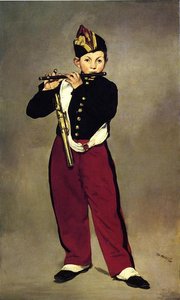
  76. The Fifer by Édouard Manet, 1866, Musée d'Orsay
    76

    Édouard ManetContemporary Realism

    The Fifer

    Musée d'Orsay, Paris1866Oil on canvas161 × 97 cm

    Created in 1866, The Fifer by Édouard Manet presents a singular presence on a large scale. It was deeply informed by a 1865 visit to the Museo del Prado in Spain, where the artist encountered the works of Diego Velázquez.

    Its story

  77. Man with a Hoe by Jean-François Millet, 1862, Getty Center
    77

    Getty Center, Los Angeles1862Oil on canvas80 × 99 cm

    The composition of "Man With A Hoe" is both balanced and dynamic. "Man With A Hoe" has had a lasting influence on art and literature. It inspired Edwin Markham's 1898 poem " The Man With the Hoe," which became a symbol of labor exploitation and social reform.

    The singular detailsolitary figure engaged in manual laborearthy and muted color palette

    Its story

  78. El Popocatépetl y el Iztaccíhuatl by José María Velasco, 1895, Národní Galerie v Praze
    78

    Národní Galerie v Praze, Prague1895Oil on canvas45 × 60 cm

    The oil on canvas titled El Popocatépetl y el Iztaccíhuatl captures a specific moment of geological stillness. Created in 1895, the work measures 45 x 60 cm. José María Velasco placed these two volcanic peaks within a frame of light and shadow, anchoring the landscape in the physical reality of the Mexican terrain.

    Its story

  79. Tunas (Still Life with Prickly Pear Fruit) by Frida Kahlo
    79

    Oil on canvas

    While best known for her Surrealist -leaning self-portraits, Tunas demonstrates Kahlo’s versatility and grounding in earlier artistic traditions. The style leans towards early 20th-century realism, yet possesses a distinct flattening of perspective characteristic of Mexican folk art. Kahlo frequently incorporated elements of her Mexican heritage into her work, and this still life is no exception.

    The singular detailpearred apple

    Its story

  80. Brigid Polk by Gerhard Richter, 1971
    80

    Gerhard RichterContemporary Realism

    Brigid Polk

    1971Painting100 × 125 cm

    Acrylic pigment on canvas Surface treatment: Layered and sanded for a smooth, matte finish Visual effect: Mimicry of photographic halftone patterns Color palette: Muted, desaturated tones Created in 1971, this piece emerged during a period of significant transition in post-war Germany.

    Its story

  81. Loch Coruisk, Isle of Skye by Sidney Richard Percy, 1874
    81

    1874Oil on canvas116 × 182 cm

    The painting presents a majestic scene with a lake in the foreground, surrounded by towering mountains. A herd of cows stands near the water's edge, adding a sense of tranquility and life to the landscape. 'CITE> Sidney Richard Percy's work is notable for its attention to detail and ability to capture the essence of natural landscapes. For more information on art museums, visit Serpukhov Historical and Art Museum (Serpukhov, Russia).

    Its story

  82. A Little Piece of Yorkshire by David Hockney, Neue Sammlung Munich
    82

    Neue Sammlung MunichOil

    The composition is anchored by three large trees in the foreground, creating a rhythmic structure across the landscape. Using broad, gestural strokes and a vibrant palette of yellows and oranges, Hockney simplifies forms to capture the essence of light and movement.

    Its story

  83. The Last Muster by Hubert von Herkomer, 1875, Lady Lever Art Gallery
    83

    Lady Lever Art Gallery, Ліверпуль1875Oil on canvas

    The arrival of this work at the Royal Academy in 1875 creates an immediate sensation. In Hard Times (1885), a struggling family faces the harshness of their circumstances, a theme that echoes the quiet dignity found in his depictions of the working class.

    Its story

  84. Portrait of a Young Girl by Bertha Wegmann, 1890
    84

    1890Oil on canvas

    The work is a portrait of a young girl, rendered with the meticulous detail characteristic of the artist's approach to her subjects. Wegmann, a prominent figure in the Danish Realism movement, was born in Soglio, Switzerland.

    Its story

  85. Young woman reading by a window by Delphin Enjolras
    85

    Oil on canvas

    The composition utilizes this light to establish a sense of warmth and domestic stillness. The arrangement of these elements emphasizes a sense of peace and the simple pleasure of a private moment.

    Its story

  86. Office at Night by Edward Hopper, 1940
    86

    Edward HopperContemporary Realism

    Office at Night

    1940Oil on canvas56 × 64 cm

    The composition features a woman standing by a filing cabinet on the left side and a man seated at a desk working on the right. Created in 1940, "Office at Night" reflects the social and professional dynamics of the time.

    The singular detailmuted color palette with a striking blue dresstypewriter in the foreground

    Its story

  87. Boyarynya Morozova by Vasily Surikov, 1887, Tretyakov Gallery
    87

    Tretyakov Gallery, Moscow1887Oil on canvas304 × 587 cm

    Surikov drew upon the grit of his childhood in Siberia to render this historical drama. The work is an oil on canvas of immense scale, measuring 304 cm in height and 587.5 cm in width. The paint holds the chill of the Russian winter within its very grain.

    Its story

  88. Bouquet of violets by Édouard Manet, 1872
    88

    1872Oil on canvas27 × 22 cm

    The artist, Édouard Manet, produced this work during a period of significant transition in French art. In 1861, he produced The Spanish Singer, a work featuring a model in Andalusian costume holding a guitar. A Bar at the Folies-Bergère, completed in 1882, captures the psychological ambiguity of a Parisian café.

    Its story

  89. La Plena by Rafael Tufiño Figueroa, 1952–1954, Museo de Arte de Puerto Rico
    89

    Museo de Arte de Puerto Rico, San Juan1952–1954Mural

    In this work, titled La Plena, Rafael Tufiño Figueroa captures a specific moment of Puerto Rican musical expression. The piece was created about 1952–1954. The subject matter of La Plena is rooted in the twelve Puerto Rican plenas composed by Manuel Jiménez "Canario".

    Its story

  90. Mother by Aleksandr Deyneka, 1932
    90

    Aleksandr DeynekaSocialist Realism

    Mother

    1932Oil on canvas120 × 159 cm

    A woman holds a child against her chest. The baby is a small weight, a soft presence pressed into the center of the frame.

    Its story

  91. El Comanche David, Talpa, NM by Miguel a Gandert, 1996
    91

    1996Silver gelatin print41 × 51 cm

    In this black and white photograph, titled El Comanche David, Talpa, NM, the artist Miguel A Gandert captures a singular moment of cultural expression. The image focuses on a man dressed in traditional Native American clothing, positioned against a landscape of snow. Created about 1996, this work by Miguel A Gandert offers a direct look at the traditions of the genízaro people. To understand the breadth of Gandert's documentation of the Rio Grande corridor, one might look toward his comprehensive work, Nuevo México Profundo (2000).

    Its story

  92. Orbea Hermanos Model 1884 Military Revolver by Fábrica Orbea Hermanos, 1884, Museum of the Civil Guard
    92

    Museum of the Civil Guard, Madrid1884Painting

    The Orbea Hermanos Model 1884 Military Revolver is a precise instrument of steel and wood. Created by Fábrica Orbea Hermanos, this piece dates to about 1884. Inside the museum, the image of the Orbea Hermanos Model 1884 Military Revolver finds its place among a collection of weaponry and uniforms.

    Its story

  93. Peasant Family by Pavel Filonov, 1910, State Russian Museum
    93

    Pavel FilonovAnalytical Realism

    Peasant Family

    State Russian Museum, Saint Petersburg1910Oil on canvas159 × 128 cm

    Filonov was a key figure in developing “Analytical Realism,” a style he termed "anti- Cubism." Unlike the fragmented geometric forms of Cubism, Analytical Realism sought to represent an object's inner essence – its ‘soul’ – through meticulous detail and layered construction.

    The singular detailvibrant color palettedense composition

    Its story

  94. Español Desnudo masculino by Alfredo Valenzuela Puelma, 1890
    94

    1890Oil

    A man sits prominently in the foreground, his legs crossed in a posture of relaxed contemplation. This creates an intimacy that feels unforced and private.

    Its story

  95. The Death of Marat by Jacques-Louis David, 1793, Louvre
    95

    Louvre, Paris1793Oil on canvas

    David, then at the height of his Neoclassical powers, deliberately eschewed the opulent grandeur favored by earlier generations, opting instead for a stark, almost journalistic depiction that immediately confronts the viewer with the horror of Marat’s demise. The Death of Marat remains one of David’s most celebrated works and a cornerstone of Western art history.

    The singular detailclose-up scene

    Its story

  96. A passing glance by Thomas Pollock Anshutz
    96

    Oil paints on canvas

    This arrangement creates a dual presence, capturing a fleeting instance of self-reflection through the mirrored image. The subject's gaze suggests a sense of contemplation or melancholy. The work is reminiscent of late 19th and early 20th-century American Impressionism or Realism.

    Its story

  97. Ema by Gerhard Richter, 1992
    97

    Gerhard RichterContemporary Realism

    Ema

    1992Oil on canvas153 × 227 cm

    This work is a portrait of her, captured in a moment of quiet movement. This choice establishes a direct, intimate connection between the observer and the subject, grounding the work in a private reality. The artist first produced the oil painting in 1966.

    Its story

  98. Sleeping Nude Woman by Gustave Courbet, 1862
    98

    Gustave CourbetContemporary Realism

    Sleeping Nude Woman

    1862Oil on canvas75 × 97 cm

    Rejecting the polished surfaces and theatrical compositions favored by Romantic artists like Delacroix, he embraced a gritty realism achieved through meticulous observation and painstaking brushwork. The artistic landscape of France in the mid-1860s was dominated by the Académie des Beaux-Arts, which rigidly enforced stylistic rules and prioritized classical ideals.

    Its story

  99. The Bellelli Family by Edgar Degas, 1858–1867, Musée d'Orsay
    99

    Edgar DegasImpressionist Realism

    The Bellelli Family

    Musée d'Orsay, Paris1858–1867Oil on canvas200 × 253 cm

    It is not simply a record of faces, but a psychological landscape where every gaze and posture whispers of unspoken tensions and deep-seated emotions. At the heart of the scene stands Laura Bellelli, her presence commanding yet vulnerable.

    Its story

  100. Old Women or Time by Francisco Goya, 1810
    100

    1810Oil on canvas181 × 125 cm

    The figures, rendered in Goya’s signature somber palette of browns, greys, and muted blues, are bathed in an almost theatrical gloom, suggesting a space perpetually caught between light and shadow. "Old Women or Time" was painted during a period of immense social and political upheaval in Spain.

    The singular detaileerie atmosphere

    Its story

Lineages

The famous Realism paintings by lineage

Where they live

The one place you can see each famous Realism painting

Paris keeps 14 of these originals; the Musée d'Orsay, 11.

Art Institute of Chicago1

Staatliche Kunstsammlungen Dresden1

The masters

The Realism masters our artists look to

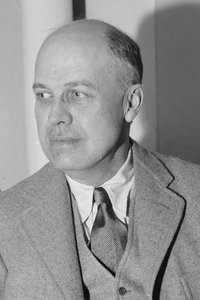
Portrait of Edward Hopper

Edward Hopper

1882–1967 · United States of America · 10

American realist of urban isolation and evocative light, capturing the quietude of a late-night diner or a solitary roadside gas station.

2. Nighthawks, 12. Gas, 16. Automat, 19. Sunday, 25. People in the Sun, 41. Sunlight in a Cafeteria, 50. Summertime, 58. New York Movie, 69. Chop Suey, 86. Office at Night

Portrait of Gustave Courbet

Gustave Courbet

1819–1877 · France · 8

French Realist known for thick impasto and unvarnished depictions of manual labor and nature, from stone breakers to rugged landscapes.

1. The Origin of the World, 18. The Stone Breakers, 26. A Burial at Ornans, 33. Woman with a Parrot, 42. The Painter's Studio, 49. The Sleepers, 75. The Desperate Man, 98. Sleeping Nude Woman

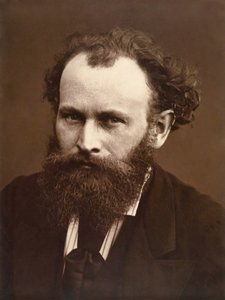
Portrait of Édouard Manet

Édouard Manet

1832–1883 · France · 5

French modernist painter of Parisian café scenes and bold, direct brushwork who bridged the gap between Realism and Impressionism.

4. Olympia, 43. The Balcony, 53. The Execution of the Emperor Maximillian, 76. The Fifer, 88. Bouquet of violets

Portrait of Ilya Repin

Ilya Repin

1844–1930 · Ukraine · 4

Russian Realist known for psychological depth and powerful depictions of the human condition, from barge haulers to defiant Cossacks.

3. The Reply of the Zaporozhian Cossacks to Sultan Mahmoud IV, 9. Barge Haulers on the Volga, 14. Ivan the Terrible and His Son Ivan on November 16, 39. Unexpected Return.

Portrait of Jean-François Millet

Jean-François Millet

1814–1875 · France · 4

French Realist of the Barbizon school who captured the heavy, sculptural toil of peasants through earthy tones and monumental forms.

10. The Gleaners, 13. The Angelus, 29. Harvesters Resting, 77. Man with a Hoe

Portrait of William-Adolphe Bouguereau

William-Adolphe Bouguereau

1825–1905 · France · 4

French academic realist known for luminous skin tones and idealized mythological figures, rendered with meticulous anatomical precision.

24. Dante and Virgil, 34. Nymphes et satyre, 54. Christ Meeting His Mother on the Way to Calvary, 65. The Wave

Portrait of Ivan Shishkin

Ivan Shishkin

1831–1898 · Russia · 3

Russian realist painter of detailed forests and vast landscapes, known for precise textures and the play of light through towering pines.

20. Morning in a Pine Forest, 62. Oak Grove, 67. Twilight

+53more masters our artists study Realism Masters Their stories

In confidence

About these Realism paintings

Hover gently over a question to read the answer.

Who is the most important Realism painter?

Judged by this ranking, Edward Hopper: 10 of the 100 most famous Realism paintings are from this painter's hand, including Nighthawks, Gas and Automat.

How is this ranking made?

By recognition: Wikipedia articles in the most languages (Wikidata sitelinks), our manual ranking and page visits. Several records of one painting count once; details, copies and studies are excluded.

How the selection is made

We went through every Realism painting in our catalogue and placed the best-known first: those Wikipedia describes in the most languages, those our artists and curators rank highest and those most viewed on our pages. Each original appears once — no details or copies.

Other movements that inspire us

The periods that inspire us