Inspiration · Rococo

The 100 Famous Rococo Paintings That Inspire Our Artists

1711 – 1803

Jean-Honoré Fragonard's The Swing (1767, Wallace Collection), Thomas Gainsborough's The Blue Boy (Jonathan Buttall) (1770, Henry E. Huntington Library) and Jean-Antoine Watteau's Embarkation for Cythera (1717, The Louvre): these are the most famous Rococo paintings. Below, all 100 of them — painted from 1711 to 1803 by 41 artists — with their date, their size and the museum that keeps them.

The Swing by Jean-Honoré Fragonard, 1767, Wallace Collection — famous Rococo painting
No. 1 · Jean-Honoré FragonardThe Swing1767 · Wallace Collection, London
100singular works
41masters · Donato Creti – Élisabeth Louise Vigée Le Brun
38homes in 23 cities
12kept at the The Louvre

Singular works

100 Rococo paintings that exist only once

Every original here is unique and kept in one place. Its story, its home, and the detail that makes it unmistakable.

  1. The Swing by Jean-Honoré Fragonard, 1767, Wallace Collection
    1

    Wallace Collection, London1767Oil on canvas81 × 64 cm

    At its heart, the painting portrays a young woman on a swing, her pale pink gown billowing around her as she playfully kicks off a shoe. The Rococo style, with its emphasis on frivolity, would soon fall out of favor as revolutionary fervor swept across France.

    The singular detaillush gardenplayful elegance

    Its story

  2. The Blue Boy (Jonathan Buttall) by Thomas Gainsborough, 1770, Henry E. Huntington Library
    2

    Henry E. Huntington Library, San Marino1770Oil on canvas177.8 × 112.1 cm

    The subject is believed to be Jonathan Buttall, though recent scholarship suggests it may be Gainsborough’s nephew, Gainsborough Dupont. This painterly approach, characteristic of the Rococo and early Romantic periods, prioritizes capturing mood and character over precise detail.

    The singular detaildramatic landscape backgroundatmospheric quality

    Its story

  3. Embarkation for Cythera by Jean-Antoine Watteau, 1717, The Louvre
    3

    The Louvre, Paris1717Oil on canvas129 × 194 cm

    The artwork depicts a lively scene of aristocratic revelry set against a pastoral landscape. Watteau's distinctive Rococo style is characterized by its lightheartedness, decorative detail, and emphasis on color and movement. This genre celebrated the carefree and pleasure-seeking lifestyle of the French aristocracy following the death of Louis XIV.

    The singular detailgolden boathazy landscape

    Its story

  4. A Young Girl Reading by Jean-Honoré Fragonard, 1769, National Gallery of Art
    4

    National Gallery of Art, Washington1769Oil on canvas105 × 90 cm

    Whether placed in a sunlit library or a sophisticated study, Young Girl Reading acts as a window into a bygone era of elegance and contemplation.

    Its story

  5. Gilles by Jean-Antoine Watteau, 1719, The Louvre
    5

    The Louvre, Paris1719Oil on canvas (presumed)185 × 150 cm

    Watteau revolutionized French painting with his invention of the fête galante – a genre depicting elegant outdoor gatherings infused with a sense of playful romance and gentle melancholy. This painting reflects the aristocratic tastes of early 18th-century France, where leisure, refinement, and subtle emotional expression were highly valued.

    The singular detailpierrot costumedonkey

    Its story

  6. Pierrot by Jean-Antoine Watteau, 1718
    6

    1718Oil on canvas184 × 149 cm

    Initial struggles within Parisian artistic circles fueled his determination, shaping his distinctive style and thematic concerns. Despite facing rejection from established institutions like Académie Royale de peinture et de sculpture, Watteau persevered, driven by an unwavering belief in his artistic vision.

    Its story

  7. Mr. and Mrs. Andrews by Thomas Gainsborough, 1748, National Gallery
    7

    National Gallery, London1748Oil on canvas70 × 119 cm

    Thomas Gainsborough painted Mr and Mrs Andrews in 1748. This oil on canvas captures Robert Andrews and his wife Frances. The work functions as a triple portrait, documenting Robert Andrews, Frances Andrews, and the vast expanse of their land.

    The singular detailriflelandscape

    Its story

  8. An Experiment on a Bird in the Air Pump by Joseph Wright of Derby
    8

    Oil on canvas

    This painting exemplifies Joseph Wright of Derby’s signature use of chiaroscuro, a technique that emphasizes dramatic contrasts between light and dark. The scene references real experiments conducted with Robert Boyle’s air pump, symbolizing human ingenuity and the quest to understand the natural world.

    The singular detailchiaroscurodramatic lighting

    Its story

  9. Miss Bowles by Joshua Reynolds, 1775
    9

    1775Oil on canvas91 × 70 cm

    This work is a significant example of the Grand Style, a method that sought to move portraiture beyond simple likeness toward a more idealized representation of character. The painting reflects the social and intellectual currents of 18th-century Britain, where the depiction of childhood began to incorporate themes of innocence and domestic tranquility.

    Its story

  10. The Young Schoolmistress by Jean-Baptiste-Siméon Chardin, 1740, National Gallery
    10

    National Gallery, London1740Oil on canvas66 × 61 cm

    The scene exudes tenderness and focus, emphasizing the importance of nurturing relationships and the transmission of knowledge. The figures are centrally positioned, creating a harmonious interaction that draws viewers into their shared moment of concentration and trust.

    The singular detailsubtle color variationssoft lighting

    Its story

  11. Portrait of Jean-Jacques Rousseau by Maurice Quentin de La Tour, 1753, Musée d'Art et d'Histoire
    11

    Musée d'Art et d'Histoire, Женева1753Pastel47 × 38 cm

    Measuring a modest 47 x 38 cm, this work – currently residing within the esteemed Musée d'Art et d'Histoire in Geneva – possesses an intimacy that draws the viewer into the thoughtful gaze of its subject. De La Tour, a master of Rococo portraiture, expertly employs pastel to achieve a remarkable softness and luminosity, qualities perfectly suited to capturing the nuances of Rousseau’s character. A Portrait of an Icon: The commission itself speaks volumes about Rousseau’s standing at the time.

    The singular detailattiresmiling subject

    Its story

  12. Song of the Angels by François Boucher
    12

    Oil on canvas

    Around them, a choir of heavenly beings gathers to perform. One angel rests on the left, another occupies the middle, while two more flank the right side.

    Its story

  13. The Stolen Kiss by Jean-Honoré Fragonard, 1787, Hermitage Museum
    13

    Hermitage Museum, Saint Petersburg1787Oil on canvas45 × 55 cm

    The composition itself is a carefully orchestrated dance of light and shadow, drawing the viewer into the heart of the narrative. The painting reflects the Rococo’s emphasis on beauty, love, and leisure – values that were highly prized within the French aristocracy.

    The singular detailflirtationrococo style

    Its story

  14. Pierrot Content by Jean-Antoine Watteau, 1712, Thyssen-Bornemisza Museum
    14

    Thyssen-Bornemisza Museum, Madrid1712Oil on canvas35 × 31 cm

    A gentleman, a lady, two actors, and Pierrot himself sit amidst the greenery, their presence anchored by a dining table and scattered chairs. Powdered wigs and richly embroidered jackets catch the light, blurring the line between a private gathering and a staged performance.

    Its story

  15. Party of Four by Jean-Antoine Watteau, 1713, Fine Arts Museums of San Francisco
    15

    Fine Arts Museums of San Francisco1713Oil on canvas

    Interestingly, the year 1713 was also significant as the year the Merchant’s House Museum was built in Paris, showcasing the architectural advancements and cultural flourishing of the era. George Romney’s “Percivall Pott (1713–1788),” for example, demonstrates a similar attention to detail and character portrayal, reflecting Watteau’s emphasis on capturing the essence of human interaction.

    The singular detailguitarred dress

    Its story

  16. The Setting of the Sun by François Boucher, 1752, Wallace Collection
    16

    Wallace Collection, London1752Oil on canvas318 × 261 cm

    Boucher was a pivotal figure in the Rococo movement, and “The Setting of the Sun” exemplifies its key characteristics. At its core, “The Setting of the Sun” tells a story rooted in Greek mythology. Boucher's work was highly sought after by the aristocracy, who commissioned him to create lavish decorations for their palaces and estates.

    The singular detailmythological scene

    Its story

  17. The Chocolate Girl by Jean-Étienne Liotard, 1744, Gemäldegalerie
    17

    Gemäldegalerie, Dresden1744Unknown (likely pastel)82 × 52 cm

    To stand before Jean-Étienne Liotard's The Chocolate Girl is to step directly into the luminous, delicate atmosphere of mid-eighteenth-century Parisian society. Dating to 1744, this painting situates itself squarely within the vibrant cultural milieu preceding the grand shifts of Neoclassicism.

    Its story

  18. The Love Lesson by Jean-Antoine Watteau, 1715–1717, Nationalmuseum
    18

    Nationalmuseum, Stockholm1715–1717Oil on panel610 × 440 cm

    The scene is filled with life as a man plays a Spanish guitar, while one of the girls breaks off roses and strews petals over the group. “The Love Lesson” exemplifies this style, showcasing Watteau’s ability to capture the essence of a carefree moment in time. 610 x 440 cm Date: 1717

    Its story

  19. The Rape of Europa by François Boucher, 1747, The Louvre
    19

    The Louvre, Paris1747Oil on canvas160 × 193 cm

    As the viewer's eye wanders through the composition, one feels the palpable tension between divine will and human vulnerability. The painting breathes with the soft, blended strokes characteristic of the 18th-century French style, creating an atmosphere that feels almost ethereal.

    Its story

  20. Man in a Green Coat Holding a Hare with Four Hounds at His Feet by George Smith
    20

    Oil

    At his feet, four hounds wait in a state of quiet anticipation. The scene is set within a dense thicket of trees and foliage, where deep greens and earthy browns create a sense of shadowed depth.

    Its story

  21. GALERIE de VUES de LA ROME MODERNE by Giovanni Paolo Panini, 1759, The Louvre
    21

    The Louvre, Paris1759Oil on canvas

    Completed in 1759, this piece represents a specific moment in the artist's career when his command of perspective and architectural illusion reached a high point of refinement. This particular composition was commissioned by Claude-François de Montboissier de Canillac de Beaufort, who served as the chargé d'affaires of the embassy of France to the Holy See. Ancient Rome (1757) Modern Rome (1757) Gallery of Views of Ancient Rome (1758) This work emerged from a period of intense cultural exchange between France and Italy.

    Its story

  22. The French Comedy by Jean-Antoine Watteau, 1716, Staatliche Museen zu Berlin
    22

    Staatliche Museen zu Berlin1716Oil on canvas37 × 48 cm

    “The French Comedy” emerged during a period of opulent extravagance in Louis XIV’s France – specifically, the reign of Versailles.

    Its story

  23. The Apotheosis of Hercules by François Lemoyne, 1736, Château de Versailles
    23

    Château de Versailles1736Oil

    Characteristic of the Rococo movement, Lemoyne’s work abandons the austere formality of Neoclassicism for exuberant ornamentation and dynamic movement. "The Apotheosis of Hercules" overwhelms the viewer with its sheer scale and dazzling color palette —primarily warm hues of gold, crimson, and cream.

    Its story

  24. Lady and Gentleman by Nicolas Lancret, 1742, National Gallery
    24

    National Gallery, London1742Oil on canvas89 × 98 cm

    Lancret’s signature style is immediately apparent: a delicate dance of light, color, and movement. At first glance, “Lady and Gentleman with Two Girls and a Servant” appears to be a straightforward depiction of a wealthy family enjoying an afternoon in their garden.

    The singular detailfamily scenegarden

    Its story

  25. The Swing by Jean-Honoré Fragonard, 1777, The Louvre
    25

    The Louvre, Paris1777Oil on canvas73 × 93 cm

    In the quiet, dimly lit chambers of 18th-century France, certain moments were meant to remain unseen, yet Jean-Honoré Fragonard possessed the singular ability to pull back the velvet curtain. Fragonard employs his signature Rococo technique, characterized by soft, feathery strokes and a palette of ethereal creams, blush pinks, and deep, moody shadows.

    Its story

  26. Diana getting out of her bath by François Boucher, 1742
    26

    1742Oil on canvas56 × 73 cm

    The work centers on the Roman goddess Diana, portrayed in a state of nudity. The mythological subject focuses on the private moment of the goddess. In Venus Consoling Love, he further developed this visual language, emphasizing the playful and sensual atmosphere characteristic of his mid-century commissions.

    Its story

  27. The Pleasures of LIfe by Jean-Antoine Watteau, 1716, Wallace Collection
    27

    Wallace Collection, London1716Oil on canvas65 × 93 cm

    Measuring 65 x 93 cm and currently residing at the Wallace Collection in London, this oil on canvas work captures a quintessential scene from aristocratic leisure: a gentleman serenading his companion with a lute amidst a beautifully appointed courtyard.

    Its story

  28. The Declaration of Love by François de Troy, 1724, Metropolitan Museum of Art
    28

    Metropolitan Museum of Art, New York1724Oil on canvas65 × 53 cm

    As the soft illumination falls upon the scene, it highlights the man kneeling beside the seated woman, creating a sense of intimacy that feels both private and performative.

    Its story

  29. The Education of Dionysus by Sebastiano Conca, 1730
    29

    1730Oil on canvas78 × 64 cm

    The painting, which dates to about 1730, exists today within the collection of the Brighton & Hove Museums. The scale of his vision expands into the architecture of the sacred, seen in the 1727 fresco detail of the Glory of St Cecilia.

    Its story

  30. Susan Murrill (1717–1794), Mrs Henry Hill by Thomas Gainsborough, 1750, New York Historical Society
    30

    New York Historical Society, New York City1750Oil75 × 62 cm

    The sitter, Susan Murrill, is presented in a moment of quiet composure. A yellow ribbon encircles her neck, providing a sharp point of color against the cool tones of her attire, while a pearl choker adds a subtle luster to her throat.

    Its story

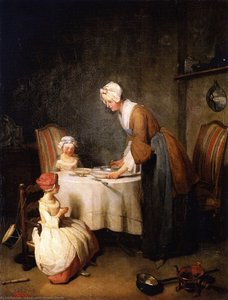
  31. Saying Grace by Jean-Baptiste-Siméon Chardin, 1740, The Louvre
    31

    The Louvre, Paris1740Oil on canvas49.5 × 38.5 cm

    Considering Chardin's background as a cabinetmaker, it’s not surprising that he possessed an innate understanding of form and material, translating this knowledge into his art with remarkable sensitivity.

    The singular detailfamily sceneprayer

    Its story

  32. Mademoiselle Puvigné by Maurice Quentin de La Tour
    32

    Pastel

    The portrait of Mademoiselle Puvigné is a delicate pastel work by the French artist Maurice Quentin de La Tour. The subject is identified as Mlle Puvigny, captured in a moment of quiet presence. The work is held within the Musée Antoine Lécuyer de Saint-Quentin.

    Its story

  33. Portrait of Louis XV of France and Maria Anna Victoria of Spain by François de Troy, 1723
    33

    1723Oil on canvas195 × 129 cm

    Every detail, from the heavy folds of the garments to the placement of the furniture, contributes to the formal atmosphere of this moment captured in 1723.

    Its story

  34. The Love Letter by François Boucher, 1750, National Gallery of Art
    34

    National Gallery of Art, Washington1750Oil on canvas81 × 75 cm

    The painting captures a moment of quiet intimacy within a verdant forest setting, depicting two young women seated on the ground, lost in conversation amidst scattered sheep, creating an atmosphere of serene beauty and subtle intrigue. The painting's creation was intrinsically linked to the patronage of Madame de Pompadour, Louis XV’s influential mistress.

    The singular detailpastoral scene

    Its story

  35. The Grand Cascade at Tivoli by Jean-Honoré Fragonard, 1775
    35

    1775Oil on wood

    The artwork titled The Grand Cascade at Tivoli is a painting by the artist Jean-Honoré Fragonard. This work, which depicts a Roman landscape, was executed in 1775. The composition focuses on a water cascade set within a landscape containing classical architectural elements and lush greenery. Jean-Honoré Fragonard produced this piece during the late eighteenth century.

    Its story

  36. Jupiter and Danae by Giovanni Battista Tiepolo, 1736
    36

    1736Oil on canvas41 × 53 cm

    Every element, from the architectural hints in the background to the posture of Danae, contributes to a narrative of vulnerability meeting overwhelming power. The painting’s palette, characterized by brilliant highlights and soft, atmospheric tones, possesses a unique ability to transform a space.

    Its story

  37. Head of a Young Girl by Jean-Baptiste Greuze, 1787, Gemäldegalerie
    37

    Gemäldegalerie, Berlin1787Oil paint on canvas

    Head of a Young Girl is an oil portrait by the French artist Jean-Baptiste Greuze. This work is dated about 1750. The subject of the painting is a young girl whose face is characterized by a contemplative expression. This specific work is held at Musée Fabre, Montpellier.

    Its story

  38. Canvassing for Votes by William Hogarth, 1754–1755, Sir John Soane's Museum
    38

    Sir John Soane's Museum1754–1755Oil on canvas

    The painting’s aesthetic is firmly rooted in the Rococo style, a trend popular during Hogarth’s time. The “Humours of an Election” series was a commercial success, demonstrating the public's appetite for works that held authority accountable. The engravings derived from these paintings were widely distributed, spreading Hogarth’s critique far beyond London’s elite circles.

    The singular detailsatirical tactics

    Its story

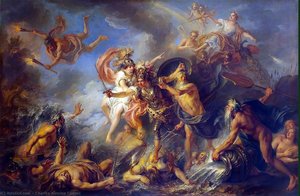
  39. Fury of Achilles by Charles Antoine Coypel, 1737, Hermitage Museum
    39

    Hermitage Museum, Saint Petersburg1737Oil on canvas147 × 195 cm

    At its heart, “Fury of Achilles” is a retelling of Homer's Iliad, specifically focusing on the moment following Patroclus’s death. Achilles, consumed by rage and grief, unleashes his fury upon the Trojan ranks, depicted with brutal realism.

    The singular detaildramatic scenefigures

    Its story

  40. Aeneas Carrying Anchises by Charles-André van Loo, 1729, The Louvre
    40

    The Louvre, Paris1729Oil on canvas110 × 105 cm

    As a leading figure in the Rococo movement, Van Loo’s signature style is immediately recognizable. The act of Aeneas carrying his father represents not only filial devotion but also the burden of leadership and the transmission of legacy.

    The singular detailtrojan hero scene

    Its story

  41. Girl with a book by Pietro Rotari, 1756–1762
    41

    1756–1762Oil on canvas

    The painting titled Girl with a book is a work by the artist Pietro Rotari. It belongs to the period of the artist's career spanning c. 1756 - 1762. The painting moved from the commerce of Berlin to the private sphere of Amsterdam. There, it was acquired in 1921 by Julius Wilhelm Edwin vom Rath, who held the work until his passing in 1940. A final transition occurred in 1941, when the work entered its current home through a bequest from J.W.

    Its story

  42. The Reception before a Wedding by Pietro Longhi
    42

    Oil paint on canvas

    At the center of the composition, a couple is positioned slightly forward, presumably the bride and groom. The arrangement of the figures is dense and theatrical, creating a sense of social intimacy within the room.

    Its story

  43. Fêtes Vénitiennes by Jean-Antoine Watteau, 1718, National Gallery of Scotland
    43

    National Gallery of Scotland, Edinburgh1718Oil on canvas56 × 46 cm

    Jean-Antoine Watteau produced Fêtes Vénitiennes around 1718. The work is a cornerstone of the Rococo style, marking a departure from the formal rigidity of the preceding era. Watteau’s exploration of social gatherings and the fête galante genre is further evidenced by Venetian Pleasure, a work held at the National Gallery of Scotland alongside this piece.

    Its story

  44. Cornard Wood by Thomas Gainsborough, 1748, National Gallery
    44

    National Gallery, London1748Oil on canvas122 × 155 cm

    This sale, which took place between 1789 and 1790, was organized by his nephew, Gainsborough Dupont. Some sources suggest the work dates to about 1740, while other records indicate a date of 1748. The work is part of the permanent collection and was acquired by the institution in 1875 through the Lewis Fund.

    Its story

  45. Young Woman Playing with a Dog by Jean-Honoré Fragonard, 1765, Fondation Cailleux
    45

    Fondation Cailleux, Paris1765Oil on canvas70 × 87 cm

    “Young Woman Playing with a Dog” emerged during a period of opulent artistic patronage within Louis XV’s court at Versailles. WahooArt.com offers exceptional reproductions of Jean-Honoré Fragonard's “Young Woman Playing with a Dog,” meticulously crafted to capture the original artwork’s luminous quality and textural richness.

    Its story

  46. The Suicide of the Countess by William Hogarth, 1743–1745, National Gallery
    46

    National Gallery, London1743–1745Oil on canvas

    The artwork depicts the Countess in her final moments, lying lifeless upon a bed within an opulent room. The scene is laden with symbolic details that reveal the tragic trajectory of her life.

    Its story

  47. Idolatry of Solomon by Sebastiano Conca, 1750, Museo del Prado
    47

    Museo del Prado, Madrid1750Oil on canvas54 × 71 cm

    Born in 1680, he developed a style that bridges the dramatic energy of the Baroque with the lighter, more graceful sensibilities of the Rococo. Conca lived until 1764, leaving behind a legacy of works that navigate the intricate world of religious and allegorical themes.

    Its story

  48. The Gravenor Family by Thomas Gainsborough, 1752, Yale Center for British Art
    48

    Yale Center for British Art, New Haven1752Oil on canvas90 × 90 cm

    The painting depicts the Gravenor family – a father, mother, and three daughters – seated beneath the dappled shade of an ancient tree. Gainsborough's style in The Gravenor Family exemplifies the Rococo tradition, yet with a distinctly English sensibility.

    The singular detailobjectsfamily scene

    Its story

  49. The Young Draughtsman by Jean-Baptiste-Siméon Chardin, 1737, The Louvre
    49

    The Louvre, Paris1737Oil on canvas80 × 65 cm

    Technically, “The Young Draughtsman” is a triumph of the French Rococo and Neoclassical transition. While Chardin’s roots were planted in the formal elegance of the Enlightenment, his heart belonged to the humble and the real.

    Its story

  50. Jupiter and Antiope by Jean-Antoine Watteau, 1715, The Louvre
    50

    The Louvre, Paris1715Oil on canvas73 × 107 cm

    Jean-Antoine Watteau (1684–1721), a luminary of the Rococo movement, irrevocably transformed eighteenth-century painting away from the grandeur of the Baroque towards an ethereal realm of refined pleasure and nuanced emotion.

    Its story

  51. The Toilet of Venus by François Boucher, 1751, Metropolitan Museum of Art
    51

    Metropolitan Museum of Art, New York1751Oil on canvas108 × 85 cm

    In the heart of the eighteenth century, amidst the gilded splendor of the French court, François Boucher captured a moment of pure, unadulterated grace. At the center of this luminous tableau lies Venus, the Roman goddess of love, reclining upon a lavish pink velvet canapé.

    Its story

  52. The Festival of Love by Jean-Antoine Watteau, 1717, Gemäldegalerie
    52

    Gemäldegalerie, Dresden1717Oil on canvas61 × 75 cm

    The presence of Venus and Cupid is particularly significant. “The Festival of Love” is a quintessential example of Rococo art – characterized by its emphasis on lightness, elegance, and sensuality.

    The singular detailhorsecouples

    Its story

  53. The Interrupted Sleep by François Boucher, 1750, Metropolitan Museum of Art
    53

    Metropolitan Museum of Art, New York1750Oil on canvas82 × 75 cm

    The painting measures 82 x 75 cm and features a man and woman in a serene forest setting. For those interested in exploring more works by François Boucher, Angelica and Medoro (67 x 56 cm) is another notable piece.

    Its story

  54. The Souvenir by Jean-Honoré Fragonard, 1775, Wallace Collection
    54

    Wallace Collection, London1775Oil on panel25 × 19 cm

    This era, defined by the reign of Louis XV, championed elegance, frivolity, and a celebration of sensual pleasure. Though the canvas is intimate in scale—measuring just 25 x 19 cm—it possesses a magnetic presence that draws the viewer into a world of shimmering light and airy color.

    Its story

  55. Young Lady of the Le Blond Family by Rosalba Carriera, 1730, Gallerie dell'Accademia di Venezia
    55

    Gallerie dell'Accademia di Venezia, Venice1730Oil34 × 27 cm

    The subject, a young lady with cascades of blonde hair, gazes out from the canvas with an almost knowing serenity. The Rococo style, reflected here, favored grace over grandeur, intimacy over formality.

    Its story

  56. Astronomical Observations. Mars by Donato Creti, 1711
    56

    1711Oil on canvas51 × 35 cm

    These works were intended to advocate for the establishment of an astronomical observatory in Bologna, eventually securing papal support for the cause. The style moves between the theatricality of the Baroque and the more structured, formal restraint of the emerging Neoclassical movement.

    Its story

  57. Count Giacomo Durazzo by Martin van Meytens, 1760, Metropolitan Museum of Art
    57

    Metropolitan Museum of Art, New York1760Oil on canvas229 × 191 cm

    The scene unfolds on a richly appointed bench, bathed in soft light that emphasizes the subjects’ elegant attire and the luxurious textures surrounding them. At the heart of the composition are Count Giacomo Durazzo, a Genoese diplomat deeply embedded in Viennese society, and his wife, Ernestine Aloisia Ungnad von Weissenwolff.

    The singular detailcoupledogs

    Its story

  58. Girl with a Dove by Antoine Pesne, 1754
    58

    1754Oil on canvas55 × 46 cm

    The portrait known as Girl with a Dove emerges from the brush of Antoine Pesne, a creator who captures a quiet moment of stillness. Painted in 1754, this work presents a woman in a moment of calm reflection. This peace is shattered in 1943 when German forces remove the work from the museum.

    Its story

  59. MADAME ROUSSEAU ET SA FILLE by Élisabeth Louise Vigée Le Brun, 1789, The Louvre
    59

    The Louvre, Paris1789Oil on canvas

    Vigée Le Brun achieves remarkable textural depth through meticulous brushwork. This meticulous attention to detail underscores Vigée Le Brun’s commitment to capturing not just appearance but also emotional nuance.

    Its story

  60. The 'Buckingham' on the Stocks at Deptford by John Cleveley the Elder, 1752, National Maritime Museum
    60

    National Maritime Museum, London1752Oil on canvas81 × 119 cm

    It is widely understood that the vessel depicted is the 'Buckingham', a ship that was launched from this very location in 1751. John Cleveley The Elder brings a specific, technical clarity to this scene. To the left, the River Thames flows past the Master Shipwright's house, a structure dating back to 1708.

    Its story

  61. Nativity by Jean Baptiste Marie Pierre
    61

    Oil

    A soft light gathers around the central figures, pulling the eye toward the infant lying amidst the straw. Small details emerge from the gloom: Jean Baptiste Marie Pierre brings a specific French elegance to this religious scene.

    Its story

  62. Harpsichord by Pascal-Joseph Taskin, 1782, Museu Nacional da Música
    62

    Museu Nacional da Música, Lisbon1782Painting

    It was born from a specific royal command, commissioned by King Louis XVI of France. The monarch intended the piece as a gift for his sister, Marie Clotilde. The structure itself holds echoes of an earlier hand, incorporating specific elements from Andreas Ruckers, including a rose and a soundboard dated 1636.

    Its story

  63. Sir Robert Kite (c.1708–1772), Lord Mayor of London by Nathaniel Dance-Holland, Guildhall Art Gallery
    63

    Guildhall Art Gallery, LondonOil on canvas142 × 119 cm

    Created about 1770, the work is the handiwork of the British painter Nathaniel Dance-Holland. The subject is a high-ranking official, identified by his ceremonial robes as the Lord Mayor of London. The oil on canvas resides within the Indianapolis Museum of Art in Indianapolis.

    Its story

  64. Wild boar hunting by Jean-Baptiste Oudry, 1726
    64

    1726Oil painting on canvas

    The oil painting titled Wild boar hunting by Jean-Baptiste Oudry captures a moment of muscular tension. Created in 1726, the work depicts a visceral encounter between the ferocity of a boar and the focused instinct of hunting hounds. The scene centers on this animal struggle, presenting the physical strain inherent in the pursuit.

    Its story

  65. Bacchanal by Charles-Joseph Natoire, Museum of Fine Arts
    65

    Museum of Fine Arts, HoustonOil on canvas81 × 101.3 cm

    The scene known as Bacchanal emerges from the brush of Charles-Joseph Natoire, a painter who breathes life into the myths of old. The artist's hand moves through many different realms, from the grand halls of Paris to the intricate looms of the Manufacture de Beauvais.

    Its story

  66. Moses striking the Rock by Corrado Giaquinto, 1743, National Gallery
    66

    National Gallery, London1743Oil on canvas136.5 × 95 cm

    This specific work belongs to the era of the Italian Rococo, a period defined by a shift toward light and rhythmic movement. Within the walls of a Villa della Regina, he decorated the ceiling with the Story of Aenid, alongside the Death of Adonis and Apollo & Daphne.

    Its story

  67. View of the grand canal towards the rialto bridge from the north by Apollonio Domenichini
    67

    Oil on canvas

    Small figures are situated near the water's edge, including one individual on the left and another toward the right. The painting captures a specific moment in the Venetian Baroque period, focusing on the intersection of permanent stone architecture and the fluid movement of the canal.

    Its story

  68. The Lagoon from the Fondamenta Nuove by Francesco Guardi
    68

    Oil

    Small boats and larger crafts are scattered across the surface, some positioned near the shoreline and others drifting further into the open water. The water reflects the light of the sky, creating a surface of shifting tones. Created during the late 18th century, this work reflects the period of the Venetian School.

    Its story

  69. The Building of Westminster Bridge by Samuel Scott, 1747, Metropolitan Museum of Art
    69

    Metropolitan Museum of Art, New York1747Oil on canvas61 × 113 cm

    The Building of Westminster Bridge is an oil on canvas riverscape painting. The English artist Samuel Scott rendered this scene, documenting the heavy labor required to span the River Thames. Work began in 1738, a slow movement of stone and timber against the tide.

    Its story

  70. The Gore Family with George, 3rd Earl Cowper by Johann Zoffany, 1775, Yale Center for British Art
    70

    Yale Center for British Art, New Haven1775Oil on canvas78.7 × 97.8 cm

    The foreground figures, including Lord Cowper himself, his wife, Lady Henrietta, and their three daughters, are presented in a naturalistic pose, engaged in conversation or observation. However, behind them, occupying a significant portion of the canvas, is a staged scene depicting Hercules battling Envy, a deliberate inclusion that subtly alludes to the family’s circumstances.

    The singular detailconversation piececello

    Its story

  71. Portrait of a Lady in Blue by Thomas Gainsborough, 1779, Hermitage Museum
    71

    Hermitage Museum, Saint Petersburg1779Oil on canvas76 × 64 cm

    The subject herself remains an intriguing mystery – her identity lost to history, she exists as an idealized representation of feminine beauty and status within a rigidly defined societal framework. Gainsborough’s style firmly places “Portrait of a Lady in Blue” within the Rococo tradition, though with a distinctly neoclassical restraint. The influence of Antoine Watteau, a master of pastel landscapes and elegant figures, is evident in the delicate handling of fabrics and the overall sense of grace.

    The singular detailloose brushworkrich texture

    Its story

  72. Madame de Pompadour by François Boucher, 1758, Scottish National Gallery
    72

    Scottish National Gallery, Edinburgh1758Oil on canvas37.9 × 46.3 cm

    The context of this painting is inseparable from the cultural zenith of the Rococo period. Madame de Pompadour herself was a figure synonymous with royal patronage and artistic taste during the reign of Louis XV.

    The singular detailfanpearl bracelet

    Its story

  73. John Murray, 4th Earl of Dunmore by Joshua Reynolds, 1765
    73

    1765Oil on canvas238 × 146 cm

    Its story

  74. The Triumph of Flora by Giovanni Battista Tiepolo, 1743–1744, Fine Arts Museums of San Francisco
    74

    Fine Arts Museums of San Francisco1743–1744Oil on canvas72 × 69 cm

    Created between 1743 and 1744, this piece focuses on the Roman goddess Flora. His earlier compositions include Apollo and Marsyas from 1725, as well as Perseus and Andromeda from 1730. Between 1767 and 1769, he executed The Immaculate Conception.

    Its story

  75. Luncheon Party in a Park by Nicolas Lancret, 1735, Museum of Fine Arts
    75

    Museum of Fine Arts, Boston1735Oil on canvas54 × 46 cm

    During the regency of the Duke of Orleans and the early reign of King Louis XV, the French elite sought art that reflected their values of wit, elegance, and the enjoyment of nature. Lancret, having trained under the lineage of Watteau, was uniquely positioned to capture this zeitgeist.

    Its story

  76. Isabella Teotochi Marini by Élisabeth Louise Vigée Le Brun, 1792
    76

    1792Oil

    The portrait titled Isabella Teotochi Marini was painted in 1792 by the French artist Élisabeth Louise Vigée Le Brun. The subject faces the viewer with a quiet, steady gaze. In this 1792 creation, she focuses on the soft contours of the sitter.

    Its story

  77. HMY 'Royal Caroline' in a Stiff Breeze by John Cleveley the Elder, 1750, National Trust
    77

    National Trust, Greenwich1750Oil on canvas50 × 65 cm

    HMY 'Royal Caroline' in a Stiff Breeze is an oil on canvas painting by John Cleveley The Elder. The artist, a specialist in marine art, utilized his technical background as a shipwright to render the vessel with structural precision. John Cleveley The Elder was born in Southwark, United Kingdom.

    Its story

  78. Self-Portrait Holding a Portrait of Her Sister by Rosalba Carriera, 1715, Galleria degli Uffizi
    78

    Galleria degli Uffizi, Florence1715Oil71 × 57 cm

    To fully appreciate “Self-Portrait Holding a Portrait of Her Sister,” it's crucial to understand Rosalba Carriera’s place within the vibrant artistic milieu of 18th-century Venice. Born in 1675, she emerged from a family of artisans—her mother a lacemaker and her father a lawyer—and initially found success creating miniature portraits on snuffboxes.

    Its story

  79. Pilgrimage to Cythera by Jean-Antoine Watteau, 1717, The Louvre
    79

    The Louvre, Paris1717Oil on canvas129 × 194 cm

    This technique not only captures the textures of flowing fabrics and lush foliage but also imbues the scene with a dreamlike quality that is characteristic of the period. The scene alludes to the ancient Greek myth of Cythera, the birthplace of Venus, goddess of love, symbolizing beauty, desire, and divine influence.

    The singular detailmythological themesallegorical scene

    Its story

  80. Scene in a tavern by William Hogarth, 1735, Sir John Soane's Museum
    80

    William HogarthRococo Decorative Style

    Scene in a tavern

    Sir John Soane's Museum, London1735Oil on canvas62 × 75 cm

    Technically, "Scene in a Tavern" is a triumph of Rococo -influenced realism.

    Its story

  81. Lady Delm and her Children by Joshua Reynolds, 1780
    81

    1780Oil on canvas239 × 147 cm

    Reynolds, a towering figure of the Enlightenment, was celebrated for his command of the Grand Manner—a style rooted in classical ideals yet imbued with palpable naturalism. While the overall feeling echoes the delicate sensibilities sometimes associated with Rococo art through its soft palette and gentle lines, Reynolds anchors it with a classical structure, paying homage to masters like Raphael.

    Its story

  82. Portrait of a Woman by Élisabeth Louise Vigée Le Brun, 1803, National Museum of Women in the Arts
    82

    National Museum of Women in the Arts, Washington, D.C.1803Oil on canvas90.81 × 71.12 cm

    Élisabeth Louise Vigée Le Brun's “Portrait of a Woman, Said to Be Anne Catherine (Aimée) Augier Vestris” is more than simply a likeness; it’s a poignant meditation on beauty, loss, and the fleeting nature of life. Vigée- Le Brun’s mastery is immediately apparent in her use of light.

    The singular detaildark eyesluminous skin

    Its story

  83. The flirtation of the servant by Nicolas Lancret
    83

    Oil on copper

    A man leans toward a seated woman, his posture suggesting a whispered confidence or a playful remark. The scene is framed by the soft light of a window with a grid pattern, which illuminates the figures from the left.

    Its story

  84. Self-Portrait with Pug-Dog by William Hogarth, 1745
    84

    1745Oil paint

    There is an undeniable emotional resonance in the way Hogarth presents himself—not through the grand, sweeping gestures of aristocratic portraiture, but through a grounded, naturalistic presence that feels remarkably modern even centuries later. Every element within the frame has been carefully orchestrated to communicate Hogarth's identity and aspirations.

    Its story

  85. Soap Bubbles by Jean-Baptiste-Siméon Chardin, 1733, National Gallery of Art
    85

    National Gallery of Art, Washington1733Oil on canvas93 × 75 cm

    By 1735, his command of surface and light had matured further, seen in Still Life with Herrings, which highlights his skill in depicting varied surfaces through a combination of delicate glazes and thick, textured paint. In 1739, he produced The Return from Market, a scene capturing the quietude of everyday life.

    Its story

  86. The Fountain of Love by Jean-Honoré Fragonard, 1785, J. Paul Getty Museum
    86

    J. Paul Getty Museum, Los Angeles1785Oil on canvas64 × 52 cm

    Fragonard, a master of capturing fleeting moments of intimacy, employs his signature loose brushwork and delicate pastel hues to create an atmosphere of airy lightness. Painted in the twilight years of Louis XV's reign, the painting reflects the opulent lifestyle and decadent tastes of the French aristocracy.

    The singular detailloversfountain

    Its story

  87. Portrait of Marquise de Pompadour by François Boucher, 1759, Wallace Collection
    87

    Wallace Collection, London1759Oil on canvas91 × 68 cm

    The painting is dated 1759. Through this portrait, François Boucher presents a likeness of the Marquise de Pompadour that reflects her significant standing within the French court. The collection is housed within Hertford House, where the spirit of the 18th century remains palpable through its assembled works.

    Its story

  88. Still Life with Two Rabbits by Jean-Baptiste-Siméon Chardin, 1750
    88

    1750Oil on canvas50 × 57 cm

    Two rabbits lie side by side upon the ground, their forms resting in a state of complete repose. Scattered around these central figures are bananas, some resting near the animals and others placed toward the edges of the frame.

    Its story

  89. Rake's Progress' the Gaming House by William Hogarth, 1735, Sir John Soane's Museum
    89

    Sir John Soane's Museum, London1735Oil on canvas62 × 75 cm

    The scene portrays a lavish gaming room populated by men engaged in gambling activities—a practice considered scandalous and indicative of moral decay by the standards of respectable society. The Enlightenment championed reason and intellectual inquiry, challenging traditional beliefs and prompting discussions about ethical conduct.

    Its story

  90. Pleasures of the Ball by Jean-Antoine Watteau, 1717, Dulwich Picture Gallery
    90

    Dulwich Picture Gallery, London1717Oil on canvas52.5 × 65.2 cm

    As the heavy, dramatic shadows of the Baroque era began to recede, Watteau ushered in an age of lightness, grace, and refined leisure. While the scene celebrates social indulgence, Watteau weaves in reminders of the ephemeral nature of life.

    Its story

  91. Diana and Endymion by Jean-Honoré Fragonard, 1753, National Gallery of Art
    91

    National Gallery of Art, Washington1753Oil on canvas95 × 137 cm

    Fragonard skillfully portrays this pivotal encounter, placing Diana on a mossy rock adorned with blossoms, radiating serene composure as she gazes upon Endymion asleep beneath her watchful gaze.

    Its story

  92. The Attributes of Painting and Sculpture by Jean-Baptiste-Siméon Chardin
    92

    Oil

    This figure rests upon a wooden table alongside several books, including one near the upper left corner, one at the bottom right, and a third toward the center-right. The arrangement also includes two bowls, one positioned near the head and the other further away.

    Its story

  93. Sarah Malcolm in Prison by William Hogarth, 1733
    93

    1733Oil on canvas

    The collision of social classes and the tension of arranged marriages define the series Marriage A-la-Mode, produced between 1743 and 1745. Other compositions from his prolific years include The Painter and his Pug, created in 1745, and The murder of the count, also from 1745.

    Its story

  94. Meeting in the Open Air by Jean-Antoine Watteau, 1719, Staatliche Kunstsammlungen
    94

    Staatliche Kunstsammlungen, Dresden1719Oil on canvas60 × 75 cm

    Measuring 60 x 75 cm, Meeting in the Open Air is executed in oil on canvas —a medium favored by Watteau for its capacity to capture subtle nuances of color and texture.

    Its story

  95. Nude on a Sofa by François Boucher, 1751
    95

    1751

    This particular pose was one of Boucher's favorite themes. This painting (59.5 x 73.5 cm) is Now in the collection of the Wallraf-Richartz Museum, Cologne.

    Its story

  96. Pomeranian Bitch & Pup by Thomas Gainsborough, 1777, Tate Gallery
    96

    Tate Gallery, London1777Oil on canvas111.8 × 83.2 cm

    The painting immediately draws the eye with its harmonious composition. The adult Pomeranian, a creature of fluffy exuberance, dominates the foreground, her posture radiating an almost regal composure. While often categorized as Romantic, “Pomeranian Bitch and Pup” reveals a fascinating interplay with Rococo aesthetics.

    The singular detailsoft colorsdetail

    Its story

  97. The Reception of the French Ambassador in Venice by Canaletto, 1745, Hermitage Museum
    97

    Hermitage Museum, Saint Petersburg1745Oil on canvas181 × 259 cm

    The scene unfolds near a formidable, castle-like structure, where the shimmering waters of a moat reflect the bustling energy of an era defined by ceremony and prestige.

    The singular detailboatsgondola

    Its story

  98. Duchess of Beaufort by Thomas Gainsborough, 1775, The State Hermitage Museum
    98

    The State Hermitage Museum, Russia1775Oil on canvas

    As the viewer's eye meets the subject, there is an immediate sense of warmth and poise that defines Gainsborough’s unique ability to breathe life into his sitters. The Duchess is captured in a moment of quiet splendor, her presence commanding yet gentle, draped in the luxurious textures of her era.

    The singular detaildramatic lightingrich textures

    Its story

  99. Portrait of Denis Diderot by Louis Michel van Loo, 1767, The Louvre
    99

    The Louvre, Paris1767Oil on canvas81 × 65 cm

    The painting immediately draws the eye to Diderot himself. Van Loo’s style is quintessential Rococo —characterized by its graceful lines, delicate colors, and emphasis on luxurious detail. The presence of multiple chairs—one occupied by Diderot, another further back—suggests a space dedicated to intellectual exchange and debate.

    The singular detailbookschair

    Its story

  100. King Lear in the Storm by John Runciman, 1767, Scottish National Gallery
    100

    Scottish National Gallery, Edinburgh1767Oil on panel45 × 61 cm

    The sky is a bruised weight of gray and shadow. This work emerged from a life cut short, a brief flash of intense creativity in the late 18th century.

    Its story

Lineages

The famous Rococo paintings by lineage

Where they live

The one place you can see each famous Rococo painting

London keeps 17 of these originals; the The Louvre, 12.

The masters

The Rococo masters our artists look to

Portrait of François Boucher

François Boucher

1703–1770 · France · 10

French Rococo painter of luminous, pastel mythological scenes and idyllic landscapes, known for his voluptuous and amorous subjects.

12. Song of the Angels, 16. The Setting of the Sun, 19. The Rape of Europa, 26. Diana getting out of her bath, 34. The Love Letter, 51. The Toilet of Venus, 53. The Interrupted Sleep, 72. Madame de Pompadour, 87. Portrait of Marquise de Pompadour, 95. Nude on a Sofa

Portrait of Jean-Honoré Fragonard

Jean-Honoré Fragonard

1732–1806 · France · 9

French Rococo painter of playful, sensual scenes rendered with luminous, rapid brushwork and a sense of exuberant, fleeting movement.

1. The Swing, 4. A Young Girl Reading, 13. The Stolen Kiss, 25. The Swing, 35. The Grand Cascade at Tivoli, 45. Young Woman Playing with a Dog, 54. The Souvenir, 86. The Fountain of Love, 91. Diana and Endymion

Portrait of Thomas Gainsborough

Thomas Gainsborough

1727–1788 · United Kingdom · 8

British Rococo painter of elegant portraits and landscapes, known for fluid brushstrokes and integrating sitters into the English countryside.

2. The Blue Boy (Jonathan Buttall), 7. Mr. and Mrs. Andrews, 30. Susan Murrill (1717–1794), Mrs Henry Hill, 44. Cornard Wood, 48. The Gravenor Family, 71. Portrait of a Lady in Blue, 96. Pomeranian Bitch & Pup, 98. Duchess of Beaufort

Portrait of Jean-Baptiste-Siméon Chardin

Jean-Baptiste-Siméon Chardin

1699–1779 · France · 6

French painter of quiet domestic scenes and still lifes rendered with tactile, granular impasto and a soft diffusion of light.

10. The Young Schoolmistress, 31. Saying Grace, 49. The Young Draughtsman, 85. Soap Bubbles, 88. Still Life with Two Rabbits, 92. The Attributes of Painting and Sculpture

Portrait of William Hogarth

William Hogarth

1697–1764 · United Kingdom · 6

English satirist and engraver of modern moral subjects, using biting narrative series to dissect the social fabric of 18th-century London life.

38. Canvassing for Votes, 46. The Suicide of the Countess, 80. Scene in a tavern, 84. Self-Portrait with Pug-Dog, 89. Rake's Progress' the Gaming House, 93. Sarah Malcolm in Prison

Portrait of Joshua Reynolds

Joshua Reynolds

1723–1792 · United Kingdom · 3

British Neoclassical portraitist and Royal Academy founder who used the Grand Style to idealize subjects with grace and dignity.

9. Miss Bowles, 73. John Murray, 4th Earl of Dunmore, 81. Lady Delm and her Children

+34more masters our artists study Rococo Masters Their stories

In confidence

About these Rococo paintings

Hover gently over a question to read the answer.

Which 10 Rococo paintings should everyone know?

How is this ranking made?

Each painting is ranked by how widely it is known: the number of Wikipedia language editions with an article on it (Wikidata sitelinks), its place in our catalogue's manual ranking and the visits its page receives. The same painting catalogued several times counts once, and details, copies and studies are left out.

How the selection is made

We went through every Rococo painting in our catalogue and placed the best-known first: those Wikipedia describes in the most languages, those our artists and curators rank highest and those most viewed on our pages. Each original appears once — no details or copies.

Other movements that inspire us

The periods that inspire us