


A Corridor of Light and Order
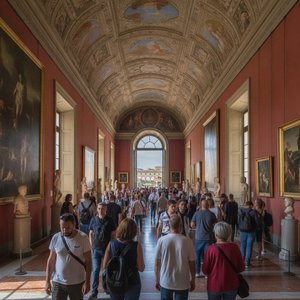
The structure begins with the rhythmic repetition of architectural elements that guide the eye through its long, narrow passages. Designed by Giorgio Vasari, the building originally functioned as administrative offices for Florentine magistrates. The internal courtyard opens toward the Arno River, creating a space where natural light flows freely across Doric columns and delicate arches. This design creates a sense of balanced order. Large windows are placed strategically to ensure that light falls precisely upon the surfaces within the halls.
Walking through the corridors, one notices how the architecture interacts with the surrounding city. The building sits adjacent to the Piazza della Signoria and Palazzo Vecchio, positioned between the historic center and the river. The sweeping internal courtyard acts as a lung for the complex, blurring the boundaries between the interior halls and the exterior atmosphere. The rhythmic repetition of the roof cornices and the continuous steps provides a sense of movement along the length of the gallery.
The Presence of the Medici Legacy
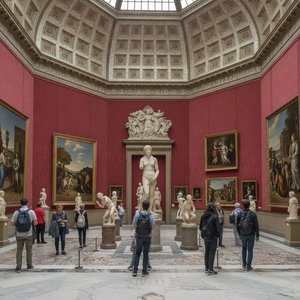
The collection is deeply rooted in the history of the Medici family, whose patronage transformed these offices into a sanctuary for art. Much of the gathered beauty arrived through the ambition of Cosimo I de' Medici and his successors. The halls contain works that trace the evolution of Western creativity from the Middle Ages through the Baroque period. Within these walls, the transition from structured religious imagery to the exploration of human anatomy and emotion is visible in every frame.
Specific works demand a slow, observant gaze. One might find themselves before the following notable pieces:
- The Birth of Venus by Sandro Botticelli, where soft pastel hues and flowing lines depict a goddess emerging from a seashell.
- The Primavera by Sandro Botticelli, an allegory filled with botanical detail and graceful figures.
- Leonardo da Vinci’s chalk drawing, Heads of an Old Man and a Youth, which uses tonal gradation to capture the texture of skin and the weight of expression.
- Andrea Pozzo’s Self-Portrait, a 1690 work that demonstrates a mastery of perspective and light.
- The Tribuna of the Uffizi as depicted by Johan Zoffany, showing the octagonal room designed by Bernardo Buontalenti.
The collection also includes ancient Roman sculptures and copies of lost Greek originals, which populate the corridors alongside later Renaissance paintings. The presence of these works creates a dialogue between different eras of human achievement. The space holds the tension between political power and the pursuit of aesthetic perfection.