
Inspiration · Expressionism

The 100 Famous Expressionism Paintings That Inspire Our Artists

1888 – 1973

Ask for the most famous Expressionism paintings and you will hear of Edvard Munch's The Scream (1893, Nasjonalgalleriet), George Grosz's The Pillars of Society (1926, Staatliche Museen zu Berlin) and Wassily Kandinsky's Composition VII (1913, Tretyakov Gallery). This ranking lists the 100 best-known Expressionism paintings, painted between 1888 and 1973 by 32 artists, with the museum where each one hangs today.

The Scream by Edvard Munch, 1893, Nasjonalgalleriet — famous Expressionism painting
No. 1 · Edvard MunchThe Scream1893 · Nasjonalgalleriet, Oslo
100singular works
32masters · James Ensor – Francis Bacon
52homes in 29 cities
4kept at the Nasjonalgalleriet

Singular works

100 Expressionism paintings that exist only once

Every original here is unique and kept in one place. Its story, its home, and the detail that makes it unmistakable.

  1. The Scream by Edvard Munch, 1893, Nasjonalgalleriet
    1

    Edvard MunchExpressionism

    The Scream

    Nasjonalgalleriet, Oslo1893Oil and tempera91 × 73 cm

    The scene does not attempt to replicate reality with photographic precision; instead, it translates an internal psychological storm onto the canvas. The figure is not emitting a sound, but rather reacting to an overwhelming sensation—a great, infinite scream of nature that Munch himself described in his diary.

    Painted for you from $200 A print, from $58

  2. The Pillars of Society by George Grosz, 1926, Staatliche Museen zu Berlin
    2

    Staatliche Museen zu Berlin1926Oil on canvas108 × 200 cm

    Created during the Weimar Republic, "The Pillars of Society" reflects the social and political unrest of the time. Grosz, a key figure in Berlin Dada and New Objectivity, used his art to critique society, politics, and the rise of fascism.

    The singular detailexaggerated mask-like facesnewspapers and printed materials

    Its story

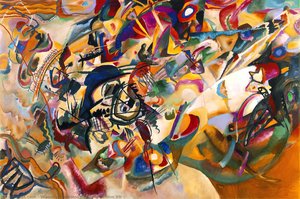
  3. Composition VII by Wassily Kandinsky, 1913, Tretyakov Gallery
    3

    Tretyakov Gallery, Moscow1913Oil on canvas200 × 300 cm

    Influenced by Theosophy, music (particularly Wagner), and a desire to connect art with the spiritual realm, he sought to liberate color and form from their descriptive roles. It foreshadows the complete abandonment of recognizable imagery that would characterize much of 20th-century art.

    The singular detailvibrant colorslayering of forms

    Painted for you from $200 A print, from $58

  4. Woman in a Green Jacket by August Macke, 1913, Museum Ludwig
    4

    Museum Ludwig, Cologne1913Oil on canvas44 × 44 cm

    It reflects Macke's evolving style, influenced by Fauvism and, crucially, his encounter with Robert Delaunay’s Orphic Cubism – a synthesis visible in the painting’s dynamic interplay of shapes and hues. Created just before the outbreak of World War I, this artwork captures a fleeting moment of peace and prosperity in Europe.

    Painted for you from $375 A print, from $58

  5. Madonna by Edvard Munch, 1894, Munch Museum
    5

    Edvard MunchExpressionism

    Madonna

    Munch Museum, Oslo1894Lithograph (implied from description)90 × 68 cm

    Munch eschews traditional artistic conventions, employing swirling lines, distorted forms, and a deliberately jarring color palette to convey inner turmoil. It foreshadows the broader anxieties of the modern age, capturing a sense of existential dread that would become increasingly prevalent in 20th-century art.

    The singular detailthemes of motherhoodloss

    Painted for you from $200 A print, from $58

  6. The Large Blue Horses by Franz Marc, 1911, Walker Art Center
    6

    Franz MarcGerman Expressionism

    The Large Blue Horses

    Walker Art Center, Minneapolis1911Oil on canvas104 × 181 cm

    Marc's use of bright primary colors —deep blues, vivid reds, and lively yellows—creates a harmonious yet dynamic composition. "The Large Blue Horses" is one of Marc's earliest major works featuring animals, a subject that would become central to his oeuvre.

    The singular detaildynamic background with swirling lines and vibrant colorsthick impasto technique creating a textured surface

    Painted for you from $200 A print, from $58

  7. Melancholy (Laura) by Edvard Munch, 1894, Nasjonalgalleriet
    7

    Nasjonalgalleriet, Oslo1894Oil on canvas81 × 101 cm

    The scene depicts a solitary figure seated on a shoreline, lost in contemplation. This individual, positioned prominently on the right side of the canvas, dominates roughly one-third of the space, emphasizing their emotional presence against the vastness of the landscape.

    The singular detaildistorted formssomber color palette

    Painted for you from $200 A print, from $58

  8. The Self-Seers II (Death and Man) by Egon Schiele, 1911, Leopold Museum
    8

    Leopold Museum, Vienna1911Oil on canvas81 × 80 cm

    Painted in 1911, this intensely psychological work by Egon Schiele is a cornerstone of early Expressionism and a powerful meditation on life, death, and the human condition. Schiele's signature style is immediately apparent in this piece: distorted forms, angular lines, and a raw emotional intensity that breaks from traditional representation.

    The singular detaildistorted formssomber colors

    Painted for you from $200 A print, from $58

  9. Three Studies for Figures at the Base of a Crucifixion by Francis Bacon, 1944
    9

    1944Oil on sundeala fibre board

    The three panels present distorted, almost unrecognizable figures set against a searing orange backdrop, creating an atmosphere of claustrophobia and unease. Created during the final years of World War II, this work reflects the pervasive atmosphere of trauma and uncertainty gripping Europe.

    Its story

  10. Reclining Nude with Blue Cushion by Amedeo Modigliani, 1916
    10

    1916Oil on canvas60.1 × 92.1 cm

    Created during a period of radical artistic experimentation in early 20th-century Paris, this painting reflects the influence of both Cubism and Expressionism, yet remains uniquely Modigliani’s own.

    The singular detailblue cushionelongated forms

    Painted for you from $200 A print, from $58

  11. The Bride of the Wind by Oskar Kokoschka, 1914, Kunstmuseum
    11

    Kunstmuseum, Basel1914Oil on canvas180.4 × 220.2 cm

    The figure is rendered with bold, sweeping strokes that suggest both flesh and fabric, seamlessly blending into the turbulent background. Created in 1914, this piece exemplifies the powerful emotional language of Expressionism.

    The singular detailcontrasting color palettelayered textures

    Its story

  12. Four Trees by Egon Schiele, 1917, Austrian Gallery Belvedere
    12

    Egon SchieleExpressionism

    Four Trees

    Austrian Gallery Belvedere, Vienna1917Oil on canvas110 × 141 cm

    Egon Schiele’s influence extends far beyond the confines of Vienna, establishing him as a pivotal figure in modern art —particularly Expressionism. Reproductions of Four Trees offer a glimpse into this extraordinary artistic vision.

    Painted for you from $200 A print, from $58

  13. The Family by Egon Schiele, 1917, Austrian Gallery Belvedere
    13

    Egon SchieleExpressionism

    The Family

    Austrian Gallery Belvedere, Vienna1917Oil on canvas152 × 162 cm

    In The Family, this manifests through jagged, angular lines that seem to vibrate with tension. Schiele was a leading figure in Austrian Expressionism, a movement that prioritized subjective experience over objective reality.

    Painted for you from $250 A print, from $58

  14. Landscape with Yellow Birds by Paul Klee, 1923
    14

    1923Oil painting

    Paul Klee’s Landscape with Yellow Birds is a quintessential example of the artist’s unique blend of expressionism and surrealism. Painted in 1923, this artwork showcases Klee’s innovative approach to color, form, and composition. For a comprehensive understanding of 20th-century Western painting, refer to 20th-Century Western Painting.

    Painted for you from $200 A print, from $58

  15. Child with Dove by Pablo Picasso, 1901, University of Iowa
    15

    University of Iowa1901Oil on canvas73 × 54 cm

    Following the tragic loss of his sister, Conchita, in 1901, Picasso was deeply affected by grief and social injustice. This approach fundamentally altered how artists depicted reality, paving the way for numerous subsequent art movements, including Futurism, Suprematism, and Constructivism.

    The singular detailballdove

    Its story

  16. The Judgement of Paris by Ernst Ludwig Kirchner
    16

    Oil on canvas

    The central figure stands upright, while the other two figures are positioned to the left and right, their bodies intertwined. "The Judgement of Paris" reflects Kirchner's commitment to this vision, capturing the raw emotion and spontaneity that define German Expressionism.

    The singular detailthick, visible brushstrokes and impasto techniquetriangular formation of figures

    Painted for you from $250 A print, from $58

  17. Triptych by Francis Bacon, 1973
    17

    Francis BaconExpressionism

    Triptych

    1973Oil on canvas

    Bacon’s style is immediately recognizable for its raw energy and expressive brushwork. triptych, may -june, 1973 a exemplifies this perfectly. George Dyer's suicide deeply affected the artist, and these works were, as Bacon himself described, an attempt at “exorcism” – a way to confront and process his overwhelming grief and guilt.

    The singular detaildoorways as symbolic transitionsimpasto technique

    Its story

  18. Dance (II) by Henri Matisse, 1910, Hermitage Museum
    18

    Henri MatisseFauvist Expressionism

    Dance (II)

    Hermitage Museum, Saint Petersburg1910Oil on canvas260 × 391 cm

    When one first encounters this work, it is impossible not to be swept up in the rhythmic cadence of the figures. As a leader of the Fauves—the "wild beasts"— Matisse abandoned the subtle tonal gradations and academic precision of his predecessors.

    Painted for you from $200 A print, from $58

  19. Mother with Two Children by Egon Schiele, 1917, Austrian Gallery Belvedere
    19

    Austrian Gallery Belvedere, Vienna1917Oil on canvas150 × 160 cm

    The composition is deceptively simple yet powerfully effective. Painted in 1917, during the height of WWI, Mother with Two Children is deeply rooted in its historical context.

    The singular detailtriangular compositionelongated figures

    Painted for you from $250 A print, from $58

  20. Death and the Masks by James Ensor, 1897, La Boverie
    20

    La Boverie, Liège1897Oil on canvas78.5 × 100 cm

    Created in the late 19th century, this oil on canvas artwork features a group of people with masks on their faces, set against a backdrop of a sky and clouds. The Mu.ZEE museum in Ostend, Belgium, has an extensive collection of James Ensor's works, including Death and the Masks.

    Painted for you from $200 A print, from $58

  21. The White Cat (also known as Tom Cat on Yellow Pillow) by Franz Marc, 1912, Staatliche Galerie Moritzburg
    21

    Staatliche Galerie Moritzburg, Germany1912Oil on panel50 × 60 cm

    Marc’s distinctive style is immediately apparent in The White Cat.

    The singular detailwhite cat reclining on a yellow pillow against a red couch

    Painted for you from $200 A print, from $58

  22. Triptych, May-June 1973 by Francis Bacon, 1973
    22

    1973Oil on canvas

    The year 1973 was pivotal for Bacon. “Triptych, May-June 1973” marks a shift towards greater monumentality in Bacon's style. The painting’s commercial success – it sold for $6.3 million in 1989, setting a record price for a Bacon at the time – underscores its significance within art history.

    Its story

  23. The Iron Bridge (View of Frankfurt) by Max Beckmann, 1922, Kunstsammlung Nordrhein-Westfalen
    23

    Kunstsammlung Nordrhein-Westfalen, Duesseldorf1922Oil on canvas42 × 25 cm

    Beckmann's distinctive style merges detailed realism with bold, expressive brushstrokes, reflecting his unique vision of urban life. Painted in the aftermath of World War I, "The Iron Bridge (View of Frankfurt)" reflects Beckmann's altered vision of humanity and urban life.

    The singular detailsuspension bridge as central focususe of strong diagonal lines for depth and perspective

    Painted for you from $200 A print, from $58

  24. Near the bed of death (fever) by Edvard Munch, 1915, Munch Museum
    24

    Munch Museum, Oslo1915Oil on canvas60 × 80 cm

    Created in 1915, this powerfully emotive painting by Edvard Munch is a cornerstone of Expressionist art, offering a raw and unflinching depiction of grief, mortality, and the psychological weight of loss. It reflects a broader cultural preoccupation with illness, loss, and the fragility of life that permeated early 20th-century Europe.

    The singular detailemotional intensityswirling background

    Painted for you from $250 A print, from $58

  25. Orange and Red on Red by Mark Rothko
    25

    Mark RothkoColor Field Expressionism

    Orange and Red on Red

    Oil on canvas

    However, it was in the late 1940s that Rothko truly found his voice, stripping away representational elements to focus on the expressive power of color. “Orange and Red on Red,” like many of his works, isn’t about precise lines or defined forms; it's about the subtle gradations of color and the emotional weight they carry.

    Its story

  26. Strong Dream by Paul Klee, 1929
    26

    Paul KleeExpressionism

    Strong Dream

    1929Gouache21 × 26 cm

    Key Works by Paul Klee: View onto a Square, 1912 – A foundational work demonstrating Klee’s early experimentation with geometric abstraction. Young Woman in the Armchair, 1913 – A compelling example of Klee’s ability to blend realism with abstract elements.

    Painted for you from $200 A print, from $58

  27. Mujer y perro cara a la luna by Joan Miró, 1936, Museo Nacional Centro de Arte Reina Sofía
    27

    Joan MiróSurrealist Expressionism

    Mujer y perro cara a la luna

    Museo Nacional Centro de Arte Reina Sofía1936Oil on canvas

    A woman’s figure—a recurring motif in Miró's oeuvre—is positioned alongside a dog’s head, which rests upon her shoulder. “Mujer y perro cara a la luna” was executed using oil on canvas —a medium favored by Miró for its ability to capture nuanced tonal variations.

    Its story

  28. Fruit Harvest in a Mountain Orchard by Marianne von Werefkin, 1912, Berlinische Galerie
    28

    Berlinische Galerie1912Oil on panel

    From the outset, young Marianna demonstrated an exceptional aptitude for visual representation, commencing her artistic pursuits at fourteen following a debilitating illness. Influenced by artists like Edvard Munch and Wassily Kandinsky, Werefkin embraced a palette saturated with intense hues—reds, oranges, and yellows—creating canvases that pulsated with palpable emotion.

    Painted for you from $200 A print, from $58

  29. Self-Portrait with Bonito by Frida Kahlo, 1941
    29

    Frida KahloSurrealist Expressionism

    Self-Portrait with Bonito

    1941Oil on canvas

    Kahlo’s style during this period firmly resides within the realm of Surrealism, though she often resisted being strictly categorized. At first glance, ‘Self-Portrait with Bonito’ might appear a straightforward self-representation. Alternatively, exploring resources like the Frida Kahlo Foundation (https://www.fridakahlo.org/) offers invaluable insights into her artistic process and symbolism.

    The singular detailmustachebonito

    Painted for you from $200 A print, from $58

  30. All Saints Day I by Wassily Kandinsky, 1911
    30

    1911Oil paint50 × 64 cm

    This dynamic composition bursts with energy, featuring bold colors, overlapping figures, and symbolic elements that create a sense of movement and celebration. "All Saints Day I" was created during a period of significant artistic exploration for Kandinsky. Experience the transformative power of "All Saints Day I" by Wassily Kandinsky.

    The singular detailoverlapping figuresmusical instruments

    Painted for you from $300 A print, from $58

  31. Portrait of Wally by Egon Schiele, 1912, Leopold Museum
    31

    Leopold Museum, Vienna1912Oil on panel327 × 398 cm

    The subject is Walburga “Wally” Neuzil, Schiele’s lover and frequent muse. Schiele, alongside Gustav Klimt, challenged the conservative norms of the Viennese art establishment.

    Painted for you from $200 A print, from $58

  32. The Dance of Life by Edvard Munch, 1899, Nasjonalgalleriet
    32

    Nasjonalgalleriet, Oslo1899Oil on canvas49 × 75 cm

    The artwork bursts with bold, contrasting colors that create an immediate visual impact. The central figures—a man in dark clothing and a woman in a striking red dress —command attention against a backdrop of muted tones and lush greenery.

    Painted for you from $325 A print, from $58

  33. The Hat Shop by August Macke, 1913, Museum Folkwang
    33

    August MackeExpressionism

    The Hat Shop

    Museum Folkwang, Essen1913Oil on canvas

    It reflects the influence of Fauvism and the emerging German Expressionist movement, emphasizing bold color and emotional resonance. The early 1900s was a time of rapid urbanization and cultural change, and this scene captures the vibrant spirit of modern city life.

    The singular detailbold shapesvibrant colors

    Painted for you from $200 A print, from $58

  34. Figure with Meat by Francis Bacon, 1954, Edwin A. Ulrich Museum
    34

    Edwin A. Ulrich Museum1954Oil on canvas

    The painting’s power lies not in beauty or harmony, but in its raw, unflinching depiction of vulnerability, fear, and the unsettling proximity of life and death.

    The singular detailraw meatwings

    Its story

  35. Grazing Horses IV by Franz Marc, 1911
    35

    Franz MarcGerman Expressionism

    Grazing Horses IV

    1911Oil on canvas121 × 183 cm

    The composition is balanced yet dynamic, with the three horses arranged in a triangular formation. Marc's style is expressive and somewhat abstract, characteristic of the German Expressionist movement. Franz Marc was a key figure in the German Expressionism movement and co-founder of Der Blaue Reiter, an influential artists' group.

    The singular detailbold colorsdynamic composition

    Painted for you from $200 A print, from $58

  36. Forest Painting by Hans Emmenegger, 1936
    36

    1936Oil on canvas61 × 41 cm

    This oil on canvas work presents a specific slice of the natural world, held within a frame measuring 61 x 41 cm. Every inch of the surface carries the weight of the artist's hand, translating a sense of place into a tangible, physical presence.

    Painted for you from $200 A print, from $58

  37. Skeletons Warming Themselves by James Ensor, 1889, Kimbell Art Museum
    37

    James EnsorSymbolist Expressionism

    Skeletons Warming Themselves

    Kimbell Art Museum, Fort Worth1889Oil on canvas74 × 60 cm

    Interestingly, X-radiographs revealed that Skeletons Warming Themselves was created over an earlier painting: a bust-length portrait of a young girl. The decision to rework an existing canvas suggests a period of economic hardship, a common struggle for many artists in late 19th-century Europe.

    The singular detailmasksskeletons

    Painted for you from $200 A print, from $58

  38. The Falling Angel by Marc Chagall, 1947, Kunstmuseum
    38

    Marc ChagallExpressionism/Surrealism

    The Falling Angel

    Kunstmuseum, Basel1947Oil or tempera on canvas148 × 189 cm

    Central to the composition is a fiery, winged figure that appears to be falling or ascending, evoking themes of spiritual conflict, transformation, and divine intervention. The artist, Marc Chagall, was deeply influenced by his Belarusian Jewish heritage, Eastern European folklore, and the tumultuous events of the 20th century.

    The singular detailsymbolic imagerydynamic composition

    Its story

  39. Adrienne (Woman with Bangs) by Amedeo Modigliani, 1917, National Gallery of Art
    39

    National Gallery of Art, Washington1917Oil55.3 × 38.1 cm

    The focus on the upper body and face creates an intimate connection, drawing viewers into her quiet, reflective mood. Modigliani’s distinctive style, blending elements of Cubism and Expressionism, broke away from traditional portraiture, emphasizing mood, personality, and the inner life of his subjects.

    The singular detailstylized featuresbold

    Painted for you from $200 A print, from $58

  40. Legend of the Nile by Paul Klee, 1937, Kunstmuseum Bern
    40

    Kunstmuseum Bern1937Oil on canvas

    Inspired by the legendary Nile, the piece weaves a narrative of water, life, and spirituality through abstract motifs and symbolic forms. Employing a synthesis of Expressionism, Cubism, and Surrealism, Klee's distinctive style is characterized by geometric shapes, fluid lines, and layered textures.

    The singular detailsymbolic motifslayered textures

    Painted for you from $200 A print, from $58

  41. Ashes by Edvard Munch, 1894, National Museum of Art, Architecture and Design
    41

    Edvard MunchExpressionism

    Ashes

    National Museum of Art, Architecture and Design, Oslo1894Oil on canvas120 × 141 cm

    This piece exemplifies Munch's distinctive style, blending elements of Symbolism and Expressionism to create a scene that is both visually striking and emotionally resonant. The painting depicts a mysterious forest scene with two central figures: a standing woman with long red hair and a flowing white dress, and a prone figure lying on the ground. Created in 1894, "Ashes" reflects Munch's preoccupation with themes of love, fear, death, melancholia, and anxiety.

    The singular detailprone figure on the grounddense forest background

    Painted for you from $200 A print, from $58

  42. Military Policeman arresting the spirit by Yannis Tsarouchis, 1965
    42

    1965

    Its story

  43. La tristesse du roi by Henri Matisse, 1907, Musée National d'Art Moderne
    43

    Henri MatisseFauvist Expressionism

    La tristesse du roi

    Musée National d'Art Moderne1907Gouache on paper

    The painting depicts three figures—a man seated with his hands raised, a woman holding an umbrella, and a musician playing a violin—creating a tableau of quiet contemplation amidst a vibrant landscape. “La Tristesse du Roi” emerged during a period of artistic ferment in France—the Fauvist movement spearheaded by Matisse and André Derain.

    Painted for you from $200 A print, from $58

  44. Great Scene of Agony by Max Beckmann, 1906, Bavarian State Painting Collections
    44

    Bavarian State Painting Collections, Munich1906Oil on canvas141 × 131 cm

    A muted palette of browns, ochres, grays, and greens reinforces the somber mood, while touches of blue-green offer only fleeting contrast.

    The singular detailambiguous scenedistorted figures

    Painted for you from $225 A print, from $58

  45. View of Murnau with train and castel by Wassily Kandinsky, 1909, Stadtische Galerie in Lenbach
    45

    Stadtische Galerie in Lenbach, Munich1909Oil36 × 49 cm

    The artwork is a prime example of Expressionism, characterized by its bold colors, fluid shapes, and emotional resonance. Created in 1909, this artwork reflects Kandinsky's transition towards abstraction, a movement he would later pioneer. During this period, Kandinsky was deeply influenced by the landscapes around Murnau, where he lived with his partner, artist Gabriele Münter.

    The singular detaildynamic compositionsilhouetted figures

    Painted for you from $200 A print, from $58

  46. Dans mon pays by Marc Chagall, 1943, Galleria Civica di Arte Moderna e Contemporanea Torino
    46

    Marc ChagallSurrealist Expressionism

    Dans mon pays

    Galleria Civica di Arte Moderna e Contemporanea Torino, Turin1943Oil on canvas

    Comparison to “The House With The Green Eye”: While “Dans Mon Pays” exudes tranquility compared to the unsettling gaze of “The House With The Green Eye,” painted in 1944, both works share a core preoccupation with confronting anxieties about mortality and exploring the subconscious realm.

    Its story

  47. Self-portrait with Model by Ernst Ludwig Kirchner, 1910, Hamburger Kunsthalle
    47

    Hamburger Kunsthalle1910Oil on canvas150.4 × 100 cm

    Kirchner does not seek to replicate reality through the lens of academic perfection, but rather to distill the very essence of human experience—the tension, the isolation, and the vibrant, often clashing, energies of modern life. To touch upon the technique of this work is to understand the heartbeat of the Die Brücke movement.

    Painted for you from $200 A print, from $58

  48. Nudo rosso by Amedeo Modigliani, 1917, Nakanoshima Museum of Art
    48

    Nakanoshima Museum of Art, Osaka1917Oil on canvas60 × 92 cm

    The artwork's inclusion in Modigliani’s inaugural exhibition at Galerie Berthe Weill—a venture tragically shuttered by police intervention—highlights the artist’s defiance of societal norms and his unwavering commitment to artistic freedom. This extraordinary valuation underscores not only the painting's artistic merit but also its cultural significance as a symbol of modernist innovation and aesthetic excellence.

    Painted for you from $200 A print, from $58

  49. Self-portrait of a 'Degenerate Artist' by Oskar Kokoschka, 1937
    49

    1937Oil on canvas110 × 85 cm

    Bold, visible brushstrokes dominate the canvas, creating a textured surface that vibrates with energy. The painting’s very title, "Self-portrait of a 'Degenerate Artist'," is a direct response to the Nazi regime's condemnation of modern art. Kokoschka’s art was included, effectively ostracizing him and countless others from the German art world.

    The singular detailemotional intensitycontrast between figure

    Its story

  50. Women by Paul Klee, 1921, Aichi Prefectural Museum of Art
    50

    Paul KleeExpressionism

    Women

    Aichi Prefectural Museum of Art, Nagoya1921Watercolor/ink52 × 41 cm

    The painting feels less like a representation of reality and more like a distillation of emotion, memory, and perhaps even the subconscious. The painting's creation in 1921 coincided with a period of intense experimentation for the artist, reflecting his ongoing exploration of color theory, musicality, and the relationship between art and emotion.

    The singular detailfragmented forms

    Painted for you from $200 A print, from $58

  51. Le Dent Du Midi from Leysin, Switzerland by Sir William Rothenstein, 1930
    51

    1930Oil on canvas

    The mountain peaks of Switzerland rise to meet the eye in Le Dent Du Midi From Leysin, Switzerland. Sir William Rothenstein brings a sense of quiet presence to this scene. Through his unique perspective, the rugged textures of the landscape become a living part of the viewer's immediate surroundings. In the lower right corner, a single building rests near the edge of the scene, suggesting a quiet human presence amidst the vastness of the Swiss wilderness.

    Painted for you from $200 A print, from $58

  52. Self-Portrait with Masks by James Ensor, 1899, Philadelphia Museum of Art
    52

    Philadelphia Museum of Art1899Oil on canvas120 × 80 cm

    The composition centers on Ensor himself, depicted with a contemplative gaze, holding a palette and brush, symbolizing his identity as a creator. Produced during a pivotal period in Ensor’s career, this piece reflects his fascination with masks, carnival imagery, and the exploration of human psychology.

    The singular detailfacesmasks

    Painted for you from $250 A print, from $58

  53. La tertulia del café de Pombo by José Gutiérrez Solana
    53

    Oil on canvas

    A group of men occupies a dining table within a bar or restaurant setting, caught in a moment of shared conversation. The scene is rendered in a monochromatic palette, emphasizing the stark interplay of light and shadow across the figures.

    Painted for you from $200 A print, from $58

  54. Mystical Head: Meditation by Alexej von Jawlensky, 1918, Lenbachhaus
    54

    Lenbachhaus, Munich1918Oil40.1 × 30.8 cm

    The face, depicted with exaggerated features and simplified geometric forms, exudes a sense of introspection and spiritual serenity. The year 1918 situates this piece amidst the tumult of post-World War I Europe, where artists turned inward, seeking solace and meaning through bold color and symbolic forms.

    The singular detailbold colorssimplified forms

    Painted for you from $200 A print, from $58

  55. Retrato de Juanita Obrador by Joan Miró, 1918, Art Institute of Chicago
    55

    Joan MiróSurrealist Expressionism

    Retrato de Juanita Obrador

    Art Institute of Chicago1918Oil on canvas

    The painting immediately draws the eye to its central figure – a woman presented in a striking black dress against a backdrop that seems both familiar and utterly alien.

    The singular detailvaseclock

    Its story

  56. The old blind guitarist by Pablo Picasso, 1903, Art Institute of Chicago
    56

    Art Institute of Chicago1903Oil on canvas121 × 82 cm

    This period was deeply personal for Picasso, reflecting his own struggles with poverty and the emotional impact of losing a close friend, Carlos Casagemas, to suicide. The guitar itself dominates the composition, symbolizing not only his livelihood but also his sole source of comfort and solace.

    Its story

  57. Passion (Jealousy) by Edvard Munch, 1895, Bergen Kunstmuseum
    57

    Bergen Kunstmuseum1895Oil on canvas48 × 58 cm

    The artwork presents a dreamlike scene featuring three central figures arranged in a triangular formation. Munch's distinctive Expressionist style is evident in "Jealousy." The painting emphasizes emotional experience over physical reality, characterized by fluid, somewhat indistinct lines and loosely defined shapes.

    The singular detailearthy tones contrasted with vibrant splashes of redvibrant red dress of the central figure

    Painted for you from $225 A print, from $58

  58. Bathing Girls with Town in the Background by August Macke, 1913, Staatsgalerie Moderner Kunst
    58

    Staatsgalerie Moderner Kunst, Munich1913100 × 80 cm

    The artwork depicts a group of nude or semi-nude figures amidst dense foliage, suggesting a sense of communal activity or ritual. Macke was part of the German Expressionist group Der Blaue Reiter, which sought to express emotional experience through color and form.

    The singular detailbold colorsexpressive lines

    Painted for you from $325 A print, from $58

  59. Death and the Maiden by Egon Schiele, 1915, Austrian Gallery Belvedere
    59

    Austrian Gallery Belvedere, Vienna1915Oil on canvas

    This contrast not only highlights the emotional interaction between the figures but also adds depth and complexity to the painting. Created during World War I, "Death and the Maiden" reflects Schiele's personal experiences and the broader societal anxieties of the time.

    The singular detailcontrast between dark and light figuresvibrant colors on the lighter figure's garment

    Painted for you from $225 A print, from $58

  60. Jeanne Hebuterne with Hat and Necklace by Amedeo Modigliani, 1917
    60

    1917Oil on canvas164 × 137 cm

    This work exemplifies Modigliani's signature style – a graceful elongation of form, inspired by African sculpture and Renaissance portraiture. Departing from traditional representation, he simplifies features, particularly the face and neck, creating an elegant austerity.

    Painted for you from $200 A print, from $58

  61. New Angel by Paul Klee, 1920, Israel Museum
    61

    Paul KleeCubist Expressionism

    New Angel

    Israel Museum, Jerusalem1920Oil31.8 × 24.2 cm

    In 1915, he produced Woman Knitting, a piece that captures a sense of quiet, rhythmic movement. The 1925 work Fish Magic demonstrates his ability to use simple shapes to suggest something much more complex. By 1927, in Ships in the Dark, he showed a particular skill at balancing light and shadow to create a sense of space. Comedians' Handbill, produced in 1938, features thicker lines and more generalized forms, marking a departure from the precision of his Bauhaus years.

    Painted for you from $200 A print, from $58

  62. Portrait of Isabel Rawsthorne Standing in Soho by Francis Bacon, 1967, Neue Nationalgalerie
    62

    Neue Nationalgalerie, Berlin1967Oil on canvas

    The painting reflects a broader cultural preoccupation with trauma and disillusionment following World War II, capturing the pervasive sense of unease that permeated European society during this period. Bacon’s fascination with Freud's psychoanalytic theories fueled his desire to depict inner turmoil—a stylistic hallmark shared with Surrealists like René Magritte and Salvador Dalí.

    Its story

  63. Space Concept ,Waiting by Lucio Fontana, 1965, Sezon Museum of Modern Art
    63

    Lucio FontanaSpatial Expressionism

    Space Concept ,Waiting

    Sezon Museum of Modern Art, Karuizawa1965Canvas & paint

    The canvas itself is deceptively simple: a rectangular expanse painted uniformly white. Fontana's work emerged during a period of intense artistic experimentation following World War II. Influenced by thinkers like Alfred Jules Ayer and Marcel Duchamp, Fontana sought to dismantle the accepted framework of artistic expression, mirroring a broader cultural shift toward questioning established dogma.

    Its story

  64. Tibet stronghold (Potala) by Nicholas Roerich, 1939
    64

    1939Tempera91 × 152 cm

    In his earlier years, he turned his gaze toward the architectural identity of Russia, capturing the Walls of Kremlin in Novgorod in 1903. Even as the years pass, his vision remains fixed on these heights, as seen in the 1940 depiction of Tibet.

    Painted for you from $200 A print, from $58

  65. The Man of Sorrows by James Ensor, 1891, Koninklijk Museum voor Schone Kunsten
    65

    James EnsorSymbolic Expressionism

    The Man of Sorrows

    Koninklijk Museum voor Schone Kunsten, Antwerp1891Oil on panel20 × 15.5 cm

    Ensor’s style is undeniably theatrical, characterized by a jarring blend of realism and grotesque distortion. Painted during a period marked by intellectual and social upheaval—the waning years of the Belle Époque —"The Man of Sorrows" reflects anxieties surrounding societal decay and spiritual disillusionment.

    Painted for you from $200 A print, from $58

  66. Slow Swirl at the Edge of the Sea by Mark Rothko, 1944, MoMA
    66

    MoMA, New York City1944Oil on canvas

    The 1913 immigration to Portland, Oregon, represented not just a geographical shift but a cultural upheaval, forcing assimilation and shaping his perspective on identity. At first glance, Slow Swirl at the Edge of the Sea appears deceptively simple – a collection of amorphous shapes and blocks of color arranged on a canvas.

    Its story

  67. Para David Fernández Miró by Joan Miró, 1964
    67

    Joan MiróSurrealist Expressionism

    Para David Fernández Miró

    1964

    To encounter Joan Miró's “Para David Fernández Miró 1” is to step through a portal into the very architecture of the subconscious. In the context of Catalan culture and Miró's personal worldview, such imagery often represents aspiration, freedom, and the liberation of the soul from earthly constraints.

    Its story

  68. Moses with the Burning Bush by Marc Chagall, 1966
    68

    1966Oil on canvas195 × 312 cm

    Executed in oil on canvas and measuring an impressive 195 x 312 cm, this monumental artwork exemplifies Chagall's signature Naive Art style—a movement that deliberately eschews academic conventions to prioritize emotional expression and visual intuition. “Moses with the Burning Bush” resides firmly within the broader context of Modern Art movements like Naive Art (Primitivism).

    Its story

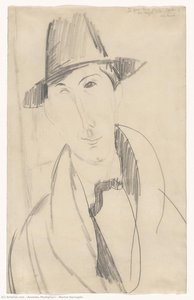
  69. Marios Varvoglis by Amedeo Modigliani, 1920, MOMA - Museum of Modern Art
    69

    MOMA - Museum of Modern Art, New York City1920Pencil on paper

    The drawing depicts a man wearing a hat and coat, positioned centrally within a minimalist composition that prioritizes facial detail above all else. Influenced by Nietzsche, Baudelaire, and Lautréamont—artists who championed subjectivity and challenged conventional aesthetic ideals—Modigliani forged his own path as an avant-garde sculptor and painter.

    Painted for you from $200 A print, from $58

  70. White Black Arch by Wassily Kandinsky
    70

    Oil painting

    “White Black Arch” exemplifies this revolutionary approach, offering viewers not a depiction of something, but an experience in itself. At first glance, “White Black Arch” appears as a dynamic field of intersecting shapes – circles, triangles, lines, and amorphous forms – rendered in a rich palette of red, green, yellow, blue, orange, and white.

    The singular detailtriangleslines

    Painted for you from $200 A print, from $58

  71. The Child and Death by Edvard Munch, 1899, Kunsthalle Bremen
    71

    Kunsthalle Bremen1899100 × 90 cm

    A fascinating aspect of this work’s history is the discovery in 2005 that it conceals another painting beneath the surface – Girl and Three Male Heads. The gesture of covering one's ears is a recurring motif in Munch’s oeuvre, most famously seen in The Scream. Created at the turn of the 20th century, The Child and Death reflects the growing anxieties and psychological explorations prevalent in Symbolist and early Expressionist art.

    The singular detailthree Male Heads)double canvas with hidden painting underneath (Girl

    Painted for you from $225 A print, from $58

  72. Thinking About Death by Frida Kahlo, 1943, Museo Dolores Olmedo
    72

    Frida KahloSurrealist Expressionism

    Thinking About Death

    Museo Dolores Olmedo, Mexico City1943Masonite45 × 37 cm

    Painted during Kahlo’s convalescence following a debilitating bus accident that shattered her spine and left her with lifelong physical limitations, “Thinking About Death” speaks directly to the pervasive anxieties surrounding illness and suffering prevalent in Mexican culture. The painting’s visual vocabulary is laden with potent symbols reflecting Kahlo’s personal struggles.

    Painted for you from $200 A print, from $58

  73. The honeymooners by Lyonel Feininger
    73

    Oil on canvas

    The honeymooners is a work by Lyonel Feininger. Born in New York City in 1871, the artist developed a distinctive visual language that bridged the gap between commercial graphic design and fine art. Feininger’s practice was marked by a deep engagement with modernism.

    Painted for you from $200 A print, from $58

  74. Berlin Street by Ernst Ludwig Kirchner, 1913, Neue Galerie
    74

    Ernst Ludwig KirchnerGerman Expressionism

    Berlin Street

    Neue Galerie, NYC1913Oil on canvas

    This oil on canvas, now housed within the Neue Galerie in New York, plunges us directly into the heart of Berlin’s burgeoning modernity, a period marked by rapid industrialization, social upheaval, and a growing sense of displacement.

    The singular detaildistorted figures

    Painted for you from $250 A print, from $58

  75. Bust of Nude Woman by Pablo Picasso, 1906, Art Institute of Chicago
    75

    Art Institute of Chicago1906Oil on canvas

    Simultaneously, the nascent theories of Cubism, spearheaded by Georges Braque, were beginning to challenge the traditional single-point perspective and the illusion of depth in painting. Picasso’s “Bust of Nude Woman” perfectly encapsulates this transitional moment, blending elements of Expressionist intensity with the geometric fragmentation that would soon define his groundbreaking Cubist works.

    The singular detaildistorted forms

    Its story

  76. Entry of Christ Into Brussels by James Ensor, 1888, Getty Center
    76

    Getty Center, Los Angeles1888Oil253 × 431 cm

    The artwork depicts a bustling scene filled with grotesque figures wearing masks, clowns, and other fantastical characters. Painted in 1888, "Entry of Christ Into Brussels" was initially rejected by the artistic group Les XX and kept in Ensor's house in Ostend.

    The singular detailChrist figure almost hidden in the center

    Painted for you from $750 A print, from $58

  77. Pregnant Woman and Death by Egon Schiele, 1911, National Gallery
    77

    National Gallery, Prague1911Oil on canvas100 × 100 cm

    “Pregnant Woman and Death” is firmly rooted in the Expressionist movement. "Pregnant Woman and Death" can be interpreted as a reflection of these broader societal fears, but also as a deeply personal exploration of grief and the fragility of life.

    Painted for you from $225 A print, from $58

  78. The Poetess by Joan Miró, 1940
    78

    Joan MiróSurrealist Expressionism

    The Poetess

    1940Gouache

    "The Poetess" is characterized by its vibrant colors and intricate patterns, typical of Miró's surrealist approach. For those interested in exploring more of Miró's work, The Poetess is available for viewing on AllPaintingsStore. Additionally, the Centre Pompidou in Paris houses a significant collection of his works, including "Constellations," which can be found at Centre Pompidou.

    Its story

  79. Three Studies of Lucian Freud by Francis Bacon, 1969
    79

    1969Oil on canvas

    Francis Bacon's "Three Studies of Lucian Freud, right" is a powerful triptych that captures the essence of psychological introspection through bold lines, chaotic brushstrokes, and a muted color palette. Painted in 1969, this triptych is part of a series that Bacon created during a prolific period of his career.

    Its story

  80. Interior with Egyptian Curtain by Henri Matisse, 1948, The Phillips Collection
    80

    The Phillips Collection, Washington, D.C.1948Oil on canvas116 × 89 cm

    The painting immediately draws attention to the window—a recurring motif in Matisse’s oeuvre—which acts as a portal to an imagined landscape. Furthermore, delving into the world of Art Deco —a movement that shared Matisse’s fascination with decorative patterns and geometric abstraction —offers valuable insights into the broader artistic landscape of the early 20th century.

    The singular detailwindowcurtain

    Painted for you from $200 A print, from $58

  81. Columbine by Max Beckmann, 1950, Saint Louis Art Museum
    81

    Max BeckmannExpressionism

    Columbine

    Saint Louis Art Museum1950Oil on canvas381 × 500 cm

    Max Beckmann's "Columbine" is a striking example of German Expressionism, created in 1950 during the artist's later years. The central subject of "Columbine" is a masked female figure engaged in an enigmatic activity involving cards or play. Beckmann's style in "Columbine" is deeply rooted in Expressionism, with influences from Fauvism evident in the bold, unnatural color palette. "Columbine" was created in 1950, a time when Beckmann had already established himself as a leading figure in German Expressionism.

    The singular detailexpressive brushworkmasked figure

    Painted for you from $200 A print, from $58

  82. Animal Legend by Franz Marc, 1912
    82

    Franz MarcGerman Expressionism

    Animal Legend

    1912Oil on canvas34 × 24 cm

    The technique is remarkably tactile; through the use of thick impasto, Marc applies pigment heavily onto the canvas, creating a rugged, textured surface that catches the light and breathes life into the composition.

    Painted for you from $200 A print, from $58

  83. Villaggio con viottoli blu by Ernst Ludwig Kirchner
    83

    Oil on canvas

    Painted for you from $200 A print, from $58

  84. On Two Banks by Marc Chagall, 1956
    84

    Marc ChagallNaive Expressionism

    On Two Banks

    1956Oil on canvas148 × 102 cm

    This technique is particularly evident in the depiction of the birds and animals scattered throughout the scene – a deliberate choice reflecting Chagall’s deep connection to his Jewish heritage and his fascination with biblical imagery.

    Its story

  85. Portrait of Jeanne Hébuterne by Amedeo Modigliani, 1919, Metropolitan Museum of Art
    85

    Metropolitan Museum of Art, New York1919Oil on canvas

    Tragically, both Modigliani and Jeanne died within days of each other in 1920, adding another layer of poignancy to this already moving portrait. Portrait of Jeanne Hebuterne, Left Arm Behind Her Head: A painting that highlights Modigliani's unique style and technique.

    Painted for you from $200 A print, from $58

  86. Cree (casein on cardboard) 2 by Edvard Munch, 1893, National Museum of Art, Architecture and Design
    86

    National Museum of Art, Architecture and Design, Oslo1893Tempera91 × 73.5 cm

    This casein-on-cardboard painting showcases the artist's mastery of capturing raw emotion, making it a significant work in the Expressionist movement. The figure's face is contorted in anguish, emphasizing the emotional turmoil that Munch sought to convey. For more information on Edvard Munch's life and work, visit his page on AllPaintingsStore.com.

    Painted for you from $200 A print, from $58

  87. The Rights of Man by René Magritte, 1947, Musées Royaux des Beaux-Arts
    87

    René MagritteSurrealist Expressionism

    The Rights of Man

    Musées Royaux des Beaux-Arts1947Oil on canvas

    Instead, it presents a deliberately unsettling tableau—a clay statue holding a pipe in its mouth, positioned beside a fire hydrant against a backdrop of two simple cups. To understand "The Rights of Man," it's essential to consider René Magritte’s personal history. “The Rights of Man” exemplifies this approach perfectly.

    The singular detailfire hydrantpipe

    Its story

  88. Woman at Table in Strong Light by Richard Diebenkorn
    88

    Its story

  89. Taranto Harbour, Swordfish from 'Illustrious'... by Charles David Cobb, 1940
    89

    1940Oil on canvas44 × 75 cm

    It was painted by Charles David Cobb, an artist born in 1921 who lived until 2014. The work fixes the date of 11 November 1940 within its layers of pigment. Charles David Cobb approached the canvas with a focus on the mechanics of war.

    Its story

  90. The Pit by George Grosz, 1946
    90

    George GroszExpressionism

    The Pit

    1946Oil paint153 × 94 cm

    George Grosz's "The Pit" (1946) is a tour de force of abstract expressionism that plunges viewers into a whirlwind of chaos and intensity. Grosz's style in "The Pit" is highly expressive and abstract, with influences from movements like Expressionism and Surrealism. Created in 1946, "The Pit" reflects the post-war atmosphere of uncertainty and upheaval.

    The singular detailbold colors, dynamic lines, thick texturesfiery atmosphere with deep reds, oranges, and yellows

    Its story

  91. In the Blue by Wassily Kandinsky, 1925, Kunstsammlung Nordrhein-Westfalen
    91

    Kunstsammlung Nordrhein-Westfalen, Duesseldorf1925Oil on canvas80 × 110 cm

    Yet, within this seemingly boundless azure, a carefully orchestrated dance of shapes emerges: geometric forms intertwine with organic curves, creating a dynamic tension that speaks volumes about Kandinsky's evolving artistic philosophy. The painting reflects the burgeoning interest in spirituality and inner experience that characterized early 20th-century thought, mirroring a desire to move beyond the limitations of depicting the external world and tap into realms of subjective feeling. Classifying “In the Blue” within the Expressionist movement offers a crucial lens through which to understand its emotional intensity.

    The singular detailcolorgeometric shapes

    Painted for you from $200 A print, from $58

  92. Selbstbildnis als Kranker by Ernst Ludwig Kirchner, 1917, Staatsgalerie Moderner Kunst
    92

    Staatsgalerie Moderner Kunst, Munich1917Oil on canvas57 × 66 cm

    To fully appreciate "Selbstbildnis als Kranker," it's crucial to understand the historical context surrounding its creation. Alongside works like "Spielende nachte Manschen unter Baum," " Der Tanz zwischen den Frauen," and " Rotes Eilsabethufer, Berlin," this piece showcases Kirchner’s unique artistic vision and his significant contribution to the development of modern art.

    Painted for you from $200 A print, from $58

  93. Autumn Trees by Egon Schiele, 1911
    93

    Egon SchieleExpressionism

    Autumn Trees

    1911Oil on canvas79 × 80 cm

    Egon Schiele's "Autumn Trees," created in 1911, is a striking example of Austrian Expressionism, showcasing the artist’s unique ability to convey intense emotion through distorted forms and vibrant colors. "Autumn Trees" presents a stylized landscape dominated by three slender trees silhouetted against a hazy background.

    Painted for you from $200 A print, from $58

  94. The Bad Doctors by James Ensor, 1892, Fin-de-Siècle Museum
    94

    Fin-de-Siècle Museum, Brussels1892Oil on panel50 × 61 cm

    A large clock hangs prominently above a physician, acting as a silent witness to the inevitable confrontation with mortality that haunts every figure in the frame.

    Painted for you from $200 A print, from $58

  95. Moonlight by Edvard Munch, 1895, Nasjonalgalleriet
    95

    Edvard MunchExpressionism

    Moonlight

    Nasjonalgalleriet, Oslo1895Oil on canvas93 × 110 cm

    Munch’s artistic development was significantly shaped by his time in Paris, where he encountered and drew inspiration from artists like Paul Gauguin, Vincent van Gogh, and Henri de Toulouse-Lautrec. "Moonlight" is part of Munch’s larger series known as “The Frieze of Life,” a collection exploring universal themes such as love, anxiety, jealousy, and betrayal.

    Painted for you from $200 A print, from $58

  96. Young Woman in a Shirt by Amedeo Modigliani, 1918, Albertina
    96

    Albertina, Vienna1918Oil on canvas100 × 65 cm

    Modigliani, a master of synthesis, weaves together the geometric abstraction found in African sculpture with the idealized elegance of Italian Renaissance portraiture.

    Painted for you from $200 A print, from $58

  97. Tyrol by Franz Marc, 1914, Staatsgalerie Moderner Kunst
    97

    Franz MarcExpressionism

    Tyrol

    Staatsgalerie Moderner Kunst, Munich1914Oil on canvas135 × 144 cm

    Marc's style in "Tyrol" blends elements of Expressionism, Cubism, and Futurism. The artwork features fragmented forms, dynamic lines, and a rich, varied color palette.

    The singular detailfragmented compositionbold colors

    Painted for you from $200 A print, from $58

  98. The Concert by Marc Chagall, 1957
    98

    Marc ChagallNaive Expressionism

    The Concert

    1957Oil on canvas140 × 239 cm

    The scene unfolds with a sense of cosmic movement, where figures dance and musicians play amidst a sea of azure and a sky ablaze with celestial fire. For Chagall, the boat often represented displacement and the wandering spirit—a reflection of the Jewish experience of migration and the search for a permanent home.

    Its story

  99. Fish Magic by Paul Klee, 1925, Philadelphia Museum of Art
    99

    Paul KleeSurrealist Expressionism

    Fish Magic

    Philadelphia Museum of Art1925Oil on panel98 × 77 cm

    Paul Klee, a Swiss-born German painter, was celebrated for his unique blend of expressionism, cubism, and surrealism. Klee's style is often described as a fusion of various movements, including expressionism, cubism, and surrealism. The composition of 'Fish Magic' is carefully balanced, with a strong emphasis on symmetry and repetition.

    Painted for you from $200 A print, from $58

  100. Visitors to the sun by Ossip Zadkine, 1956
    100

    1956

    Its story

Lineages

The famous Expressionism paintings by lineage

Where they live

The one place you can see each famous Expressionism painting

Oslo keeps 8 of these originals; the Nasjonalgalleriet, 4.

The masters

The Expressionism masters our artists look to

Portrait of Edvard Munch

Edvard Munch

1863–1944 · Norway · 10

Norwegian Expressionist of soul painting and rhythmic lines, using distorted forms to capture the tremors of anxiety and existential dread.

1. The Scream, 5. Madonna, 7. Melancholy (Laura), 24. Near the bed of death (fever), 32. The Dance of Life, 41. Ashes, 57. Passion (Jealousy), 71. The Child and Death, 86. Cree (casein on cardboard) 2, 95. Moonlight

Portrait of Egon Schiele

Egon Schiele

1890–1918 · Austria · 8

Austrian Expressionist known for raw, contorted figures and nervous, expressive line work that explores sexuality and the human condition.

8. The Self-Seers II (Death and Man), 12. Four Trees, 13. The Family, 19. Mother with Two Children, 31. Portrait of Wally, 59. Death and the Maiden, 77. Pregnant Woman and Death, 93. Autumn Trees

Portrait of Amedeo Modigliani

Amedeo Modigliani

1884–1920 · Italy · 7

Italian Expressionist known for soulful portraits with elongated faces and almond-shaped eyes, capturing the essence of the human spirit.

10. Reclining Nude with Blue Cushion, 39. Adrienne (Woman with Bangs), 48. Nudo rosso, 60. Jeanne Hebuterne with Hat and Necklace, 69. Marios Varvoglis, 85. Portrait of Jeanne Hébuterne, 96. Young Woman in a Shirt

Portrait of Francis Bacon

Francis Bacon

1909–1992 · Ireland · 6

British Expressionist known for visceral, distorted figures trapped within geometric space-frames and the raw sensation of the human scream.

9. Three Studies for Figures at the Base of a Crucifixion, 17. Triptych, 22. Triptych, May-June 1973, 34. Figure with Meat, 62. Portrait of Isabel Rawsthorne Standing in Soho, 79. Three Studies of Lucian Freud

Portrait of Paul Klee

Paul Klee

1879–1940 · Switzerland · 6

Swiss-German Bauhaus artist of rhythmic abstraction, delicate watercolors, and musical forms, known for his scientific approach to color theory.

14. Landscape with Yellow Birds, 26. Strong Dream, 40. Legend of the Nile, 50. Women, 61. New Angel, 99. Fish Magic

Portrait of James Ensor

James Ensor

1860–1949 · Belgium · 6

Belgian Expressionist known for grotesque carnival masks and chaotic, brightly colored processions.

20. Death and the Masks, 37. Skeletons Warming Themselves, 52. Self-Portrait with Masks, 65. The Man of Sorrows, 76. Entry of Christ Into Brussels, 94. The Bad Doctors

Portrait of Wassily Kandinsky

Wassily Kandinsky

1866–1944 · Russia · 5

Russian pioneer of abstraction and the Blue Rider movement, known for spiritual, colorful forms and the musical interplay of shapes and lines.

3. Composition VII, 30. All Saints Day I, 45. View of Murnau with train and castel, 70. White Black Arch, 91. In the Blue

+25more masters our artists study Expressionism Masters Their stories

In confidence

About these Expressionism paintings

Hover gently over a question to read the answer.

Can I own a copy of a famous Expressionism painting?

70 of these 100 paintings are available hand-painted in oil, from $200, and 70 as a canvas print, from $58.

How was this list of Expressionism paintings ranked?

Each painting is ranked by how widely it is known: the number of Wikipedia language editions with an article on it (Wikidata sitelinks), its place in our catalogue's manual ranking and the visits its page receives. The same painting catalogued several times counts once, and details, copies and studies are left out.

One of a kind

70 of the 100, painted for you alone

70 of these works can be painted by hand for a single owner, from $200.

The Scream by Edvard MunchThe Pillars of Society by George GroszComposition VII by Wassily KandinskyWoman in a Green Jacket by August MackeMadonna by Edvard Munch

Discover original art

How the selection is made

We went through every Expressionism painting in our catalogue and placed the best-known first: those Wikipedia describes in the most languages, those our artists and curators rank highest and those most viewed on our pages. Each original appears once — no details or copies.

Other movements that inspire us

The periods that inspire us