Gustav Klimt's The Kiss (1908) is the best-known painting in the Austrian Gallery Belvedere; after it come Jacques-Louis David's Napoleon at the St. Bernard Pass (1801), Gustav Klimt's Judith (1901) and Egon Schiele's The Family (1917).
Below, the 10 paintings of the Austrian Gallery Belvedere that are most widely known — painted from 1801 to 1917 by 3 painters — with their date, medium and size.
The originals
The 10 famous paintings of the Austrian Gallery Belvedere our artists study first
The painter, the date, the medium and the dimensions of each original, with a note from its page.
- The Kiss by Gustav Klimt, 1908
- Napoleon at the St. Bernard Pass by Jacques-Louis David, 1801
- Judith by Gustav Klimt, 1901
- The Family by Egon Schiele, 1917
- Birch Forest by Gustav Klimt, 1903
- Poppy Field by Gustav Klimt, 1907
- Mother with Two Children by Egon Schiele, 1917
- Death and the Maiden by Egon Schiele, 1915
- Avenue of Schloss Kammer Park by Gustav Klimt, 1912
- The Apple Tree by Gustav Klimt, 1912
-

Gustav Klimt (1862–1918)
1. The Kiss by Gustav Klimt, 1908
Austrian Gallery Belvedere, Vienna1908Oil on canvas180 × 180 cm
The composition draws the eye inward, using verticality to create a sense of quiet enclosure. It feels as though the rest of the world has fallen away, leaving only this singular, luminous moment. As a founding member of the Vienna Secession, the artist sought to break free from the rigid academic traditions of the time.
-

Jacques-Louis David (1748–1825)
2. Napoleon at the St. Bernard Pass by Jacques-Louis David, 1801
Austrian Gallery Belvedere, Vienna1801Oil on canvas246 × 231 cm
Completed in 1801, this work immortalizes Napoleon’s daring crossing of the Great St. Bernard Pass in May 1800 during his Italian campaign – a pivotal moment that solidified his rise to prominence. The painting was commissioned by Charles IV of Spain, intended for a gallery of great military leaders within the Royal Palace of Madrid, signifying a diplomatic gesture and acknowledging Napoleon’s growing influence. It followed Napoleon's coup d'état in 1799, establishing him as First Consul, and his subsequent successful campaign against Austria.
-

Gustav Klimt (1862–1918)
3. Judith by Gustav Klimt, 1901
Austrian Gallery Belvedere, Vienna1901Oil paint on canvas
The central figure in "Judith" is a woman of regal bearing and serene confidence. Klimt's "Judith" is a quintessential example of Art Nouveau, characterized by its flowing lines, decorative patterns, and emphasis on beauty.
-

Egon Schiele (1890–1918)
4. The Family by Egon Schiele, 1917
Austrian Gallery Belvedere, Vienna1917Oil on canvas152 × 162 cm
In The Family, this manifests through jagged, angular lines that seem to vibrate with tension. Schiele was a leading figure in Austrian Expressionism, a movement that prioritized subjective experience over objective reality.
-

Gustav Klimt (1862–1918)
5. Birch Forest by Gustav Klimt, 1903
Austrian Gallery Belvedere, Vienna1903Oil on canvas110 × 110 cm
Painted during Klimt's early Impressionist phase, this artwork exemplifies his ability to blend realism with atmospheric effects. The loose, expressive brushwork creates a sense of movement and depth, while the play of light and shadow brings the forest scene to life. "Birch Forest" was created in 1903, a pivotal year for Gustav Klimt. This period marked his transition from the decorative styles of the Vienna Secession to a more personal and symbolic approach.
-

Gustav Klimt (1862–1918)
6. Poppy Field by Gustav Klimt, 1907
Austrian Gallery Belvedere, Vienna1907Oil paint on canvas110 × 110 cm
Painted in 1907, Poppy Field is part of Klimt’s exploration of landscape painting during his golden phase. Klimt’s father was a traveling artisan specializing in gold engravings, but Klimt’s use of gold leaf in paintings was inspired by a trip he made to Italy in 1903. During his stay in Litzlberg on the Attersee in the summer of 1907, Klimt discovered a magnificent poppy-filled meadow which he captured in the painting “Poppy Field.” The meadow extends across almost the entire surface of the painting.
-

Egon Schiele (1890–1918)
7. Mother with Two Children by Egon Schiele, 1917
Austrian Gallery Belvedere, Vienna1917Oil on canvas150 × 160 cm
In this 1917 oil on canvas, Egon Schiele presents Mother with Two Children. In 1911, he produced Pregnant woman and Death, a work that, much like this portrait, navigates the delicate intersection of life and its inevitable conclusion. The artist’s preoccupation with the fragility of existence is further reflected in Death and the Maiden, created in 1915. Agony, 1912 Death and the Maiden, 1915 To experience this work in its original setting, one must travel to Vienna, Austria.
-

Egon Schiele (1890–1918)
8. Death and the Maiden by Egon Schiele, 1915
Austrian Gallery Belvedere, Vienna1915Oil on canvas
The earthy tones of brown, beige, and green in the background contrast sharply with the vibrant reds, pinks, and purples on the Maiden's garment. This contrast not only highlights the emotional interaction between the figures but also adds depth and complexity to the painting. Created during World War I, "Death and the Maiden" reflects Schiele's personal experiences and the broader societal anxieties of the time.
-

Gustav Klimt (1862–1918)
9. Avenue of Schloss Kammer Park by Gustav Klimt, 1912
Austrian Gallery Belvedere, Vienna1912Oil on canvas110 × 110 cm
"Avenue of Schloss Kammer Park" exemplifies Klimt's mastery of the Art Nouveau style, characterized by its emphasis on organic forms, intricate patterns, and a harmonious blend of nature and architecture. The artwork is part of a series of landscapes Klimt created, showcasing his ability to capture the essence of nature with remarkable detail and sensitivity. "Avenue of Schloss Kammer Park" is executed in an impressionistic style, characterized by visible brushstrokes, a focus on capturing the overall impression of the scene rather than fine details, and an emphasis on light and color.
-

Gustav Klimt (1862–1918)
10. The Apple Tree by Gustav Klimt, 1912
Austrian Gallery Belvedere, Vienna1912Oil on canvas80 × 80 cm
The background features a serene sky with wispy clouds and distant hills, creating a sense of depth and tranquility. The foreground is adorned with a patch of grass, adding to the overall harmony of the scene. "The Apple Tree" was created during Klimt's later years, a period marked by his exploration of natural themes and symbolic elements.
The collection in figures
The originals of the Austrian Gallery Belvedere in our catalogue
95 originals of the Austrian Gallery Belvedere — paintings and works on paper — century by century
The originals in figures
- 10 originals, ranked by fame, 3 painters of the originals, Jacques-Louis David to Egon Schiele.
- Painters with the most originals here: Gustav Klimt (6), Egon Schiele (3), Jacques-Louis David (1).
- Jacques-Louis David's Napoleon at the St. Bernard Pass (1801) – Egon Schiele's The Family (1917).
- Jacques-Louis David's Napoleon at the St. Bernard Pass (1801), 246 × 231 cm – Gustav Klimt's The Apple Tree (1912), 80 × 80 cm.
- 96 originals of the Austrian Gallery Belvedere in our catalogue: 95 paintings and works on paper by 32 artists, 1746–1924.
The countries the painters of the Austrian Gallery Belvedere came from
The painters with the most originals at the Austrian Gallery Belvedere
Two museums
The Austrian Gallery Belvedere and the Kunsthistorisches Museum: two collections of originals
The Austrian Gallery Belvedere
- Originals in our catalogue
- 96
- Painted between
- 1746 – 1924, most from the 19th century
- Most famous originals
- The Kiss, Napoleon at the St. Bernard Pass, Judith
- Most originals by
- Эмиль Якоб Шиндлер, Ловис Коринт, Эгон Шиле
The Kunsthistorisches Museum
- Originals in our catalogue
- 2,272
- Painted between
- 1405 – 1911, most from the 16th century
- Most famous originals
- The Hunters in the Snow (Winter), Adoration of the Trinity (Landauer Altar), The Tower of Babel
- Most originals by
- Питер Брейгель Старший, Фердинанд ван Кессель, Тициан
Questions to the studio
Questions about the originals of the Austrian Gallery Belvedere
Open a question to read our answer.
Which painting in the Austrian Gallery Belvedere is the most famous?
No. 1 in the Austrian Gallery Belvedere is Gustav Klimt's The Kiss (1908). Next come Jacques-Louis David's Napoleon at the St. Bernard Pass (1801), Gustav Klimt's Judith (1901) and Egon Schiele's The Family (1917).
What are the five best-known paintings in the Austrian Gallery Belvedere?
In order: The Kiss by Gustav Klimt, Napoleon at the St. Bernard Pass by Jacques-Louis David, Judith by Gustav Klimt, The Family by Egon Schiele and Birch Forest by Gustav Klimt.
Are there any Gustav Klimt paintings in the Austrian Gallery Belvedere?
Gustav Klimt has 6 paintings in this ranking — The Kiss (No. 1), Judith (No. 3), Birch Forest (No. 5), Poppy Field (No. 6), Avenue of Schloss Kammer Park (No. 9) and The Apple Tree (No. 10) — and 8 records in our catalogue of the Austrian Gallery Belvedere.
Which Egon Schiele paintings hang in the Austrian Gallery Belvedere?
Egon Schiele has 3 paintings in this ranking — The Family (No. 4), Mother with Two Children (No. 7) and Death and the Maiden (No. 8) — and 10 records in our catalogue of the Austrian Gallery Belvedere.
Are there any Jacques-Louis David paintings in the Austrian Gallery Belvedere?
Jacques-Louis David has 1 paintings in this ranking — Napoleon at the St. Bernard Pass (No. 2) — and 1 records in our catalogue of the Austrian Gallery Belvedere.
What are 10 must-see paintings at the Austrian Gallery Belvedere?
In order: The Kiss (Gustav Klimt), Napoleon at the St. Bernard Pass (Jacques-Louis David), Judith (Gustav Klimt), The Family (Egon Schiele), Birch Forest (Gustav Klimt), Poppy Field (Gustav Klimt), Mother with Two Children (Egon Schiele), Death and the Maiden (Egon Schiele), Avenue of Schloss Kammer Park (Gustav Klimt) and The Apple Tree (Gustav Klimt).
Where is the Austrian Gallery Belvedere?
In Vienna, Austria. The Austrian Gallery Belvedere holds 96 works of our catalogue by 32 artists (1746–1924), among them the 10 paintings ranked here.
What is the difference between the Austrian Gallery Belvedere and the Kunsthistorisches Museum?
The Austrian Gallery Belvedere holds 95 paintings of our catalogue, dated 1746 to 1924 and mostly from the 19th century; the Kunsthistorisches Museum holds 2,249, dated 1405 to 1911 — its best-known are The Hunters in the Snow (Winter), Adoration of the Trinity (Landauer Altar) and The Tower of Babel.
Which three works is the Austrian Gallery Belvedere most famous for?
the Gustav Klimt's The Kiss, the Egon Schiele works and the Oskar Kokoschka works are the three works everyone comes to the Austrian Gallery Belvedere for; the museum's record also names the Austrian art from Middle Ages to present.
What is the oldest painting in the Austrian Gallery Belvedere on this list?
Jacques-Louis David's Napoleon at the St. Bernard Pass (1801), dated 1801. The most recent is Egon Schiele's The Family (1917), dated 1917.
What is the largest painting in the Austrian Gallery Belvedere on this list?
Jacques-Louis David's Napoleon at the St. Bernard Pass (1801), 246 × 231 cm. The smallest is Gustav Klimt's The Apple Tree (1912), 80 × 80 cm.
How is this ranking made?
The paintings of the Austrian Gallery Belvedere in our catalogue are ranked by how widely each one is known: the number of Wikipedia language editions with an article on it (Wikidata sitelinks), its place in our catalogue's manual ranking and the visits its page receives. The same painting catalogued several times counts once; details, copies and studies are left out.
The house of the originals
The Austrian Gallery Belvedere in Vienna: history and collections of the originals
The Austrian Gallery Belvedere (Österreichische Galerie Belvedere, Belvedere Museum, Belvedere) — museum — in Vienna, Austria. Its highlights: Gustav Klimt's The Kiss, Egon Schiele works, Oskar Kokoschka works, Austrian art from Middle Ages to present. Our catalogue lists 95 of its paintings and works on paper, by 32 artists, dated 1746 to 1924.
Origins and History of the Austrian Gallery Belvedere
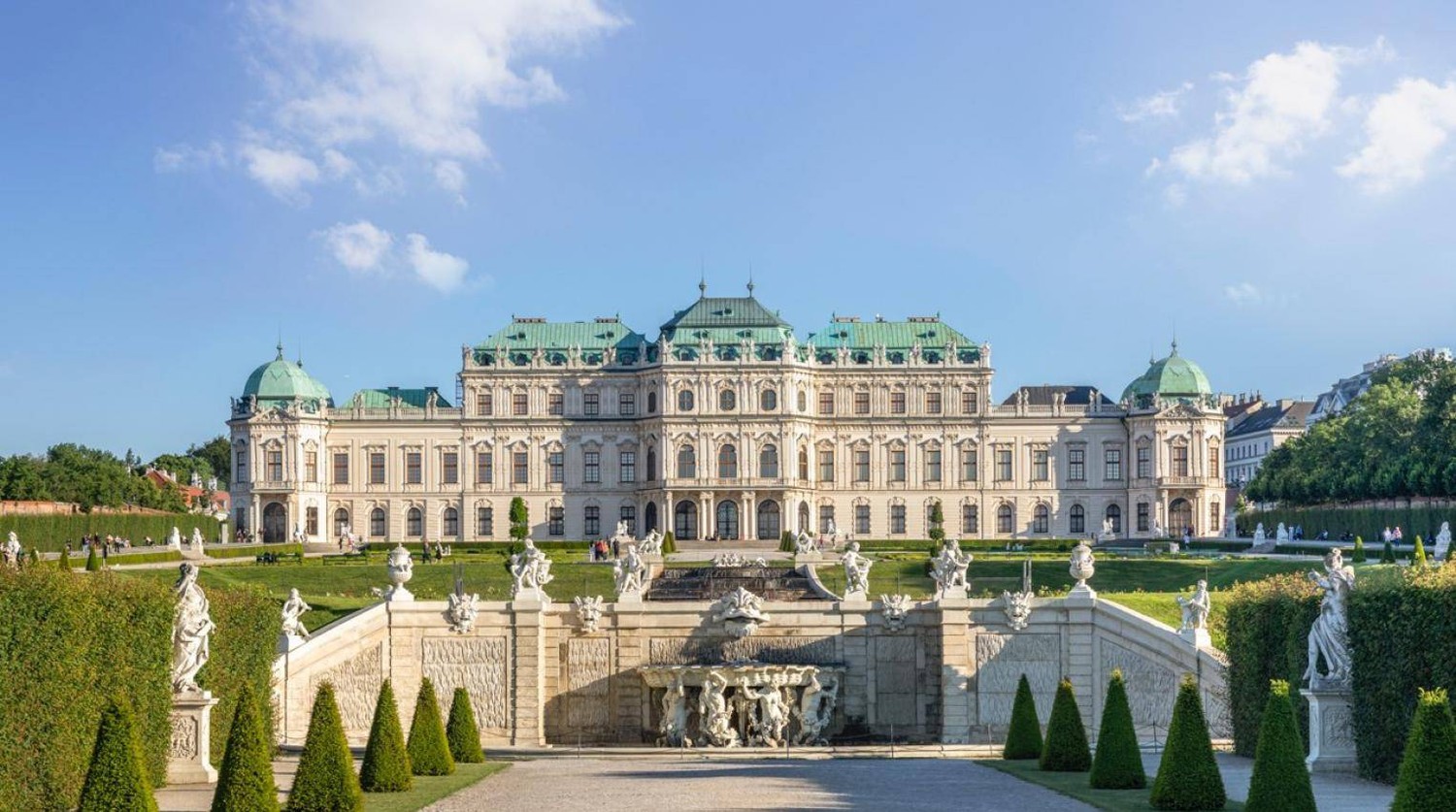
The Austrian Gallery Belvedere is situated within the Belvedere Palace & Museum in Vienna, Austria. The complex was originally constructed in the early eighteenth century as the summer residence for Prince Eugene of Savoy. The architect Johann Lucas von Hildebrandt designed the ensemble, creating a structure that would eventually transition from a private aristocratic retreat to a public institution. The history of the site is marked by a shift toward the democratization of art. In 1776, Empress Maria Theresa transferred the Imperial Picture Gallery from the Stallburg to the Upper Belvedere. This movement preceded the formal establishment of the Belvedere as Vienna's first public museum in 1781. These developments ensured that the imperial collections would eventually be accessible to the public rather than remaining solely within the private sphere of the monarchy. Today, the institution presents Austrian art from the Middle Ages to the present. The collection is organized within an international context, tracing the development of the nation's visual culture through several centuries.
The Architecture of the Baroque Palaces
The Belvedere complex consists of two Baroque palaces, the Upper and Lower Belvedere, alongside the Orangery and the Palace Stables. Designed principally by Johann Lukas von Hildebrandt, the ensemble was completed in the early eighteenth century. The architecture reflects the formal requirements of a summer residence for Prince Eugene of Savoy, emphasizing symmetry and structured elegance. The palace and its surrounding gardens form part of the Baroque heritage of the Historic Centre of Vienna, a UNESCO World Heritage Site. The layout follows strict Baroque principles. The gardens are meticulously landscaped to complement the palace structures, utilizing formal hedges and axial vistas to create a sense of order. This integration of architecture and nature was central to the design of the estate.
The Extensive Collection of Austrian Art
The collection spans several major movements, from the formal structures of Baroque Illusionism to the developments of the 19th and 20th centuries. It includes the greatest collection of Viennese Biedermeier art and significant works of French Impressionism. These pieces are held within the Upper and Lower Belvedere, providing a continuous view of Austrian artistic evolution. The museum houses an extensive selection of Austrian art, with a particular focus on the Vienna Secession and Art Nouveau. This includes the works of Gustav Klimt, alongside significant contributions from Egon Schiele and Oskar Kokoschka. These artists represent the shift toward Expressionism and the psychological depth of the modern era. The holdings reflect the transition from academic traditions to more subjective forms of expression. Die fünf Sinne, 1879 - Hans Makart Judith, 1901 - Gustav Klimt Death and the Maiden, 1915 - Egon Schiele
Contemporary Art at Belvedere 21
The museum expanded its reach in 2001 with the addition of Belvedere 21. This state-of-the-art contemporary art space is housed within a former tobacco factory. It functions as a platform for contemporary Austrian and international art, including film and music. The programming at this venue focuses on current artistic practices. It provides a space where the dialogue between historical traditions and modern innovation continues. By incorporating media such as film and music, the institution engages with the diverse forms of contemporary creativity. This extension ensures the museum remains connected to the evolving landscape of international art.
5 facts about the home of the originals
- Who was the architect of the Belvedere Palace?Johann Lucas von Hildebrandt
- Which artist's works are the centerpiece of the Upper Belvedere's collection?Gustav Klimt
- What was the original purpose of the Lower Belvedere?A hunting lodge
- In which year was the Belvedere conceived as Vienna's first public museum?1781
- Which contemporary art space was added to the museum in 2001?Belvedere 21
The Austrian Gallery Belvedere: every original we catalogueThe museums of Vienna
To read
Three articles on the originals and their painters
 The painter of the first original
Gustav Klimt's Greatest Works: 25 Essential Paintings and Designs
6 of the 10 originals are by Gustav Klimt.
 The other great museum in Vienna
25 Masterpieces You Must See at the Kunsthistorisches Museum in Vienna
2,272 originals in our catalogue.
 The painter with the most originals here
Egon Schiele's Top 25 Masterpieces: The Raw Power of Expressionism
6 of the 10 originals are by Gustav Klimt.
How the originals are ranked
The originals of the Austrian Gallery Belvedere in our catalogue are ranked by fame: the Wikipedia language editions that describe the painting, our studio's ranking and the visits to its page on OriginalUniqueArt.com. One entry per original, counted in our catalogue and not in the museum's inventory, without details, copies, studies, sculptures or works on paper; every date, dimension and medium is the catalogue's, and the notes are drawn from the painting's description.
Go on