


The History and Origins of Alte Nationalgalerie
The foundations of the Alte Nationalgalerie were laid by the order of King Frederick William IV of Prussia. Construction began in 1862 and continued until 1876. This period of building coincided with a significant expansion of the institution's holdings. In 1861, the banker Johann Heinrich Wagener donated 262 paintings, a gift that fundamentally shaped the direction of the collection. This influx of works provided the substance necessary for the institution to fulfill its purpose as a repository for nineteenth-century art.
Located on Museum Island in the historic centre of Berlin, Germany, the building is a component of a larger complex. This site was inscribed on the UNESCO World Heritage List in 1999. The presence of the Alte Nationalgalerie within this specific urban landscape connects the art to the historical development of the city. The institution was established in 1876, marking the formal beginning of its life as a public space for the contemplation of European art.
The Architecture of the Neoclassical Temple
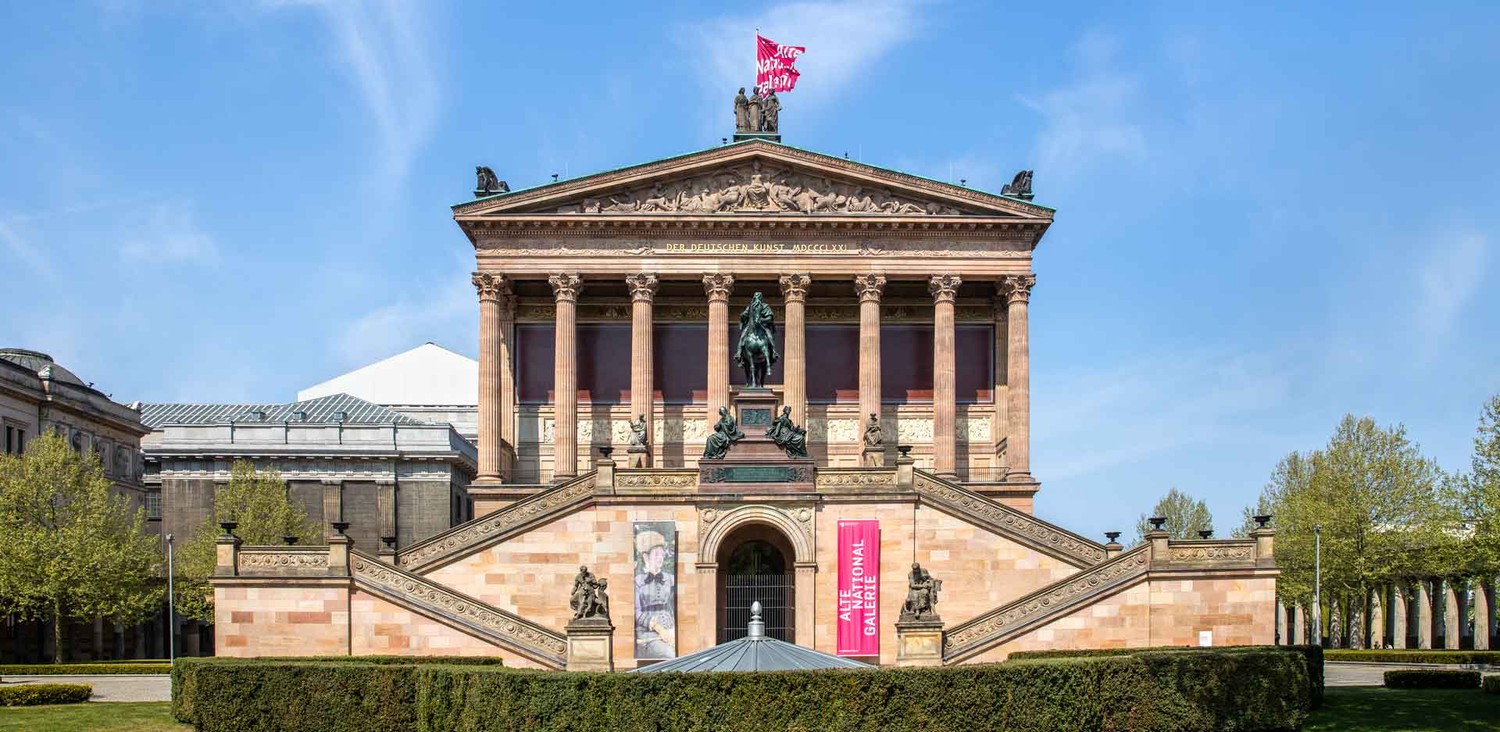
The structure occupies a prominent position on Museum Island in the historic centre of Berlin, Germany. Its design originated from a sketch by King Frederick William IV of Prussia, later realized through the work of Friedrich August Stüler and Johann Heinrich Strack. The building presents a harmonious blend of Neoclassical elegance and innovative iron construction. This combination of styles reflects the technical ambitions of the nineteenth century. The exterior is characterized by a staircase that leads to a memorial dedicated to King Frederick William IV.
Materiality defines the presence of the building. The construction utilizes brick and iron, alongside distinctive Triassic sandstone sourced from Nebra. This choice of stone provides a specific texture to the façade. The listed building functions as a temple of art, where the interplay of light and shadow within the galleries creates a contemplative atmosphere. The scale of the architecture, with its soaring ceilings and grand proportions, establishes a sense of gravitas for those standing before it.
A Collection of 19th-Century Art
The holdings within these walls focus on European art from the 19th century, a period of significant stylistic transition. The collection spans from the Neo-Classicism of Goethe’s era through the developments of Romanticism, Biedermeier, and Impressionism. This breadth allows for a direct encounter with the shifting visual language of the century, as the focus moves from the structured ideals of the early 1800s toward the atmospheric experiments of later decades.
Paintings and sculptures are presented with equal importance, reflecting the diverse media used to capture the era. The presence of Realism and early Impressionism alongside Romantic landscapes creates a dialogue between different ways of perceiving the natural and social world. One finds the meticulous detail of Prussian society existing in the same space as the loose brushwork of the Impressionists. This coexistence highlights the rapid evolution of artistic thought during this transformative time.
- The Isle of the Dead, 1883 - Arnold Böcklin
- Man and his Thought, 1900 - Auguste Rodin
- Dancer, Looking at the Sole of her Right Foot, 1910 - Edgar Degas
- William I Departs for the Front, July 31, 1870, 1871 - Adolph von Menzel
Masterpieces of the Romantic Period
The museum provides a profound representation of German Romanticism. A significant portion of the space is dedicated to the works of Caspar David Friedrich, with a gallery entirely focused on his presence. One can stand before Monk by the Sea, painted about 1808-1810, and experience the weight of the vast, open sky. The composition invites a quiet contemplation of the relationship between humanity and the natural world.
Other works from this era contribute to the atmosphere of introspection found within the halls. Arnold Böcklin’s The Isle of the Dead, dated 1883, offers a different perspective on the themes of mortality and stillness. These paintings exist as physical presences that demand a slow, steady gaze.
- The Abbey in the Oakwood, 1810 - Caspar David Friedrich
- The Isle of the Dead (Version 3), 1883 - Arnold Böcklin
Impressionist and Realist Artworks
The second floor holds the light and color of French Impressionism. Here, the works of Claude Monet, Édouard Manet, and Pierre-Auguste Renoir exist as quiet presences. One can find Édouard Manet’s In the Conservatory, painted about 1878-79, among these canvases. The atmosphere changes as the eye moves from the fleeting light of the Impressionists toward the more grounded depictions of Prussian life.
On the first floor, the art of Adolph Menzel is documented in detail. His paintings offer a sober look at the realities of nineteenth-century Germany. The Iron Rolling Mill (Modern Cyclopes), created between 1872 and 1875, remains a significant presence in this collection. The precision of his craftsmanship provides a counterpoint to the atmospheric effects found in the galleries above.
Notable Sculptures and Classical Works
The presence of classical sculpture provides a grounding weight to the institution. These works occupy the space with a stillness that invites long observation. Johann Gottfried Schadow’s Princess Group, created between 1795 and 1797, remains a central part of this sculptural dialogue. The figures possess a quiet dignity that reflects the aesthetic priorities of the era.
The collection also holds significant examples of nineteenth-century figurative work. Christian Daniel Rauch’s Seated Victoria, Throwing a Wreath, dating from 1845, demonstrates a precise command of form. Nearby, the bronze work The Age of Bronze by Auguste Rodin, produced from 1875 to 1876, offers a different approach to the human figure. The textures and surfaces of these pieces respond to the light in the galleries in distinct ways.
- Princess Group, 1795-97
- Seated Victoria, Throwing a Wreath, 1845
- The Age of Bronze, 1875–1876
Recent Restorations and Renovations
The physical presence of the building bears the marks of a turbulent century. During World War II, Allied air raids caused heavy damage to the structure. The process of reconstruction was a long endeavor, continuing until 1969. These efforts sought to restore the architectural integrity of the site after the devastation of the conflict.
A more recent chapter of preservation occurred at the turn of the millennium. Between 1998 and 2001, the building underwent a thorough renovation directed by architect HG Merz. This project required an investment of $62 million to ensure the preservation of the Neoclassical and Renaissance Revival elements. The work focused on the structural and aesthetic continuity of the institution, allowing the art to be viewed within its intended architectural context once again.


