A Life Shaped by Light and Water
The story of Oscar-Claude Monet begins in the streets of Paris, though his heart was often found wandering the salt-misted air of Le Havre. As a young boy, he moved to Normandy, where his father initially hoped he would follow a path in commerce. Yet, the boy possessed a restless eye for detail, finding early success by selling charcoal caricatures to local acquaintances. It was during these formative years that a chance encounter with Eugène Boudin changed everything. Boudin did not merely offer lessons in oil paint; he introduced the young man to the practice of painting en plein air, teaching him to set his easel directly within the unpredictable elements of nature.
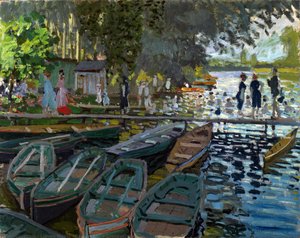
This early training instilled a lifelong obsession with the fleeting moment. When the Franco-Prussian War forced him into the streets of London, Monet found himself absorbing the atmospheric effects seen in the works of J.M.W. Turner. He returned to France with a new understanding of how mist and light could dissolve solid forms. In Paris, he sought formal instruction under Charles Gleyre, where he formed deep bonds with fellow painters like Auguste Renoir. These friendships were forged in a shared desire to break away from the rigid, dark constraints of the academic Salon, seeking instead a way to record the world as it was actually perceived by the eye.
The Rebellion of Impression
The year 1874 marked a turning point for this group of rebels. Dissatisfied with conservative standards, they organized their own independent exhibitions. It was during one such showing that his painting, Impression, Sunrise, gave a name to a movement that many initially viewed with derision. The term "Impressionism" emerged from the very criticism meant to mock his loose brushstrokes and unfinished appearance. Monet did not recoil from this label; he embraced it, using it to define a style centered on the subjective sensation of a scene.
His technique became a study in optical truth. He applied unmixed colors side-by-side, a method known as broken color, allowing the viewer's eye to blend the hues. He rejected traditional dark grounds, opting instead for light-colored primers that added a new brightness to his canvases. His work often focused on the following elements:
- The use of rapid, visible brushstrokes to capture movement.
- The study of how sunlight alters the appearance of a single subject over time.
- The rejection of linear perspective in favor of asymmetrical, flattened arrangements influenced by Japanese prints.
Giverny and the Final Vision
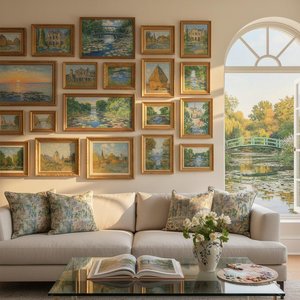
In 1883, Monet settled in Giverny, creating a sanctuary that would become his most profound subject. He transformed his property into an elaborate garden, complete with a water lily pond and a Japanese bridge. This was no mere landscape; it was a living laboratory where he could observe the interplay of light on water and foliage under controlled conditions. The gardens at Giverny provided him with a steady stream of inspiration for decades.
The later years of his life were defined by the monumental Water Lilies series. These vast canvases, often painted while he struggled with cataracts, moved toward a near-abstract state where the horizon line vanished entirely. He painted the same pond repeatedly, documenting the way shadows danced across the surface at dusk or how morning mist clung to the lilies. Through these works, he achieved a sense of immersion, inviting anyone who looked upon them to lose themselves in a world of pure, shifting color. He left behind a legacy that fundamentally altered the trajectory of modern art, proving that the most transient moment could be captured through the power of paint.
Questions & Answers
Where can I see the color profile of Claude Monet's work?
The Palette Genome of Claude Monet is a page that presents the color profile of the artist's body of work.
What are the birthplace and birth year of Claude Monet?
Claude Monet was born in Paris in 1840.
How do I find works by Claude Monet on a specific theme?
The By Keywords page of Claude Monet groups the artist's artworks by their keywords.