Surrealism · 1925
Dancer (Joan Miró, 1925)
Joan Miró (1893–1983) made Dancer. It dates from 1925. It belongs to the Surrealism movement. It is made in oil on canvas. It measures 115 × 88 cm (45.3 × 34.6 in).
- 1925
- Oil On Canvas
- 115 × 88 cm (45.3 × 34.6 in)

 Preview

 Hand Made Oil Painting
 Send
 Share
 Fact sheet


 Download
 Similars
 X-Ray
 Diaporama
 Q&A

 Stats
Dancer, in brief
- Title
- Dancer
- Artist
- Joan Miró (1893–1983)
- Artist born in
- Barcelona, Spain
- Date
- 1925
- Medium
- Oil On Canvas
- Dimensions
- 115 × 88 cm (45.3 × 34.6 in)
- Movement
- Surrealism
- Period
- Modern
- Subject
- dancer, surrealism, movement, blue, symbolism, abstract
What does Dancer depict?
A Dance Between Dreams and Reality
Joan Miró’s *Dancer*, created in 1925, is a captivating exploration of movement and stillness rendered through the lens of Surrealism. This oil on canvas (115 x 88 cm) isn't merely a depiction of a dancer; it’s a visual poem—a distillation of rhythm, energy, and subconscious thought. Miró masterfully translates the ephemeral quality of dance into a static image, inviting viewers to participate in its silent performance.Inspiration & Historical Context
The genesis of *Dancer* lies in Miró’s fascination with a performance he witnessed at Eden Concert in Barcelona. However, rather than a literal representation, the painting embodies the *feeling* of dance—its fluidity and grace juxtaposed with an underlying sense of quietude. Created during a period when artists were actively challenging traditional artistic conventions, *Dancer* reflects the burgeoning Surrealist movement’s interest in exploring the realm of dreams, the unconscious mind, and automatic processes. While Miró resisted strict categorization within any single movement, his work undeniably shares key characteristics with Surrealism, particularly its embrace of symbolism and non-representational forms. 1925 was a pivotal year for the Surrealists, marked by their first group exhibition in Paris, further solidifying the artistic landscape that influenced Miró’s creative direction.Composition & Symbolic Language
The canvas is dominated by deep blues layered over a warm brown primer, creating a grounding effect and framing the dynamic composition. A striking black and white form suggests the dancer's head, while a heart shape—pierced by a spider—symbolically represents the dancer’s core and sensuality. The spider, often interpreted as representing creativity or even danger, adds an intriguing layer of complexity. Stylized musical notes serve as feet, directly linking the figure to rhythm and movement. Ascending from the right side is a sinuous line adorned with yellow dots, evoking the snake-like undulation of the dancer’s body.- Style: Surrealism
- Medium: Oil on Canvas
- Dimensions: 115 x 88 cm
- Date: 1925
Technique & Artistic Innovation
Miró’s technique in *Dancer* is characterized by a deliberate simplicity and boldness. He employs broad brushstrokes and flat planes of color, eschewing traditional modeling techniques to create a sense of immediacy and visual impact. The layering of blues creates depth while maintaining an overall flatness that emphasizes the painting's two-dimensionality. This approach aligns with his exploration of “automatic painting,” where he sought to bypass conscious control and allow images to emerge from his subconscious—a technique celebrated by the Surrealists for its innovative spirit.Emotional Impact & Legacy
*Dancer* evokes a sense of mystery, longing, and playful energy. The abstract forms invite individual interpretation, allowing viewers to project their own emotions and experiences onto the artwork. It’s a piece that resonates on both an intellectual and emotional level—a testament to Miró's ability to tap into universal themes of movement, desire, and the human condition. Miró’s influence extends far beyond Surrealism, impacting generations of artists working in Abstract Expressionism and Color Field painting. His bold use of color, simplified forms, and evocative symbolism continue to inspire contemporary artists and designers alike. *I*t remains a powerful example of how art can transcend representation and communicate directly with the soul.Further Exploration
To delve deeper into Miró’s world, visit Dancer on OriginalUniqueArt (here). For a comprehensive overview of his artistic journey, consider a visit to the Fundació Joan Miró in Barcelona (here).High-resolution images of Dancer

Protected by copyright: these files are for personal reference, not a licence to republish.
Joan Miró, Dancer (1925).
Joan Miró (1893–1983), Dancer, 1925, oil on canvas. Image: OriginalUniqueArt.com.
Questions on Dancer, answered
What is "Dancer" made with?
"Dancer" is executed in oil on canvas.
What size is "Dancer" by Joan Miró in real life?
What is "Dancer" about?
Can the image of "Dancer" by Joan Miró be freely reproduced?
Which artistic current is "Dancer" by Joan Miró part of?
What stage of Joan Miró's development does "Dancer" represent?
About the artist, Joan Miró
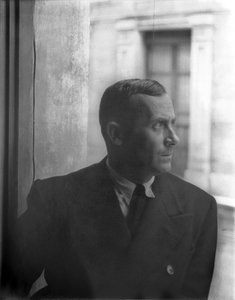
1893–1983, Spain
Joan Miró
The Life and Art of Joan Miró Barcelona, April 20, 1893. Joan Miró i Ferrà enters a world of precision and gears, born into a family of watchmakers. This early environment provides a backdrop of meticulous craftsmanship that persists through his evolution as a painter, sculptor, and ceramicist. He moves through the decades not by following a set path, but by constantly shifting his focus, eventually becoming a central figure in the development of Surrealism and Abstract Art.
Also by Joan Miró
 The Farm1922
 Harlequin's Carnival1925
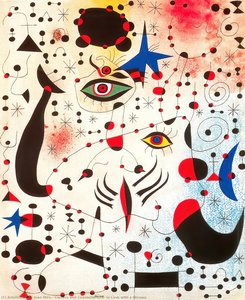 Ciphers and Constellations, in Love with a Woman1941
 Joan Miró- Catalan Landscape (The Hunter)1924
Essays around Dancer
 Spanish artworks of the 1950sSalvador Dalí's 1954 Crucifixion uses a hypercube to merge religious iconography with the atomic age. How did science reshape Spanish surre…
 Dreams on Canvas: Understanding Automatist and Veristic SurrealismIn 1924, André Breton launched a movement in Paris to liberate the mind. One path used spontaneous gestures, while the other used photograp…
 Spanish artworks of the 1920s1922 saw Miró paint The Farm, bridging Naive art and Surrealism. Compare his symbolic landscape with Dalí's 1929 psychological dreamscapes.