The Genesis of Fragmentation: From Cézanne to Early Cubism
Cubism is an early-20th-century avant-garde art movement which began in Paris. It revolutionized painting and the visual arts, and sparked artistic innovations in music, ballet, literature, and architecture. Cubist subjects are analyzed, broken up, a...
The story of Synthetic Cubism isn’t one of sudden invention, but rather a gradual unfolding—a deliberate dismantling of artistic convention rooted in the late works of Paul Cézanne. Before Picasso and Braque fractured form and redefined perspective, Cézanne embarked on his own radical journey, questioning the very nature of representation. He wasn't interested in mimicking reality’s surface; instead, he sought to capture its underlying structure, reducing natural forms to their essential geometric components—cylinders, spheres, cones. This pursuit of fundamental shapes, visible brushstrokes that acknowledged the painting’s two-dimensionality, and a rejection of traditional modeling laid the groundwork for the Cubist revolution. The 1904 retrospective of Cézanne's paintings at the Salon d'Automne served as a pivotal moment, igniting a spark in a generation of artists eager to break free from academic constraints. It was a call to explore not *what* things looked like, but *how* they were constructed—a shift that would irrevocably alter the course of art history.
Early experiments by Picasso and Braque, fueled by their fascination with African sculpture – particularly masks – further propelled this deconstructive process. These sculptures weren’t valued for their realistic depiction of anatomy but for their powerful geometric forms and symbolic resonance. The artists began to incorporate these influences into their work, flattening perspective, simplifying shapes, and challenging the illusion of depth that had dominated Western painting for centuries. This nascent stage, often referred to as Proto-Cubism, was characterized by a deliberate distortion of form, hinting at the fragmentation to come.
Analytical Cubism: Dissecting Form and Perspective
Around 1908, Picasso and Braque entered a period of intense collaboration that birthed Analytical Cubism. This phase wasn’t about creating visually pleasing compositions; it was an intellectual exercise—a systematic dissection of objects and scenes into their constituent parts. Subjects – often still lifes or portraits – were broken down into fragmented planes, analyzed from multiple viewpoints simultaneously, and reassembled on the canvas in a monochromatic palette dominated by browns, grays, and ochres. The goal wasn’t to replicate reality but to represent it as a complex interplay of forms seen from various angles at once. Imagine holding an object in your hand, rotating it slowly, observing its changing contours—Analytical Cubism sought to capture this dynamic experience on a static surface.
This approach resulted in paintings that were often visually dense and challenging to decipher. Forms overlapped and intersected, creating a sense of ambiguity and fragmentation. The emphasis was on intellectual understanding rather than immediate visual appeal. The limited color palette further reinforced the analytical nature of the work, stripping away distractions and focusing attention on the interplay of shapes and lines. It’s important to note that this wasn't simply about randomness; there was a rigorous logic underlying these compositions—a deliberate attempt to represent the subject in its totality.
Synthetic Cubism: Reconstructing Reality Through Collage & Color
 Wikipedia: Collage
Collage (, from the French: coller, "to glue" or "to stick together") is a technique of art creation, primarily used in the visual arts, but in music too, by which art results from an assembly of different forms, thus creating a new whole. (Compare w...
By 1912, Analytical Cubism had reached a point of near-abstraction. Picasso and Braque began to question whether further fragmentation was necessary or even desirable. This led them to explore new avenues—a shift that marked the emergence of Synthetic Cubism. Instead of breaking down objects, they started building them up from simplified geometric shapes, often incorporating elements of collage into their compositions. Newspaper clippings, patterned papers, and other found materials were pasted onto the canvas, blurring the boundaries between painting and reality.
Papier collé, or “pasted paper,” became a defining characteristic of this phase. It wasn’t merely about adding texture; it was a radical gesture—a deliberate introduction of the real world into the realm of art. This technique allowed artists to explore new possibilities for representation, challenging traditional notions of authorship and originality. The color palette also expanded, becoming brighter and more vibrant than in Analytical Cubism. Simplified forms were juxtaposed with bold colors and patterns, creating a dynamic interplay of shapes and textures. Synthetic Cubism embraced a playful aesthetic while retaining the intellectual rigor of its predecessor.
Key Figures and Masterpieces of the Synthetic Cubist Movement
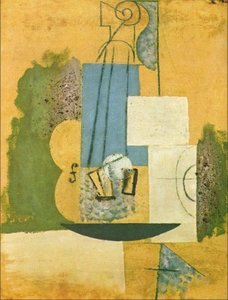 Violin
"Violin" by Pablo Picasso exemplifies Synthetic Cubism's innovative collage techniques and exploration of multiple perspectives—a cornerstone of modern art’s evolution. Explore its legacy!
While Picasso and Braque are considered the pioneers of Synthetic Cubism, other artists played significant roles in its development. Juan Gris, for example, emerged as a key figure after 1911, producing works that retained close ties to anti-pictorialism and compositional depth. His paintings often featured bright colors, simplified geometric shapes, and a flattened perspective, showcasing his mastery of the technique.
Several masterpieces exemplify the hallmarks of Synthetic Cubism. Still Life with Chair Caning (1912) by Picasso is particularly iconic—an oval canvas framed by rope, featuring a painted tableau of objects and a piece of oilcloth printed with a chair caning pattern. The work deliberately conflates reality and representation, challenging the viewer’s perception of space and form. Similarly, Picasso's Violin (1913) showcases the innovative use of collage techniques and exploration of multiple perspectives—a cornerstone of modern art’s evolution. Other notable examples include Braque’s series of still lifes featuring fruit dishes and musical instruments, each a testament to the movement’s revolutionary approach to form and composition.
Beyond Painting: The Enduring Legacy of Cubism in Modern Art
The impact of Cubism extended far beyond the realm of painting. It sparked artistic innovations in sculpture, music, ballet, literature, and architecture. Artists began to experiment with fragmentation and abstraction in various mediums, challenging traditional conventions and pushing the boundaries of creative expression. The movement’s influence can be seen in Futurism, Suprematism, Dada, Constructivism, and Art Deco—each a testament to Cubism’s revolutionary spirit.
Cubism also introduced collage as a modern art form, paving the way for new techniques and approaches to visual representation. Its emphasis on multiple perspectives influenced filmmakers, writers, and designers, shaping the aesthetic landscape of the 20th century. Even today, Cubism continues to inspire artists and challenge viewers to see the world in new ways—a testament to its enduring legacy as one of the most influential art movements in history.
Collecting Cubism: A Guide for Enthusiasts
For those interested in collecting works related to Cubism, it’s important to understand the different phases and styles within the movement. Early Analytical Cubist paintings are rare and highly sought after, commanding significant prices. Synthetic Cubist works, while more accessible, still represent a substantial investment.
When considering a purchase, authenticity is paramount. Consult with reputable art dealers and appraisers to ensure the work’s provenance and condition. OriginalUniqueArt.com offers high-quality reproductions of Cubist masterpieces, allowing enthusiasts to experience the movement’s beauty and innovation firsthand. Whether you're seeking a museum-quality oil painting or a giclée canvas print, OriginalUniqueArt provides access to a vast collection of artworks at various price points. Explore our selection today and discover the transformative power of Cubism—a movement that continues to redefine our understanding of art and reality.