Early Life and Artistic Foundations
Konstantin Fyodorovich Yuon, born in Moscow on October 24, 1875, emerged from a family steeped in both Swiss-Russian heritage and artistic inclination. His brother, Paul Juon, would achieve renown as a composer, hinting at the creative currents flowing through their upbringing. From a young age, Konstantin demonstrated an affinity for visual expression, nurtured by a mother who fostered artistic pursuits within the home. This early exposure laid the groundwork for his formal education at the Moscow School of Painting, Sculpture and Architecture from 1892 to 1898. There, he came under the tutelage of distinguished masters like Konstantin Savitsky and Konstantin Korovin, absorbing their techniques and philosophies that would shape his initial artistic trajectory. These formative years weren’t confined to Russia; Yuon embarked on journeys to Western Europe, particularly Paris, where he encountered the burgeoning
Impressionist movement. While captivated by artists such as
Camille Pissarro, he didn't simply imitate—he synthesized these influences with a uniquely Russian sensibility, forging his own distinct style.
From Symbolism to Soviet Realism
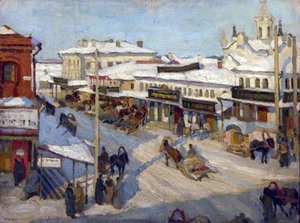
Yuon’s early work is characterized by an evocative blend of Impressionistic landscapes infused with subtle Symbolist undertones. Paintings like
To the Trinity (1903) and
Tverskoy Boulevard (1909) exemplify this period, capturing
fleeting moments of light and atmosphere while hinting at deeper emotional resonances. He wasn’t content to remain solely within the realm of
Impressionism; Yuon began experimenting with lyrical landscapes that incorporated elements drawn from traditional
Russian art forms—the delicate precision of Palekh miniature painting and the spiritual depth of icon artistry. This fusion created a visual language uniquely his own, steeped in national identity yet open to innovation. However, the political upheaval of the
early 20th century dramatically altered the course of Yuon’s artistic development. As the Soviet era dawned, he navigated the shifting demands of a new ideological landscape. His style gradually evolved towards a more academic approach, embracing the tenets of
Socialist Realism—a style that prioritized accessibility and served as a tool for propagating revolutionary ideals. This shift is powerfully evident in his monumental work
Parade on the Red Square on November 7, 1941, a patriotic depiction of Soviet strength during wartime.
A Multifaceted Career and Institutional Leadership
Konstantin Yuon’s contributions extended far beyond the canvas. He was not merely a painter but also an influential figure in the organization and administration of the
Russian art world. He co-founded both the Union of Russian Artists and, later, the Association of Artists of Revolutionary Russia, actively shaping the direction of artistic expression during periods of profound social change. His administrative talents were further recognized through his leadership roles: he served as director of the Research Institute of the Academy of Arts (1948–1950) and, culminating in a distinguished career, became the First Secretary of the Union of Soviet Artists (1956–1958). These positions afforded him considerable influence over artistic policy and education, allowing him to champion his vision for
Russian art. His dedication was acknowledged with prestigious accolades, including the Stalin Prize in 1943 and the Order of Lenin, solidifying his status as a national treasure.
Legacy and Enduring Influence
Konstantin Yuon’s legacy is complex and multifaceted—a testament to an artist who navigated turbulent times while remaining committed to his craft. He stands as a pivotal figure in Russian
art history, bridging the gap between the aesthetic sensibilities of the
late 19th century and the ideological demands of the Soviet era. His early Symbolist landscapes possess a haunting beauty that continues to captivate viewers, while his later Socialist Realist works offer valuable insights into the artistic strategies employed by the Soviet regime. Today, Yuon’s paintings are held in prominent museum collections across Russia, including the
Tretyakov Gallery and the
Taganrog Art Museum, ensuring their accessibility for generations to come.
His work continues to be studied and celebrated for its technical mastery,
emotional depth, and historical significance—a lasting tribute to a remarkable artist who left an indelible mark on the cultural landscape of Russia.