Inspiration · Academic Art

The 100 Famous Academic Art Paintings That Inspire Our Artists

1823 – 1920

The most famous Academic Art paintings are Jean-Léon Gérôme's Truth Coming Out of Her Well (1896, Musée Anne de Beaujeu), Alexandre Cabanel's The Birth of Venus (1863, Musée d'Orsay) and Vittorio Reggianini's An amusing song (n.d.). Below, all 100 of them — painted from 1823 to 1920 by 74 artists — with their date, their size and the museum that keeps them.

Truth Coming Out of Her Well by Jean-Léon Gérôme, 1896, Musée Anne de Beaujeu — famous Academic Art painting
No. 1 · Jean-Léon GérômeTruth Coming Out of Her Well1896 · Musée Anne de Beaujeu, Moulins
100singular works
74masters · Alexey Venetsianov – Jose Ruiz de Almodovar Burgos
32homes in 17 cities
3kept at the Metropolitan Museum of Art

Singular works

100 Academic Art paintings that exist only once

Every original here is unique and kept in one place. Its story, its home, and the detail that makes it unmistakable.

  1. Truth Coming Out of Her Well by Jean-Léon Gérôme, 1896, Musée Anne de Beaujeu
    1

    Musée Anne de Beaujeu, Moulins1896Oil on canvas91 × 72 cm

    The painting 'Truth Coming from the Well Armed with Her Whip to Chastise Mankind' was created by Gérôme in 1896. It is an oil on canvas painting with dimensions of 91 x 72 cm. The painting is currently housed at the Musée Anne de Beaujeu in Moulins, France. However, art historian Bernard Tillier argues that Gérôme's images of Truth and the well were part of his ongoing diatribe against Impressionism.

    Its story

  2. The Birth of Venus by Alexandre Cabanel, 1863, Musée d'Orsay
    2

    Musée d'Orsay, Paris1863Oil on canvas130 × 225 cm

    This work arrived at the Paris Salon of 1863 to meet with immediate and great success, drawing eyes to the grace of her form and the mythological drama unfolding before the viewers. This particular iteration, dating from 1875, resides within the Metropolitan Museum of Art.

    Its story

  3. An amusing song by Vittorio Reggianini
    3

    Oil on canvas

    Every surface is rendered with a specific, sensory weight: The heavy folds of silk and satin that drape across chairs. The painting exists in the private sphere, far from grand historical dramas.

    Its story

  4. Granville Sharp the Abolitionist Rescuing a Slave from the Hands of His Master by James Hayllar, 1864
    4

    1864Oil on canvas

    The setting is a courtroom, a space of rigid rules and wooden chairs, where the weight of the law meets the weight of human suffering. This encounter ignited a fire in Sharp, leading him to challenge the legal status of enslaved people in Britain.

    Its story

  5. General View of Paris from a Hot-air Balloon by Victor Navlet, 1855
    5

    1855Oil on canvas

    In 1855, Victor Navlet captured a panoramic view of Paris from the basket of a hot-air balloon. Acquired by Napoleon III at the Exposition Universelle, the canvas reflects the ambition of the Second Empire. The painting functions as a visual record of 19th-century French urbanism.

    Its story

  6. Le déluge (ébauche) by Léon Comerre, 1911
    6

    1911Oil on canvas

    It is a vision of survival and struggle amidst the rising waters. These dark hues reflect the oppressive weight of the storm, leaving only the pale skin of the struggling figures to catch the light amidst the murky, drowning world.

    Its story

  7. Bannockburn by John Hassall, 1915
    7

    1915Oil on canvas126 × 180 cm

    The scene centers on a group of warriors gathered around a central figure. By focusing on the prayers and the gathering of the troops, John Hassall captures the weight of the historical event through the eyes of those who lived it.

    Its story

  8. Isabella and the Pot of Basil by Arthur Trevethin Nowell, 1904, Museo de Arte de Ponce
    8

    Museo de Arte de Ponce1904Oil155 × 102 cm

    The subject, a woman draped in a deep red dress, sits with a certain stillness that suggests a weight upon her spirit. A crown rests upon her head, hinting at a nobility that feels more like a burden than a privilege.

    Its story

  9. Sympathy by Briton Rivière, 1878
    9

    1878Oil on canvas37.5 × 45.1 cm

    A young girl sits perched upon the patterned steps of a staircase, her small frame draped in a blue dress with delicate ruffled sleeves. It moves away from grand historical spectacles to find meaning in the small, private moments of life.

    Its story

  10. Cleopatra Testing Poisons on Condemned Prisoners by Alexandre Cabanel, 1887, Royal Museum of Fine Arts Antwerp
    10

    Royal Museum of Fine Arts Antwerp1887Oil on canvas162 × 287 cm

    To stand before Alexandre Cabanel's Cleopatra Testing Poisons on Condemned Prisoners is to step directly into the opulent, dramatic heart of nineteenth-century academic painting.

    Its story

  11. Figure walking on the shore, Lake Como, Italy by Arthur Hacker, 1913
    11

    1913Oil on paper

    Figure walking on the shore, Lake Como, Italy is an oil on paper created by Arthur Hacker, R.A., R.I. Arthur Hacker was a British artist who achieved significant standing within the established art world, eventually being elected an Academician.

    Its story

  12. The Bitter Draught of Slavery by Ernest Normand, 1885
    12

    1885Oil on canvas137 × 198 cm

    There are at least five people visible in the scene, some sitting while others stand or kneel. The room is decorated with several potted plants and multiple vases, which, rather than adding to a pleasant ambiance, serve to frame the unsettling nature of the gathering.

    Its story

  13. Empress Eugenie Surrounded by her Ladies in Waiting by Franz Xaver Winterhalter, 1855, Musee National du Chateau de Compiegne
    13

    Musee National du Chateau de Compiegne1855Oil on canvas300 × 420 cm

    The oil on canvas titled Empress Eugenie Surrounded by her Ladies in Waiting was completed in 1855 by the German artist Franz Xaver Winterhalter. In 1846, he captured The Royal Family in 1846, documenting the lineage of a house in repose.

    Its story

  14. A Maid of Volendam by Beryl Fowler, 1911, Laing Art Gallery
    14

    Laing Art Gallery, Newcastle upon Tyne1911Oil on canvas61 × 51 cm

    The white of her lace-detailed bonnet draws the eye immediately, creating a sharp contrast against the muted, shadowy tones of the background. There is a stillness here, a moment captured with a focus on the textures of her clothing and the softness of her skin.

    Its story

  15. Queen Victoria Opening of the Royal Courts of Justice by Henry Tanworth Wells, 1882, Government Art Collection
    15

    Government Art Collection, London1882Oil on canvas211 × 350 cm

    At the heart of the composition, Queen Victoria is depicted in her regal attire, surrounded by a structured assembly of courtiers and officials. The atmosphere is one of quiet, ordered dignity, reflecting the solemnity of the legal institution.

    Its story

  16. Saint François d'Assise by Ernest Ange Duez, 1884
    16

    1884Oil on canvas

    Executed in 1884, the work measures 285 cm in height and 300 cm in length. Ernest Ange Duez was born in Paris in 1843 and died in Saint-Germain-en-Laye in 1896. The work is documented in the museum's official catalogues, specifically within the 1978 and 1993 publications for the Musée des Beaux-Arts de Pau.

    Its story

  17. Spoliarium by Juan Luna, 1884
    17

    Juan LunaAcademic Art

    Spoliarium

    1884Oil on canvas400 × 800 cm

    This triumph carries the work into a new chapter in 1886, when it is sold to the provincial government of Barcelona for 20,000 pesetas. Later, in 1982, Suzano "Jun" Gonzalez performs a cleaning to refresh the view of the scene.

    Its story

  18. The Last of the Garrison by Briton Rivière, 1875, Manchester Art Gallery
    18

    Manchester Art Gallery1875Oil on canvas

    A bloodhound lies on the floor, its body heavy and still. This piece has a history that extends beyond its initial exhibition at the Royal Academy in 1875. It carries its own marks of conflict, having been subject to vandalism during an attack by Suffragettes in 1913.

    Its story

  19. At the Cottage Door by William Henry Margetson
    19

    Oil on canvas

    A woman stands at the threshold of a cottage, her hands resting upon the window frame. The scene is framed by the architectural elements of the doorway and the windowsill, which are crowded with various botanical elements. The integration of Post-Impressionist influences through a more varied use of pigment.

    Its story

  20. American Progress by John Gast, 1872, Autry Museum of the American West
    20

    Autry Museum of the American West, Los Angeles County1872Oil on canvas29.2 × 40 cm

    In 1872, John Gast painted American Progress. The work arrived through a commission from publisher George Crofutt. Gast was a Prussian-born American painter, printer, and lithographer. It was commissioned in 1872 by George Crofutt, a publisher of American Western travel guides.

    The singular detailschool bookcolumbia

    Its story

  21. 'Cutty Sark' Speaking 'E. S. Hocken' (of Fowey) by Reuben Chappell, Clipper Ship Cutty Sark
    21

    Clipper Ship Cutty Sark, LondonOil paint on canvas56 × 80 cm

    The composition centers on a large sailing ship, its silhouette cutting through a heavy, overcast sky. There is a palpable sense of movement here, captured in the way the water churns beneath the hull and the sails catch the diffused light of a stormy day.

    Its story

  22. I Know a Maiden Fair to See by Charles Edward Perugini, 1868, Minneapolis Institute of Art
    22

    Minneapolis Institute of Art1868Oil on canvas

    The composition focuses on her head, shoulders, and arms, creating a sense of closeness that feels almost private. The painting is rooted in the literary traditions of the mid- 19th century, drawing its inspiration from a German ballad translated by Henry Wadsworth Longfellow in 1843. The work was exhibited at the Royal Academy in 1868.

    The singular detailpearl earringswoman with fan

    Its story

  23. Paradise Lost by Alexandre Cabanel, 1867
    23

    1867Oil on canvas

    One can almost feel the tension radiating from the composition—the palpable weight of lost grace mingling with the stark reality of expulsion. Alexandre Cabanel, a titan of 19th-century French academic painting, employed a style characterized by its polished finish, idealized forms, and rich narrative scope.

    Its story

  24. Lamour and Psyche Children by William-Adolphe Bouguereau, 1890
    24

    1890Oil on canvas121.3 × 73 cm

    The painting has a significant history within the academic tradition, having been displayed at the Salon of Paris in 1890. It is frequently misidentified in various digital archives and museum records as Le Premier Baiser (The First Kiss, 1873).

    Its story

  25. Remorse by Louis Marie Baader
    25

    Oil on canvas

    The scene draws from the myth of Orestes, who has just carried out the violent act of avenging his father, Agamemnon. By depicting Orestes and his victims in the nude, the work strips away the distractions of status or clothing, leaving only the raw, vulnerable reality of the flesh.

    Its story

  26. A village scene by Robert Gallon
    26

    Oil on canvas

    The composition centers on a dirt thoroughfare, its uneven texture suggesting the heavy passage of feet and hooves. Oil on canvas medium Muted palette of earth tones Loose, gestural brushstrokes Emphasis on atmospheric light The work reflects a commitment to the academic tradition of realistic representation, yet it avoids the stiffness of formal portraiture.

    Its story

  27. My Wife's Lovers by Carl Kahler, 1891
    27

    1891Oil painting182.88 × 259.08 cm

    In 1891, a massive canvas begins to take shape under the brush of the Austrian artist Carl Kahler. After its creation, the painting finds itself on display for the 1893 Chicago World's Fair, where it meets a vast audience. Disaster strikes the city in 1906, yet the painting survives the San Francisco earthquake.

    Its story

  28. The First Mourning by William-Adolphe Bouguereau, 1888, National Museum of Fine Arts
    28

    National Museum of Fine Arts, Buenos Aires1888Oil on canvas203 × 250 cm

    The scene captures the biblical aftermath of the first murder, where Adam and Eve confront the lifeless form of their son, Abel. This moment marks the transition from innocence to the heavy reality of human mortality.

    Its story

  29. The Prussian Homage by Jan Matejko, 1882, National Museum in Kraków
    29

    National Museum in Kraków, Krakow1882Oil on canvas388 × 875 cm

    Following this, he painted Rejtan in 1866, which captures a moment of political tension. In 1878, he produced Battle of Grunwald, a depiction of conflict characterized by a sense of urgent, dynamic energy and meticulous detail in the rendering of movement.

    Its story

  30. Nero's Torches by Henryk Siemiradzki, 1876, National Museum in Kraków
    30

    National Museum in Kraków, Krakow1876Oil on canvas385 × 704 cm

    The oil on canvas painting titled Nero's Torches was executed by the artist Henryk Siemiradzki. This work is also identified by the titles Candlesticks of Christianity or Nero's Living Torches. The subject matter focuses on the persecution of early Christians during the reign of the Roman Emperor Nero.

    Its story

  31. Venus Rising by Jean-Léon Gérôme, 1890
    31

    1890Oil on canvas129.5 × 79.5 cm

    In 1847, he painted The Cock Fight. Later, in 1872, he produced Pollice Verso, a composition centered on a moment in the Roman Colosseum where a gladiator's fate rests upon a single gesture. In 1873, he created The Gray Cardinal, a painting that utilizes heavy robes to render a sense of solemnity and power. Moving toward the end of the nineteenth century, he turned his attention to the legend of Pygmalion and Galatea in 1890.

    Its story

  32. L'offensive de L'yser by François Flameng
    32

    Oil

    François Flameng lived until 1923, leaving behind a body of work that reflects the shifting landscapes of French society.

    Its story

  33. A Nymph in the Forest by Charles Amable Lenoir
    33

    Oil on canvas

    The surrounding forest is populated by scattered purple flowers and a single bird in the upper periphery, grounding the ethereal subject in a tangible, natural setting. The composition relies on several key elements: The interplay of light on the subject's limbs to define muscular structure.

    Its story

  34. The Parable of Forgiveness by James Eckford Lauder, 1847, Walker Art Gallery
    34

    Walker Art Gallery, Liverpool1847Oil on canvas198 × 314 cm

    The scene is set within a room defined by grand columns, which lend a sense of permanence and gravity to the assembly. Men and women are gathered in various states of engagement; some are seated upon benches, while others stand in clusters, their bodies angled toward one another in the midst of deep conversation.

    Its story

  35. Flowers in an agate vase placed on a marble console by Jan Frans van Dael, 1850
    35

    1850Oil on canvas116 × 88 cm

    Jan Frans Van Dael was born in Antwerp in 1764. In 1786, he relocated to Paris, establishing his presence within the artists’ quarters of the Louvre. His transition into specialized flower painting was marked by a consistent presence in the Paris Salon, where he exhibited regularly between 1793 and 1833.

    Its story

  36. Romans of the Decadence by Thomas Couture, 1847, Musée d'Orsay
    36

    Musée d'Orsay, Paris1847Oil on canvas472 × 772 cm

    In the foreground, numerous figures occupy the space, engaged in various activities that suggest a state of indulgence. Some individuals recline on couches, while others stand or sit in close proximity. It was presented at the 1847 Salon, where it drew attention for its scale and its depiction of ancient life.

    Its story

  37. Napoleon's Farewell to Josephine by Louis Marie Baader
    37

    Oil on canvas

    A man in military uniform leans toward a woman resting upon a couch. It is a study of the private cost of public duty.

    Its story

  38. Soul Carried to Heaven by William-Adolphe Bouguereau, 1878
    38

    1878Oil

    Soul Carried to Heaven is an oil on canvas work by the artist William-Adolphe Bouguereau. The piece is currently held at the Musee du Perigord in France. The work by William-Adolphe Bouguereau focuses on a specific spiritual subject.

    Its story

  39. The Long Sleep by Briton Rivière, 1868
    39

    1868Oil

    It is a work of quietude, measuring 30.6 x 23.4 cm, or 12 x 9.2 inches. Briton Rivière, an artist of British descent, brought a specific sensibility to this composition. The painting offers a glimpse into a private, still moment, rendered with the precision characteristic of his hand.

    Its story

  40. Œdipus by Jean-Léon Gérôme, 1886
    40

    1886Oil on canvas61.6 × 101.9 cm

    The oil on canvas titled Œdipus was presented at the Salon of 1886. In 1898, William Randolph Hearst acquired the painting, bringing it into his private holdings. The shadows of power found expression in 1873 through the heavy robes of The Gray Cardinal.

    Its story

  41. September Morn by Paul Émile Chabas, 1912, Metropolitan Museum of Art
    41

    Metropolitan Museum of Art, New York1912Oil on canvas164 × 217 cm

    The scene is set amidst the icy morning waters of Lake Annecy in Upper Savoy. By the end of 1913, Leon Mantashev had acquired the work, and it was carried into Russia. It resurfaced in 1935 within the collection of Calouste Gulbenkian. Philadelphia Main Liner William Coxe Wright purchased the piece, and in 1957, it was donated to the Metropolitan Museum of Art. It belongs to the museum's Modern and Contemporary Art department.

    Its story

  42. Nymphs Hunting by Julius LeBlanc Stewart, 1898
    42

    1898Oil on canvas

    The forest breathes with a quiet, heavy life as three women move through the dappled light. A third woman moves on the right, completing a silent choreography of grace. It feels like a dream of a pastoral existence, where the only clock is the movement of sunlight through the trees.

    Its story

  43. Latimer Preaching before Edward VI at Paul's Cross by Ernest Board, 1910
    43

    1910Oil206 × 211 cm

    The scene focuses on the preacher Latimer, whose presence commands the attention of a vast, layered crowd. The composition draws the eye through the assembly, moving from the figures in the immediate foreground toward the central figure of the preacher.

    Its story

  44. The Twelve-Year-Old Jesus in the Temple by Carl Bloch, 1869
    44

    1869Oil on copper

    This work, painted by Carl Bloch, illustrates the specific narrative found in the biblical passage Luke 2:41-52. It depicts the moment Mary and Joseph finally locate their son after a three-day search through Jerusalem. The piece was created as part of a significant commission for the Frederiksborg Palace Chapel.

    Its story

  45. Cuerda de Presos by Jose Maria Lopez Mezquita
    45

    Oil on canvas

    A procession of prisoners moves through the damp air, bound together in a heavy, rhythmic march. This piece, which earned a first medal at the National Exhibition of Fine Arts in Madrid, reflects a deep preoccupation with the social tensions of the era.

    Its story

  46. Sunday Afternoon at Sea by Joseph Nash the Younger
    46

    Oil

    The water beneath the hull is choppy, a restless expanse of blue that suggests a day of movement rather than rest. On the deck, small figures move among the rigging, their bodies engaged in the quiet labor of navigation.

    Its story

  47. Jacob Wrestling with the Angel by Alexander Louis Leloir, 1865
    47

    1865Oil on canvas

    It is a scene that has occupied the minds of painters for centuries, yet Leloir approaches the encounter with a distinct sense of immediacy. At only twenty-two years of age, the artist demonstrated a remarkable ability to handle such a demanding and large-scale historical subject.

    Its story

  48. A Young Fishwife by Eugene de Blaas
    48

    Oil85 × 45 cm

    In exploring the breadth of Eugene de Blaas’s oeuvre, one finds a recurring interest in the quiet, industrious moments of Venetian life. While Venetian Flower Seller offers a glimpse into the commerce of the city, other works like Which Came First allow for a different kind of narrative engagement.

    Its story

  49. Pensive Girl by Friedrich von Amerling
    49

    Oil on canvas

    A woman sits in a moment of stillness, her head bowed toward an unseen thought. Friedrich Ritter von Amerling was a master of the academic tradition in Vienna.

    Its story

  50. Nymphe by Guillaume Seignac
    50

    Oil

    The soft light filters through the canopy, catching the curves of her form and the subtle textures of the surrounding greenery. This approach creates a space where the viewer feels they have stumbled upon a private, mythological moment frozen in time.

    Its story

  51. Elegant Soiree by Jean Béraud
    51

    Oil

    Elegant Soiree is a detailed painting depicting a lively ballroom scene. The composition features a large gathering of people engaged in dancing and conversation. Within the space, at least 14 individuals are visible, dressed in elegant suits and gowns. The dancers are distributed throughout the room, with some positioned in the foreground and others further back, creating a sense of depth and movement.

    Its story

  52. The Cook's Tale by Alex de Andreis
    52

    Oil

    The cook stands with a dish held aloft, offering its contents to the seated figures. The interaction between the cook and his patrons is not one of grand drama, but of a shared, quiet necessity.

    Its story

  53. Joan of Arc at the Stake by Frederic Theodore Lix
    53

    Oil

    This work illustrates a specific moment from the Hundred Years' War, centering on the execution of a French figure. Following a trial conducted by Bishop Pierre Cauchon, she was convicted of heresy. Frederic Theodore Lix utilizes a structured approach to depict this historical event.

    Its story

  54. Springtime by Pierre Auguste Cot, 1873, Metropolitan Museum of Art
    54

    Metropolitan Museum of Art, New York1873Oil on canvas213.4 × 127 cm

    The two are wearing classical garb and seem to be enthralled by each other, described as "drunken with first love." The painting was first exhibited at the 1873 Paris Salon, where it received critical acclaim and became Cot's most successful work of art.

    Its story

  55. Pride of Place by Briton Rivière
    55

    Oil painting

    In this oil painting, two dogs occupy a rustic outdoor setting. A large, dark-coated dog moves through the foreground, its body angled toward the viewer in a posture of alertness.

    Its story

  56. All the world over by James Hayllar
    56

    Oil on canvas

    All the world over is a work by James Hayllar. The artist's technical approach was shaped by formal training at Cary’s Art Academy in London and the Royal Academy Schools.

    Its story

  57. Countess Varvara Alekseyevna Musina-Pushkina by Franz Xaver Winterhalter, 1850, Hermitage Museum
    57

    Hermitage Museum, Saint Petersburg1850Oil on canvas147 × 112 cm

    Franz Xaver Winterhalter rendered this likeness during a period when he was established within the French art scene. In 1855, he painted Empress Eugénie Surrounded by her Ladies in Waiting, a work exhibited at the Exposition Universelle. In 1865, he turned his attention to the Austrian court to paint Empress Elisabeth of Austria.

    Its story

  58. Evening Mood by William-Adolphe Bouguereau, 1882, National Museum of Fine Arts of Cuba
    58

    National Museum of Fine Arts of Cuba, Havana1882Oil on canvas207.5 × 108 cm

    It was created in France, emerging from the rigorous academic traditions that defined the era. Measuring 207.5 cm in height and 108 cm in width, the painting possesses a verticality that lends a certain grace to its composition. This oil on canvas resides within the National Museum of Fine Arts of Cuba.

    Its story

  59. The Doctor by Luke Fildes, 1891
    59

    Luke FildesAcademic Art

    The Doctor

    1891Oil on canvas166 × 242 cm

    During a 1949 campaign by the American Medical Association, the work is used to influence public discourse regarding nationalized health care. In 1874, he presents The Casual Ward, a work that confronts the starkness of life within a workhouse.

    Its story

  60. Death of Cleopatra by Louis Marie Baader, 1899
    60

    1899Oil paint, canvas

    The heavy silence of a royal chamber hangs over the scene in Death Of Cleopatra. This work, painted about 1899, freezes a moment of immense historical gravity.

    Its story

  61. Madonnina by Roberto Ferruzzi, 1897
    61

    1897Oil on panel

    A young woman cradles a sleeping infant against the weight of a heavy blue cloak. The scene is a close-up, a private moment caught in the soft light of an afternoon. It was not born from religious iconography, but from the domestic reality of a young girl named Angelina Cian. The original canvas has vanished into the unknown, leaving only the memory of its impact. The light fades into an indistinct background, leaving only the mother and the child in the quiet dark.

    Its story

  62. Harem Pool by Jean-Léon Gérôme, 1876, Hermitage Museum
    62

    Hermitage Museum, Saint Petersburg1876Oil on canvas73.5 × 62 cm

    The composition features a group of people immersed in an atmosphere of opulence and relaxation, surrounded by decorative tiles and gold accents.

    Its story

  63. Edward John Slinn by George Henry Grenville Manton, 1901
    63

    1901Oil

    The portrait depicts a man with a white beard seated in a chair. Painted in 1901, this work reflects the realist traditions of the late Victorian period.

    Its story

  64. Equestrian Portrait of Captain Burns Hartopp with Hounds by Arthur Stockdale Cope, 1906
    64

    1906Oil on canvas163 × 143 cm

    Equestrian Portrait of Captain Burns Hartopp with Hounds is an oil on canvas work by the British portraitist Arthur Stockdale Cope. The work is part of the Leicestershire County Council Artworks Collection, held at County Hall. This specific commission reflects the artist's technical proficiency in rendering both human likeness and animal form.

    Its story

  65. And in the First Career they Ran by Daniel Maclise
    65

    Oil paint on canvas

    He eventually settled in London, England, where he remained until his death in 1870. Subtle variations in tone provide the only warmth, hinting at the presence of light catching a surface or a fold of fabric.

    Its story

  66. At the Opera by Seymour Joseph Guy, 1887
    66

    1887Oil on canvas

    It is a study of refinement and the social grace expected of an operagoer during the late Victorian era. Seymour Joseph Guy, an artist born in England who later established himself in the United States, brings a particular sensitivity to this subject.

    Its story

  67. Portrait of Ángel Ganivet by Jose Ruiz de Almodovar Burgos, 1920, Museo Casa de los Tiros de Granada
    67

    Museo Casa de los Tiros de Granada1920Oil57 × 44 cm

    The Portrait of Ángel Ganivet is a painting by the Spanish artist Jose Ruiz De Almodovar Burgos. This work depicts the Spanish writer and diplomat Ángel Ganivet, who lived from 1865 to 1898. José Ruiz de Almodóvar Burgos was born in 1867 in Granada, Spain.

    Its story

  68. Kelly Pool by Cassius Marcellus Coolidge
    68

    Oil

    Cassius Marcellus Coolidge captures a spirited moment in Kelly Pool, where the usual quiet of a billiard room is replaced by the animated energy of canine competitors. Multiple chairs are scattered throughout the space, placed strategically for patrons to sit and watch the unfolding competition.

    Its story

  69. The King's Armourers by Adolphe Alexandre Lesrel
    69

    Oil on canvas

    Opposite him, a man dressed as a knight holds a wine glass, his attention turned toward his companion. It captures a sense of social dynamics and the quietude of a private chamber.

    Its story

  70. Portrait of M. M. Philosophova by Alexey Venetsianov, 1823
    70

    1823Oil, canvas

    Philosophova emerges from the shadows of history, a quiet encounter with a woman from 1823. There is no movement here, only the weight of her presence. The work measures 71×61, a scale that brings the viewer into an intimate proximity with the subject's steady gaze.

    Its story

  71. The Canterbury Pilgrims by Edmund Thomas Parris, 1836
    71

    1836Oil106 × 172 cm

    The painting titled The Canterbury Pilgrims was executed by the artist Edmund Thomas Parris. This work dates to 1836. It is currently held within the collection of Canterbury Museums and Galleries. This specific piece, The Canterbury Pilgrims, was produced during a period when Parris was active in the United Kingdom.

    Its story

  72. Cupid Disguised as a Roman Shepherd Boy by James Edward Freeman, 1842
    72

    1842Oil

    A young boy occupies the center of the composition, positioned against a solid blue background. The subject matter, a child in mythological or pastoral disguise, reflects a mid- 19th-century interest in fantasy and the romanticized depiction of classical figures.

    Its story

  73. Church Interior Florence by Robert Mcinnes, 1860, The Stirling Smith Art Gallery - Museum
    73

    The Stirling Smith Art Gallery - Museum1860Oil32 × 36 cm

    Painted about 1860, the piece captures a specific moment of devotion within a sanctuary. It is a study of light and communal presence, rendered with the technical precision characteristic of the artist's hand.

    Its story

  74. The Last Parting of Marie-Antoinette and her Son by Edward Matthew Ward
    74

    Oil on canvas

    The work was presented to the public at the Royal Academy Exhibition of 1856 at the National Gallery, London. In 1859, he exhibited Marie Antoinette Listening to the Act of Accusation the Day Before Her Trial. At least one work featuring the Queen's daughter, Marie-Thérèse, was exhibited in 1875.

    Its story

  75. The martyr of fanaticism by José Joaquim de Brito, 1895, National Museum of Contemporary Art - Museu do Chiado
    75

    National Museum of Contemporary Art - Museu do Chiado, Lisbon1895Oil on canvas239 × 295 cm

    De Brito's training at the Academy of Fine Arts in Porto and his subsequent studies in Paris provided him with the technical ability to render such intense human emotion and anatomical detail.

    Its story

  76. Children Playing in a Park by Hugues Merle, 1860
    76

    1860Oil on canvas45 × 54 cm

    This work dates to about 1860. It captures a quiet moment of youth within a lush green field, where the light settles upon the grass and the figures of children. He spent his final years in Paris, where he died in 1881.

    Its story

  77. French, ) by Aristide Maillol
    77

    In the painting French,) by Aristide Maillol, a woman is positioned on a beach near the edge of the ocean. The figure is oriented toward the water, looking out at the expanse of the ocean that occupies the background.

    Its story

  78. Venus and her Attendants by Hans Zatzka
    78

    Oil

    A bird rests atop the bed, adding a touch of life to the stillness of the composition. Hans Zatzka, born in Vienna, Austria, was a painter who navigated the boundaries between religious iconography and the realms of fantasy.

    Its story

  79. A Star in the East by Thomas Davidson
    79

    Oil113 × 87 cm

    A Star in the East is a painting by Thomas Davidson. The artist, born in 1842, captured this scene within the quietude of a domestic or sacred gathering. Davidson, who passed away in 1919, brought a specific focus to the figures surrounding a central woman and her infant.

    Its story

  80. Anna Bilinska (1857–1893) by Emmeline Deane, 1884, Victoria Art Gallery
    80

    Victoria Art Gallery, Bath1884Oil on canvas128 × 91 cm

    To look at this portrait is to encounter a moment of private sorrow.

    Its story

  81. Water Babies by Edward Poynter, 1900
    81

    1900Oil on canvas

    The work was originally exhibited at the Royal Academy Summer Exhibition of 1900. This work was exhibited at the Royal Academy Summer Exhibition of 1900, Burlington House, no. 224. The work was first presented to the public at the Royal Academy Summer Exhibition of 1900, Burlington House, appearing as item number 224. The painting later appeared at auction through Sotheby's, London, on 19 February 1987, listed as lot 185. Among these are Israel in Egypt (1867), a large-scale work noted for its narrative composition and atmospheric effects.

    Its story

  82. Highland Landscape with Sheepdog and Sheep by John Joseph Barker, Dumfries Museum And Camera Obscura
    82

    Dumfries Museum And Camera ObscuraOil125 × 100 cm

    This animal sits in an alert posture, observing a herd of sheep that is spread across the field. Some sheep stand in close proximity to one another, while others are situated further away in the landscape.

    Its story

  83. Shalmaneser I Pours Out the Dust of Arina Before His God Ashur by Ambrose Dudley
    83

    Painting

    Ambrose Dudley brings a specific, illustrative precision to this historical scene.

    Its story

  84. Ulysses and the Sirens by Herbert James Draper, 1909
    84

    1909Oil

    The oil painting titled Ulysses And The Sirens -was executed by the artist Herbert James Draper in 1909. The gallery acquired the work directly from Herbert James Draper in 1910 for the sum of £600. The Water Nixie was painted in 1908, and The Kelpie was painted in 1913.

    Its story

  85. The Duet by James Sant, Tate Britain
    85

    James SantAcademic Art

    The Duet

    Tate Britain, LondonOil on canvas76.8 × 64.1 cm

    Born in London, United Kingdom, Sant developed a technical foundation in watercolor before transitioning to oil painting. In The Duet, Sant applies his characteristic sensitivity to human emotion.

    Its story

  86. Napoleon Bonaparte in the Grand Mosque at Cairo by Henri Léopold Levy, Musée Des Beaux Arts
    86

    Musée Des Beaux Arts, MulhouseOil on canvas

    Napoleon Bonaparte occupies this sacred ground, a figure of political intent amidst the stillness of the mosque. The light falls across the scene, catching the curve of the horse's neck and the stillness of the gathered figures. Henri Léopold Levy uses oil on canvas to build this historical encounter.

    Its story

  87. Sunset over the Lake by Serhii Vasylkivsky, National Art Museum of Ukraine
    87

    National Art Museum of Ukraine, KievOil on canvas

    The canvas presents a landscape dominated by a vast sky meeting a calm body of water. The following elements define the visual structure of the work: Color Palette: Predominantly pink, orange, and various shades of reflected light on the water.

    Its story

  88. Illustration to Imre Madách's The Tragedy of Man: In Athens (Scene 5) by Mihály Zichy, 1887, Hungarian National Gallery
    88

    Hungarian National Gallery, Budapest1887Illustration100 × 70 cm

    The artist, a prominent figure in Hungarian romantic painting, produced this specific illustration to interpret a pivotal moment within the literary work. Mihály Zichy’s contribution to this series emerged during a period when he was increasingly focused on illustrative projects.

    Its story

  89. Fidelity by Briton Rivière, 1869
    89

    1869Oil on canvas

    The scene unfolds within the quiet, heavy atmosphere of 1869, a moment frozen in oil on canvas. The arrangement of these elements creates a sense of stillness, as if the viewer has stumbled upon a private, unhurried moment of companionship.

    Its story

  90. Volunteers at the Firing Point, 1866 by Henry Tanworth Wells, 1866
    90

    1866Oil on canvas182 × 292 cm

    Under the wide, open sky, a group of men gathers, their presence a mixture of formal civic duty and raw, unpracticed readiness. At the center of this assembly stands a soldier, his grey uniform a stark contrast against the natural landscape.

    Its story

  91. The Wife of Jeroboam and the Blind Prophet by George Henry Grenville Manton, 1888, Guildhall Art Gallery
    91

    Guildhall Art Gallery, London1888Oil198 × 152 cm

    Beside her, another woman sits, her posture more modest, her gaze fixed on a point beyond the immediate frame. The scene is anchored by simple, functional objects: two vases placed near the edges of the composition and a chair positioned in the background.

    Its story

  92. The Death of Marshal Ney by Jean-Léon Gérôme, 1868, Graves Art Gallery
    92

    Graves Art Gallery1868Oil on canvas65.2 × 104.2 cm

    The scene unfolds with a sudden, sharp stillness, focusing on the execution of Maréchal Michel Ney. The narrative continues into 1873 with The Gray Cardinal, where the artist renders the solemnity of power through heavy robes and quiet dignity. In 1890, the focus turns to the legend of myth in Pygmalion and Galatea.

    Its story

  93. Spring by William-Adolphe Bouguereau, 1886, Joslyn Art Museum
    93

    Joslyn Art Museum, Omaha1886Oil on canvas201.3 × 117.79 cm

    The painting, also known as Le Printemps or The Return of Spring, was executed in 1886. Following its debut in France, the painting traveled to the United States, where it was included in the Omaha Art Exhibition Associated First Annual Exhibition in 1890, listed as number 198.

    Its story

  94. Farewell in Washington to His Mother by Louis Marie Baader
    94

    Oil paint on canvas

    In "Farewell In Washington To His Mother" by Louis Marie Baader, a heavy silence fills the room as history pauses to witness a private, poignant moment. The scene captures George Washington in the act of bidding farewell to his mother, Mary Ball Washington.

    Its story

  95. Gypsy at the Door of Brousse by Louis Marie Baader, 1885, Musée des Beaux-Arts de Morlaix
    95

    Musée des Beaux-Arts de Morlaix1885Oil on canvas

    Behind her, a wall forms a solid backdrop to the scene, while a vase rests on a surface in the background. Created in 1885, this work belongs to a period when French painters often moved between large-scale historical subjects and intimate genre scenes. The painting was acquired from the artist in 1887.

    Its story

  96. Anacréon 3 (Cupidon s'enfuit) by Jean-Léon Gérôme, 1899
    96

    1899Oil

    Anacréon 3 (Cupidon s'enfuit) is a painting by the French artist Jean-Léon Gérôme. This work, created about 1899, focuses on the subject matter of Greek mythology. He produced the painting Pollice Verso in 1872 and later painted Pygmalion and Galatea in 1890.

    Its story

  97. Lart and literature by William-Adolphe Bouguereau, 1867, Arnot Art Museum
    97

    Arnot Art Museum1867Oil on canvas200 × 108 cm

    This piece presents a portrait of two women seated upon a bench. The figures are positioned within an outdoor setting, framed by the presence of trees in the background.

    Its story

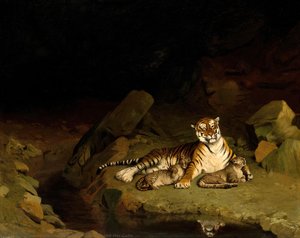
  98. Tigress and Her Cubs by Jean-Léon Gérôme, 1895, Metropolitan Museum of Art
    98

    Metropolitan Museum of Art, New York1895Oil on canvas73.7 × 91.4 cm

    In 1847, he created The Cock Fight. By 1872, he had produced Pollice Verso. The year 1873 brought The Gray Cardinal. Around 1894, he rendered Harem Women Feeding Pigeons in a Courtyard. In 1895, he completed Tigress and Her Cubs.

    Its story

  99. The Hanging of the Sigismund bell at the Cathedral Tower in 1521 in Kraków by Jan Matejko, 1874, National Museum in Warsaw
    99

    National Museum in Warsaw1874Oil on canvas94 × 189 cm

    Painted by Jan Matejko and completed in 1874, this oil on canvas is a significant example of history painting. The subject matter centers on the year 1521, a period of great power for the Kingdom of Poland. He completed Rejtan in 1866, followed by The Union of Lublin in 1869.

    Its story

  100. EMMANUEL, MARQUIS de GROUCHY, MARECHAL de FRANCE by Jean Sébastien Rouillard
    100

    Oil paint on canvas

    Jean Sébastien Rouillard produced this work about 1835. In 1819, he painted the Portrait of the Woman of General Pauchez. This was followed by the Portrait of General Dominique René Vandamme, Count of Unsebourg, which he executed in 1835. Later in his career, he completed the Portrait of Victor Henry Juglar in 1847.

    Its story

Lineages

The famous Academic Art paintings by lineage

Where they live

The one place you can see each famous Academic Art painting

London keeps 4 of these originals; the Metropolitan Museum of Art, 3.

The masters

The Academic Art masters our artists look to

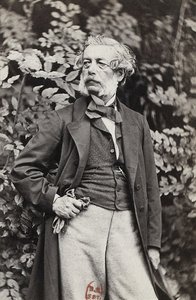
Portrait of Jean-Léon Gérôme

Jean-Léon Gérôme

1824–1904 · France · 7

French Academicist known for meticulous detail and dramatic Orientalist and historical scenes, from Roman gladiators to desert landscapes.

1. Truth Coming Out of Her Well, 31. Venus Rising, 40. Œdipus, 62. Harem Pool, 92. The Death of Marshal Ney, 96. Anacréon 3 (Cupidon s'enfuit), 98. Tigress and Her Cubs

Portrait of William-Adolphe Bouguereau

William-Adolphe Bouguereau

1825–1905 · France · 6

French academic realist known for luminous skin tones and idealized mythological figures, rendered with meticulous anatomical precision.

24. Lamour and Psyche Children, 28. The First Mourning, 38. Soul Carried to Heaven, 58. Evening Mood, 93. Spring, 97. Lart and literature

Portrait of Briton Rivière

Briton Rivière

1840–1920 · United Kingdom · 5

Victorian academic artist known for emotive animal scenes and historical narratives rendered with meticulous detail and psychological depth.

9. Sympathy, 18. The Last of the Garrison, 39. The Long Sleep, 55. Pride of Place, 89. Fidelity

Louis Marie Baader

1828–1920 · France · 5

Known for Breton life & military history, his works showcase historical and genre scenes.

25. Remorse, 37. Napoleon's Farewell to Josephine, 60. Death of Cleopatra, 94. Farewell in Washington to His Mother, 95. Gypsy at the Door of Brousse

Portrait of Alexandre Cabanel

Alexandre Cabanel

1823–1889 · France · 3

French academic realist known for polished figures and the sensual grace of The Birth of Venus, rendered with meticulous, smooth brushwork.

2. The Birth of Venus, 10. Cleopatra Testing Poisons on Condemned Prisoners, 23. Paradise Lost

Portrait of James Hayllar

James Hayllar

1829–1920 · United Kingdom · 2

British genre and portrait painter of charming domestic scenes and pretty young girls, known for his technical precision and Royal Academy style.

4. Granville Sharp the Abolitionist Rescuing a Slave from the Hands of His Master, 56. All the world over

Portrait of Franz Xaver Winterhalter

Franz Xaver Winterhalter

1805–1873 · Germany · 2

German academic painter of elegant royal portraits with smooth, enamel-like textures of silk and lace for the courts of Europe.

13. Empress Eugenie Surrounded by her Ladies in Waiting, 57. Countess Varvara Alekseyevna Musina-Pushkina

+67more masters our artists study Academic Art Masters Their stories

In confidence

About these Academic Art paintings

Hover gently over a question to read the answer.

What are the 10 most famous Academic Art paintings?

How was this list of Academic Art paintings ranked?

By recognition: Wikipedia articles in the most languages (Wikidata sitelinks), our manual ranking and page visits. Several records of one painting count once; details, copies and studies are excluded.

How the selection is made

We went through every Academic Art painting in our catalogue and placed the best-known first: those Wikipedia describes in the most languages, those our artists and curators rank highest and those most viewed on our pages. Each original appears once — no details or copies.

Other movements that inspire us

The periods that inspire us