Inspiration · Naturalism

The 100 Famous Naturalism Paintings That Inspire Our Artists

1870 – 1918

Ask for the most famous Naturalism paintings and you will hear of Lewis L Cross's Passenger Pigeons (1900), Anton von Werner's Kaiserproklamation in Versailles (1871) and Anton von Werner's Proclamation of the German Empire (1871). Below, all 100 of them — painted from 1870 to 1918 by 56 artists — with their date, their size and the museum that keeps them.

Passenger Pigeons by Lewis L Cross, 1900 — famous Naturalism painting
No. 1 · Lewis L CrossPassenger Pigeons1900
100singular works
56masters · Albert Pinkham Ryder – Gari Melchers
33homes in 23 cities
9kept at the Soares dos Reis National Museum

Singular works

100 Naturalism paintings that exist only once

Every original here is unique and kept in one place. Its story, its home, and the detail that makes it unmistakable.

  1. Passenger Pigeons by Lewis L Cross, 1900
    1

    1900Oil on canvas

    This piece is dated about 1900. The composition focuses on a large group of birds in flight, capturing a specific moment of avian movement across the sky. Lewis L Cross utilized an oil medium to render the subjects. The painting depicts at least 14 birds scattered throughout the frame. At least 14 birds are visible within the composition, distributed across the expanse of the scene.

    Its story

  2. Kaiserproklamation in Versailles by Anton von Werner, 1871
    2

    1871Oil

    Created as a birthday present for Otto von Bismarck, this 1885 iteration offers a specific, curated perspective on the assembly. By capturing the ceremony in the Hall of Mirrors, the artist anchored the political transformation of 1871 in a setting of immense historical weight.

    Its story

  3. Proclamation of the German Empire by Anton von Werner, 1871
    3

    1871Oil on canvas

    A final version was produced in 1913, a late reflection on the event. This painting was a gift for Otto von Bismarck's 70th birthday in 1885. In different iterations, the imperial moment took various forms, such as Kaiserproklamation in Versailles from about 1871 and Die Kaiserproklamation from about 1877.

    Its story

  4. A Leopard by Cuthbert Edmund Swan
    4

    Oil19 × 22 cm

    In this intimate study, a leopard occupies the center of the canvas, its body stretching across the frame in a moment of quiet repose. This work reflects a period of artistic transition, where the precision of scientific observation met the expressive energy of the late 19th and early 20th centuries.

    Its story

  5. Mt. Washington Hood Canal (painting) by James Everett Stuart, 1891
    5

    1891Oil

    These peaks rise in the background, heavy and silent, casting a long shadow over the stillness of the Hood Canal. Trees are scattered along the shoreline and the rising slopes, their dark forms providing a textured anchor to the pale, icy light of the high country.

    Its story

  6. A Frisian family drinking Coffee by Carl Ludwig Jessen, 1897
    6

    1897Oil on canvas

    The artist, Carl Ludwig Jessen, was a significant figure in North Frisian art, often recognized for his detailed documentation of regional life. This particular piece, an oil on canvas, functions as a formal record of contemporary customs and attire from the late nineteenth century.

    Its story

  7. Young Girl by Jules Bastien-Lepage
    7

    Oil

    In Jules Bastien-Lepage's Young Girl, a quiet moment in the grass unfolds before us. By 1875, his brush finds the solemnity of ritual in First Communion, while simultaneously portraying the character of Portrait of M. Hayern. He explores classical themes in 1876 with Priam at the Feet of Achilles.

    Its story

  8. Jeanne d'Arc by Jules Bastien-Lepage, 1879, Metropolitan Museum of Art
    8

    Metropolitan Museum of Art, New York1879Oil on canvas254 × 279.4 cm

    Jeanne d'Arc is an oil on canvas painting created by the French artist Jules Bastien-Lepage. The composition includes the figures of Saint Michael, Saint Margaret, and Saint Catherine. It was first presented at the Salon in 1880. In 1889, the painting became a gift from Davis.

    Its story

  9. River Sado by João Vaz, Soares dos Reis National Museum
    9

    João VazNaturalism

    River Sado

    Soares dos Reis National Museum, PortoOil on canvas35 × 59 cm

    The sky above is filled with clouds, creating an atmospheric layer over the landscape. In the background, two smaller boats are visible, one situated on the left side and another toward the right. The artist was a member of the Lion's Group, an association dedicated to promoting naturalism within the arts.

    Its story

  10. The Last Supper by Pascal Dagnan-Bouveret, 1896, Musée d'Orsay
    10

    Musée d'Orsay, Paris1896Oil

    This large-scale religious composition was exhibited at the Salon de Champ-de-Mars in 1896. His earlier career was marked by significant recognition at the Salon, including the 1880 work An Accident and the 1885 painting Horses at the Watering Trough.

    Its story

  11. Fra Svolvær by Gunnar Berg, 1889, Nordnorsk Kunstmuseum
    11

    Nordnorsk Kunstmuseum, Tromsø1889Oil on canvas

    The work is dated about 1889. The artist, Gunnar Berg, was born in Svolvær, Norway, in 1863. One such work is Fra Vaterfjord, dated between 1886 and 1893, which is currently on display at Svolvær City Hall. Another composition, Trollfjordslaget, was produced in 1890 and is situated in the Gunnar Berg Gallery in Svolvær. This work depicts the Battle of Trollfjord, an event from 1890 involving local fishermen and large steamships over fishing rights.

    Its story

  12. Tigers at a Drinking Pool by Wilhelm Kuhnert
    12

    Oil painting

    Two tigers occupy the center of this living scene, positioned side by side near the edge of a watering hole. One tiger rests on the left while the second is situated more toward the right, both appearing to watch a potential prey or perhaps another animal moving through the brush.

    Its story

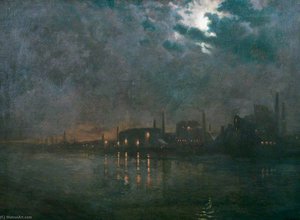
  13. The River Thames from Wandsworth Bridge by Charles Ernest Butler, Government Art Collection
    13

    Government Art Collection, LondonOil painting on canvas77 × 103 cm

    A full moon hangs in a cloudy sky, casting a diffused, soft glow that settles over the entire landscape. Along the banks, industrial buildings and chimneys rise into the darkness, their windows emitting a warm, amber light that cuts through the prevailing cool tones of the night.

    Its story

  14. Ladyslippers by Frank Mcclure
    14

    Painting

    Long green leaves drape around the blossoms, framing the delicate structures of the Ladyslippers. The composition rests in a stillness that mimics the hush of a forest floor. The light settles on the white surfaces, creating a soft, atmospheric quality that pulls the viewer into a private, silent space.

    Its story

  15. Child with an Orange by Gari Melchers, 1918
    15

    1918Oil

    There is a certain weight to her presence, a quiet dignity that belies her years.

    Its story

  16. Least Pewee Flycatcher. Male. (White Oak. Quercus Prinus.) by John James Audubon
    16

    Oil painting

    Quercus Prinus.) is an oil painting by John James Audubon. The artist, John James Audubon, was born in Les Cayes, Haiti, on April 26, 1785. John James Audubon was a French-American naturalist and explorer whose work was defined by a relentless engagement with the natural world.

    Its story

  17. Mill on the Brown's River by Charles Louis Heyde
    17

    Near the center-right, a dog rests, a small, living punctuation mark in a landscape of stone and timber. This work reflects a deep connection to the American landscape, specifically the character of the New England terrain.

    Its story

  18. The Salon Jury by Henri Gervex, 1883
    18

    1883Oil on canvas

    It depicts a meeting of the painting jury of the Salon, which was the official exhibition of the Académie des Beaux-Arts, during the year 1883. The provenance of the piece moved from private ownership to a public institution when Waldeck-Rousseau gave the painting to the Musée du Luxembourg in 1892.

    Its story

  19. Une Soiree Mondaine by Henri Gervex, 1909, Carnavalet Museum
    19

    Carnavalet Museum, Paris1909Oil on canvas217 × 318 cm

    A soft, amber glow spills from a covered patio, catching the edge of a white tablecloth. In the center of this social theater, a man and a woman are locked in a quiet exchange.

    Its story

  20. Self portrait Aurélia de Souza by Aurélia de Souza, 1900, Soares dos Reis National Museum
    20

    Soares dos Reis National Museum, Porto1900Oil on canvas45 × 36 cm

    Self portrait Aurélia de Souza, also known as Self-Portrait in a Red Coat or Autorretrato, is an oil on canvas work by the artist Aurélia de Souza. The painting was created about 1900. It is currently held in the collection of the Soares dos Reis National Museum in Porto, Portugal.

    Its story

  21. Returning to the Fox's Lair by Heywood Hardy, 1896
    21

    1896Oil on canvas

    Returning to the Fox's Lair is a notable work by the British artist Heywood Hardy. Hardy, who was born in Chichester, United Kingdom, developed a reputation for his precise understanding of animal anatomy and the quiet drama found in rural settings. In this particular composition, the artist focuses on the red fox, a subject that allows for a study of both form and instinct. It remains part of a private collection, preserved away from the public eye.

    Its story

  22. Standing Female Nude by John Robertson Reid, 1873, Edinburgh College of Art
    22

    Edinburgh College of Art1873Oil on canvas76 × 51 cm

    The painting titled Standing Female Nude is a work by the Scottish painter John Robertson Reid. The figure remains still, a quiet presence held within the frame of the canvas. Perhaps she is posing for the artist, or perhaps she is simply existing in a private interval of time.

    Its story

  23. Red Squirrels by Charles Frederick Tunnicliffe
    23

    Oil76 × 64 cm

    In "Red Squirrels" by Charles Frederick Tunnicliffe, a quiet moment in the wild unfolds with sudden life. The scene feels alive, as if the viewer has stumbled upon a private, fleeting encounter deep within the woods. It feels as though the viewer has stumbled upon a private encounter in the thicket.

    Its story

  24. Niagara Falls by Scotlan George Inness, 1885, Smithsonian American Art Museum
    24

    Smithsonian American Art Museum, Washington, D.C.1885Oil on panel40 × 61 cm

    His 1855 work, The Lackawanna Valley, offers a glimpse into his foundational years. His 1887 painting, September Afternoon, demonstrates this shift, capturing a specific sense of tranquility through a careful balance of shadow and warmth. By 1893, in The Home of the Heron, he utilized subtle tonal variations to suggest a hazy, almost ethereal atmosphere.

    Its story

  25. Field with Geese by Léon Augustin Lhermitte, 1897
    25

    1897Oil

    There is a gentle sense of movement in the way the birds are positioned; some are standing still on the ground, while others are caught in the middle of flight or resting quietly. This arrangement creates a natural depth that draws the eye across the terrain.

    Its story

  26. Moonlit Seascape by Thomas Moran, 1891
    26

    1891Oil on canvas

    Created in 1891, this oil on canvas captures a moment where the ocean meets the dark sky under a lunar glow. It arrives late in his life, appearing only two years before his death in 1926. A transformative moment occurs in 1862 when the brothers travel to England.

    Its story

  27. Loch Moidart by Robert Lillie
    27

    Oil45 × 60 cm

    A single tree stands near the shoreline, its form a dark anchor against the pale reflections of the sky. Behind it, mountains rise in muted layers, their peaks softened by the heavy, damp air of the Highlands.

    Its story

  28. The Eider Trilogy, Morning by Johannes Larsen, The Danish Parliament
    28

    The Danish Parliament, CopenhagenOil on canvas

    Johannes Larsen, a prominent figure in the Funish Painters movement, created The Eider Trilogy, Morning. The artist lived until 1961, leaving behind a body of work deeply rooted in the maritime and rural environments of Funen. In 1936, he executed a fresco mural titled Mørgensøl for the festival hall of Odense City Hall.

    Its story

  29. In Summer (first version) by Hans Emmenegger, 1901–1905
    29

    1901–1905Oil

    The work reflects a period of intense technical experimentation, specifically the "layered painting" method documented in the artist's private notebooks between 1901 and 1905. Created in 1905, this version of the scene avoids the romanticized exaggerations common in contemporary landscape traditions.

    Its story

  30. The Letter by James Carroll Beckwith, 1910
    30

    1910Oil paint on canvas127 × 87 cm

    In The Letter, James Carroll Beckwith captures a quiet, suspended moment of intimacy. The atmosphere remains still, as if the world outside has paused to allow this single, private exchange to take place. The soft, diffused light catches the edges of her form, grounding the scene in a sense of immediate, private reality.

    Its story

  31. Highland Landscape by Charles Oppenheimer, The Stewartry Museum
    31

    The Stewartry Museum, CairnsOil on canvas75 × 106 cm

    The mountains rise with a quiet strength, their peaks catching the light as they frame a deep, verdant valley. Trees are scattered across the terrain, their lush greenery anchoring the composition and providing a sense of scale against the vastness of the hills.

    Its story

  32. C Krohg-Kone som skjærer brød by Christian Krohg, 1879, KODE Art museums and composer homes
    32

    KODE Art museums and composer homes, Bergen1879Oil on canvas80 × 66 cm

    The painting titled C Krohg -Kone som skjærer brød is a work by Christian Krohg. Born on 13 August 1852 in Vestre Aker, Norway, the artist occupied a space between the soft echoes of Romanticism and the stark clarity of Naturalism.

    Its story

  33. La route (Seine et Marne) by Jean Charles Cazin, Musee des Beaux-Arts
    33

    Musee des Beaux-Arts, ReimsOil on canvas59.8 × 72.8 cm

    There is no harshness in the application of oil on canvas, only a layering of color that mimics the atmospheric weight of a cloudy day. The scene captures a specific, fleeting moment of rural life, where the only movement is the implied direction of the road itself.

    Its story

  34. Fishing Village, Lofoten by Thorolf Holmboe
    34

    Oil on canvas100 × 140 cm

    In 1900, he was appointed a Knight of the 1st Class of the Order of St. Olav. Later, in 1912, he was awarded the Petter Dass-medaljen. In 1906, he was appointed as an artist for Porsgrunds Porselænsfabrik, the famous Norwegian pottery maker.

    Its story

  35. Lion by Rosa Bonheur
    35

    Rosa BonheurNaturalism

    Lion

    Oil paint on canvas

    In the artwork titled Lion by Rosa Bonheur, the subject is a single lion positioned within a vast, arid landscape. This composition focuses on a study of animal anatomy and behavior, presenting the creature in its natural habitat. The lion gazes toward the distant horizon, creating a scene of solitude and quiet observation.

    Its story

  36. The 'nancy Lee' of Great Yarmouth by Philip Richard Morris
    36

    Oil paint

    On the shores of Great Yarmouth, the construction of a vessel becomes a site of collective labor. The scene captures the building of the Nancy Lee, a ship rising from its wooden scaffolding. Eleven carpenters are positioned along the hull, their movements dictated by the rhythm of their hammers.

    Its story

  37. A L'opera by Gaston La Touche
    37

    Oil on canvas

    The oil painting A L'opera is a work by the French artist Gaston La Touche. A man and a woman occupy the center of this social landscape, their presence anchored amidst the movement of other guests in the background.

    Its story

  38. Flowers near a well by Henri Biva
    38

    Oil on canvas

    This particular work carries a significant presence, measuring 71.2 in (180.9 cm) in height and 46.5 in (118.1 cm) in width. Henri Biva was a painter who understood the subtle shifts of light.

    Its story

  39. In the Tavern by Simon Hollósy
    39

    Oil

    By moving away from the rigid, idealized models of the Munich Academy, the artist embraced a philosophy of direct engagement with the world. The scene is not a staged performance but a fragment of existence, captured with the same sincerity found in the landscapes of the Nagybánya colony.

    Its story

  40. Sheep by Charles Jones
    40

    Charles JonesNaturalism

    Sheep

    The painting Sheep presents a lively pastoral setting within a grassy field. The composition is centered around three primary subjects: a large adult sheep standing prominently in the foreground, a smaller sheep positioned to its left, and a third sheep located further back on the right side.

    Its story

  41. Western quoll by John Gould
    41

    Painting

    The artwork titled western quoll by John Gould presents a detailed study of a specific marsupial. This subject, also known as the chuditch, is a member of the family Dasyuridae. The depiction focuses on the physical presence of this animal, which is Western Australia's largest endemic mammalian carnivore. The artist, John Gould, captures the animal within its natural context, focusing on the specific anatomical features that define the species. These habitats include the mallee and the Jarrah Forest.

    Its story

  42. Winter romance by Maurice Leloir
    42

    Oil

    The man is clad in a green coat, while the woman wears a brown dress. In the background, two additional figures are visible, one situated on the left and the other on the right, adding depth to the scene.

    Its story

  43. Summer's Fruitful Pasture by Albert Pinkham Ryder, 1870
    43

    1870Painting

    Summer's Fruitful Pasture, (painting) is a work by Albert Pinkham Ryder. This piece dates to about 1870. It emerges from a period when the painter was beginning to find his voice within the American landscape. Albert Pinkham Ryder was an American painter known for his poetic and moody allegorical works and seascapes.

    Its story

  44. Boats in an Estuary by Paul Jean Clays
    44

    Oil

    Several vessels sit moored in the calm, their masts reaching upward like silent sentinels against an overcast heavens. These boats, weathered by salt and sun, carry the weight of many voyages, their hulls resting heavily in the shallow, reflective waters.

    Its story

  45. The beach by João Vaz, 1900, Casa-Museu Dr. Anastácio Gonçalves
    45

    João VazNaturalism

    The beach

    Casa-Museu Dr. Anastácio Gonçalves, Lisbon1900Oil on canvas47.5 × 57.5 cm

    These subjects appear to be observing something together, directing attention toward the horizon or the sky. The presence of sand and water in River Sado reinforces his specialization in capturing the naturalistic qualities of the Portuguese coast.

    Its story

  46. Marguerite au Sabbat by Pascal Dagnan-Bouveret, 1911, Musée d'Art et d'Histoire de Cognac
    46

    Musée d'Art et d'Histoire de Cognac1911Oil, canvas

    Created about 1911, the work reflects the artist's commitment to the naturalist school, a movement defined by its focus on realism and the meticulous depiction of life. This is evident in Woman in Breton Costume Seated in a Meadow, Les Bretonnes au Pardon, and the 1887 Portrait of Brittany Girl.

    Its story

  47. Le Pardon de Ploumanac'h (Finistère) by Léon Augustin Lhermitte, 1879
    47

    1879Oil on canvas

    The scene unfolds in the rugged, salt-aired landscape of the Finistère region in France. Through the hand of Léon Augustin Lhermitte, the viewer witnesses a specific, localized expression of piety. The work, created about 1879, finds its heart in the intersection of the natural world and the spiritual life of the Breton people.

    Its story

  48. Sovende mor med barn by Christian Krohg, 1883, Rasmus Meyer Collection
    48

    Rasmus Meyer Collection, Bergen1883Oil on canvas107.5 × 142 cm

    The painting titled Sovende mor med barn (1883) is a significant work by the Norwegian artist Christian Krohg. Krohg, who was born in Vestre Aker, Norway, in 1852, brought a specific, observational depth to his subjects that defined much of his creative output.

    Its story

  49. Three Dogs (painting) by Lewis L Cross
    49

    Three Dogs, (painting) rests in a world of monochrome stillness. Three dogs lie nestled within the tall grass, their forms resting in a state of calm repose. One dog occupies the left, a second settles in the center, and a third rests on the right, creating a rhythmic sequence of life amidst the greenery.

    Its story

  50. Brüllender Löwe by Wilhelm Kuhnert
    50

    Oil on canvas

    The painting titled Brüllender Löwe is a work by the artist Wilhelm Kuhnert. The title, which translates from German as "Roaring Lion," refers to the subject depicted in the composition. Wilhelm Kuhnert was born in 1865 in Opole, Poland.

    Its story

  51. Bretons praying by Pascal Dagnan-Bouveret, 1888, Montreal Museum of Fine Arts
    51

    Montreal Museum of Fine Arts1888Oil on canvas123.5 × 68.9 cm

    The work before us is titled bretons praying, a piece executed by the French artist Pascal Dagnan-Bouveret. Created in 1888, this painting reflects the naturalist sensibilities that defined much of the artist's career. It is a quiet, observant study that captures a specific moment of devotion within the Breton tradition. Pascal Dagnan-Bouveret was born in Paris, France, in 1852. This is particularly evident in The Last Supper, executed in 1896.

    Its story

  52. A Meeting of the Judges of the Salon des Artistes by Henri Gervex, 1883
    52

    1883Oil on canvas

    It is an oil on canvas composition that depicts a meeting of the painting jury of the Salon, the official exhibition of the Académie des Beaux-Arts, in 1883. In 1892, the painting moved from private hands to a public institution.

    Its story

  53. Laundress by Pascal Dagnan-Bouveret, 1879
    53

    1879Oil

    A woman sits upon a bench, her presence defined by a sense of stillness as she tends to her infant, who rests within a basket. Around her, the world continues its slow, rhythmic movement; figures pass by, some standing in conversation, others merely drifting through the background.

    Its story

  54. Valtesse de La Bigne by Henri Gervex, 1889, Musée d'Orsay
    54

    Musée d'Orsay, Paris1889Oil on canvas200 × 122 cm

    The work, titled Valtesse De La Bigne, offers a glimpse into the sophisticated world she inhabited. These pieces demonstrate a capacity to move between the private elegance of a muse and the stark, observational nature of modern life.

    Its story

  55. Christ and the Disciples at Emmaus by Pascal Dagnan-Bouveret, 1890, Carnegie Museum of Art
    55

    Carnegie Museum of Art, Pittsburgh1890Oil on canvas254 × 335.28 cm

    The artist, Pascal Dagnan-Bouveret, was a prominent figure in the French art scene and a leading member of the naturalist school. It is currently held in the collection of the Carnegie Museum of Art.

    Its story

  56. Consolatrix Afflictorum by Pascal Dagnan-Bouveret
    56

    Oil on canvas

    Consolatrix Afflictorum, also known as Consolatrix Afflictorium, is a painting by Pascal Dagnan-Bouveret. The subject matter of the painting carries specific historical weight, as it was commissioned by Henry Clay Frick. Other notable compositions include the 1883 depiction of Hamlet and the Gravediggers. In 1880, he received a first-class medal for An Accident.

    Its story

  57. Ophelia by Pascal Dagnan-Bouveret, 1900
    57

    1900Oil on canvas

    The figure is positioned within a landscape containing dense foliage and a body of water. Pascal Dagnan-Bouveret rendered the subject in a naturalist style.

    Its story

  58. Lady with the Fan by Pascal Dagnan-Bouveret
    58

    Oil

    In this portrait, a woman sits in a moment of stillness, her presence defined by the soft textures of her pink clothing.

    Its story

  59. Albertine to see the Police Surgeon by Christian Krohg, 1880, National Museum of Art, Architecture and Design
    59

    National Museum of Art, Architecture and Design, Oslo1880Oil on canvas211 × 326 cm

    Discover "Albertine to see the Police Surgeon" by Christian Krohg.

    Its story

  60. Research by Joaquín Sorolla, 1897, Sorolla Museum
    60

    Joaquín SorollaBaroque Naturalism

    Research

    Sorolla Museum, Madrid1897Oil122 × 151 cm

    Sorolla’s ability to freeze this dynamic interaction within a single, powerfully rendered frame speaks volumes about his keen eye for capturing not just appearances, but also the very essence of intellectual pursuit. Dr. Simarro Lacabra’s work aligns with the Institución Libre de Enseñanza's commitment to fostering critical thinking and scientific inquiry.

    The singular detailsingle light sourcechiaroscuro

    Its story

  61. October - gathering potatoes by Jules Bastien-Lepage, 1878, National Gallery of Victoria
    61

    National Gallery of Victoria, Melbourne1878Oil on canvas180.7 × 196 cm

    Jules Bastien-Lepage, a French painter, is renowned for his realistic and detailed depictions of rural life. The painting features two women working in a field, each holding a basket filled with freshly gathered potatoes. During the late 19th century, when this painting was created, rural life was a common subject matter in art. October - Gathering Potatoes is not only a beautiful piece of art but also a historical document that provides insight into the lives of rural workers during that era.

    Its story

  62. Struggle for Survival by Christian Krohg, 1889, National Museum of Art, Architecture and Design
    62

    National Museum of Art, Architecture and Design, Oslo1889Oil on canvas300 × 225 cm

    Explore Christian Krohg’s ‘Struggle for Survival,’ a poignant oil painting depicting poverty & hardship in Eastern Europe.

    Its story

  63. Figure of a woman - Roman model by Henrique Pousão, 1882, Soares dos Reis National Museum
    63

    Soares dos Reis National Museum, Porto1882Oil40 × 32 cm

    The painting presents a woman poised with an effortless grace, her blue dress accented by crisp white trim that catches the light, creating a rhythmic visual harmony. There is a certain melancholy inherent in Pousão’s work—a reflection of his own brief, meteoric career—that lends the portrait a hauntingly beautiful quality.

    Its story

  64. Herding the flock (outskirts of Lisbon) by António Carvalho de Silva Porto, 1893, Soares dos Reis National Museum
    64

    Soares dos Reis National Museum, Porto1893Oil

    With a staff in hand, he guides the sheep through the verdant expanse, his presence anchoring the composition with a sense of quiet purpose. As a prominent figure in the Portuguese naturalist school, Silva Porto brings an unparalleled authenticity to this work.

    The singular detailman with staffsheep

    Its story

  65. Manda Lamétrie by Alfred Philippe Roll, 1887, Musée d'Orsay
    65

    Musée d'Orsay, Paris1887Oil on canvas214.3 × 160 cm

    The subject is Amanda (Manda) Lamétrie, a peasant woman hailing from Sainte-Marguerite-sur-Mer in Normandy. In 1888, the work was purchased directly from the artist for the Musée du Luxembourg. It remained there until 1920, when it was transferred to the Louvre. In 1980, the painting was transferred to the Musée d'Orsay.

    Its story

  66. Georg Brandes at the University in Copenhagen by Harald Slott-Møller, 1889, Detroit Institute of Arts
    66

    Detroit Institute of Arts1889Oil on canvas92.1 × 81 cm

    The transition to its current setting began on November 29, 1990, when the piece was offered at Christie's in London, England. Shortly thereafter, in 1991, the Detroit Institute of Arts secured the work through the Robert H. Tannahill Foundation Fund. It is held as part of the institution's holdings of European Modern Art to 1970.

    Its story

  67. The artist Eva Bonnier by Richard Bergh, 1889, Nationalmuseum
    67

    Nationalmuseum, Stockholm1889Oil on canvas123 × 120 cm

    The Artist Eva Bonnier is an oil on canvas portrait executed by Richard Bergh in 1889. This portrait was created during a period when Bergh was a central figure in the Opponenterna movement, a group of Swedish artists advocating for the reform of traditional academic teaching methods. It was acquired by the museum in 1897.

    Its story

  68. Untitled by Joaquina Serrano y Bartolomé, 1875, Museo del Prado
    68

    Museo del Prado, Madrid1875Oil on canvas41 × 33 cm

    The canvas presents "Untitled," a work that emerges from the hands of Joaquina Serrano y Bartolomé. This painting, dating to 1875, captures a quiet moment of natural life. In 1876, she presents Una charra, a work that finds its place within the collections of the Museo del Prado.

    Its story

  69. Lady dressed in black by Henrique Pousão, 1882, Soares dos Reis National Museum
    69

    Soares dos Reis National Museum, Porto1882Oil28 × 18 cm

    As she sits poised within an elegantly appointed room, the viewer is drawn into a private world where time seems to have slowed. The composition, though intimate in scale, possesses a grand emotional weight, suggesting a narrative of high society, quiet reflection, and the refined grace of the late nineteenth century.

    Its story

  70. The white houses of Capri by Henrique Pousão, 1882, Soares dos Reis National Museum
    70

    Soares dos Reis National Museum, Porto1882Oil

    A serene sun-drenched beach scene featuring white hillside houses by Henrique César de Araújo Pousão captures the essence of 1882 naturalism, inviting you to bring this tranquil Italian landscape into your collection.

    Its story

  71. Diogenes by Jules Bastien-Lepage, 1877, Musée Marmottan Monet
    71

    Musée Marmottan Monet, Paris1877Oil on canvas92 × 117 cm

    Experience Jules Bastien-Lepage’s ‘Diogenes.’ A poignant Naturalist painting capturing introspective solitude & French peasant life.

    Its story

  72. La Communiante by Jules Bastien-Lepage, 1875, Musée des Beaux-Arts
    72

    Musée des Beaux-Arts, Tournai1875Oil on canvas53 × 38 cm

    Discover 'La Communiante' by Jules Bastien-Lepage – a poignant portrait of a bride in realistic oil painting.

    Its story

  73. The artist's grandfather by Jules Bastien-Lepage, 1874, Musée d'Orsay
    73

    Musée d'Orsay, Paris1874Oil on canvas103 × 77 cm

    An elderly man sits within a wooded setting, his presence defined by a quiet dignity. The composition focuses on the subject from the waist up, positioned slightly off-center to maintain a sense of naturalism. Painted in 1874, this portrait emerged during a period when Jules Bastien-Lepage was establishing himself within the French art scene.

    Its story

  74. Pseudostoma talpoides by John James Audubon
    74

    John James Audubon19th Century Naturalism

    Pseudostoma talpoides

    John James Audubon’s ‘Pseudostoma talpoides’ is a stunning 19th-century watercolor illustrating two opossums.

    Its story

  75. Glaucus Gull - Burgomaster. 1. Adult male. 2. Young first Autumn by John James Audubon
    75

    John James Audubon’s ‘Glaucus Gull - Burgomaster’ showcases stunning heron illustrations in a meticulous 19th-century style.

    Its story

  76. Varied Thrush . 1. Male. 2. Female. (American Mistletoe by John James Audubon
    76

    John James Audubon’s ‘Varied Thrush’ showcases exquisite detail & scientific precision.

    Its story

  77. Palms in Mahé, Seychelles by Marianne North, 1883, Marianne North Gallery
    77

    Marianne North Gallery, Richmond1883Oil on board35 × 25 cm

    Driven by an insatiable curiosity and a desire to experience the world firsthand, North embarked on a decades-long global expedition, traveling to over 30 countries – including the Seychelles – specifically to document flora. North’s style is firmly rooted in the Pre-Raphaelite tradition, yet uniquely adapted to her botanical pursuits.

    The singular detailpalm treesjungle scene

    Its story

  78. View from Kalutara, Ceylon by Marianne North, 1877, Marianne North Gallery
    78

    Marianne North Gallery, Richmond1877Oil25 × 35 cm

    The scene captures the lush beauty of Kalutara, Ceylon (now Sri Lanka), showcasing a vibrant tropical forest teeming with life. “View from Kalutara” exemplifies Marianne North's distinctive “North Method,” a technique she developed during her extensive travels. Painted in 1877, this artwork reflects the spirit of exploration that characterized the Victorian era.

    The singular detailrivertropical forest

    Its story

  79. Curved Street by Frank Mcclure
    79

    Frank McclureAmerican Naturalism

    Curved Street

    Discover "Curved Street" by Frank McClure – a captivating watercolor depicting a riverside town.

    Its story

  80. Seashore with Moon by Frank Mcclure
    80

    Frank McclureAmerican Naturalism

    Seashore with Moon

    Experience 'Seashore with Moon' by Frank McClure – a serene night scene of rocky coastline & moonlit ocean.

    Its story

  81. Full Moon by Frank Mcclure
    81

    Frank McclureAmerican Naturalism

    Full Moon

    A tranquil scene rendered in a classic, evocative style.

    Its story

  82. Lavender Piano by Frank Mcclure
    82

    Frank McclureAmerican Naturalism

    Lavender Piano

    Discover 'Lavender Piano' by Frank McClure – a serene painting of a blue piano with birds.

    Its story

  83. Corn Stacks by Frank Mcclure
    83

    Frank McclureAmerican Naturalism

    Corn Stacks

    Explore Frank McClure’s ‘Corn Stacks,’ a haunting monochrome drawing of figures in water.

    Its story

  84. Tulip Rows by Frank Mcclure
    84

    Frank McclureAmerican Naturalism

    Tulip Rows

    Explore 'Tulip Rows' by Frank McClure – a captivating black & white painting of vibrant tulips.

    Its story

  85. Night Light by Frank Mcclure
    85

    Frank McclureAmerican Naturalism

    Night Light

    Discover 'Night Light' by Frank McClure – a captivating woodcut print showcasing dramatic lighting & domestic scenes.

    Its story

  86. Sailboat and Moon by Frank Mcclure
    86

    Frank McclureAmerican Naturalism

    Sailboat and Moon

    Experience a serene nighttime seascape featuring a lone vessel & mountainous landscape.

    Its story

  87. Visit to the Iron Rolling Mill by Annibale Carracci, 1900, Kupferstichkabinett
    87

    Kupferstichkabinett, Berlin1900Gouache19 × 26 cm

    Measuring just 19 x 26 cm, its intimate scale belies the complex narrative it unfolds. Eduard Arnhold’s presence as a prominent Jewish patron highlights the artist's engagement with the complexities of German society at the turn of the century, reflecting the growing influence of wealthy merchants like him in shaping local economies.

    Its story

  88. Wild Pine Apple in Flower and Fruit, Borneo by Marianne North, 1876, Marianne North Gallery
    88

    Marianne North Gallery, Richmond1876Oil paint51 × 35 cm

    This oil painting, created in 1876, depicts a vibrant scene of tropical flora. The central focus is a ripe pineapple with a characteristic spiky exterior rendered in shades of green and brown. The background is composed of lush greenery, including broad leaves and other tropical plants, which creates a dense jungle atmosphere.

    Its story

  89. Birds by Winslow Homer
    89

    Winslow HomerNaturalism

    Birds

    Oil on canvas53 × 45 cm

    The artwork depicts a vibrant congregation of diverse bird species nestled within the branches and foliage of a stylized tree. While Homer would later become synonymous with American Realism and Impressionism, “Birds” showcases his early mastery of precise draftsmanship and meticulous technique.

    The singular detailfoliage settingmeticulous detail

    Its story

  90. A mother plainting her little daughter's hair by Christian Krohg, 1888, Skagens Museum
    90

    Skagens Museum1888Oil on canvas44 × 40.8 cm

    As the mother sits before her daughter, her hands move with a practiced, loving grace, creating a scene of deep psychological connection. Krohg, a man who balanced a legal education with a passion for visual storytelling, possessed a unique ability to find extraordinary meaning in ordinary moments.

    Its story

  91. English Under the Yoke by Eero Järnefelt, 1893, Ateneum Art Museum
    91

    Ateneum Art Museum, Helsinki1893Oil164 × 131 cm

    In this 1893 scene, a group of at least twelve figures moves through a desolate, dirt-strewn landscape, their backs turned to the viewer in a silent, collective stance. The figures do not reveal their faces; instead, they become universal symbols of the human condition, stripped of individual identity to represent the collective struggle of the working class. There is a palpable tension in the atmosphere, a sense of the "Kampen för tillvaron"—the struggle for existence—that permeates the very air.

    Its story

  92. Nude (Italy) by António Carvalho de Silva Porto, 1877, Casa-Museu Dr. Anastácio Gonçalves
    92

    Casa-Museu Dr. Anastácio Gonçalves, Lisbon1877Oil47 × 99 cm

    At the heart of the composition lies a woman, draped in a state of effortless grace, reclining upon a rich, crimson cloth. Through his mastery of light and shadow, Silva Porto creates a sense of depth that pulls the observer into the room, making the atmosphere feel almost palpable.

    The singular detailrelaxed posered cloth

    Its story

  93. Two Shorthorn Calves by Henry Hetherington Emmerson, 1874, Cragside
    93

    Cragside1874Oil on canvas51 × 103 cm

    The first calf is situated on the left, while the second calf is placed toward the right side of the frame. The landscape extends toward a background of a hillside, where the silhouettes of trees are visible in the distance.

    Its story

  94. Apple tree in flower by António Carvalho de Silva Porto, 1893, Soares dos Reis National Museum
    94

    Soares dos Reis National Museum, Porto1893Oil on canvas45 × 55 cm

    The scene captures a tree in full bloom, its branches heavy with the promise of fruit. Painted in 1893, this work emerged from a period when Portuguese art was deeply influenced by the Barbizon school and the principles of naturalism.

    Its story

  95. A derelict house - Rome by Henrique Pousão, 1882, Soares dos Reis National Museum
    95

    Soares dos Reis National Museum, Porto1882Oil on panel9 × 16 cm

    The building in the background looms with a sense of age, its walls holding the weight of passing years. A chair rests abandoned on the walkway, and a handbag lies nearby, suggesting a life momentarily paused.

    Its story

  96. In my atelier - self-portrait by Columbano Bordalo Pinheiro, 1884, Grão Vasco National Museum
    96

    Grão Vasco National Museum, Viseu1884Oil on canvas38 × 68 cm

    This piece functions as a direct self-representation, capturing the artist within his own workspace. The painting places the artist in his atelier, a setting defined by the presence of a dining table and a cake.

    Its story

  97. Paisagem (estudo) by Pedro Alexandrino Borges, 1910, Pinacoteca do Estado de São Paulo
    97

    Pinacoteca do Estado de São Paulo, Sao Paulo1910Oil30 × 39 cm

    The composition centers on a body of water, rendered in varying shades of blue to suggest differing depths. A river flows through the scene, bordered by a dense collection of trees. This piece is held at the Pinacoteca do Estado de São Paulo in São Paulo.

    Its story

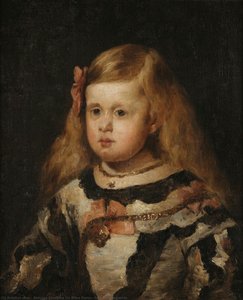
  98. Infanta Margarida by António Carvalho de Silva Porto, 1874, Casa-Museu Dr. Anastácio Gonçalves
    98

    Casa-Museu Dr. Anastácio Gonçalves, Lisbon1874Oil on canvas44 × 36 cm

    Infanta Margarida is an oil on canvas painting by António Carvalho da Silva Porto, executed about 1874. This work functions as an academic study, produced during the artist's period of scholarship in Paris between 1873 and 1879. The composition focuses on the young subject, characterized by long blonde hair and a pink bow.

    Its story

  99. The Poacher - A Hare in View by Peter Henry Emerson, 1886, George Eastman Museum
    99

    George Eastman Museum, Rochester1886Black and white photograph23 × 28 cm

    Born in Cuba to an American father and English mother, Peter Henry Emerson returned to England at age 13 with his mother after the death of his father. He studied medicine, receiving a degree from Kings College in 1879.

    Its story

  100. The village of St. Sauves by Henrique Pousão, 1881, Soares dos Reis National Museum
    100

    Soares dos Reis National Museum, Porto1881Oil on panel46 × 37 cm

    The village of St. Sauves emerged from the brush of Henrique Pousão in 1881. This oil on wood piece measures 460 mm x 378 mm, a compact window into a quiet afternoon. The grain of the wood supports the pigment, holding a moment of stillness within its physical boundaries.

    The singular detailvillage lifepeople walking

    Its story

Lineages

The famous Naturalism paintings by lineage

Where they live

The one place you can see each famous Naturalism painting

Porto keeps 9 of these originals; the Soares dos Reis National Museum, 9.

The masters

The Naturalism masters our artists look to

Frank Mcclure

1896–1979 · United States · 9

Known for novels like 'The Octopus,' his work exposes corporate corruption & social injustice.

14. Ladyslippers, 79. Curved Street, 80. Seashore with Moon, 81. Full Moon, 82. Lavender Piano, 83. Corn Stacks, 84. Tulip Rows, 85. Night Light, 86. Sailboat and Moon

Portrait of Pascal Dagnan-Bouveret

Pascal Dagnan-Bouveret

1852–1929 · France · 8

French Naturalist painter known for realistic Breton scenes and religious compositions, utilizing photography to enhance meticulous detail.

10. The Last Supper, 46. Marguerite au Sabbat, 51. Bretons praying, 53. Laundress, 55. Christ and the Disciples at Emmaus, 56. Consolatrix Afflictorum, 57. Ophelia, 58. Lady with the Fan

Portrait of Jules Bastien-Lepage

Jules Bastien-Lepage

1848–1884 · France · 6

Tragically cut short at thirty-six, the painter achieved fame for his luminous depictions of rural peasant life in France.

7. Young Girl, 8. Jeanne d'Arc, 61. October - gathering potatoes, 71. Diogenes, 72. La Communiante, 73. The artist's grandfather

Portrait of Christian Krohg

Christian Krohg

1852–1925 · Norway · 5

Having studied law at the University of Oslo, the painter turned to the raw realities of daily life and social hardship.

32. C Krohg-Kone som skjærer brød, 48. Sovende mor med barn, 59. Albertine to see the Police Surgeon, 62. Struggle for Survival, 90. A mother plainting her little daughter's hair

Portrait of John James Audubon

John James Audubon

1785–1851 · Haiti · 4

Self-taught naturalist, he transformed from a failed merchant to create the 435 engraved plates in The Birds of America.

16. Least Pewee Flycatcher. Male. (White Oak. Quercus Prinus.), 74. Pseudostoma talpoides, 75. Glaucus Gull - Burgomaster. 1. Adult male. 2. Young first Autumn, 76. Varied Thrush . 1. Male. 2. Female. (American Mistletoe

Portrait of Henri Gervex

Henri Gervex

1852–1929 · France · 4

A scandalous rejection by the Salon de Paris launched his career: keep an eye on the nude figure in Rolla.

18. The Salon Jury, 19. Une Soiree Mondaine, 52. A Meeting of the Judges of the Salon des Artistes, 54. Valtesse de La Bigne

+49more masters our artists study Naturalism Masters Their stories

In confidence

About these Naturalism paintings

Hover gently over a question to read the answer.

What are the 10 most famous Naturalism paintings?

How is this ranking made?

By recognition: Wikipedia articles in the most languages (Wikidata sitelinks), our manual ranking and page visits. Several records of one painting count once; details, copies and studies are excluded.

How the selection is made

We went through every Naturalism painting in our catalogue and placed the best-known first: those Wikipedia describes in the most languages, those our artists and curators rank highest and those most viewed on our pages. Each original appears once — no details or copies.

Other movements that inspire us

The periods that inspire us