The Life and Artistic Evolution of Richard Bergh
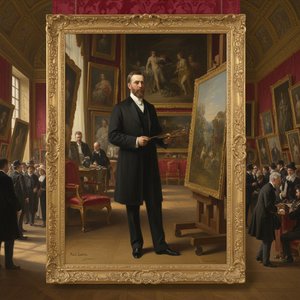
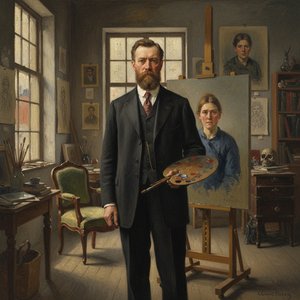
Born in Stockholm City, Sweden, Richard Bergh was a painter, art critic, and museum manager. His formal training began under Edvard Perséus before he attended the Royal Swedish Academy of Fine Arts from 1878 to 1881. Seeking further instruction, he traveled to Paris to study under Jean-Paul Laurens at the Académie Colarossi, eventually exhibiting at the Salon in 1883. While many of his contemporaries embraced Impressionism, Bergh preferred the Naturalism of artists like Jules Bastien-Lepage and rejected the practice of creating landscapes en plein aire.
Bergh was a central figure in the Opponenterna, a group of Swedish artists protesting outmoded teaching methods at the Academy. This movement led to the creation of the Artists' Association, where Bergh served as secretary. In 1896, he coined the term stämningsmåleri, or "mood painting," describing a subjective style that moved away from realism. His later years were marked by a shift toward Romantic Nationalism, a preference strengthened by a stay in Italy between 1897 and 1898.
Legacy and Notable Works
In 1904, Bergh settled in Storängen, Nacka Municipality, in a home designed by architect Albin Brag. Despite his retirement to the Villa Bergh, he returned to public service in 1915 when he was appointed curator and director of the Nationalmuseum. During this time, he worked on modernization projects and wrote various essays regarding art and his involvement with the Opponenterna.
His artistic output includes several significant works, such as:
Questions & Answers
What are the birthplace and birth year of Richard Bergh?
Richard Bergh was born in Stockholm City in 1858.
How can I follow Richard Bergh's work year by year?
A timeline of Richard Bergh's works exists: the artist's Artwork Timeline page orders the artworks by creation date.
Where are Richard Bergh's artworks grouped by keywords?
To find works by Richard Bergh on a specific theme, use the artist's By Keywords page, which groups the artworks by keyword.