
Inspiration · Pop Art

The 100 Famous Pop Art Paintings That Inspire Our Artists

1954 – 1986

Ask for the most famous Pop Art paintings and you will hear of Andy Warhol's Marilyn Diptych (1962, Tate Modern), Roy Lichtenstein's Whaam! (1963, Tate Modern) and Andy Warhol's Campbell's Soup Cans (1962, MOMA - Museum of Modern Art). This ranking lists the 100 best-known Pop Art paintings, painted between 1954 and 1986 by 35 artists, with the museum where each one hangs today.

Marilyn Diptych by Andy Warhol, 1962, Tate Modern — famous Pop Art painting
No. 1 · Andy WarholMarilyn Diptych1962 · Tate Modern, London
100singular works
35masters · Jasper Johns – Keith Haring
17homes in 7 cities
3kept at the Tate Modern

Singular works

100 Pop Art paintings that exist only once

Every original here is unique and kept in one place. Its story, its home, and the detail that makes it unmistakable.

  1. Marilyn Diptych by Andy Warhol, 1962, Tate Modern
    1

    Tate Modern, London1962Silkscreen printing

    The sheer scale of the piece – nearly six feet tall – commands attention, drawing viewers into a world where image and reality blur. This dramatic shift is often interpreted as representing Monroe’s transition from vibrant life to tragic death, or perhaps the fading of her image into history. The artwork quickly became a defining image of the 1960s, solidifying Warhol’s position as a leading figure in contemporary art.

    The singular detaildichotomy of colorblack

    Its story

  2. Whaam! by Roy Lichtenstein, 1963, Tate Modern
    2

    Tate Modern, London1963Oil on canvas172 × 421 cm

    A fighter plane streaks across the canvas, unleashing a fiery attack, rendered with an immediacy that belies its carefully constructed artifice. Created during the Cold War era, this piece reflects anxieties surrounding conflict and technological advancement.

    The singular detailben-Day dotsonomatopoeia ("WHAAAM!")

    Its story

  3. Campbell's Soup Cans by Andy Warhol, 1962, MOMA - Museum of Modern Art
    3

    MOMA - Museum of Modern Art, New York City1962Oil on canvas246.38 × 414.02 cm

    The repetition of identical images underscores the ubiquity of mass-produced goods, making a powerful statement on consumerism and the democratization of art. The series coincided with the rise of consumerism and mass media in America, reflecting a society obsessed with branding, celebrity, and instant gratification.

    The singular detailbold color palettecommercial branding

    Its story

  4. A Bigger Splash by David Hockney, 1967, Tate Britain
    4

    Tate Britain, London1967Oil on canvas

    Painted in California between April and June 1967, " A Bigger Splash" reflects Hockney's fascination with the Californian lifestyle and landscape. This work is part of a sequence that includes "The Little Splash" (1966) and "The Splash" (1966), gradually simplifying and abstracting the composition.

    The singular detailmodern house with flat roof and sliding glass doorsyellow diving board

    Its story

  5. Drowning Girl by Roy Lichtenstein, 1963
    5

    1963Oil and synthetic polymer paint on canvas172 × 172 cm

    This vibrant and dynamic piece immediately draws attention with its bold lines, vivid colors, and expressive subject matter. Created during the height of the Pop Art movement in the 1960s, "Drowning Girl" reflects Lichtenstein's fascination with the emotional content and detached handling of love, hate, war, and other intense subjects found in comic strips.

    The singular detailben-Day dotsturbulent sea background

    Its story

  6. Just what is it that makes today’s homes so different by Richard Hamilton, 1956
    6

    1956Collage

    Blending photorealism with collage techniques, this piece exemplifies the pioneering spirit of Pop Art. Created in 1956 by Richard Hamilton, this artwork is widely regarded as one of the first pieces of Pop Art, marking a revolutionary shift in contemporary art.

    The singular detailcollagevintage advertisements

    Its story

  7. Marilyn by Andy Warhol, 1964
    7

    1964Screen print on paper or canvas

    Andy Warhol's "Marilyn, leo castelli gallery, new york" is a striking portrait of the legendary actress Marilyn Monroe, capturing her essence in a bold and vibrant style. Created in 1964, this portrait is part of Warhol's extensive series of celebrity portraits that began after Monroe's tragic death in 1962.

    Its story

  8. Portrait of an Artist (Pool) by David Hockney, 1971
    8

    1971

    The scene unfolds with an almost cinematic quality, drawing the viewer into the tranquil setting of a swimming pool nestled amongst the rolling hills of Devon. This juxtaposition of precise observation with expressive color is what defines Hockney’s unique artistic voice and cemented his place as one of Britain's most influential artists.

    The singular detailfiguresplants

    Its story

  9. Still life no. 20 by Tom Wesselmann, 1962
    9

    1962Mixed media

    Wesselmann’s signature Pop Art style is immediately recognizable in Still Life No. 20. Created at the height of Pop Art’s emergence, Still Life No. 20 directly responds to the cultural shifts of the early 1960s.

    The singular detailsinkabstract painting

    Its story

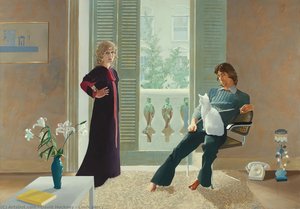
  10. Pool 2 Figures by David Hockney
    10

    Oil on canvas

    The artwork employs a harmonious yet vibrant color palette, with dominant shades of green for the foliage, blue for the pool and sky, and neutral tones like beige and white for the pool deck.

    The singular detailnatural lighting and subtle shadowsambiguous narrative between the two figures

    Its story

  11. Crying Girl by Roy Lichtenstein, 1964, Museum Ludwig
    11

    Museum Ludwig, Cologne1964Porcelain enamel on steel116 × 116 cm

    "Crying Girl," specifically the 1964 porcelain enamel on steel version, exemplifies this approach. Created during the 1960s, "Crying Girl" reflects the broader cultural landscape of its time. The Pop Art movement emerged in response to Abstract Expressionism, rejecting its emphasis on subjective expression in favor of embracing popular culture – advertising, comic books, and mass-produced objects. The image itself draws from a panel in DC Comics' "Secret Hearts," further grounding it within the realm of popular media.

    Its story

  12. Che Guevara by Andy Warhol, 1968, Staatsgalerie Moderner Kunst
    12

    Staatsgalerie Moderner Kunst, Munich1968Silkscreen print

    Pop art is a visual art movement that emerged in the mid-20th century, characterized by its use of popular and mass culture as subject matter. One of the leading figures of pop art was Andy Warhol, whose works explored the relationship between artistic expression, advertising, and celebrity culture.

    Its story

  13. Estate by Robert Rauschenberg, 1963
    13

    1963Mixed media

    Rauschenberg juxtaposes sharp, defined lines – most prominently seen in the clear delineation of street signs like “One Way” and “Stop” – with fluid, organic brushstrokes that suggest movement and decay. Paired with other abstract or Pop Art pieces.

    The singular detaillayered compositionstreet signs ("One Way", "Stop")

    Its story

  14. The Longest Night by Yoshitomo Nara
    14

    Likely digital or mixed media with painterly textures

    Dressed in a vibrant red hooded outfit, the figure exudes a sense of innocence and adventure, while the expressive face hints at introspection or mischievousness. Created within the contemporary art landscape, this piece reflects the influence of Japanese pop art and graphic illustration, echoing the playful yet emotionally nuanced style of artist Nara Yoshitomo Zuzanna.

    The singular detailvibrant color palettetextured background

    Its story

  15. M-Maybe by Roy Lichtenstein, 1965, Museum Ludwig
    15

    Museum Ludwig, Cologne1965Oil on canvas152 × 152 cm

    Roy Lichtenstein's "M-Maybe," painted in 1965, is a quintessential example of the Pop Art movement, capturing a fleeting moment of emotional vulnerability within the context of modern urban life. Emerging in the 1960s alongside artists like Andy Warhol, Roy Lichtenstein became a leading figure in the American Pop Art movement.

    Its story

  16. Handle with care by Corita Kent
    16

    Painting

    Handle with care emerges from the creative spirit of Corita Kent, an artist who leaves a lasting impression through her unique perspective. In this work, the artist uses a bold approach to communicate, turning simple phrases into something that demands attention.

    Its story

  17. Mushrooms by Yayoi Kusama
    17

    The artwork Mushrooms by Yayoi Kusama emerges from a long history of vision and pattern. Created in 1995, Mushrooms belongs to a period where the artist's style often utilizes highly colored acrylics to express deep-seated psychological landscapes. A deep pink, specifically #ea1171, dominates the work, acting as a powerful anchor for the other hues.

    Its story

  18. Flag by Jasper Johns, 1954
    18

    1954Oil, encaustic, and collage on canvas (suggested)

    At first glance, it is the American flag – thirteen stripes alternating red and white, a canton of blue adorned with fifty stars. Emerging in the mid-1950s, “Flag” arrived at a time when Abstract Expressionism dominated the art world.

    The singular detaildeconstruction of symbolismtextured surface

    Its story

  19. The Road to York Through Sledmere by David Hockney
    19

    Acrylic on Canvas: Executed with acrylic paint on canvas, the technique allows for rapid layering and vibrant color mixing – essential elements in Hockney’s process. The painting's subject matter—a small town along the A166 road in Yorkshire—is deeply rooted in the region’s history.

    The singular detailpeoplecolorful scene

    Its story

  20. Campbells by Andy Warhol, 1961, Museum of Modern Art
    20

    Museum of Modern Art1961Silkscreen print

    The bold graphic style—characterized by simplified forms and vibrant hues—contrasts sharply with the gestural brushstrokes prevalent in Abstract Expressionism, signaling Warhol’s rejection of traditional artistic conventions. Campbell’s Soup Cans ignited considerable debate upon its debut at Ferus Gallery in Los Angeles.

    Its story

  21. Garrowby Hill by David Hockney
    21

    Oil on canvas

    The scene unfolds with a deliberate grace: rolling hills rendered in shades of emerald and ochre, punctuated by the cool blues and greens of distant fields. The dominant curve of the road acts as a visual anchor, drawing the eye into the heart of the composition while simultaneously suggesting an endless horizon. Hockney’s ability to capture this essence has cemented his place as one of Britain’s most beloved and influential artists. AllPaintingsStore is proud to offer meticulously crafted, hand-painted oil painting reproductions of David Hockney's Garrowby Hill.

    The singular detailfigureswinding road

    Its story

  22. Knifeship by Claes Oldenburg
    22

    Digital photography

    The imposing knife-like structure, rendered with meticulous attention to detail, symbolizes sharpness, conflict, and transformation. The scene’s layered composition, featuring a historic brick building and a tranquil waterway, enhances its narrative depth, making it a compelling centerpiece for both art enthusiasts and sophisticated interiors.

    The singular detailwater reflectionoversized knife sculpture

    Its story

  23. Mickey by Andy Warhol, 1982
    23

    1982

    Emerging in the 1950s, Pop Art sought to bridge the gap between “high” art and mass culture. By choosing Mickey Mouse – a symbol of American entertainment and childhood innocence – Warhol directly engaged with the pervasive influence of commercialism on contemporary life. The choice of Mickey Mouse is laden with symbolism.

    Its story

  24. Pop by Roy Lichtenstein, 1966
    24

    1966Painting

    By translating a mechanical process onto a fine art canvas, Lichtenstein achieved a luminous quality that defies the flatness often associated with the Pop Art movement.

    Its story

  25. Target by Jasper Johns, 1961, Art Institute of Chicago
    25

    Art Institute of Chicago1961Encaustic and newspaper on canvas

    A series of concentric circles occupies the square canvas, pulling the eye toward a central point. Red, blue, and yellow rings expand outward from the middle, creating a bullseye that commands the space. The paint sits heavy on the surface, thick with encaustic and oil.

    Its story

  26. Andy Mouse by Keith Haring, 1986, Nakamura Keith Haring Collection
    26

    Nakamura Keith Haring Collection, Hōkuto1986Silkscreen prints on paper

    The series comprises four individual prints, each depicting a playful reimagining of Andy Warhol as Mickey Mouse, immersed in a world of consumerism and celebration. This method allows for flat blocks of color and sharp lines, characteristic of Pop Art.

    Its story

  27. Five Deaths by Andy Warhol, 1963
    27

    1963Silkscreen print

    An overturned vehicle dominates the composition, its crumpled form suggesting violent impact. The repetition inherent in silkscreen isn’t accidental; it underscores Warhol's commentary on how tragedy becomes commonplace through constant exposure. Ideal for: Modern living rooms, home offices, art studios.

    Its story

  28. Still Life by Tom Wesselmann
    28

    Oil on canvas

    At its core, a detailed portrait of Abraham Lincoln commands attention, symbolizing American history and leadership. Emerging from the mid-20th-century pop art movement, this artwork reflects a period of cultural upheaval and media influence.

    The singular detailvintage televisionbeer bottles

    Its story

  29. Sinking Sun by Roy Lichtenstein, 1964
    29

    1964Oil on canvas

    The painting’s genesis lies in the artist's fascination with the visual techniques employed in commercial printing, particularly the use of Ben-Day dots. Lichtenstein’s work, including Sinking Sun, played a pivotal role in challenging established artistic conventions.

    The singular detailrainbowben-Day dots

    Its story

  30. Flower ball by Takashi Murakami
    30

    The central focus of the composition is a magnificent, spherical form, a celestial body composed of countless smaller spheres, each bearing a tiny, radiant smiling face.

    Its story

  31. Montreux by Keith Haring
    31

    Digital illustration

    This vibrant artwork captures the exhilarating spirit of the Montreux Jazz Festival, a legendary event renowned for its lively performances and cultural significance. Through bold, playful imagery, it celebrates the universal language of music, dance, and artistic expression. Surrounding lines suggest sound vibrations and rhythmic movement, immersing viewers in a scene filled with vitality and celebration. This piece not only commemorates a specific event but also encapsulates the universal celebration of musical artistry and communal joy.

    The singular detailbold linesvivid colors

    Its story

  32. Watermelon Large by Wayne Thiebaud
    32

    Oil or pastel

    This lively still life captures three succulent watermelon slices, expertly arranged on delicate white plates. The artist’s focus on this universally loved fruit transforms an everyday subject into a celebration of color and vitality, making it an ideal centerpiece for any space seeking a touch of cheerful energy.

    The singular detailloose textured brushworkthree watermelon slices

    Its story

  33. (Untitled) from Sunset by Andy Warhol, 1972, Ulyanovsk Oblast Art Museum
    33

    Ulyanovsk Oblast Art Museum1972Oil on canvas71 × 64 cm

    The deliberate positioning – the first woman’s hands on her hips, a gesture of command, and the second woman's posture suggesting deference – establishes a dynamic of power and perhaps even a subtle tension. Warhol, along with artists like Roy Lichtenstein and James Rosenquist, deliberately blurred the boundaries between high art and popular culture.

    Its story

  34. Frightened by Roy Lichtenstein, 1964
    34

    1964Oil on canvas

    This choice is deeply symbolic; by using a technique associated with "cheap" print to create a monumental oil on canvas, Lichtenstein blurs the line between the ephemeral nature of pop culture and the permanence of museum-quality art.

    Its story

  35. Nichols Canyon by David Hockney, 1968
    35

    1968

    The scene captures the serpentine path of the canyon, where winding roads meander through lush greenery and nestled architecture. The technique employed in this work marks a significant departure from traditional methods, showcasing Hockney’s role as a pioneer of the Pop Art movement.

    Its story

  36. Impeller by Peter Phillips
    36

    Likely screenprint or mixed media

    This striking artwork captures the raw power and primal intensity of a jaguar, rendered with meticulous realism that draws viewers into its fierce gaze. The animal’s detailed fur, with spots and shading, contrasts sharply with the surrounding abstract and mechanical elements, creating a compelling dialogue between the organic and inorganic.

    The singular detailgeometric shapesvibrant colors

    Its story

  37. Michael Jackson by Andy Warhol
    37

    Digital

    This vibrant artwork is a striking portrait of music legend Michael Jackson, rendered in the unmistakable style of Pop Art master Andy Warhol. Andy Warhol (1928-1987) was a pivotal figure in the Pop Art movement of the 1960s and beyond.

    Its story

  38. Killer pink by Takashi Murakami
    38

    4c offset print, gold and uv white

    Each bloom carries a wide, grinning face, arranged in a dense, kaleidoscopic pattern that seems to swarm across the gray background. There are no visible brushstrokes to interrupt the gaze; instead, there is only the immaculate, uniform layer of color.

    Its story

  39. Look Mickey by Roy Lichtenstein, 1961
    39

    1961Oil on canvas121 × 175 cm

    The painting makes its debut at the Leo Castelli Gallery in New York City, appearing in a first solo exhibition in February 1962. It does not stay confined to the white walls of the gallery for long; by 1964, the image finds its way into the pages of Life magazine, reaching a much wider audience.

    Its story

  40. Family by Marisol Escobar
    40

    Its story

  41. Pretending by Hariton Pushwagner
    41

    Its story

  42. Andy Warhol and Members of the Factory, 30 October 1969 by Richard Avedon, 1969
    42

    1969Gelatin silver prints

    The composition is divided into distinct vignettes, creating a rhythmic, almost cinematic sequence of human forms. Instead, the figures are presented in varying states of undress, blurring the distinction between public performance and private intimacy.

    Its story

  43. Late spring tunnel by David Hockney
    43

    Oil on canvas

    In “Late Spring Tunnel,” this is evident in his use of flattened perspective, simplified forms, and bold color choices. Hockney’s early influences included Matisse and Picasso, but he quickly developed a distinctly personal style that blended these influences with his own unique vision.

    Its story

  44. Red Race Riot by Andy Warhol, 1964
    44

    1964Collage

    Through a series of layered, collage -like images, it captures the chaos and confrontation of protests, symbolizing the broader struggles for civil rights and justice. The silhouettes and jagged textures serve as symbols of anonymity, dehumanization, and the raw emotion of collective action, making it a poignant reflection of American history and social consciousness.

    The singular detailbold silhouettesrepetitive scenes

    Its story

  45. Standard Station by Ed Ruscha, 1966
    45

    1966Digital illustration

    This artwork presents a stylized, minimalist depiction of a classic gas station, capturing a quintessential symbol of American roadside culture. Produced during a pivotal era of American art, this piece reflects the rise of Pop Art’s focus on mass culture, consumerism, and vernacular imagery.

    The singular detailgraphic design aestheticbold geometric shapes

    Its story

  46. Mer detaljer by Hariton Pushwagner
    46

    Painting

    A large, pink car dominates the frame, its heavy presence pushing against the edges of the composition. Beside him, a woman reacts with her mouth open, her expression frozen in a state of shock or perhaps a sudden realization.

    Its story

  47. Thinking of Him by Roy Lichtenstein, 1963
    47

    1963Magna on canvas172 × 172 cm

    The bold outlines, flat planes of color, and – most notably – the Ben-Day dot technique are directly inspired by commercial printing processes. This technique gives the painting a unique visual rhythm and tactile quality, despite its seemingly flat surface.

    Its story

  48. Across two hundred years by Aya Takano
    48

    This style, founded by Takashi Murakami, blends elements of manga, anime, and fine art to create visually striking pieces that challenge traditional notions of high and low culture. Other notable works include Heaven is inside of you, Venerable fox the god of abundance, and Heaven is inside of you (2).

    Its story

  49. Pink sweater by Alex Katz
    49

    Its story

  50. Scene de Famille by Fernando Botero
    50

    Oil on canvas

    The composition centers around a family unit of four—a man, a woman, and two children—all settled into a tableau of relaxed intimacy. Botero’s signature style immediately draws the eye, presenting figures rendered with an unmistakable, voluminous roundness. The symbolism within Scene de Famille is deeply resonant.

    Its story

  51. Moon Over Alabama by Richard Lindner
    51

    Painting

    The piece features a composition of stylized human figures set against a background of geometric shapes and saturated colors. The artist, Richard Lindner, developed a visual language characterized by a tension between organic forms and industrial precision.

    Its story

  52. The Toy Shop by Peter Blake, 1962, Tate Modern
    52

    Tate Modern, London1962Wood, glass, paper

    This piece captures that specific moment where the mundane architecture of a shop window transforms into a dazzling repository of possibility. Technically, "The Toy Shop" is a quintessential example of collage art, a medium perfectly suited to the spirit of Pop Art.

    The singular detailcollageunion Jack

    Its story

  53. Triple Elvis by Andy Warhol, 1963
    53

    1963Silkscreen

    This striking artwork features a triptych of Elvis Presley, the legendary King of Rock and Roll, captured in a bold, high-contrast style. Created in 1963, during the height of Warhol’s exploration of celebrity culture, this artwork reflects the burgeoning influence of mass media and consumerism.

    The singular detailtriptychrepetition

    Its story

  54. The Arrival of Spring in Woldgate by David Hockney
    54

    Ipad drawing on paper

    The scene depicts a wooded area within the Yorkshire landscape during a period of seasonal change. In the foreground and middle ground, various species of trees appear with emerging foliage. The creation of these images took place in 2011, specifically documenting the transition from winter to spring in East Yorkshire, England.

    The singular detailiPad drawing technique

    Its story

  55. White Flag by Jasper Johns, 1955
    55

    1955Encaustic, oil, newsprint, charcoal on canvas

    Created in 1955, this piece exemplifies contemporary abstract and minimalist art, emphasizing texture, pattern, and materiality. The 1950s were marked by a questioning of national ideals and identity, and Johns’ reinterpretation of the American flag in monochrome can be seen as a subtle critique or meditation on patriotism, memory, and loss.

    The singular detailembossed starstextured stripes

    Its story

  56. Marilyn by Andy Warhol, 1967, Lentos Kunstmuseum Linz
    56

    Lentos Kunstmuseum Linz1967Silkscreen print

    This vibrant silkscreen print captures Marilyn Monroe not as a flesh-and-blood woman, but as an icon—a carefully constructed persona endlessly reproduced and consumed by mass culture. The choice of Marilyn Monroe as his subject was particularly astute.

    Its story

  57. Hey You by Roy Lichtenstein, 1973, de Young Museum
    57

    de Young Museum, San Francisco197368 × 88 cm

    This striking artwork captures a universally recognizable gesture—a pointing hand—conveying immediacy, command, and engagement. The bold, graphic depiction emphasizes the power of simple gestures to communicate complex emotions and messages.

    The singular detailpointing hand gesturebold outlines

    Its story

  58. Untitled by Hariton Pushwagner
    58

    Its story

  59. 727 by Takashi Murakami
    59

    Its story

  60. Still life -30 by Tom Wesselmann, 1963
    60

    1963Mixed media

    The arrangement feels both casual and meticulously constructed, as if the artist has paused time within a private, lived-in space. The composition relies on several key elements to achieve its unique visual weight: The juxtaposition of smooth, manufactured surfaces against organic plant life.

    Its story

  61. War games by Richard Hamilton
    61

    Digital collage

    This provocative artwork offers a sharp critique of modern warfare, geopolitics, and media influence. Central to the piece is a television screen displaying a stylized, cartoon-like landscape of mountains, deserts, and water, interwoven with military vehicles and international flags. As a piece by Richard Hamilton, a pioneer of British pop art, it exemplifies his mastery in merging popular culture with critical commentary. Whether displayed in a gallery, a corporate space, or a private collection, this piece offers a compelling blend of aesthetic appeal and intellectual engagement.

    The singular detaildomestic settingblood-like drip

    Its story

  62. AC Delco Spark Plug Pin Up Girl Decal by Mel Ramos
    62

    Its story

  63. Still life autumn fashion by Patrick Caulfield
    63

    Its story

  64. Gothe by Andy Warhol, 1982, The Andy Warhol Foundation for the Visual Arts
    64

    The Andy Warhol Foundation for the Visual Arts, London1982Screenprint

    In 1982, Andy Warhol turned his attention to the masters, revisiting historical figures through a distinctly contemporary lens. ‘Gothe’ is a prime example of this exploration – a screenprint that brilliantly fuses the past and present, celebrity and art history.

    Its story

  65. Blam by Roy Lichtenstein, 1962
    65

    1962172 × 203 cm

    The use of Ben-Day dots, sharp outlines, and geometric shapes creates a sense of immediacy and clarity, characteristic of Lichtenstein’s work. As a conversation piece, it not only enhances aesthetic appeal but also reflects a bold attitude towards art and culture, making it a valuable addition to any collection.

    The singular detailexplosive colorsstylized firearm

    Its story

  66. Clark Percy by David Hockney, 1970, Tate Modern
    66

    Tate Modern, London1970

    Hockney employs a vibrant palette—primarily yellows and oranges—characteristic of Pop Art’s rejection of traditional tonal painting. “Clark Percy” emerged during a period of significant artistic experimentation following World War II. Pop Art challenged the dominance of Abstract Expressionism by embracing imagery from popular culture—advertising, comics, and television—reflecting the optimism and consumerism of the era.

    Its story

  67. There by Hariton Pushwagner
    67

    Its story

  68. Normalized by Takashi Murakami
    68

    Painting

    The artwork presents a large, central face composed of a dense arrangement of smaller, intersecting facial features. This central entity is constructed from various other faces, creating a complex, layered pattern of eyes and mouths.

    Its story

  69. Yellow pumpkin by Yayoi Kusama
    69

    Its story

  70. Monterey jackie by Mel Ramos
    70

    Its story

  71. Hopeless by Roy Lichtenstein, 1963, Kunstmuseum Basel
    71

    Kunstmuseum Basel1963

    This particular work falls into Lichtenstein's "fantasy drama" series, a collection depicting women entangled in unhappy love affairs with domineering men—a theme reflecting emotional turmoil and societal anxieties prevalent during the early 1960s. "Hopeless" is characterized by its simplified color palette, thick black outlines, and the distinctive use of Ben-Day dots —the colored dots used in newspaper printing to create tonal variations. The creation of "Hopeless" coincided with a period of significant social and cultural change in the United States.

    Its story

  72. Frog by Andy Warhol
    72

    Andy WarholPop Art

    Frog

    Screenprint

    Andy Warhol, one of the most influential artists of the 20th century, is renowned for his vibrant and thought-provoking works. Pop Art emerged in the 1950s and 1960s, characterized by its use of popular culture imagery. This series, commissioned by his friends Ron Feldman and Freyda, reflects Warhol's engagement with social issues through art.

    Its story

  73. Girl with Ball by Roy Lichtenstein, 1961
    73

    1961Oil on canvas153 × 92 cm

    The composition is vertically oriented, focusing on the upper half of the woman's body as she reaches up to hit a volleyball. This painting was exhibited at Lichtenstein's first solo exhibition and was displayed in Newsweek's 1962 review of the show.

    The singular detailben-Day dots techniquesimplified, stylized forms

    Its story

  74. Landscape no. 2 by Tom Wesselmann
    74

    Its story

  75. Secret Pastures by Keith Haring, 1985, Nakamura Keith Haring Collection
    75

    Nakamura Keith Haring Collection, Hōkuto1985

    Understanding “Secret Pastures” requires acknowledging its roots within the vibrant street art culture of 1980s New York. WahooArt offers meticulously crafted hand-painted reproductions that capture the essence of Haring’s original work – the bold lines, vibrant colors, and dynamic energy.

    The singular detailradiant babieslines

    Its story

  76. Device Circle by Jasper Johns, 1959
    76

    1959Encaustic

    At first glance, the viewer is met with a striking arrangement of concentric circles that seem to pulse with a quiet, rhythmic energy. The artwork functions as an interrogation of visual language, where the familiar becomes a vessel for deeper inquiry.

    Its story

  77. Flowers by Andy Warhol, 1964, Art Institute of Chicago
    77

    Art Institute of Chicago1964Silkscreen61 × 61 cm

    The initial impetus for “Flowers” stemmed from a photograph of hibiscus blossoms featured in Modern Photography magazine (June 1964), captured by Patricia Caulfield. “Flowers” is quintessentially Pop Art, a movement that emerged in the 1950s and 60s as a reaction against Abstract Expressionism’s perceived elitism.

    Its story

  78. On the Balcony by Peter Blake
    78

    Oil on canvas

    This approach not only celebrates popular culture but also critiques its pervasive influence, making the artwork both visually engaging and intellectually stimulating. It reflects the influence of artists like Sir Peter Blake, who pioneered the use of collage and popular imagery to challenge traditional notions of fine art.

    The singular detailmedia referencesvibrant collage

    Its story

  79. Spectrocoupling by Peter Phillips
    79

    Mixed media

    The artist, Peter Phillips, a prominent figure in British pop art, is known for his vibrant collages and graphic compositions that challenge conventional perceptions of art and society.

    The singular detailgeometric shapesmechanical imagery

    Its story

  80. Qe by John Wesley
    80

    John WesleyPop Art

    Qe

    Its story

  81. Dishes by James Rosenquist
    81

    Its story

  82. The holocaust by George Segal
    82

    Its story

  83. The three graces by Niki de Saint Phalle
    83

    Its story

  84. Donuts Coffee Cups and Comics by Jann Haworth
    84

    Its story

  85. My colouring book by Pauline Boty
    85

    Its story

  86. Head large by Peter Max
    86

    Painting

    A woman’s face emerges from a field of saturated color. Yellow, blue, red, green, and orange collide upon her skin, mapping her features in a pop art language. A single large yellow star rests on the left, a sharp geometric interruption to the organic curves of her neck and hair.

    Its story

  87. Dinner Conversation with Nancy by Roger Shimomura, 1983
    87

    1983152 × 183 cm

    Co-owner of the former Kellas Gallery in Lawrence, Kansas, Zimmerman not only showed Lawrence artists’ work in the gallery, but also encouraged them by treating them to meals, arranging employment opportunities, and visiting their studios.

    Its story

  88. På vei I by Hariton Pushwagner
    88

    Its story

  89. 0 through 9 by Jasper Johns
    89

    The artwork’s core is undeniably numerical – the digits 0 through 9. Johns ' approach aligns with his pivotal role in bridging Abstract Expressionism and Pop Art. Created during a period of significant artistic upheaval – the late 20th century – “0 through 9” reflects the broader cultural shifts occurring in America.

    The singular detailnumbersletters

    Its story

  90. Forest scene by Roy Lichtenstein, 1980
    90

    1980Oil on canvas

    Rather than offering a traditional, romanticized view of the woods, Lichtenstein presents an audacious reimagining of the natural world through his signature visual language. Heavily influenced by the Ben-Day printing processes found in comic strips and commercial advertising, the artist utilized bold black outlines and a palette of primary hues to flatten perspective.

    Its story

  91. 129 Die in Jet! by Andy Warhol, 1962
    91

    1962Ink on paper254 × 182 cm

    The work titled 129 Die in Jet! emerged from the studio of Andy Warhol in 1962. It exists as a singular entry within the artist's Death and Disaster series. Andy Warhol, born in Pittsburgh, Pennsylvania, utilized the tools of mass media to capture the suddenness of loss. Beneath the text, the structure of a daily paper remains visible through smaller details, including the masthead of the New York Mirror and sections for weather information. Even the mundane objects of the supermarket, such as the Campbell's soup cans (1962), were subjected to this same industrial gaze.

    Its story

  92. Custom Print No. II by Peter Phillips
    92

    Mixed media (photographic/printed imagery with graphic elements)

    This artwork features a striking black-and-white photograph of a mechanical object—possibly an engine or machinery—set against a lively backdrop of colorful, interwoven shapes. The artist, Peter Phillips, a prominent figure in British pop art, was known for his innovative collages and bold visual language.

    The singular detailintricate line workvibrant geometric shapes

    Its story

  93. Fabs by Wayne Thiebaud, Not specified
    93

    Not specifiedOil on canvas

    Artists like Wayne Thiebaud revolutionized the perception of mundane items—pastries, desserts, and consumer goods—transforming them into symbols of mass culture and personal nostalgia.

    The singular detailtextured surfacescolorful popsicles

    Its story

  94. Heaven is inside of you by Aya Takano
    94

    Its story

  95. Air Show by Hiro Yamagata
    95

    Its story

  96. The bumsteads by John Wesley
    96

    Its story

  97. Signs by Robert Rauschenberg, 1970
    97

    1970Screenprint89 × 67 cm

    Originally commissioned by Newsweek to commemorate the end of the decade, the piece was famously rejected by the magazine, likely due to its unflinching and politically charged content. Through the intervention of the renowned dealer Leo Castelli, the screenprint was released as a limited edition, ensuring that Rauschenberg’s uncompromising vision reached the world.

    Its story

  98. Gold Marilyn Monroe by Andy Warhol, Museum of Modern Art
    98

    Museum of Modern Art, New York CitySilkscreen ink and synthetic polymer paint on canvas

    Created in the distinctive style of Pop Art, this piece employs the techniques that revolutionized modern art in the 1960s. The artist utilizes silkscreen printing, a method popularized by Andy Warhol, to produce a layered, textured surface that emphasizes repetition and mass production.

    The singular detailbold colorscelebrity portrait

    Its story

  99. I love london by Peter Blake
    99

    Its story

  100. Yellow Dots B by Yayoi Kusama, MAXXI National Museum of XXI Century Arts
    100

    MAXXI National Museum of XXI Century Arts, RomePainting

    This piece, featuring luminous yellow dots against a deep, enveloping black ground, captures the essence of her signature motif: the polka dot.

    Its story

Where they live

The one place you can see each famous Pop Art painting

London keeps 6 of these originals; the Tate Modern, 3.

Cologne2

Museum Ludwig

Art Institute of Chicago2

Munich1

Staatsgalerie Moderner Kunst

Museum of Modern Art1

Museum of Modern Art

Lentos Kunstmuseum Linz1

San Francisco1

Kunstmuseum Basel1

Kunstmuseum Basel

Not specified1

Not specified

The masters

The Pop Art masters our artists look to

Portrait of Andy Warhol

Andy Warhol

1928–1987 · United States · 17

American Pop artist known for silkscreen prints of celebrity faces and mass-produced consumer goods like Campbell's soup cans.

1. Marilyn Diptych, 3. Campbell's Soup Cans, 7. Marilyn, 12. Che Guevara, 20. Campbells, 23. Mickey, 27. Five Deaths, 33. (Untitled) from Sunset, 37. Michael Jackson, 44. Red Race Riot, 53. Triple Elvis, 56. Marilyn, 64. Gothe, 72. Frog, 77. Flowers, 91. 129 Die in Jet!, 98. Gold Marilyn Monroe

Portrait of Roy Lichtenstein

Roy Lichtenstein

1923–1997 · United States · 14

American Pop Artist using Ben-Day dots and bold outlines to transform comic book panels and advertising into monumental, graphic works.

2. Whaam!, 5. Drowning Girl, 11. Crying Girl, 15. M-Maybe, 24. Pop, 29. Sinking Sun, 34. Frightened, 39. Look Mickey, 47. Thinking of Him, 57. Hey You, 65. Blam, 71. Hopeless, 73. Girl with Ball, 90. Forest scene

Portrait of David Hockney

David Hockney

1937–2026 · United Kingdom · 9

British Pop Artist of saturated colors and swimming pools, capturing the vibrant light of Los Angeles through acrylics and digital tools.

4. A Bigger Splash, 8. Portrait of an Artist (Pool), 10. Pool 2 Figures, 19. The Road to York Through Sledmere, 21. Garrowby Hill, 35. Nichols Canyon, 43. Late spring tunnel, 54. The Arrival of Spring in Woldgate, 66. Clark Percy

Portrait of Jasper Johns

Jasper Johns

· United States · 5

American Neo-Dadaist using encaustic wax to transform familiar flags, targets, and maps into textured explorations of visual perception.

18. Flag, 25. Target, 55. White Flag, 76. Device Circle, 89. 0 through 9

Portrait of Hariton Pushwagner

Hariton Pushwagner

1940–2018 · Norway · 5

Norwegian Pop artist of dystopian urban landscapes and the Soft City series, using vibrant colors to depict the alienation of modern life.

41. Pretending, 46. Mer detaljer, 58. Untitled, 67. There, 88. På vei I

Portrait of Tom Wesselmann

Tom Wesselmann

1931–2004 · United States · 4

American Pop artist known for bold nudes and still lifes that blend collage with vibrant colors and patriotic motifs.

9. Still life no. 20, 28. Still Life, 60. Still life -30, 74. Landscape no. 2

Portrait of Takashi Murakami

Takashi Murakami

· Japan · 4

Japanese contemporary artist blending anime aesthetics with Superflat theory through vibrant colors and smiling flower motifs.

30. Flower ball, 38. Killer pink, 59. 727, 68. Normalized

+28more masters our artists study Pop Art Masters Their stories

In confidence

About these Pop Art paintings

Hover gently over a question to read the answer.

Which cities have the most famous Pop Art paintings?

Most of them are in London (6), New York City (2) and Cologne (2). The museums with the most are the Tate Modern, the Museum Ludwig and the Art Institute of Chicago.

What museum holds the most Pop Art masterpieces?

The Tate Modern holds 3 of the 100, followed by the Museum Ludwig (2) and the Art Institute of Chicago (2). London is the city with the most: 6.

How is this ranking made?

Each painting is ranked by how widely it is known: the number of Wikipedia language editions with an article on it (Wikidata sitelinks), its place in our catalogue's manual ranking and the visits its page receives. The same painting catalogued several times counts once, and details, copies and studies are left out.

How the selection is made

We went through every Pop Art painting in our catalogue and placed the best-known first: those Wikipedia describes in the most languages, those our artists and curators rank highest and those most viewed on our pages. Each original appears once — no details or copies.

Other movements that inspire us

The periods that inspire us