Wayne Thiebaud

1920 - 2021

Wayne Thiebaud (1920–2021) is known above all for Pop art; the catalogue holds 55 of the artist's works.

Essentials

  • Creative periods: mature period
  • Mediums: oil on canvas
  • Born: 1920, Mesa, United States
  • Copyright status: Under copyright
  • Movements: pop art
  • Nationality: United States
  • Typical colors: putty
  • Topics explored:
    • still life
    • american art
    • vibrant colors
    • everyday objects

Which work is Wayne Thiebaud best known for?

Above all Pop art; then Watermelon large and Fabs.

A Life Painted in Nostalgia: The World of Wayne Thiebaud

Wayne Thiebaud, who passed away at the remarkable age of 101 in December 2021, wasn’t merely a painter of pies and pastries; he was a chronicler of American desire, a master of light and texture, and an artist whose work resonated with a uniquely poignant nostalgia. Born Morton Wayne Thiebaud on November 15, 1920, in Mesa, Arizona, his early life was one of constant movement, shaped by the demands of his father’s work and rooted in the devout faith of his Mormon upbringing. This itinerant childhood, spent largely in Southern California, instilled within him a keen observational sensibility and perhaps a longing for stability—themes that would subtly permeate his artistic vision. Even as a young man, Thiebaud demonstrated an aptitude for visual communication, studying commercial art at Long Beach Polytechnic High School and the Los Angeles Trade-Technical College. A brief stint as an apprentice in Walt Disney Studios’ animation department honed his technical skills, but it was a series of diverse jobs – graphic designer, illustrator, advertising director – that truly exposed him to the burgeoning consumer culture that would later become a central, though never overtly critical, element of his art. His service during World War II further broadened his experiences, culminating in work with the First Motion Picture Unit, an experience that subtly informed his understanding of visual storytelling and presentation.

From Abstract Expressionism to Delicious Delights

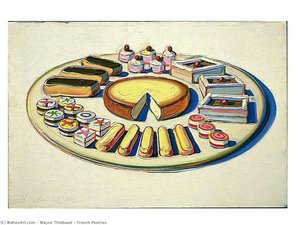
Thiebaud’s artistic journey wasn't a direct path to the iconic images he became known for. Initially drawn to the expressive power of Abstract Expressionism, he experimented with non-representational forms before gradually shifting towards figuration. This transition was pivotal. He began focusing on everyday objects – not grand historical narratives or profound philosophical statements, but rather the humble delights found in bakery windows and grocery stores: cakes, pies, candies, cosmetics. These weren’t simply still lifes; they were imbued with a personal resonance, reflecting items that had been just beyond his reach as a child, viewed through the glass barriers of storefronts. His technique was revolutionary. He didn't aim for photorealistic depiction but instead employed thick, sensuous applications of paint, often using a palette knife to create textures that mimicked frosting, glaze, and the very tactile quality of these objects. Vibrant colors, coupled with dramatic shadows, emphasized form and volume, transforming ordinary items into subjects worthy of contemplation. While frequently associated with Pop Art due to his subject matter, Thiebaud distinguished himself from artists like Warhol and Lichtenstein by focusing on the inherent beauty of the objects themselves rather than offering commentary on consumerism or mass production. He wasn’t critiquing culture; he was celebrating it, albeit with a quiet, melancholic undertone.

Influences and Expanding Horizons

Thiebaud's artistic development wasn’t isolated. He acknowledged the influence of several key figures and movements. The gestural brushwork of Willem de Kooning resonated deeply, as did the Bay Area Figurative Movement led by David Park, which championed a return to representational painting after the dominance of Abstract Expressionism. He also drew inspiration from the bold colors and expressive forms of Impressionism and Fauvism. However, Thiebaud wasn’t simply mimicking these influences; he synthesized them into something uniquely his own. Beyond his celebrated depictions of food, his artistic repertoire expanded to include portraits, landscapes – both urban and rural – and broader still life compositions. His San Francisco cityscapes, in particular, are striking for their vertiginous perspectives and masterful handling of light and shadow, capturing the energy and complexity of the urban environment. He consistently explored themes of nostalgia, memory, and the beauty found in the mundane, imbuing his work with a sense of quiet contemplation.

Recognition and Lasting Legacy

Throughout his long and distinguished career, Wayne Thiebaud received widespread recognition for his contributions to American art. He represented the United States at the prestigious São Paulo Biennale in 1967 and participated in Documenta 5 in Kassel, Germany, in 1972, solidifying his international reputation. A major retrospective of his work was held at the San Francisco Museum of Art in 1985, further cementing his place in art history. In 1994, he received the National Medal of Arts, the highest honor bestowed upon artists by the United States government. The market also recognized his significance; his painting "Two Jackpots" sold for over six million dollars at auction in 2005, a testament to the enduring appeal and value of his work. Thiebaud’s impact extends beyond his own paintings. He was a dedicated educator, teaching at Sacramento City College and later at the University of California, Davis, where he inspired generations of artists. His unique painterly style – characterized by thick impasto, vibrant colors, and dramatic lighting – continues to influence contemporary painters today. He revived an appreciation for still life painting, demonstrating that beauty could be found in the most ordinary of subjects. He elevated these everyday objects, inviting viewers to pause, reflect, and rediscover the simple pleasures of life.

A Sweet Remembrance

Wayne Thiebaud’s legacy is one of quiet brilliance and enduring charm. His paintings are not merely representations of objects; they are evocations of memory, desire, and a uniquely American sensibility. He reminded us to appreciate the beauty in the commonplace, to find joy in simple pleasures, and to savor the sweetness of life – lessons that resonate as powerfully today as they did when he first began painting those delectable delights decades ago. His work continues to be exhibited and celebrated worldwide, ensuring that his vision will continue to inspire and captivate audiences for generations to come.

Quiz

There is only one correct answer for each question.

Question 1:
Wayne Thiebaud was initially involved in the animation industry. For which studio did he work as an apprentice?
Question 2:
Thiebaud is well known for paintings of everyday objects. Which of the following is a recurring subject in his work?
Question 3:
Although often associated with Pop Art, how did Thiebaud distinguish his work?
Question 4:
Wayne Thiebaud served in the U.S. Army during which major conflict?
Question 5:
In what year did Wayne Thiebaud receive the National Medal of Arts?

Questions & Answers

How many of Wayne Thiebaud's paintings are on ArtsDot.com?

55

What creative periods did Wayne Thiebaud go through?

mature period

How long did Wayne Thiebaud live?

101 years (1920–2021)

What art period did Wayne Thiebaud belong to?

Modern

Wayne Thiebaud was initially involved in the animation industry. For which studio did he work as an apprentice?

Walt Disney Studios

Is Wayne Thiebaud's work still under copyright?

Yes, works by this artist are still under copyright.

When did Wayne Thiebaud die?

2021

What are the 3 top-ranked paintings by Wayne Thiebaud on ArtsDot.com?

Pop art, Watermelon large, Fabs

Who is Wayne Thiebaud?

A Life Painted in Nostalgia: The World of Wayne Thiebaud Wayne Thiebaud, who passed away at the remarkable age of 101 in December 2021, wasn’t merely a painter of pies and pastries; he was a chronicler of American desire, a master of light and texture, and an artist whose work resonated with a uniquely poignant nostalgia. Born Morton Wayne Thiebaud on November 15, 1920, in Mesa, Arizona, his early life was one of constant movement, shaped by the demands of his father’s work and rooted in the de

What are other names Wayne Thiebaud is known by?

Morton Wayne Thiebaud, Wayne Morton Thiebaud