Inspiration · Tonalism

The 100 Famous Tonalism Paintings That Inspire Our Artists

1854 – 1914

The most famous Tonalism paintings are James McNeill Whistler's Nocturne in Black and Gold: The Gardens (1875, Harvard Art Museums), James McNeill Whistler's Nocturne in Blue and Silver: The Lagoon, Venice (1879, Museum of Fine Arts) and L. Birge Harrison's Fifth Avenue at Twilight (1910, Detroit Institute of Arts). Below, all 100 of them — painted from 1854 to 1914 by 29 artists — with their date, their size and the museum that keeps them.

Nocturne in Black and Gold: The Gardens by James McNeill Whistler, 1875, Harvard Art Museums — famous Tonalism painting
No. 1 · James McNeill WhistlerNocturne in Black and Gold: The Gardens1875 · Harvard Art Museums, Cambridge
100singular works
29masters · James McNeill Whistler – Claude Buck
36homes in 16 cities
23kept at the Smithsonian American Art Museum

Singular works

100 Tonalism paintings that exist only once

Every original here is unique and kept in one place. Its story, its home, and the detail that makes it unmistakable.

  1. Nocturne in Black and Gold: The Gardens by James McNeill Whistler, 1875, Harvard Art Museums
    1

    Harvard Art Museums, Cambridge1875Oil on canvas49.5 × 76.2 cm

    The composition is vertically oriented, with a strong emphasis on the upper two-thirds of the canvas. "Nocturne in Black and Gold: The Falling Rocket" is part of Whistler's series of Nocturnes, which were inspired by the Cremorne Gardens, a celebrated pleasure resort in London. This painting is widely acknowledged as the high point of Whistler's middle period and exemplifies the "art for art's sake" movement. "Nocturne in Black and Gold: The Falling Rocket" is not just a painting; it is an experience.

    The singular detailinspired by Cremorne Gardens, Londonfireworks display in foggy night sky

    Its story

  2. Nocturne in Blue and Silver: The Lagoon, Venice by James McNeill Whistler, 1879, Museum of Fine Arts
    2

    Museum of Fine Arts, Boston1879Oil on canvas50.16 × 65.4 cm

    Small, warm points of light flicker upon the water, providing the only contrast to the cool, dark tones that wrap around the scene. The scene captures Venice from a viewpoint near the Piazzetta, looking south across the water toward San Giorgio Maggiore and the distant lights of the Lido.

    Its story

  3. Fifth Avenue at Twilight by L. Birge Harrison, 1910, Detroit Institute of Arts
    3

    Detroit Institute of Arts1910Oil on canvas76.2 × 58.4 cm

    The city begins to shift as the light fades in Fifth Avenue at Twilight. This oil on canvas captures a specific, fleeting moment in New York City, where the day retreats and the evening takes hold. The work emerges from about 1910, a period when the urban landscape was finding its modern rhythm.

    Its story

  4. Untitled (AQR5T4) by Edward Mitchell Bannister, 1879, Smithsonian American Art Museum
    4

    Smithsonian American Art Museum, Washington, D.C.1879Oil on canvas41 × 56 cm

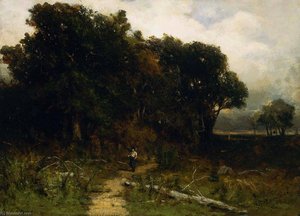
    The composition features a solitary figure of a woodcutter walking down a winding dirt path that disappears into the trees, creating a sense of depth and mystery. Surrounding the figure is a dense arrangement of foliage and towering trees, with some elements positioned in the foreground and others receding into the distance.

    Its story

  5. Pastoral Hillside Scene by William Keith, 1882
    5

    1882Oil

    The artwork titled Pastoral Hillside Scene is a landscape painting created by the artist William Keith. The composition is presented in a landscape format, providing a wide horizontal view of the terrain depicted.

    Its story

  6. At the Piano by James McNeill Whistler, 1858, Taft Museum of Art
    6

    Taft Museum of Art, Cincinnati1858Oil on canvas67 × 90.5 cm

    During the mid- 19th century, Whistler was heavily influenced by the Realism movement, which emphasized portraying everyday life with accuracy and detail. This is evident in At the Piano, where he skillfully captures a moment of intimacy between two women engaged in music-making.

    Its story

  7. Miss Ethel Philip Reading by James McNeill Whistler, 1894, The Hunterian Museum and Art Gallery
    7

    The Hunterian Museum and Art Gallery, Glasgow1894Oil on panel21.2 × 12.7 cm

    The painting is housed at the Hunterian Museum and Art Gallery in the United Kingdom. Whistler's portfolio includes several other notable works, such as Harmony in Blue and Gold: The Little Blue Girl, which exemplifies his use of tonalism. For more information on James Abbott McNeill Whistler and his works, visit Francesco Saverio Netti.

    The singular detailvasepotted plants

    Its story

  8. Harmony in Brown the Felt Hat by James McNeill Whistler, 1891, The Hunterian Museum and Art Gallery
    8

    The Hunterian Museum and Art Gallery, Glasgow1891Oil paint191.3 × 89.9 cm

    The painting presents a three-quarter length portrait of a woman, elegantly posed against a dark, almost black background. While Whistler eschewed explicit symbolism, the painting’s mood is undeniably evocative. Harmony in Brown The Felt Hat represents a significant example of Whistler’s mature style and his contribution to tonalism.

    The singular detailfeathersmuted color palette

    Its story

  9. Arrangement in White and Black by James McNeill Whistler, 1876, Freer Gallery of Art
    9

    Freer Gallery of Art, Washington, D.C.1876Oil on canvas191.4 × 90.9 cm

    This dress catches a gentle light emanating from the front left, pulling her form forward from the deep, indistinct black of the background. There are no loud colors here, only a strictly limited palette of white, grey, and deep black.

    Its story

  10. Smoky Range, Allegheny Mountains by Christopher Shearer, 1895, Reading Public Museum
    10

    Reading Public Museum1895Oil on canvas

    The Allegheny Mountains emerge from a soft, atmospheric haze, their silhouettes receding into the distance to create a sense of immense scale. It represents a significant period in American landscape painting, reflecting the influence of European training in Düsseldorf and Munich.

    Its story

  11. The Harvest Moon by Charles Melville Dewey, 1908, Smithsonian American Art Museum
    11

    Smithsonian American Art Museum, Washington, D.C.1908Oil on canvas61 × 77 cm

    The Harvest Moon is a work by the American tonalist painter Charles Melville Dewey. Created about 1908, this piece reflects the quiet, poetic sensibility that defined the artist's approach to the natural world. In this painting, Dewey utilizes the tonalist style to capture a specific moment of light and shadow. His 1904 work, Indian Summer and a November Evening, exemplifies the tonalist movement through its subtle handling of seasonal shifts.

    Its story

  12. Early Moonrise, Florida by George Inness, 1908
    12

    1908Oil on canvas

    Early Moonrise, Florida (also known as Early Morning, Florida) is an oil on canvas created by George Inness in 1908. George Inness was a significant figure in American landscape painting, known for his ability to capture light and mood through subtle color gradations.

    Its story

  13. The Good Samaritan by Lawrence W Ladd, 1880, Smithsonian American Art Museum
    13

    Smithsonian American Art Museum, Washington, D.C.1880Oil24 × 30 cm

    The painting depicts a scene from the parable of the Good Samaritan, set within a natural landscape of trees and grass. Another man is positioned over him, leaning in to provide aid or tending to his injuries. This central interaction is framed by several other figures distributed throughout the scene.

    Its story

  14. Indian Summer by John Francis Murphy, 1903, Smithsonian American Art Museum
    14

    Smithsonian American Art Museum, Washington, D.C.1903Oil on canvas41 × 56 cm

    It entered the permanent collection of the Smithsonian American Art Museum through a generous gift from William T. Evans. The piece is cataloged under the object number 1909.7.51. The piece was gifted to the museum in 1909 by William T. Evans.

    Its story

  15. Berks County PA Farm by John Heyl Raser, 1880, Payne Gallery
    15

    Payne Gallery, Bethlehem, Pennsylvania1880Oil

    Two horses graze in the field directly in front of the structure. Several cows are scattered across the landscape, with some positioned near the barn and others further in the distance. A dog is located near the center of the scene, moving through the farm setting.

    Its story

  16. The Forces of Evil by Claude Buck, 1914, Smithsonian American Art Museum
    16

    Smithsonian American Art Museum, Washington, D.C.1914Oil on panel15 × 31 cm

    The Forces of Evil is an oil on canvas painting by Claude Buck. The composition features several figures positioned among trees and bushes. Some individuals stand in close proximity to one another, while others are spread across the landscape.

    Its story

  17. The Sisters (painting) by Abbott Handerson Thayer, 1884
    17

    1884Oil on canvas

    The Sisters, (painting) is an oil on canvas created by Abbott Handerson Thayer in 1884. The portrait was commissioned by their brother, the banker James Stillman, for his own private collection. The work arrived at the Society of American Artists exhibition of 1884.

    Its story

  18. Moonlit Seascape by Thomas Moran, 1902
    18

    1902Oil on canvas

    Moonlit Seascape is an oil on canvas by the American painter Thomas Moran. While Moran is frequently associated with the vast landscapes of the American West, this maritime scene shifts his focus toward the rhythmic movement of the ocean under nocturnal light.

    Its story

  19. Forest Glen by Charles Warren Eaton, 1900
    19

    1900Oil

    Tall, green trees dominate the vertical space, their forms layered to create a sense of receding depth. A prominent tree trunk anchors the middle ground, providing a structural pillar for the eye to follow into the thicket. Executed in 1900, this work reflects the Tonalist approach through its emphasis on atmosphere and mood.

    Its story

  20. The Sea: Morning by Dwight William Tryon, 1892
    20

    1892Oil

    There is a sense of movement in the way the waves crash against the coast, breaking into white foam as they reach the sand. The artist focuses on the rhythmic nature of the tide, documenting the interaction between the water and the land during the early hours of the day.

    Its story

  21. Evening Glow by Henry Golden Dearth, 1889
    21

    1889Oil

    Behind them, the land stretches toward a line of dark trees. The sky is a weight of clouds, catching the amber glow of the setting sun.

    Its story

  22. Squaw Valley near Now ow wa aka Old Grizzly-s Den Invaded by Thomas Hill
    22

    Oil

    This work, titled Squaw Valley near Now ow wa aka Old Grizzly-s Den Invaded, was painted by Thomas Hill. The artist, born in 1829, spent much of his life capturing the specific light and atmosphere of the American wilderness. Thomas Hill lived until June 30, 1908.

    Its story

  23. Meadow and Moorland by David Farquharson
    23

    A man stands in the foreground, a solitary figure amidst the vastness of the meadow. A river winds through the grass, its path dictated by the gentle slope of the terrain.

    Its story

  24. Early Spring by Bruce Crane
    24

    Oil

    A weathered wooden fence cuts horizontally across the middle ground, separating the viewer from the rising terrain in the distance. Through this careful selection of color and light, Crane portrays a moment of stillness and the quiet anticipation of new growth in the American landscape.

    Its story

  25. Swale Lake (painting) by Edward Mitchell Bannister, 1880, Smithsonian American Art Museum
    25

    Smithsonian American Art Museum, Washington, D.C.1880Oil on canvas15 × 21 cm

    "Train" exemplifies Bannister's mastery of Tonalism, a style characterized by soft colors, diffused light, and an overall emphasis on tonal harmony rather than sharp detail. Bannister’s artistic style was heavily influenced by the Barbizon school of French painting, particularly the works of Jean-François Millet.

    Its story

  26. Mount Lyell, California Sierra by William Keith, 1874
    26

    1874Oil on canvas

    The oil on canvas titled Mount Lyell, California Sierra was painted by William Keith in 1874. This work captures a specific moment of light upon the granite and snow of the High Sierra. In The California Sierras, completed in 1875, the scale of the landscape expands into a monumental vision of the wilderness.

    Its story

  27. Chicago in Flames by Lawrence W Ladd, 1880, Smithsonian American Art Museum
    27

    Smithsonian American Art Museum, Washington, D.C.1880Painting46 × 74 cm

    The canvas depicts a cityscape consumed by fire. Buildings are engulfed in flames, their structures silhouetted against a sky darkened by thick, heavy smoke. The light from the fires illuminates the immediate surroundings, casting a glow on the urban architecture.

    Its story

  28. Harvest Moon by George Inness, 1891, National Gallery of Art
    28

    National Gallery of Art, Washington1891Oil on canvas76.2 × 113.03 cm

    George Inness produced Harvest Moon in 1891. The work captures a specific moment of transition within the countryside. A low sky holds the weight of clouds above a landscape of grass and earth. It is a scene of quietude, where the light of a sunset meets the deepening shadows of the rural terrain.

    Its story

  29. River and Road, Strathdon, Aberdeenshire by David Farquharson, 1898
    29

    1898Oil on canvas45.7 × 76.2 cm

    The landscape of Strathdon, Aberdeenshire, unfolds through a restrained palette of ochres, browns, and greys. In the middle ground, a herd of sheep grazes near the water's edge, their forms integrated into the grassy banks.

    Its story

  30. Slow Fading Day by George Inness, 1880
    30

    1880Oil

    A man stands before a tree, his presence anchored near a nearby lake, while the sky begins to surrender its warmth to the approaching dusk. The composition is populated by several figures scattered throughout the landscape, some positioned in the foreground and others receding into the distance, creating a sense of lived-in space.

    Its story

  31. End of Day, Montclair by George Inness, 1885
    31

    1885Oil on canvas

    There is a certain stillness that settles over the landscape as the light begins to retreat. A dog is positioned near the center of the scene, adding to the sense of a lived-in, working landscape.

    Its story

  32. Rose and Silver: The Princess from the Land of Porcelain by James McNeill Whistler, 1863, Freer Gallery of Art
    32

    Freer Gallery of Art, Washington, D.C.1863Oil on canvas201.5 × 116.1 cm

    Born in Lowell, Massachusetts, Whistler's early life was marked by familial mobility—his father, a railroad engineer—propelled him across the country, fostering adaptability and exposing him to diverse environments that would shape his artistic sensibilities. A formative period saw Whistler studying under Sébastien Bouré in Paris, refining his mastery of oil painting and watercolor techniques.

    Its story

  33. Harmony in Grey and Peach Colour by James McNeill Whistler, 1872, Fogg Art Museum
    33

    Fogg Art Museum, Cambridge1872Oil on canvas193 × 101 cm

    The painting is currently housed at the Fogg Art Museum in Cambridge, Massachusetts, United States. It was bequeathed to the museum by Grenville L. Winthrop. These paintings can be found at the Fogg Art Museum, showcasing Whistler’s mastery of color and composition.

    Its story

  34. Variations in Flesh Colour and Green: The Balcony by James McNeill Whistler, 1865, Freer Gallery of Art
    34

    Freer Gallery of Art1865Oil on panel

    A group of individuals – likely Whistler's friends and patrons – are gathered on a balcony overlooking a body of water, possibly the Thames River in London. Consider his famous “Arrangement in Grey and Black No. 1” (Whistler's Mother), a work that similarly eschewed narrative content in favor of pure aesthetic exploration.

    The singular detailtonal harmonyflesh tones

    Its story

  35. Harmon in Red: Lamplight by James McNeill Whistler, 1886, Hunterian Museum and Art Gallery
    35

    Hunterian Museum and Art Gallery1886Oil on canvas

    A single woman stands centered on a stage, her silhouette defined by the soft glow of a lamp. The light brushes her face, pulling her features from a deep, velvety gloom. This work emerged from the Tonalist movement, a period that favored mood over the fleeting sensory details of Impressionism.

    Its story

  36. Purple and Rose The Lange Leizen of The Six Marks by James McNeill Whistler
    36

    Born in Lowell, Massachusetts, James Abbott McNeill Whistler (1834-1903) spent much of his career in Europe, becoming a prominent figure in the artistic circles of London. “Purple and Rose The Lange Leizen of The Six Marks” represents a significant moment in Whistler's artistic development and exemplifies the aesthetic principles that defined his career.

    The singular detailelegant atmosphereuse of purple

    Its story

  37. Arrangement in Brown and Black: Portrait of Miss Rosa Corder by James McNeill Whistler, 1870, The Frick Collection
    37

    The Frick Collection, New York City1870Oil on canvas192.41 × 92.39 cm

    The palette is restricted to deep blacks, dark browns, and subtle ochre tones. By choosing to call this work an Arrangement in Brown and Black, the artist emphasizes the primacy of tonal relationships over the identity of the sitter.

    Its story

  38. Arrangement in Gray, Portrait of the Painter by James McNeill Whistler, 1872, Detroit Institute of Arts
    38

    Detroit Institute of Arts1872Oil on canvas74.9 × 53.3 cm

    Despite a brief, disappointing stint at West Point and subsequent work with the U.S. This influence is palpable in Arrangement in Grey, where the flattened forms and restrained color scheme mirror the aesthetic ideals of Edo-period Japan.

    Its story

  39. Harmony in Blue and Gold: The Little Blue Girl by James McNeill Whistler, 1898, Freer Gallery of Art
    39

    Freer Gallery of Art, Washington, D.C.1898Oil on canvas74.7 × 50.5 cm

    A large, translucent blue cloth extends upwards and outwards from her body, framing the upper torso. The color palette relies on low-saturation tones, specifically deep blues, ochre, earthy browns, and pale flesh tones. These colors are applied with soft, blurred lines that minimize sharp contours.

    Its story

  40. Grey and Silver: Old Battersea Reach by James McNeill Whistler, 1863, Art Institute of Chicago
    40

    Art Institute of Chicago1863Oil on canvas50.8 × 68.6 cm

    The scene unfolds with a deliberate restraint, dominated by subtle gradations of grey, silver, and brown, creating an almost meditative quality. The influence of Gustave Courbet is readily apparent, particularly in Whistler’s commitment to capturing the materiality of the scene and his rejection of idealized forms.

    Its story

  41. Rotherhithe by James McNeill Whistler
    41

    Graphite or charcoal on paper

    Executed with remarkable sensitivity, this work exemplifies Whistler's dedication to "art for art's sake," prioritizing aesthetic harmony over narrative detail. The scene depicts several sailing ships dominating the background, gradually fading into atmospheric perspective, while two figures occupy the foreground, providing a human anchor within the expansive landscape. The artwork’s style is immediately striking – loose, expressive, and reminiscent of early printmaking techniques like lithography or etching. Whistler's contemporaries included artists like Tristram James Ellis and James Wilson Morrice, who also explored similar themes of landscape and atmosphere.

    Its story

  42. The Storm - Sunset by James McNeill Whistler, 1880, Harvard Art Museums/Fogg Museum
    42

    Harvard Art Museums/Fogg Museum1880Pastel on brown wove paper

    A brief, unhappy stint at West Point underscored the incompatibility of military discipline with his innate artistic temperament, followed by work with the U.S. Coast and Geodetic Survey that, while delaying, didn’t extinguish his burgeoning passion for art.

    Its story

  43. Arrangement in Grey and Black Number 2 by James McNeill Whistler, 1873, Kelvingrove Art Gallery and Museum
    43

    Kelvingrove Art Gallery and Museum, Glasgow1873Oil on canvas171 × 143.5 cm

    As a prominent figure in the Tonalism movement, Whistler is renowned for his contributions to the art world during the late 19th century. In this painting, Whistler portrays Thomas Carlyle (1795-1881), a Scottish philosopher, historian, and essayist.

    The singular detailsubtle tonal values

    Its story

  44. Tennessee by Alexander Helwig Wyant, 1866, Metropolitan Museum of Art
    44

    Metropolitan Museum of Art, New York1866Oil on canvas88.3 × 136.5 cm

    Unlike the Hudson River School's emphasis on detailed realism and dramatic lighting, Wyant favored subtle gradations of tone – variations in light and shadow – to create an atmosphere of mood and emotion. Initially influenced by George Inness, he later traveled extensively in Europe, studying with Hans Gude in Düsseldorf and Karlsruhe.

    The singular detailatmospheric landscape

    Its story

  45. Sea and Rain by James McNeill Whistler, 1865, University of Michigan Museum of Art
    45

    James McNeill WhistlerTonalism & Aestheticism

    Sea and Rain

    University of Michigan Museum of Art, Ann Arbor1865Oil on canvas53.02 × 73.34 cm

    This approach anticipates the abstract explorations of later masters like Cézanne, making the piece feel remarkably modern even over a century after its creation.

    Its story

  46. Gants de Suéde by James McNeill Whistler, The Metropolitan Museum of Art
    46

    James McNeill WhistlerAestheticism & Tonalism

    Gants de Suéde

    The Metropolitan Museum of ArtTransfer lithograph

    Despite an unsuccessful foray into military service at West Point, Whistler persevered in honing his craft through work with the U.S. Coast and Geodetic Survey, experiences that solidified his dedication to artistic expression despite delaying his professional ambitions. The gloves themselves—a luxurious item—represent refinement and elegance, mirroring Whistler’s artistic ideals.

    Its story

  47. The Driving of the Last Spike by Thomas Hill, 1881
    47

    1881Oil

    The Driving of the Last Spike is an artwork by Thomas Hill. It commemorates the ceremony at Promontory Summit, Utah, where the iron paths of the nation finally met. The tension of the commission remains tied to the very figures gathered at Promontory Summit, Utah.

    Its story

  48. Rising Mist by Alexander Helwig Wyant, 1862
    48

    1862Oil

    In this 1862 landscape, the scene opens upon a wide field where several animals occupy the foreground and middle ground. Cows graze in the immediate front of the canvas, their forms rendered with attention to the weight of their bodies.

    Its story

  49. Yosemite Falls by Thomas Hill, 1884, Crystal Bridges Museum of American Art
    49

    Crystal Bridges Museum of American Art, Bentonville1884Oil on canvas135.9 × 89.5 cm

    His explorations of the Yosemite Valley resulted in several significant compositions, including Half Dome (1863) and Cathedral Rocks (1864). Beyond the valley, his subject matter expanded to include the icy expanses of Muir Glacier, Alaska (1887–1888) and the seasonal shifts of the White Mountains, as seen in Mount Lafayette in Winter.

    Its story

  50. Hastings: Fishing Boats by James McNeill Whistler, 1880, Hunterian Museum & Art Gallery
    50

    Hunterian Museum & Art Gallery1880Watercolor

    Whistler meticulously crafted his composition using a technique known as Tonalism. Painted during Whistler's formative years in London, “Hastings” reflects the broader artistic currents of Impressionism and Neo- Romanticism.

    Its story

  51. The Sweet-Shop by James McNeill Whistler, 1884, Isabella Stewart Gardner Museum
    51

    Isabella Stewart Gardner Museum, Boston1884Oil on panel12 × 18 cm

    The scene focuses on a storefront, a sweet shop, rendered with a soft, atmospheric quality that avoids any sharp or distracting contours. There is a certain stillness here, as if the street has momentarily held its breath.

    Its story

  52. (from Sketchbook) by James McNeill Whistler, 1854, Harvard Art Museums
    52

    James McNeill WhistlerImpressionistic Tonalism

    (from Sketchbook)

    Harvard Art Museums, Cambridge1854Pencil on paper10 × 9 cm

    At first glance, the image presents an abstract depiction of a rocket or similar projectile. Whistler’s Impressionistic style is immediately evident in the loose brushstrokes and blurred lines that dominate the composition. These techniques aim to reproduce the effects of light and color as perceived by the eye—a characteristic hallmark of Impressionism.

    Its story

  53. Newspaper Boy by Edward Mitchell Bannister, 1869, Smithsonian American Art Museum
    53

    Smithsonian American Art Museum, Washington, D.C.1869Oil on canvas77 × 64 cm

    Born in Canada, he later moved to Rhode Island and became an influential figure in the American art scene during the late 19th century. Created in 1875, Edward Mitchell Bannister's 'Newspaper Boy' is an oil on canvas painting measuring 77 x 64 cm.

    The singular detailloose brushworklight

    Its story

  54. The Valley of the Shadow of Death by George Inness, 1867
    54

    1867Oil on canvas

    Created in 1867, this piece represents a significant moment in the artist's development, moving toward a more spiritualized landscape. The only other surviving work from this specific trilogy is The New Jerusalem, which presents a visionary landscape of domed buildings and minarets set against an evening sky.

    Its story

  55. Lady in White (No. 2) by Thomas Dewing, 1910, Smithsonian American Art Museum
    55

    Smithsonian American Art Museum, Washington, D.C.1910Oil on canvas57 × 54 cm

    A woman sits in a chair, her body oriented toward the center of the frame. The work is an oil on canvas executed in 1910. The artist, Thomas Dewing, was a member of the Ten American Painters and was associated with the Society of Landscape Painters.

    Its story

  56. Summer Twilight by Edward Mitchell Bannister, 1899, SCAD Museum of Art
    56

    SCAD Museum of Art, Savannah1899Oil on canvas36 × 50 cm

    Summer Twilight is a painting by Edward Mitchell Bannister. The canvas captures a quiet moment in the rural landscape, where the light begins to soften against the earth. Edward Mitchell Bannister applied his brush to this scene during the final years of his life.

    Its story

  57. Luncheon Still Life by John F Francis, Smithsonian American Art Museum
    57

    Smithsonian American Art Museum, Washington, D.C.Oil on canvas64.77 × 77.15 cm

    Luncheon Still Life is an oil on canvas work by John F Francis, executed in 1860. The composition centers on a variety of fruits and vessels, capturing a moment of quietude through the depiction of everyday items. The painting is currently held in the collection of the Smithsonian American Art Museum in the United States.

    Its story

  58. The Smugglers' Cove by Albert Pinkham Ryder, 1880, Metropolitan Museum of Art
    58

    Metropolitan Museum of Art, New York1880Oil on gilt leather26 × 71 cm

    The artwork portrays a shipwrecked vessel partially embedded in a sandy beach, juxtaposed against the backdrop of rugged cliffs and a modest cottage. “The Smugglers’ Cove” firmly anchors itself within the Romantic tradition, prioritizing atmospheric perspective and loose brushwork to convey mood rather than precise realism.

    Its story

  59. Mount Monadnock (painting) by Abbott Handerson Thayer, 1914, National Gallery of Art
    59

    National Gallery of Art, Washington1914Oil on canvas78 × 83 cm

    Thayer, an artist celebrated for his ability to blend the precision of realism with the atmospheric softness of Impressionism, uses this scene to capture not just a geographical landmark, but a fleeting moment of seasonal serenity.

    Its story

  60. Nocturne by James McNeill Whistler, 1880
    60

    1880Dry pencil drawing on paper19 × 29 cm

    The artwork depicts a harbor vista, dominated by a softly defined sailing ship in the foreground. Born in Lowell, Massachusetts, Whistler spent significant time in Europe, particularly Paris, where he honed his artistic skills.

    The singular detailblending of pencil strokeshazy atmosphere

    Its story

  61. Christ Appearing to Mary by Albert Pinkham Ryder, 1885, Smithsonian American Art Museum
    61

    Smithsonian American Art Museum, Washington, D.C.1885Oil36 × 44 cm

    Christ reaches toward Mary Magdalene, his hand extended in a gesture of recognition and grace. The scene is populated by two additional figures—one positioned near the upper left and another at the bottom right—suggesting the event occurs within a communal or public setting rather than in isolation.

    Its story

  62. Dancing Dryads by Albert Pinkham Ryder, 1879, Smithsonian American Art Museum
    62

    Smithsonian American Art Museum, Washington, D.C.1879Oil23 × 18 cm

    The composition centers on the rhythmic movement of these nymphs, or dryads, whose bodies are caught in a delicate balance of motion and stillness. It possesses a unique gravity, drawing the eye inward and encouraging long periods of reflection.

    Its story

  63. Gray Day, Goochland by George Inness, 1884, The Phillips Collection
    63

    The Phillips Collection, Washington, D.C.1884Oil on panel1.81 × 2.4 cm

    The painting depicts a lush forest setting, where the skeletal silhouettes of trees and the distant suggestion of a building emerge through a soft, atmospheric haze. This inclusion of everyday life reflects Inness’s unique ability to blend the spiritual with the mundane, a hallmark of his later style influenced by the Barbizon school.

    The singular detailmuted colorssoft brushstrokes

    Its story

  64. The Spinet by Thomas Dewing, 1902
    64

    1902Oil on wood40 × 51 cm

    The instrument, a spinet, occupies the center of the composition. Created in 1902, this painting belongs to the turn of the 20th century. The subject matter focuses on a woman engaged in a musical activity, a common theme in the works of Thomas Dewing.

    Its story

  65. The Balcony, Variations in Flesh Colour and Green by James McNeill Whistler, 1865, Freer Gallery of Art
    65

    Freer Gallery of Art, Washington, D.C.1865Oil on panel61 × 49 cm

    Born July 10, 1834, in Lowell, Massachusetts, he was the first child of Anna McNeill Whistler and George Washington Whistler, and the elder brother of Confederate surgeon William McNeill Whistler. Whistler moved to Paris in 1855, a pivotal moment that irrevocably shaped his artistic trajectory.

    Its story

  66. Evensong by Arthur Bowen Davies, 1898, Smithsonian American Art Museum
    66

    Smithsonian American Art Museum, Washington, D.C.1898Oil on canvas56 × 43 cm

    Three women stand amidst the deepening shadows of a grove, their presence anchored by the silent weight of the trees behind them. There is a sense that the world has slowed its pace, leaving only the soft rustle of fabric and the quiet breathing of the woods.

    Its story

  67. Nocturne in Blue and Green by James McNeill Whistler, 1871, Tate Gallery
    67

    Tate Gallery, London1871Oil on canvas

    Nocturne in Blue and Green is not simply a depiction of a London waterfront at dusk; it is a masterclass in the Aesthetic movement’s core philosophy: art for art’s sake. To understand the allure of this Nocturne, one must appreciate Whistler’s revolutionary Tonalism.

    Its story

  68. Upland Pasture by J. Alden Weir, 1905, Smithsonian American Art Museum
    68

    Smithsonian American Art Museum, Washington, D.C.1905Oil on canvas101 × 127 cm

    This early exposure to art shaped Weir’s path, leading him to study in Paris with Jean-Léon Gérôme and Jules Bastien-Lepage. Weir's membership in the Ten American Painters group and his association with the Cos Cob Art Colony further solidified his position within the burgeoning American Impressionist movement.

    Its story

  69. Ancient Ruins in the Cañon de Chelle by Timothy Daniel Sullivan, 1873, Amon Carter Museum of American Art
    69

    Amon Carter Museum of American Art, Fort Worth1873Black and white photography20 × 27 cm

    At its core, the piece focuses on ancient ruins nestled within a high niche, perched fifty feet above the canyon floor. A unique blend of documentary photography and Tonalist-inspired painting.

    Its story

  70. Hosanna of the Mountains by Arthur Bowen Davies, 1905
    70

    1905Oil on canvas66 × 107 cm

    Hosanna of the Mountains is an oil on canvas painted by Arthur Bowen Davies in 1905. His brush moved through the years of his life, from his early fascination with nature to his later, more complex explorations of form, until his death in 1928.

    Its story

  71. Sunset on Mount Diablo (Marin Sunset) by William Keith, 1877, Cantor Arts Center at Stanford University
    71

    Cantor Arts Center at Stanford University1877Oil

    The sky above Mount Diablo transitions through a palette of amber and saffron, casting a deep shadow across the rugged terrain. Two figures are positioned within the landscape—one near the center and another toward the right—offering a human presence that emphasizes the immense proportions of the natural world. The work reflects the principles of Tonalism and the American Barbizon school, prioritizing mood and the subjective experience of light over strict realism. Painted in 1877, this work emerged during a period when artists were seeking to express the spiritual essence of the American West.

    Its story

  72. Plodding Homeward (painting) by Albert Pinkham Ryder, 1897, New Britain Museum of American Art
    72

    New Britain Museum of American Art1897Oil

    Landscape with Trees and Cattle, (painting) is an oil work by Albert Pinkham Ryder. Created in 1897, the piece emerged during a period of significant creative maturity for the artist.

    Its story

  73. November Landscape by Charles Warren Eaton, 1910, Akron Art Museum
    73

    Akron Art Museum1910Oil on fabric

    Tall, dark trees rise from the foreground, their forms silhouetted against a sky that glows with the fading warmth of a November sun.

    Its story

  74. The Little Red House by James McNeill Whistler, 1880, The Hunterian Museum and Art Gallery
    74

    The Hunterian Museum and Art Gallery, Glasgow1880Oil on panel21.5 × 12.4 cm

    “The Little Red House” was created in Glasgow during Whistler’s period of exile from London—a deliberate retreat from the pressures of the British art establishment. While seemingly simple on the surface, “The Little Red House” carries symbolic weight.

    Its story

  75. Landscape (trees) by Edward Mitchell Bannister, 1895, Smithsonian American Art Museum
    75

    Smithsonian American Art Museum, Washington, D.C.1895Oil on canvas16 × 21 cm

    In this oil on canvas, titled Landscape, the artist Edward Mitchell Bannister captures a quiet moment within the natural world. The scene unfolds with a sense of stillness, as if the viewer has stumbled upon a private, pastoral corner of the countryside.

    Its story

  76. Colour Scheme for Dining Room by James McNeill Whistler, 1873, ArtsDot.com
    76

    ArtsDot.com1873Oil on canvas

    The painting captures a glimpse into the dining room of Aubrey House, focusing on its understated elegance and architectural design. Two figures occupy the space, positioned centrally but deliberately distanced from each other, fostering a sense of contemplative solitude.

    The singular detailtonal valuesmood

    Its story

  77. Nocturne in Blue and Green, Chelsea by James McNeill Whistler, 1871, Tate Britain
    77

    Tate Britain1871Oil on panel

    For those interested in exploring more of Whistler’s works and the Tonalism movement, Tonalism Art Movement provides an in-depth look at the characteristics and notable artists associated with this style. Additionally, James Abbott McNeill Whistler offers a comprehensive overview of the artist's life and works.

    Its story

  78. The Signal Fire by Ralph Albert Blakelock, 1890, Smithsonian American Art Museum
    78

    Smithsonian American Art Museum, Washington, D.C.1890Oil36 × 25 cm

    This individual appears to be seated or kneeling on the ground, with the head bowed toward a small, localized light source or fire. The figure's posture suggests a moment of contemplation or prayer. Surrounding this central point, the landscape is defined by a predominantly dark color palette, utilizing heavy shades of brown and black.

    Its story

  79. Salome Receiving the Head of John the Baptist by Edward Mitchell Bannister, 1890, Smithsonian American Art Museum
    79

    Smithsonian American Art Museum, Washington, D.C.189025 × 34 cm

    Around her, at least twelve figures are positioned throughout the space, some clustered in close proximity while others remain scattered in the background. The composition is heavy with the weight of the event, utilizing a monochromatic palette to emphasize the gravity of the encounter. A central platter holding the head of John the Baptist.

    Its story

  80. Dusk in the Rushes (Alexandria Bay) by George Inness, 1880, The Phillips Collection
    80

    The Phillips Collection, Washington, D.C.1880Oil on panel2 × 1.6 cm

    There is a particular stillness that settles over the river as the light begins to fail. The scene is framed by the organic textures of the riverbank, where a solitary tree anchors the left side of the composition and a bench rests quietly in the mid-ground.

    Its story

  81. The Monastery by Albert Pinkham Ryder, 1885, Parrish Art Museum
    81

    Parrish Art Museum, Water Mill1885Oil on panel

    It is a scene that feels less like a documented location and more like a fragment of a dream, captured in the quiet moments before dawn or during the heavy shroud of a rain-soaked twilight. The technical execution of “The Monastery” is nothing short of visceral.

    Its story

  82. Symphony in White and Red by James McNeill Whistler, 1868, Freer Gallery of Art
    82

    Freer Gallery of Art1868Oil on canvas

    Whistler, a pivotal figure in the Aesthetic movement, rejected the prevailing Victorian obsession with narrative and moralistic subject matter. This philosophy is powerfully evident in “Symphony in White and Red.” The painting eschews detailed representation, opting instead to capture the feeling of a summer afternoon – a sense of quiet contemplation and understated elegance.

    The singular detailboatbird

    Its story

  83. Päť Spišských plies by Antonín Hudeček, Tatra Gallery
    83

    Tatra Gallery, PopradOil on canvas120 × 100 cm

    A massive peak dominates the background, its rugged silhouette casting a quiet authority over the landscape. The brushwork captures the specific quality of light that exists only in such high, open spaces.

    Its story

  84. Mother and Child by Abbott Handerson Thayer, 1895, Museum of Fine Arts
    84

    Museum of Fine Arts, Boston1895Oil on panel102.23 × 100.33 cm

    Thayer's artistic approach is deeply rooted in his fascination with the natural world and his belief in its spiritual significance. To fully appreciate “Mother and Child,” one must understand Thayer’s innovative approach to painting.

    The singular detailtonalism style

    Its story

  85. Lady with a Cello by Thomas Dewing, Smith College Museum of Art
    85

    Smith College Museum of ArtOil on canvas

    Eschewing the harsh outlines of traditional realism, he employs a technique that leans toward Impressionism, focusing on the subtle gradations of tone that define the Tonalist style.

    The singular detailmirrorcello

    Its story

  86. The Japanese Dress by James McNeill Whistler, Hunterian Museum and Art Gallery
    86

    Hunterian Museum and Art GalleryOil on canvas

    The work features a woman in a flowing dress, accompanied by a parasol, appearing to stand by the water or on a beach. The scene is populated by natural elements, including a bird flying above the woman and another bird perched on the ground nearby.

    Its story

  87. Landscape (Cattle in Storm) by George Inness, 1889, Buffalo AKG Art Museum
    87

    Buffalo AKG Art Museum1889Oil on canvas56.5 × 91.4 cm

    The Lackawanna Valley was painted about 1855 or 1856. This work is followed by the Catskill Mountains, which was painted in 1870. The Etretat was painted in 1875, and Autumn Oaks was created in 1878. The Home of the Heron was painted in 1893.

    Its story

  88. The Salute by Edward Mitchell Bannister, 1895, Smithsonian American Art Museum
    88

    Smithsonian American Art Museum, Washington, D.C.1895Oil on canvas36 × 49 cm

    The Salute by Edward Mitchell Bannister depicts a man positioned in front of a plowed field. His 1876 painting, Under the Oaks, received a bronze medal at the Philadelphia Centennial Exposition. The artist's later output includes Swale Land, an artwork dated 1898.

    Its story

  89. Woman Walking down Path by Edward Mitchell Bannister, 1882, Smithsonian American Art Museum
    89

    Smithsonian American Art Museum, Washington, D.C.1882Oil on canvas51 × 76 cm

    Two other figures are positioned within the landscape—one near the center and another toward the right—creating a sense of lived-in, quiet activity. Created in 1882, this work emerged during a period when the artist was establishing a significant presence in the American art scene.

    Its story

  90. Dead Bird (painting) by Albert Pinkham Ryder, 1890, The Phillips Collection
    90

    The Phillips Collection, Washington, D.C.1890Oil on panel11.11 × 25.4 cm

    A small bird lies motionless upon a wooden surface. It is a small, private observation of mortality, rendered with a focus on the physical truth of the creature.

    Its story

  91. Mother of Pearl and Silver: The Andalsiian by James McNeill Whistler, 1888, National Gallery of Art
    91

    National Gallery of Art, Washington1888Oil on canvas (presumed)

    Whistler prioritizes the impression of a woman, rather than a detailed portrait. This philosophy aligns with the broader Aesthetic movement of the late 19th century, which championed “art for art’s sake.” Whistler's early training included studies in etching, which informed his precise handling of tonal values and linear elements within this painting. The figure’s downcast gaze and passive posture suggest a quiet sadness or a moment of private reflection. ‘Mother of Pearl and Silver: The Andalusian’ is an exceptional example of Whistler’s tonalist style.

    The singular detailfeelingmuted tones

    Its story

  92. Outlet of a Mountain Lake by Ralph Albert Blakelock, 1887
    92

    1887Oil on canvas

    The painting titled Outlet of a Mountain Lake is a landscape work by the American artist Ralph Albert Blakelock. Created in 1887, the piece captures a specific moment of light and water. It remains part of the collection at the Smith College Museum of Art in the United States.

    Its story

  93. Portrait of a Woman (Miss Gertrude Bloede) by Abbott Handerson Thayer, 1881, Smithsonian American Art Museum
    93

    Smithsonian American Art Museum, Washington, D.C.1881Oil on canvas42.23 × 35.56 cm

    A woman sits before us, her presence defined by a magnetic, silent strength that requires no movement to command the space. This work emerges from a transformative era in American art history, a time when creators began to blend European academic training with a distinctly New World sensibility.

    Its story

  94. My Lady Rhododendron by Elliott Daingerfield, 1896
    94

    1896Oil on canvas92 × 76 cm

    The setting is intimate, a natural alcove of trees and bushes that frames her presence. Scattered throughout the composition, pink flowers add subtle points of color to the scene.

    Its story

  95. Moonlight by Ralph Albert Blakelock, 1890, The Phillips Collection
    95

    The Phillips Collection, Washington, D.C.1890Oil on canvas0.59 × 0.95 cm

    Moonlight is an oil on canvas painting by the American artist Ralph Albert Blakelock. Dated 1885, this work presents a nocturnal landscape. One such work is Moonlight, dated about 1883, which is held in the High Museum of Art in Atlanta.

    Its story

  96. Oak Trees by Edward Mitchell Bannister, 1876, Smithsonian American Art Museum
    96

    Smithsonian American Art Museum, Washington, D.C.1876Oil on canvas86 × 153 cm

    To understand the breadth of Bannister’s landscape practice, one might look toward his 1877 work, Tree Landscape. In the 1881 oil painting Ocean Cliffs, he applies his specific sensibilities to a different terrain, proving that his approach to mood and light translates effectively from the forest to the coast.

    Its story

  97. The Hermit Thrush by Thomas Dewing, 1890, Smithsonian American Art Museum
    97

    Smithsonian American Art Museum, Washington, D.C.1890Oil on canvas88 × 117 cm

    In 1886, he produced Lady with a Lute, a painting that focuses on the internal life of the subject. This preoccupation with the stillness of the subject is also evident in Summer, painted in 1890. The work Lady in Yellow is dated 1888, and The Necklace was painted in 1907.

    Its story

  98. Before a Mirror by Thomas Dewing, 1910
    98

    1910Oil

    While Before a Mirror is more subdued, these other works showcase Dewing's ability to capture a range of emotions and environments. Charles Webster Hawthorne's The Red Gown also features a woman as the subject, but with a different mood and setting.

    Its story

  99. Homeward by Edward Mitchell Bannister, 1895, Smithsonian American Art Museum
    99

    Smithsonian American Art Museum, Washington, D.C.1895Oil on canvas23 × 36 cm

    The figure holds a baseball bat while standing upon a grassy field. The man is the central subject of the composition, situated amidst the greenery of the landscape.

    Its story

  100. The Beach at Selsey Bill by James McNeill Whistler, 1865, New Britain Museum of American Art
    100

    New Britain Museum of American Art1865Oil on canvas61 × 47.6 cm

    The Beach at Selsey Bill emerged during a period of significant artistic change. Tonalism, as a distinctly American movement, reacted against the detailed realism prevalent in much 19th-century painting. Artists like Dwight William Tryon were also exploring similar themes within Tonalism, influenced by Whistler’s pioneering approach.

    Its story

Lineages

The famous Tonalism paintings by lineage

Where they live

The one place you can see each famous Tonalism painting

Washington, D.C. keeps 31 of these originals; the Smithsonian American Art Museum, 23.

Hunterian Museum and Art Gallery2

Hunterian Museum and Art Gallery

The masters

The Tonalism masters our artists look to

Portrait of Edward Mitchell Bannister

Edward Mitchell Bannister

1828–1901 · Canada · 10

American Barbizon school painter of serene landscapes and pastoral scenes, known for tonalist moods and subtle, muted hues.

4. Untitled (AQR5T4), 25. Swale Lake (painting), 53. Newspaper Boy, 56. Summer Twilight, 75. Landscape (trees), 79. Salome Receiving the Head of John the Baptist, 88. The Salute, 89. Woman Walking down Path, 96. Oak Trees, 99. Homeward

Portrait of George Inness

George Inness

1825–1894 · United States · 8

American Impressionist known for atmospheric landscapes and spiritual depth, using luminous color and loose brushwork to capture the unseen.

12. Early Moonrise, Florida, 28. Harvest Moon, 30. Slow Fading Day, 31. End of Day, Montclair, 54. The Valley of the Shadow of Death, 63. Gray Day, Goochland, 80. Dusk in the Rushes (Alexandria Bay), 87. Landscape (Cattle in Storm)

Portrait of Albert Pinkham Ryder

Albert Pinkham Ryder

1847–1917 · United States · 6

American Tonalist known for moody, dreamlike seascapes and landscapes rendered with thick layers of resin, wax, and luminous, glowing light.

58. The Smugglers' Cove, 61. Christ Appearing to Mary, 62. Dancing Dryads, 72. Plodding Homeward (painting), 81. The Monastery, 90. Dead Bird (painting)

Portrait of Thomas Dewing

Thomas Dewing

1851–1938 · United States · 5

American Tonalist known for dreamlike portraits of aristocratic women in moody settings, often depicted playing musical instruments.

55. Lady in White (No. 2), 64. The Spinet, 85. Lady with a Cello, 97. The Hermit Thrush, 98. Before a Mirror

Portrait of Abbott Handerson Thayer

Abbott Handerson Thayer

1849–1921 · United States · 4

American painter and naturalist known for ethereal angel figures and pioneering theories on camouflage and disruptive coloration in nature.

17. The Sisters (painting), 59. Mount Monadnock (painting), 84. Mother and Child, 93. Portrait of a Woman (Miss Gertrude Bloede)

+22more masters our artists study Tonalism Masters Their stories

In confidence

About these Tonalism paintings

Hover gently over a question to read the answer.

What are the 10 most famous Tonalism paintings?

How was this list of Tonalism paintings ranked?

By recognition: Wikipedia articles in the most languages (Wikidata sitelinks), our manual ranking and page visits. Several records of one painting count once; details, copies and studies are excluded.

How the selection is made

We went through every Tonalism painting in our catalogue and placed the best-known first: those Wikipedia describes in the most languages, those our artists and curators rank highest and those most viewed on our pages. Each original appears once — no details or copies.

Other movements that inspire us

The periods that inspire us