Inspiration · Pre Raphaelite

The 100 Famous Pre Raphaelite Paintings That Inspire Our Artists

1849 – 1917

The most famous Pre Raphaelite paintings are John Everett Millais's Ophelia (1851, Tate Britain), John William Waterhouse's Echo and Narcissus (1903, Walker Art Gallery) and William Holman Hunt's The Awakening Conscience (1853, Tate Britain). The list runs to 100 paintings by 27 artists, from 1849 to 1917, each with the collection that holds it today.

Ophelia by John Everett Millais, 1851, Tate Britain — famous Pre Raphaelite painting
No. 1 · John Everett MillaisOphelia1851 · Tate Britain, London
100singular works
27masters · John Everett Millais – John William Waterhouse
32homes in 17 cities
8kept at the Tate Britain

Singular works

100 Pre Raphaelite paintings that exist only once

Every original here is unique and kept in one place. Its story, its home, and the detail that makes it unmistakable.

  1. Ophelia by John Everett Millais, 1851, Tate Britain
    1

    Tate Britain, London1851Oil on canvas76.2 × 111.8 cm

    This commitment to realism, coupled with the Pre-Raphaelite Brotherhood’s fascination with medieval and Renaissance art, resulted in a work that feels simultaneously ancient and utterly contemporary. Elizabeth Siddall, Millais’s model for Ophelia, endured an extraordinary ordeal to achieve this portrayal. The willow branch, a traditional symbol of mourning, drapes over the riverbank, mirroring Ophelia’s descent into sorrow.

    The singular detaildetailed realismflowers

    Its story

  2. Echo and Narcissus by John William Waterhouse, 1903, Walker Art Gallery
    2

    Walker Art Gallery, Liverpool1903Oil on canvas236 × 107 cm

    The painting is dominated by an earthy color palette of greens, browns, and muted reds, creating a serene yet dramatic atmosphere. Waterhouse's "Echo and Narcissus" is rich in symbolism. Waterhouse's work is celebrated for its depictions of women from ancient Greek mythology and Arthurian legend, often exploring themes of love, tragedy, and the supernatural.

    The singular detailsymbolic use of color and posture to convey emotionsrich natural setting with intricate details

    Its story

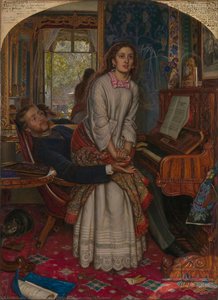
  3. The Awakening Conscience by William Holman Hunt, 1853, Tate Britain
    3

    William Holman HuntPre-Raphaelite Brotherhood

    The Awakening Conscience

    Tate Britain, London1853Oil on canvas55 × 76 cm

    At first glance, the painting presents a seemingly straightforward domestic scene: a woman, identified as a fallen woman, sits in the lap of her lover within a lavishly furnished room. “The Awakening Conscience” is a quintessential example of Pre-Raphaelite aesthetics.

    The singular detailmirrorsymbolism

    Its story

  4. The Lady of Shalott by John William Waterhouse, 1888, Tate Britain
    4

    John William WaterhousePre-Raphaelite Brotherhood

    The Lady of Shalott

    Tate Britain, London1888Oil on canvas20 × 15 cm

    Waterhouse’s approach to “The Lady of Shalott” firmly establishes it within the Pre-Raphaelite Brotherhood's aesthetic philosophy. Rejecting the academic conventions that dominated much of 19th-century art, the Brotherhood championed a return to medieval sources, an emphasis on vibrant color and meticulous detail, and a fascination with themes of mythology, legend, and literature.

    The singular detailflowing red hairmirror reflection

    Its story

  5. The Day Dream by Dante Gabriel Rossetti, 1880, Victoria and Albert Museum
    5

    Victoria and Albert Museum, London1880Oil on canvas157.5 × 92.7 cm

    While details regarding its precise creation remain elusive, the work unequivocally bears the hallmarks of Dante Gabriel Rossetti’s distinctive style. Rossetti, a pivotal figure in the Pre-Raphaelite Brotherhood, championed a return to the detailed observation and vibrant color palettes characteristic of Italian art before Raphael. ‘The Daydream’ exemplifies this philosophy.

    The singular detailsoft lightingancient tree

    Its story

  6. Canny Glasgow by John Atkinson Grimshaw, 1887, Thyssen-Bornemisza Museum
    6

    Thyssen-Bornemisza Museum, Madrid1887Oil on canvas61 × 91 cm

    Exemplifying Grimshaw’s signature style, this artwork showcases his meticulous attention to detail and mastery of realism. Painted during the late 19th century, this work captures the essence of a bustling yet serene maritime community during the Victorian era.

    The singular detaildusk lightingharbor scene

    Its story

  7. The Shadow by Edmund Blair Leighton
    7

    Oil on canvas

    Born in London, United Kingdom, on September 21st, 1852, the artist spent his life translating the quiet weight of history into pigment. In 1878, he painted A King and a Beggar Maid, a scene exploring the sharp edges of social contrast.

    Its story

  8. Hylas and the Nymphs by John William Waterhouse, 1896, Manchester Art Gallery
    8

    Manchester Art Gallery1896Oil on canvas132.1 × 197.5 cm

    Around him, the surface breaks as nude women emerge from the greenery, their forms pale and luminous against the deep greens of the pond. The palette is dominated by cool tones, where deep blues and dark greens create a melancholic mood, interrupted only by the warmth of flesh tones.

    Its story

  9. The Hireling Shepherd by William Holman Hunt, 1851, Manchester Art Gallery
    9

    Manchester Art Gallery1851Oil on canvas76 × 110 cm

    The painting depicts a young shepherd and a maiden in a lush countryside setting. The shepherd, neglecting his flock, is engrossed in showing the woman a death's-head hawkmoth. Hunt's meticulous attention to detail and vivid color palette are hallmarks of the Pre-Raphaelite style.

    The singular detailneglected sheep wandering into a wheat fielddeath's-head hawkmoth

    Its story

  10. Mariana by John Everett Millais, 1851, Tate Britain
    10

    John Everett MillaisPre-Raphaelite Brotherhood

    Mariana

    Tate Britain, London1851Oil49 × 59 cm

    The subject, identified as Mariana from Shakespeare’s “Measure for Measure,” is positioned near a window adorned with stained glass panels depicting the Annunciation. “Mariana” is rich in symbolic meaning, reflecting the anxieties and sensibilities of Victorian society. Furthermore, the reference to Tennyson’s poem adds another layer of interpretation.

    The singular detailembroiderystained glass

    Its story

  11. Penelope and the Suitors by John William Waterhouse, 1912
    11

    1912Oil on canvas130 × 188 cm

    This large-scale oil painting, measuring 130 x 188 cm, showcases Waterhouse's signature Pre-Raphaelite style, characterized by meticulous detail, rich colors, and a deep appreciation for classical themes. The artwork depicts Penelope, the faithful wife of Odysseus from Homer's "Odyssey," surrounded by her suitors.

    The singular detailcomplex composition with dynamic arrangement of figures

    Its story

  12. Mother Hubbard by Briton Rivière, 1882
    12

    1882Oil on canvas65 × 48.1 cm

    Mother Hubbard is a portrait painted by Briton Rivière in 1882. In 1882, he produced Cupboard Love and Giants at Play. His output during this timeframe also includes the 1883 paintings Companions in Misfortune and The Last of the Crew. Earlier in his career, the artist produced Sympathy in 1877.

    Its story

  13. Ariadne by John William Waterhouse, 1898
    13

    1898Oil on canvas91 × 151 cm

    Set against a tranquil harbor with ships on the horizon, the composition is both balanced and dynamic. John William Waterhouse was born in Rome to English parents and later moved to London, where he enrolled in the Royal Academy of Art Schools.

    The singular detailserene harbor with shipsexquisite detail and harmonious blend of elements

    Its story

  14. Christ in the House of His Parents by John Everett Millais, 1849–1850, Tate Britain
    14

    Tate Britain, London1849–1850Oil on canvas39 × 86 cm

    The oil painting titled Christ in the House of His Parents (`The Carpenter's Shop') was created by John Everett Millais between 1849 and 1850. It captures a quiet, industrious moment within Saint Joseph's carpentry workshop. The scene focuses on the Holy Family, grounding the sacred in the grit of manual labor.

    Its story

  15. Dantis Amor by Dante Gabriel Rossetti, 1860, Tate Gallery
    15

    Tate Gallery, London1860Oil81.3 × 74.9 cm

    “Dantis Amor” draws heavily from Dante Alighieri’s “La Vita Nuova,” a semi-autobiographical work exploring Dante's idealized love for Beatrice. Created during the Victorian era, “Dantis Amor” reflects a broader cultural interest in mythology, religion, and romanticism. The Pre-Raphaelite Brotherhood challenged the prevailing artistic conventions of their time, advocating for greater realism, detail, and emotional depth.

    Its story

  16. W H The Light of the World by William Holman Hunt, 1851
    16

    1851Oil on canvas

    W H The Light of the World is a work by William Holman Hunt, completed in 1851. After this acquisition, the work arrived at St Paul's in June 1908. Additionally, a third version hangs in St Paul's Cathedral, having arrived there in 1908 after being purchased from the artist by Charles Booth.

    Its story

  17. Ophelia by John William Waterhouse, 1894
    17

    John William WaterhousePre-Raphaelite Romanticism

    Ophelia

    1894Oil on canvas73 × 124 cm

    Romanticism at its Finest: The painting firmly establishes itself within the Romantic movement, prioritizing emotional intensity and subjective experience. Waterhouse's approach aligns with the Pre-Raphaelite Brotherhood’s emphasis on meticulous detail and a return to medieval artistic ideals – a desire for sincerity and beauty over academic convention.

    The singular detailwillowfloral motifs

    Its story

  18. Girl on a Balcony Watching a Couple by a Lake by Philip Richard Morris
    18

    Oil on board

    The scene unfolds within the oil painting titled Girl On A Balcony Watching A Couple By A Lake. This work, rendered in oil on board, captures a quiet moment of observation.

    Its story

  19. Dante's Dream by Dante Gabriel Rossetti, 1872, Walker Art Gallery
    19

    Dante Gabriel RossettiPre-Raphaelite Brotherhood

    Dante's Dream

    Walker Art Gallery, Liverpool1872Oil on canvas216 × 312 cm

    The Pre-Raphaelite Brotherhood, founded in 1848, actively challenged the prevailing artistic trends of their time, advocating for a return to the stylistic conventions of early Renaissance art as exemplified by Giotto and Fra Angelico. Ultimately, “Dante’s Dream” succeeds in capturing the essence of Romantic emotion—a palpable tension between dominance and vulnerability, aspiration and constraint.

    Its story

  20. Circe Invidiosa by Colonel Charles H. Waterhouse, Usmcr, Art Gallery of South Australia
    20

    Art Gallery of South Australia, AdelaideOil87 × 180 cm

    The oil on canvas depicts a female figure positioned within a natural landscape. The painting is dated 1892 and is categorized within the Pre-Raphaelite and Romanticism movements. This work is held at the Art Gallery of South Australia in Adelaide. It was created in 1892.

    Its story

  21. Autumn Leaves by John Everett Millais, 1856, Манчестерська художня галерея
    21

    Манчестерська художня галерея, Manchester1856Oil on canvas73 × 104 cm

    The painting is characterized by its meticulous attention to detail, rich color palette, and expressive brushwork. Painted in 1856, "Autumn Leaves" reflects the shift in Millais's style away from the strict Pre-Raphaelite aesthetic towards a more naturalistic and emotive approach. The painting was exhibited at the Royal Academy and received praise from critic John Ruskin, who described it as "the first instance of a perfectly painted twilight." This work is also notable for its influence on the development of the Aesthetic Movement.

    The singular detailcontrast between middle-class and working-class clothingtwilight setting

    Its story

  22. Godiva by John Collier, 1898, The Herbert Art Gallery and Museum
    22

    John CollierPre-Raphaelite

    Godiva

    The Herbert Art Gallery and Museum, Coventry1898Oil on canvas142.2 × 183 cm

    The painting captures a moment of suspended animation, where a young woman sits gracefully upon a luminous white horse against the backdrop of a medieval city wall. Collier, a master of the Pre-Raphaelite aesthetic, eschews the overt drama often associated with historical legends.

    Its story

  23. Endymion on Mount Latmus by John Atkinson Grimshaw, 1879
    23

    1879Oil on canvas47 × 32 cm

    The background unfolds into a vast landscape, where the sky transitions from warm oranges to cool greens, suggesting either dawn or dusk. Created in 1879, this artwork reflects the artistic sensibilities of the Victorian era. The Pre-Raphaelite influence is evident in the meticulous attention to detail and the realistic portrayal of figures and landscape.

    The singular detailreclining womandreamlike and ethereal composition

    Its story

  24. A Huguenot by John Everett Millais, 1852
    24

    1852Oil on canvas

    As they hold one another, there is a palpable sense of a final goodbye; the man, a Protestant Huguenot, stands resolute in his faith, refusing to adopt the outward symbols of the opposing Catholic faction, even at the cost of his life.

    The singular detaildetailed realismemotional depth

    Its story

  25. Ophelia 1 by John William Waterhouse, 1889
    25

    1889Oil on canvas98 × 158 cm

    The piece depicts a solitary woman lying in a meadow, surrounded by tall grass and wildflowers. The artist employs a rich, earthy color palette dominated by greens, browns, and muted yellows, with subtle hints of red adding warmth.

    The singular detaildetailed rendering of wildflowers and grass

    Its story

  26. The Light of the World by William Holman Hunt, 1851, Keble College
    26

    Keble College, Oxford1851Oil on canvas59 × 125 cm

    The painting's power lies in its meticulous detail, its deliberate use of light, and the potent symbolism woven into every element. Jesus as the Light: The central figure, Jesus Christ, holding the lantern is the core symbol. “The Light of the World” emerged during a period of significant artistic and intellectual change.

    The singular detaillanternsymbolism

    Its story

  27. Joan of Arc by Dante Gabriel Rossetti, 1864, Tate Gallery
    27

    Tate Gallery, London1864Oil on canvas

    The prominent sword she clasps isn’t brandished aggressively, but held with a quiet solemnity, hinting at both power and sacrifice. The mid- 19th century witnessed a renewed fascination with medieval history and legend – a hallmark of the Pre-Raphaelite movement.

    The singular detaildetailed realismsymbolic use of the sword

    Its story

  28. Lilith by John Collier, 1887
    28

    John CollierPre-Raphaelite

    Lilith

    1887Oil on canvas194 × 104 cm

    There was a perceived risk in drawing inspiration from the 1868 poem by Dante Gabriel Rossetti. The painting first met the public eye during the London Exhibition of the Royal Academy of Arts in 1887. It appeared again that same year at the 11th Summer show of London's Grosvenor Gallery.

    Its story

  29. God Speed! by Edmund Blair Leighton, 1900
    29

    1900Oil on canvas160 × 116 cm

    Created in 1900, the work depicts a medieval scene situated at the entrance of a castle. The painting was exhibited at the Royal Academy of Arts in 1900. It was later sold at Christie's in 1988. The most recent recorded transaction occurred at Sotheby's in London on 10 May 2012.

    Its story

  30. Lamia by John William Waterhouse, 1917, Auckland Art Gallery Toi o Tāmaki
    30

    John William WaterhousePre-Raphaelite Romanticism

    Lamia

    Auckland Art Gallery Toi o Tāmaki1917Oil on canvas90 × 144 cm

    (Image of Lamia by John Waterhouse) Waterhouse’s interpretation is deeply rooted in Keats's original poem. Initially working in the style of Lawrence Alma-Tadema, he gradually embraced the Pre-Raphaelite Brotherhood’s romantic vision, finding inspiration in Arthurian legends and medieval themes.

    Its story

  31. Venus Verticordia by Dante Gabriel Rossetti, 1868, Russell-Cotes Art Gallery - Museum
    31

    Russell-Cotes Art Gallery - Museum, Bournemouth1868Oil on canvas69 × 98 cm

    The golden apple directly references the Judgement of Paris, representing beauty and the potential for discord. This particular aspect of the goddess was invoked by Roman women seeking to turn or redirect a lover's affections – adding a layer of complexity to the painting’s interpretation. Created during the height of the Aesthetic movement, Venus Verticordia reflects the Victorian era’s fascination with classical mythology and its exploration of themes of beauty, sensuality, and morality.

    The singular detailwreathroses

    Its story

  32. Dante and Beatrice by Henry Holiday, 1884, Walker Art Gallery
    32

    Henry HolidayPre-Raphaelite Brotherhood

    Dante and Beatrice

    Walker Art Gallery, Liverpool1884Oil on canvas140 × 199 cm

    The central focus rests on Beatrice, positioned in the heart of the group, yet subtly distanced from Dante through her averted gaze. Florence, Italy, 13th Century – meticulously recreated with attention to architectural detail and period costume. Dante, Beatrice, and Monna Vanna, representing different facets of the romantic encounter.

    The singular detailshattering denial

    Its story

  33. Ecce Ancilla Domini! by Dante Gabriel Rossetti, 1850, Tate Gallery
    33

    Dante Gabriel RossettiPre-Raphaelite Brotherhood

    Ecce Ancilla Domini!

    Tate Gallery, London1850Oil on canvas73 × 42 cm

    The painting depicts a moment from Christian tradition, where the angel Gabriel announces to the Virgin Mary that she will bear Jesus Christ. Rossetti's other notable works include Joan of Arc, Proserpine, and The Girlhood of Mary Virgin.

    The singular detailchiaroscurolayered paint

    Its story

  34. Homeward Bound, Making for the Mersey by William Joseph Julius Caesar Bond, 1872
    34

    1872Oil97 × 152 cm

    The salt spray feels almost tangible as two sailboats cut through the undulating surface of the Mersey. One vessel leads the way, positioned closer to the viewer, its hull slicing through the swells with a sense of purposeful momentum.

    Its story

  35. The Temple of Eros by Herbert Gustave Schmalz
    35

    Oil

    Sunlight filters through a dense canopy of verdant leaves, casting dappled shadows across a lush, idyllic park. Some figures lean forward in contemplation, their faces softened by reverence, while others appear caught in moments of pure joy.

    Its story

  36. Mariana in the Moated Grange by John Everett Millais, 1851, Tate Gallery
    36

    Tate Gallery, London1851Oil on panel

    The artwork depicts Mariana, a woman abandoned and awaiting her lover’s return, trapped within the confines of a decaying estate. Millais was renowned for his dedication to realism and detail, a hallmark of the Pre-Raphaelite Brotherhood. Bischoffsheim," both housed at the Tate Gallery, which demonstrate his versatility in portraiture.

    Its story

  37. The Beguiling of Merlin (Merlin and Vivien) by Edward Burne-Jones, 1874, Lady Lever Art Gallery
    37

    Lady Lever Art Gallery, Ліверпуль1874Oil on canvas186 × 111 cm

    Created between 1872 and 1877, the painting emerged during a transformative period in the artist's career. The work made its public debut in 1877 at the opening exhibition of the Grosvenor Gallery in London. Specifically, the painting was held by William Hesketh Lever, 1st Viscount Leverhulme, from 1918 until 1922.

    Its story

  38. Lady Lilith by Dante Gabriel Rossetti, 1866, Metropolitan Museum of Art
    38

    Metropolitan Museum of Art, New York1866Oil on canvas96.5 × 85.1 cm

    It dominates the upper reaches of the canvas, cascading down like a silken weight over her shoulder. Originally, the face of the subject was modeled by Fanny Cornforth, but in later years, the artist returned to the work to incorporate the features of Alexa Wilding.

    Its story

  39. Chatterton by Henry Wallis, 1856, Tate Britain
    39

    Henry WallisPre-Raphaelite

    Chatterton

    Tate Britain, London1856Oil on canvas62.2 × 93.3 cm

    Following this debut, the work was presented at the Art Treasures Exhibition in Manchester in 1857. In 1854, he produced Shakespeare’s House, a work that depicts the town of Stratford-upon-Avon with precision. Additionally, he produced a version of The Death of Chatterton in 1858.

    Its story

  40. Tale from the Decameron by John William Waterhouse, 1916, Lady Lever Art Gallery
    40

    Lady Lever Art Gallery, Sunfield1916Oil on canvas102 × 159 cm

    The artwork's vibrant yet harmonious color palette is dominated by deep earth tones —rich reds, lush greens, and warm browns—that create a sense of warmth and intimacy.

    The singular detailintricate detailing of the women's clothing and the lute

    Its story

  41. Speak! Speak! (Apparition) by John Everett Millais, 1895, Tate Gallery
    41

    Tate Gallery, London1895Oil on canvas

    The painting’s genesis lies within Tennyson's poem of the same name, a poignant tale of a young woman abandoned by her lover and left to contemplate her fate in a desolate cottage. The sleeping man represents the lost love, his unconsciousness mirroring the emotional void within Mariana's world.

    The singular detailbirdchiaroscuro

    Its story

  42. Cape Cornwall from Whitesand Bay by John Edward Brett, 1872, Fitzwilliam Museum
    42

    Fitzwilliam Museum1872Oil on panel25 × 36 cm

    In the distance, several small figures are positioned along the shore, appearing as minute details against the scale of the landscape. The artist utilized specific technical methods to render the physical properties of the Cornish coast: Created in 1872, this work reflects the scientific approach to landscape painting prevalent during the nineteenth century.

    Its story

  43. The Garden of the Hesperides by Frederic Leighton, 1892, Lady Lever Art Gallery
    43

    Lady Lever Art Gallery, Ліверпуль1892Oil on canvas

    Three figures are captured in a state of serene abandon beneath the sheltering canopy of a tree, their very posture suggesting a deep communion with nature and each other. The Hesperides themselves are figures steeped in legend, associated with golden apples and paradise.

    Its story

  44. Poe Eleonora by John Byam Liston Shaw
    44

    Oil

    The painting titled Poe Eleonora is a work by the artist John Byam Liston Shaw. His career spanned several decades until his death in 1919.

    Its story

  45. Wyl_lmg_112923_large by Edward Matthew Hale
    45

    Oil

    Both figures are dressed in military uniforms characteristic of the late 19th or early 20th century. The person on the left wears a red jacket accented with white trim and black trousers. A tall hat adorned with a plume rests on their head, and a sword is attached to their belt.

    Its story

  46. The Scapegoat by William Holman Hunt, 1854–1856, Lady Lever Art Gallery
    46

    Lady Lever Art Gallery, Ліверпуль1854–1856Oil on canvas45 × 33 cm

    The composition functions as an iconographical prefiguration of Christ's sufferings and redemptive death. For those wishing to experience the full scale of this work, the larger version is held at the Lady Lever Art Gallery in Port Sunlight. A smaller version of the painting is also available for viewing, located at the Manchester Art Gallery.

    Its story

  47. Sybilla Palmifera by Dante Gabriel Rossetti, 1866, Lady Lever Art Gallery
    47

    Lady Lever Art Gallery, Ліверпуль1866Oil on canvas98.4 × 85 cm

    The artwork centers around a striking young woman with cascading, fiery red hair – a hallmark of Rossetti’s favored models. The symbolism within Sybilla Palmifera is rich and layered: The Quill Pen: Represents creativity, intellect, and the power of writing.

    The singular detailrosespoppies

    Its story

  48. La nanna, Pavonia by Frederic Leighton, 1859
    48

    1859Oil on canvas

    The gaze of the viewer meets the profile of a woman in La nanna, Pavonia, a work painted by Frederic Leighton in 1859. It traveled to London to be exhibited at the Royal Academy in 1859, where it first met the eyes of the public.

    Its story

  49. The duet portrait of alexandra daughter of rev g kitchin and winifrid by Henry Holiday
    49

    Oil

    The duet portrait of alexandra daughter of rev g kitchin and winifrid emerges from the canvas as a quiet moment of shared melody. Created by the artist Henry Holiday, this work captures a private instance of harmony between two young women.

    Its story

  50. Psyche Opening the Golden Box by John William Waterhouse, 1903
    50

    1903Oil on canvas

    His interest in the intersection of myth and human emotion is further seen in Hylas and the Nymphs from 1896, and in Pandora, also from 1896. The Soul of the Rose, created in 1908, reflects his ongoing focus on the female form and the subtle expressions that define her inner life.

    Its story

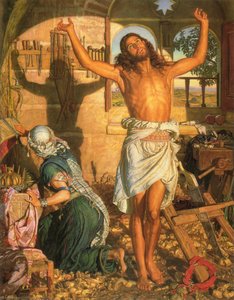
  51. The Shadow of Death by William Holman Hunt, 1873, Manchester Art Gallery
    51

    Manchester Art Gallery1873Oil on canvas73 × 94 cm

    Hunt, a key figure in the Pre-Raphaelite Brotherhood, sought to revive the artistic ideals of the early Italian Renaissance —a rejection of the academic conventions dominating the art world at the time—and his work is characterized by meticulous detail, vibrant color, and an unwavering commitment to naturalism and spiritual truth. The painting immediately draws the eye to Christ himself, a young man depicted in a state of serene acceptance as he stretches out his arms, mirroring the pose of a crucified figure.

    The singular detailchrist's figuresymbolic details

    Its story

  52. The Black Brunswicker by John Everett Millais, 1860, Lady Lever Art Gallery
    52

    Lady Lever Art Gallery, Ліверпуль1860Oil on canvas104 × 68.5 cm

    The Black Brunswicker is an oil on canvas work by John Everett Millais, dating to 1860. The man is depicted as a member of the Black Brunswickers, a specialized troop of highly-trained German soldiers from 1809. For the soldier, the artist chose a private in the Life Guards.

    Its story

  53. Untitled (AQZGCA) by John William Waterhouse, 1886, National Gallery
    53

    National Gallery, London1886Oil on canvas127 × 182.9 cm

    The canvas known as untitled (229) emerges from the brush of John William Waterhouse, a painter whose origins trace back to the classical atmosphere of Rome, Italy. Born to English parents, Waterhouse carries the legacy of a creative household into every stroke.

    Its story

  54. Isabella by John Everett Millais, 1849, Walker Art Gallery
    54

    John Everett MillaisPre-Raphaelite Brotherhood

    Isabella

    Walker Art Gallery, Liverpool1849Oil on canvas142 × 103 cm

    The canvas vibrates with the tension of a secret unearthed—the discovery of her murdered lover, Lorenzo. Every element within the frame of Isabella is a carefully placed syllable in a larger poem of sorrow.

    Its story

  55. The Blessed Damozel by Dante Gabriel Rossetti, 1878, Harvard Art Museums
    55

    Harvard Art Museums, Cambridge1878Oil on canvas84 × 174 cm

    Rossetti brilliantly translates this narrative into visual form, portraying the Damozel’s sorrowful contemplation and unwavering devotion. Characteristic of the Pre-Raphaelite movement, “The Blessed Damozel” employs meticulous detail and vibrant color palettes—primarily dominated by golds, greens, and pinks—to create an atmosphere of otherworldly beauty.

    Its story

  56. La Donna della Finestra by Dante Gabriel Rossetti, 1879, Fogg Art Museum
    56

    Fogg Art Museum, Cambridge1879Oil on canvas97 × 87 cm

    Rossetti’s style aligns perfectly with the Pre-Raphaelite Brotherhood's aesthetic principles. “La Donna Della Finestra” exemplifies this ethos—a deliberate departure from conventional portraiture aimed at capturing not just likeness but also inner spirit.

    Its story

  57. The Crown of Love by John Everett Millais, 1875
    57

    1875Oil on canvas127 × 86 cm

    In this 1875 oil on canvas, a man and a woman are positioned in the center of a dense forest. While the artist's earlier career was defined by the intense, uncompromising clarity of the Pre-Raphaelite Brotherhood, this piece from 1875 demonstrates a move toward a more atmospheric realism.

    Its story

  58. Morning music by Dante Gabriel Rossetti, 1864
    58

    1864Oil on canvas

    This group rebelled against what they perceived as the artificiality of post- Renaissance art, seeking to return to the detail, intense colors, and sincerity found in Italian art before Raphael. Pre-Raphaelite, Dante Gabriel Rossetti, Victorian Art, Romanticism, Music, Portraiture, Symbolism, Red Hair, Oil Painting

    Its story

  59. Principal John Caird (1820–1898) by John Everett Millais, 1880, The Hunterian Museum and Art Gallery
    59

    The Hunterian Museum and Art Gallery, Glasgow1880Oil on canvas127 × 92 cm

    The subject wears a dark, heavy robe that falls in thick folds across his shoulders and chest. The subject, John Caird, is presented not through idealized features, but through a direct and unadorned representation of his likeness and professional attire.

    Its story

  60. King Cophetua and the Beggar Maid by Edward Burne-Jones, 1884, Tate Britain
    60

    Tate Britain, London1884Oil on canvas135 × 293 cm

    During a period marked by rapid industrialization and shifting social mores, Burne-Jones looked backward to the legends of Camelot and the romanticism of the past to find a sense of moral clarity.

    Its story

  61. The Quarrel of Oberon and Titania by Joseph Noel Paton, 1849, Scottish National Gallery
    61

    Scottish National Gallery, Edinburgh1849Oil on canvas99 × 152 cm

    Paton, born in the textile heart of Dunfermline, Scotland, brought his upbringing steeped in intricate patterns and craftsmanship to bear on this fantastical scene, imbuing it with a remarkable level of detail and emotional resonance. The painting captures a pivotal moment from Act II, Scene I of A Midsummer Night’s Dream. Oberon, the King of the Fairies, is locked in a furious dispute with his queen, Titania. Paton’s style is deeply rooted in the Pre-Raphaelite Brotherhood's aesthetic principles.

    The singular detailwoodland scenefairy figures

    Its story

  62. Wedding of St George and the Princess by Dante Gabriel Rossetti, 1857, Tate Gallery
    62

    Tate Gallery, London1857Oil

    True to the Pre-Raphaelite Brotherhood's principles, the painting is characterized by an astonishing level of detail. Dante Gabriel Rossetti (1828-1882), a central figure in the Pre-Raphaelite movement, sought to reject what he perceived as the artificiality of academic art and return to the sincerity and detail found in early Italian Renaissance painting.

    Its story

  63. Two Little Italian Girls by John William Waterhouse, 1889, Plymouth City Museum
    63

    Plymouth City Museum1889Oil on canvas60 × 38 cm

    Waterhouse was deeply influenced by the Pre-Raphaelite Brotherhood, a group dedicated to reviving the artistic styles of the early Italian Renaissance – specifically, before Raphael. The painting’s subject matter—young girls in a rural setting —aligns perfectly with Pre-Raphaelite themes of innocence and beauty.

    The singular detailboatsanto Stefano dome

    Its story

  64. Landscape with Bridge and Figures by William James Blacklock, 1858
    64

    1858Oil on canvas30 × 42 cm

    Landscape with Bridge and Figures is an oil on canvas by the British artist William James Blacklock. In this piece, William James Blacklock utilizes his characteristic attention to detail to render a scene of natural tranquility.

    Its story

  65. FEBRUARY FILL DYKE by Benjamin Williams Leader, 1881, Birmingham Museum and Art Gallery
    65

    Birmingham Museum and Art Gallery1881Oil on canvas121.9 × 183 cm

    February Fill Dyke is an oil painting on canvas, measuring 106.7 x 152.4 cm (42 x 60 in). As a Pre-Raphaelite artist, Leader was known for his detailed depictions of nature and realistic style. Leader's brushwork in February Fill Dyke demonstrates his skillful handling of textures and light.

    Its story

  66. The Bibliophilist's Haunt (Creech's Bookshop) by William Fettes Douglas, 1864
    66

    1864Oil66 × 87 cm

    The scene depicts a man amidst a gathering of people, all contained within a room defined by the presence of books. The atmosphere is one of stillness, a moment of scholarly repose captured in the soft light of a private library or a specialized bookshop.

    Its story

  67. The Owl by Henry Clarence Whaite, 1865
    67

    1865Oil30 × 23 cm

    The Owl is a painting by Henry Clarence Whaite, executed about 1865. This work measures 30 x 23 cm. The composition focuses on a single owl perched upon a tree branch. Green leaves surround the central subject, creating layers of depth within the natural setting.

    Its story

  68. The Last Chapter by Robert Braithwaite Martineau, 1863, Birmingham Museum and Art Gallery
    68

    Birmingham Museum and Art Gallery1863Oil on canvas72 × 42 cm

    The room is a collection of scattered volumes and silent furniture. The scene is a study in domestic solitude, captured in 1863. The arrangement of the room suggests a private moment, perhaps a pause in a long afternoon of study.

    Its story

  69. Door (part of a set) by Charles Fairfax Murray, 1871
    69

    1871Oil on wood62 × 39 cm

    Within the six recessed panels, a structured dance of light and shadow unfolds. The presence of figures like Fame and Amor suggests a world governed by the whims of love and the weight of reputation.

    Its story

  70. Isabella and the Pot of Basil by John Melhuish Strudwick
    70

    Oil

    The subject matter is drawn from the poem by John Keats, which itself finds its origins in a tale from Boccaccio's Decameron. Having served as a studio assistant to Edward Burne-Jones, his hand bears the unmistakable influence of that master.

    Its story

  71. Jane Burden (Mrs William Morris) by Dante Gabriel Rossetti, 1893, National Trust
    71

    National Trust, Wolverhampton1893Oil on canvas48 × 48 cm

    William Morris (as she was formally known) with a striking directness, her vibrant red hair cascading around a face that seems both familiar and distant. The relationship between the three – William Morris, Dante Gabriel Rossetti, and Jane – was famously complex, marked by affection, artistic collaboration, and undeniable emotional entanglement. Rossetti’s technique in this portrait exemplifies the core tenets of the Pre-Raphaelite Brotherhood. The parasol itself can be interpreted as a symbol of Victorian femininity, but also perhaps of concealment or protection—a hint at the complexities hidden beneath her serene exterior.

    Its story

  72. Windflowers by John William Waterhouse, 1902, Plymouth City Museum
    72

    John William WaterhousePre-Raphaelite Romanticism

    Windflowers

    Plymouth City Museum1902Oil on canvas116 × 79 cm

    As a quintessential example of the Pre-Raphaelite movement, Windflowers reflects the group's fascination with medieval legends, mythology, and the beauty of nature. The painting's subject matter—a woman immersed in nature—was a common theme within the Pre-Raphaelite movement, representing a yearning for spiritual connection and an appreciation of the sublime.

    The singular detailpastel colorsdetail

    Its story

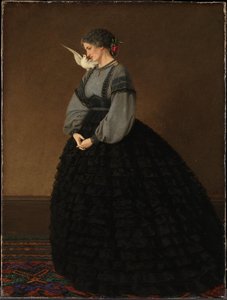
  73. Lady with a Dove: Madame Loeser by John Edward Brett, 1864, Tate Gallery
    73

    Tate Gallery, London1864Oil paint on canvas

    This oil on canvas captures a specific presence, one that remains part of the esteemed Tate collection. The portrait focuses on Madame Loeser, whose likeness is preserved through the artist's careful application of paint.

    Its story

  74. Stonehaven Harbour by William Fettes Douglas, 1874, Scottish National Gallery
    74

    Scottish National Gallery, Edinburgh1874Oil on canvas119 × 59 cm

    Painted about 1874, this oil on canvas captures a moment of maritime life along the waterfront. This search for hidden truths continues in The Alchemist, created in 1855, where the pursuit of knowledge takes on a tangible, almost physical presence.

    Its story

  75. A Lady with a Gold Chain and Earrings by Robert Braithwaite Martineau, 1861, Manchester Art Gallery
    75

    Manchester Art Gallery1861Oil

    It is a piece that reflects the meticulous observation characteristic of Martineau's approach to his subjects. The work is currently held within the collection of the Manchester Art Gallery.

    Its story

  76. Margaret Nettlefold Before Her Dining Room at Winterbourne by John Byam Liston Shaw
    76

    Oil paint on canvas

    This realistic portrait places her in a specific, lived-in setting, turning a simple instance of being present into a study of character. The painting functions as a window into a private life. Through this depiction, John Byam Liston Shaw explores the intersection of person and place.

    Its story

  77. Daughters of Judah in Babylon by Herbert Gustave Schmalz, 1892
    77

    1892Likely oil paint or charcoal

    The work focuses on the interaction between exiled Jewish women and the Babylonian royalty. Among these, Return from Calvary (1891) remains one of his most recognized compositions. His 1884 painting Too Late demonstrates his early engagement with narrative storytelling.

    Its story

  78. 's Dream on the Day of the Death of Beatrice by Dante Gabriel Rossetti, 1880, Dundee City Council
    78

    Dundee City Council1880Watercolor on paper

    The painting immediately draws the viewer in with its muted palette – predominantly dusky blues, browns, and creams – creating a sense of twilight and melancholy. The painting’s title itself reveals its genesis: Beatrice Portinari, Rossetti's beloved muse and the subject of countless poems and paintings, died in 1850.

    The singular detailintimate scenefigures

    Its story

  79. Bubbles by John Everett Millais, 1886, Lady Lever Art Gallery
    79

    Lady Lever Art Gallery, Ліверпуль1886Oil on canvas

    The painting captures the boy in a moment of quiet fascination, looking upward at a floating bubble. Millais produced this work during his later period, moving away from the meticulous detail of his youth toward a more atmospheric realism. After A & F Pears was acquired by Lever Brothers, the painting entered their permanent collection.

    Its story

  80. The Priestess of Bacchus by John Collier, 1885
    80

    1885Oil on canvas

    A wreath of ivy rests upon her head, its green leaves a stark contrast to the luminous quality of her skin. The ivy wreath, signifying the lush, growing life associated with Bacchus.

    Its story

  81. Antigone by Frederic Leighton, 1882
    81

    Frederic LeightonPre-Raphaelite

    Antigone

    1882Oil on canvas59 × 50 cm

    This work emerged from the hand of Frederic Leighton, an artist who sought to inhabit the classical world through precise form. The paint is applied to a rectangular expanse, measuring 59 x 50 cm. The physical presence of the work is defined by these specific proportions, 23 3/4 x 19 1/2 in, which anchor the figure within a controlled, steady frame.

    Its story

  82. Morgan Le Fay by Edward Burne-Jones, 1862, Holland Park
    82

    Holland Park, London1862Oil on canvas96 × 48 cm

    The landscape surrounding her is lush and serene, filled with the textures of trees and bushes that frame her figure. The painting reflects a departure from the polished academic traditions of the mid- 19th century.

    Its story

  83. The Hostage by Edmund Blair Leighton, 1912
    83

    1912Oil on canvas

    It first met the public eye during the Royal Academy summer exhibition in 1912, appearing as catalogue number 322. By 1880, the focus shifts to the intellectual and the mortal in The Dying Copernicus, a dramatic portrayal of an astronomer's final moments.

    Its story

  84. Forest Cove, Cardigan Bay by John Edward Brett, 1883, Amgueddfa Cymru
    84

    Amgueddfa Cymru, Cardiff1883Oil

    The water meets the land in a gentle rhythm, while several boats drift upon the surface—some resting near the shallow shore and others appearing as small silhouettes further out in the vastness of the ocean.

    Its story

  85. Regina Cordium by Dante Gabriel Rossetti, 1866, Johannesburg Art Gallery
    85

    Dante Gabriel RossettiPre-Raphaelite Romanticism

    Regina Cordium

    Johannesburg Art Gallery1866Oil on panel

    The work’s genesis is inextricably linked to Rossetti’s tumultuous relationship with Siddal. Furthermore, the painting’s title itself—"Regina Cordium"—references Dante Alighieri’s Divine Comedy, where Queen Victoria is depicted as a powerful and enigmatic figure.

    The singular detailgold leaf latticeroses

    Its story

  86. Priestess of Delphi by John Collier, 1891, Art Gallery of South Australia
    86

    Art Gallery of South Australia, Adelaide1891Oil on canvas16 × 8 cm

    The work before us is titled Priestess of Delphi, a significant oil on canvas painted in 1891. The piece is signed and dated on the lower left, bearing the inscription " John Collier / 1891". In 1893, the work was exhibited in Adelaide, Australia.

    Its story

  87. My Lady's Garden by Edmund Blair Leighton, 1905
    87

    1905Oil on canvas

    It offers a quiet glimpse into a private, cultivated space, rendered with the meticulous hand of a craftsman. Edmund Blair Leighton was a painter of historical genre scenes, often focusing on the romanticized details of the Regency and medieval eras.

    Its story

  88. Sibylla Delphica by Edward Burne-Jones
    88

    Oil on canvas

    This period also saw the creation of Morgan Le Fay about 1862, alongside Cupid's Hunting Fields. He moved through significant works such as The Golden Stairs in 1876 and The Garden of Pan in 1887. Later, his hand produced The Star of Bethlehem in 1888 and The Heart of the Rose in 1890.

    Its story

  89. Flora and the Zephyrs by John William Waterhouse, 1898
    89

    1898Oil on canvas45 × 29 cm

    The Pre-Raphaelite Brotherhood, to which Waterhouse was closely associated, sought to revive the artistic styles and approaches used before the Renaissance. This period saw a renewed interest in the romanticism and idealism of ancient Greece and Rome, which is evident in the artwork's composition and subject matter.

    The singular detaildreamlike atmospherecentral figure adorned in red and purple garments

    Its story

  90. The proposal by Edmund Blair Leighton
    90

    Oil paint on canvas

    He was born in London, United Kingdom, on September 21st, 1852, and lived until September 1st, 1922. By 1880, the focus shifted to the intellectual intensity of The Dying Copernicus. Later, in 1907, he turned to the tragic echoes found in Tristan and Isolde.

    Its story

  91. The Ransom by John Everett Millais, 1860, J. Paul Getty Museum
    91

    John Everett MillaisPre-Raphaelite Brotherhood

    The Ransom

    J. Paul Getty Museum, Los Angeles1860Oil on canvas114 × 129 cm

    The painting portrays a pivotal moment, likely inspired by accounts of ransom negotiations during the medieval period. The meticulous attention to clothing styles and weaponry reflects the Pre-Raphaelite commitment to accurate representation, moving away from idealized depictions favored by earlier artistic movements.

    The singular detailswordsarmor

    Its story

  92. A Favour by Edmund Blair Leighton
    92

    Oil paint on canvas66 × 35 cm

    A Favour is an oil on canvas work by Edmund Blair Leighton. By 1880, the canvas held The Dying Copernicus. He painted Godspeed in 1900, followed by The Accolade in 1901. Later, his brush traced the lines of Tristan and Isolde in 1907.

    Its story

  93. The Vale of Rest by John Everett Millais, 1858, Tate Britain
    93

    Tate Britain, London1858Oil on canvas172 × 102 cm

    The scene, inspired by the evocative atmosphere of Tennyson’s poetry, captures a world where the boundary between the living and the departed is as thin as the evening mist. Through their rhythmic, somber actions, Millais explores the duality of mourning—the labor of memory and the silent contemplation of loss.

    Its story

  94. The Charity of St. Elizabeth of Hungary by Edmund Blair Leighton, 1895
    94

    1895Oil on panel

    In 1878, he painted A King and a Beggar Maid. This was followed by The Dying Copernicus in 1880. The turn of the century saw the production of Godspeed in 1900 and The Accolade in 1901. Later in his career, Leighton produced Tristan and Isolde in 1907.

    Its story

  95. The Eve of Saint Agnes by John Everett Millais, 1863
    95

    1863Oil on canvas

    The painting is a quintessential triumph of the Pre-Raphaelite style, a movement defined by its radical commitment to meticulous detail and emotional sincerity.

    Its story

  96. Circe Offering the Cup to Odysseus by John William Waterhouse, 1891, Oldham Art Gallery
    96

    Oldham Art Gallery1891Oil on canvas

    The Pre-Raphaelite Brotherhood emerged in London in 1848 as a reaction against the perceived superficiality of academic art trends. Artists like Waterhouse sought inspiration from medieval manuscripts and Renaissance masters—specifically Botticelli—rejecting the conventions of Romanticism’s emphasis on dramatic emotion and idealized landscapes.

    Its story

  97. Fanny Waugh Hunt by William Holman Hunt, 1868, Toledo Museum of Art
    97

    William Holman HuntPre-Raphaelite Brotherhood

    Fanny Waugh Hunt

    Toledo Museum of Art1868Oil on canvas104 × 73 cm

    The painting captures the pivotal moment from Tennyson's narrative— the Lady of Shalott’s fateful decision to abandon her loom and venture forth from the tower, spurred by a glimpse of Sir Launcelot riding past. The artist painstakingly recreated the scene from Tennyson’s poem using sketches and drawings made in 1857.

    Its story

  98. Helen of Troy by Dante Gabriel Rossetti, 1863, Hamburger Kunsthalle
    98

    Hamburger Kunsthalle1863Oil on panel31 × 27 cm

    More importantly, Rossetti’s choice to portray Helen in quiet contemplation shifts the narrative away from her role as a catalyst for conflict and towards an exploration of female beauty and inner life. Measuring 31 x 27 cm, this work’s intimate scale makes it suitable for both private collections and elegant interiors.

    Its story

  99. Portia (Kate Dolan) by John Everett Millais, 1886
    99

    1886Oil on canvas125 × 84 cm

    As a founder of the Pre-Raphaelite Brotherhood in 1848, Millais brought a disciplined, sincere eye to the canvas, favoring a directness that avoids the overly polished finish of the academic tradition. The painting is part of the Catharine Lorillard Wolfe Collection, which was brought into the museum's holdings in 1906.

    Its story

  100. The Shrine by John William Waterhouse, 1895
    100

    1895Oil on canvas88 × 42 cm

    A young woman, draped in a flowing white gown, pauses upon the steps of a building.

    Its story

Lineages

The famous Pre Raphaelite paintings by lineage

Where they live

The one place you can see each famous Pre Raphaelite painting

London keeps 18 of these originals; the Tate Britain, 8.

Plymouth City Museum2

The masters

The Pre Raphaelite masters our artists look to

Portrait of William Holman Hunt

William Holman Hunt

1827–1910 · United Kingdom · 7

Pre-Raphaelite painter of meticulous detail and vivid symbolism, known for religious scenes and intense naturalism in the Holy Land.

3. The Awakening Conscience, 9. The Hireling Shepherd, 16. W H The Light of the World, 26. The Light of the World, 46. The Scapegoat, 51. The Shadow of Death, 97. Fanny Waugh Hunt

Portrait of Edmund Blair Leighton

Edmund Blair Leighton

1852–1922 · United Kingdom · 7

British Pre-Raphaelite painter of romanticized medieval scenes and chivalric drama, known for highly finished and decorative historical works.

7. The Shadow, 29. God Speed!, 83. The Hostage, 87. My Lady's Garden, 90. The proposal, 92. A Favour, 94. The Charity of St. Elizabeth of Hungary

Portrait of John Collier

John Collier

1850–1934 · United Kingdom · 4

English Pre-Raphaelite portraitist known for meticulous detail and vibrant colors, capturing figures from Charles Darwin to royalty.

22. Godiva, 28. Lilith, 80. The Priestess of Bacchus, 86. Priestess of Delphi

Portrait of Edward Burne-Jones

Edward Burne-Jones

1833–1898 · United Kingdom · 4

Pre-Raphaelite painter of melancholic, elongated figures and medieval myths, known for intricate stained glass and ink wash techniques.

37. The Beguiling of Merlin (Merlin and Vivien), 60. King Cophetua and the Beggar Maid, 82. Morgan Le Fay, 88. Sibylla Delphica

+20more masters our artists study Pre Raphaelite Masters Their stories

In confidence

About these Pre Raphaelite paintings

Hover gently over a question to read the answer.

Which cities have the most famous Pre Raphaelite paintings?

Most of them are in London (18), Ліверпуль (6) and Liverpool (4). The museums with the most are the Tate Britain, the Tate Gallery and the Lady Lever Art Gallery.

How was this list of Pre Raphaelite paintings ranked?

Each painting is ranked by how widely it is known: the number of Wikipedia language editions with an article on it (Wikidata sitelinks), its place in our catalogue's manual ranking and the visits its page receives. The same painting catalogued several times counts once, and details, copies and studies are left out.

How the selection is made

We went through every Pre Raphaelite painting in our catalogue and placed the best-known first: those Wikipedia describes in the most languages, those our artists and curators rank highest and those most viewed on our pages. Each original appears once — no details or copies.

Other movements that inspire us

The periods that inspire us