Inspiration · Naive Art

The 100 Famous Naive Art Paintings That Inspire Our Artists

1848 – 2019

Ask for the most famous Naive Art paintings and you will hear of Henri Rousseau's The Dream (1910, MOMA - Museum of Modern Art), Marc Chagall's Abraham and Three Angels (1966, Musée National Marc Chagall) and Marc Chagall's The Blue Bird (1968). The list runs to 100 paintings by 39 artists, from 1848 to 2019, each with the collection that holds it today.

The Dream by Henri Rousseau, 1910, MOMA - Museum of Modern Art — famous Naive Art painting
No. 1 · Henri RousseauThe Dream1910 · MOMA - Museum of Modern Art, New York City
100singular works
39masters · Edward Hicks – Remant Kumar Mishra
30homes in 19 cities
3kept at the Kettle's Yard

Singular works

100 Naive Art paintings that exist only once

Every original here is unique and kept in one place. Its story, its home, and the detail that makes it unmistakable.

  1. The Dream by Henri Rousseau, 1910, MOMA - Museum of Modern Art
    1

    MOMA - Museum of Modern Art, New York City1910Oil on canvas204.5 × 298.5 cm

    This captivating work exemplifies Rousseau’s unique ability to blend reality and fantasy, creating a visual experience that continues to intrigue and inspire. Henri Julien Félix Rousseau (1844-1910), affectionately known as Le Douanier (“the customs officer”) due to his profession, was a French post-impressionist painter who achieved recognition later in life. The famous “Le Banquet Rousseau” in 1908 celebrated him as a self-taught genius whose work foreshadowed many of the artistic movements to come.

    Its story

  2. Abraham and Three Angels by Marc Chagall, 1966, Musée National Marc Chagall
    2

    Marc ChagallNaive Art Primitivism

    Abraham and Three Angels

    Musée National Marc Chagall, Nice1966Oil on canvas190 × 292 cm

    The artwork centers around a horizontal bench dominating the foreground, punctuated by vertical figures that establish a dynamic rhythm. Chagall’s embrace of Naïve Art distinguishes “Abraham and Three Angels” from academic conventions. “Abraham and Three Angels” belongs to Chagall’s ambitious “The Biblical Message” series initiated in the 1930s.

    Its story

  3. The Blue Bird by Marc Chagall, 1968
    3

    Marc ChagallNaive Art Primitivism

    The Blue Bird

    1968Lithograph56 × 43 cm

    Through his signature use of vibrant hues and flattened forms, Chagulated invites us to abandon our logical perceptions and embrace a landscape shaped by memory, folklore, and spiritual longing. This central motif, deeply rooted in Jewish mysticism and the folk tales of Chagall’s youth, speaks to the eternal cycle of rebirth and renewal.

    Its story

  4. The Deer Wedding by Ivan Generalić, 1959
    4

    1959Oil paint on the reverse of a glass pane

    These animals are arranged in a loose triangular formation, creating a sense of organized movement amidst the vegetation. The deer are rendered with white pigment, providing a sharp contrast against the darker, subdued tones of the surrounding environment. Created in 1959, this work belongs to the naïve art movement.

    Its story

  5. On the Sands, Le Touquet, France by Francis Edwin Hodge, 1929
    5

    1929Oil on canvas51 × 61 cm

    Light spills across the shore, catching the white fabric of a woman's dress as she sits upon a pink blanket. This detachment creates a feeling of being an observer of a private, tranquil moment.

    Its story

  6. Gateway and Three Figures among Trees, Bali by Arie Smit
    6

    Painting47 × 42 cm

    Gateway and Three Figures among Trees, Bali is a painting by Arie Smit. Smit arrived in Bali in 1938.

    Its story

  7. Circus by Marc Chagall, 1980
    7

    Marc ChagallNaive Art / Primitivism

    Circus

    1980Oil on canvas100 × 81 cm

    Marc Chagall's "Circus," painted in 1980, isn’t merely a depiction of a traveling show; it’s an immersion into a world where reality and fantasy intertwine, a testament to the artist’s lifelong fascination with folklore, memory, and the boundless possibilities of imagination.

    The singular detailelephantdancing couple

    Its story

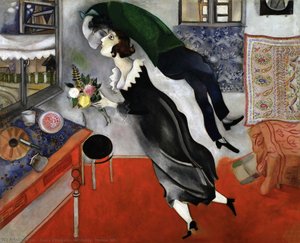
  8. Birthday, Moma NY by Marc Chagall, 1915, Museum of Modern Art (MoMA)
    8

    Marc ChagallNaive Art / Primitivism

    Birthday, Moma NY

    Museum of Modern Art (MoMA)1915Oil on cardboard

    This captivating piece falls under the category of Naive Art or Primitivism, characterized by self-taught artists who lack formal artistic education. Chagall's Birthday, Moma NY is a colorful depiction of a woman holding flowers in her hand while standing next to another person who appears to be flying through the air.

    Its story

  9. The Three Candles by Marc Chagall, 1940
    9

    Marc ChagallNaive Art / Primitivism

    The Three Candles

    1940Oil on canvas127 × 96 cm

    Some suggest the painting was finished in Gordes following the 1940 exodus, a thought that clashes with the evidence of its earlier exhibition at Galerie Mai. Meanwhile, To Russia, with Asses and Others, from about 1912, offers a different glimpse into his evolving vision.

    Its story

  10. The Canal Bridge by L. S. Lowry, 1949
    10

    1949Oil painting71 × 91 cm

    We are looking at The Canal Bridge, an oil painting by L. S. Lowry. It is currently held within the collection of the Southampton City Art Gallery in the United Kingdom. The piece captures a specific moment in the industrial landscape of post-war Britain.

    Its story

  11. A Carnival Evening by Henri Emilien Rousseau, 1885, Philadelphia Museum of Art
    11

    Philadelphia Museum of Art1885Oil on canvas117 × 90 cm

    A Carnival Evening is an oil on canvas work by Henri Emilien Rousseau. The composition features a couple in formal attire walking through a landscape under a large, luminous moon. The work is currently held in the collection of the Philadelphia Museum of Art in the United States. The resulting composition is categorized within the movements of Post-Impressionism and Symbolism. Known colloquially as Le Douanier due to his occupation as a customs officer, he began painting seriously in his forties.

    The singular detailforestcouple in carnival attire

    Its story

  12. Morning Sunlight by Anna Airy, 1926, Doncaster Museum And Art Gallery
    12

    Doncaster Museum And Art Gallery1926Oil61 × 74 cm

    Her 1906 work, Mrs Telford Simpson, offers a glimpse into her early development, much like the quiet presence found in The Kitchen's Queen from 1911. Even her more intimate studies, such as Interior with Mrs Charles Burnand from 1919, demonstrate a consistent ability to capture specific, lived-in atmospheres.

    Its story

  13. Big heads by Pablo Picasso, 1969
    13

    Pablo PicassoNaive Art / Primitivism

    Big heads

    1969Oil on canvas194 × 129 cm

    This piece, measuring 194 x 129 cm, is characterized by its bold and vibrant colors, predominantly yellow and red, which give it a warm and dynamic appearance. The painting falls under the category of Naïve Art (Primitivism), a style often associated with self-taught artists lacking formal training.

    Its story

  14. Moses Receiving the Tablets of Law by Marc Chagall, 1966
    14

    1966Oil on canvas237 × 233 cm

    Marc Chagall's 1966 masterpiece, Moses Receiving the Tablets of Law, is a vibrant and emotionally resonant depiction of one of the most pivotal moments in religious history. Born in Belarus in 1887, Marc Chagall experienced a life shaped by cultural shifts and displacement.

    Its story

  15. Three musicians by Fernand Léger, 1930
    15

    1930Oil paint

    The subject matter, while seemingly grounded in the tradition of genre painting, is transformed through Léger’s unique lens. Instead of retreating into pure form, he embraced a style often associated with Primitivism and Naïve Art, characterized by an unapologetic clarity and a commitment to direct observation.

    Its story

  16. Paris by Raoul Dufy, 1934
    16

    Raoul DufyNaive Art

    Paris

    1934Oil on canvas196 × 156 cm

    The canvas holds the spirit of the urban landscape, fixed in oil during a period of significant stylistic evolution for the artist. This work exists as a window into the French capital. The Louvre Museum and the Arc de Triomphe occupy their places within this bustling arrangement.

    Its story

  17. I Came to the Secret Springs and Lakes Where Mooses Slake Their Thurst by Theodor Kittelsen, 1900
    17

    1900Oil

    I Came to the Secret Springs and Lakes Where Mooses Slake Their Thurst unfolds in a stillness so profound it feels as though the forest itself is holding its breath. A lone moose occupies the left side of the frame, its heavy head lowered toward the water's surface.

    Its story

  18. La Charmeuse de Serpents by Henri Rousseau, 1907, Musée d'Orsay
    18

    Musée d'Orsay, Paris1907Oil on canvas167 × 189 cm

    The oil on canvas titled LA CHARMEUSE DE SERPENTS, also known as The Snake Charmer, emerged from the brush of Henri Rousseau in 1907. In 1907, he produced The Snake Charmer, a work that shares the same heavy, dreamlike atmosphere found in his jungle scenes.

    Its story

  19. Laid Table with View of Saint-Paul de Vance by Marc Chagall, 1968
    19

    1968Oil on canvas100 × 73 cm

    His 1968 masterpiece, Laid Table with View of Saint-Paul de Vence, serves as a profound invitation into the artist's inner landscape—a realm where the boundaries between reality and memory dissolve into a dreamlike haze.

    Its story

  20. Crying Woman by Pablo Picasso, 1937
    20

    Pablo PicassoNaive Art / Primitivism

    Crying Woman

    1937Oil on canvas55 × 46 cm

    This early inclination was nurtured by his father, José Ruiz y Blasco, a painter and art teacher who provided young Pablo with foundational training. “Crying Woman,” painted in 1937, stands as a pivotal example of Picasso’s engagement with Naive Art (Primitivism).

    The singular detailclockhand

    Its story

  21. Portrait of Paulo as Pierrot by Pablo Picasso, 1929
    21

    1929Oil on canvas130 × 97 cm

    Pablo Picasso's "Portrait of Paulo as Pierrot," painted in 1929, isn’t merely a depiction of a young boy in costume; it’s a poignant exploration of childhood innocence juxtaposed with the undercurrents of human experience. Picasso’s decision to employ elements reminiscent of Naïve Art – a style characterized by its directness, lack of technical polish, and often childlike quality – was deliberate. It's a fascinating example of how Picasso seamlessly blended diverse influences into his unique artistic vision.

    The singular detailvasesplants

    Its story

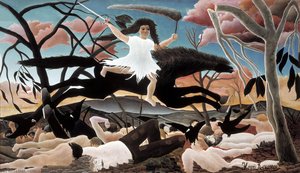
  22. War or The Ride of Discord by Henri Emilien Rousseau, 1894, Musée d'Orsay
    22

    Musée d'Orsay, Paris1894Oil on canvas195 × 114 cm

    Executed in oil on canvas, ‘War or The Ride of Discord’ showcases Rousseau's meticulous yet unrefined technique. ‘War or The Ride of Discord’ evokes a complex range of emotions – awe, unease, contemplation, and perhaps even primal fear. Framing should be simple and understated to complement, not compete with, Rousseau’s unique style.

    The singular detailfemale figure on a panther-like creaturefallen figures

    Its story

  23. Group of Jews the Minyan by Dora Holzhandler, 2000, Ben Uri Gallery - Museum
    23

    Ben Uri Gallery - Museum, London2000Painting49 × 39 cm

    Created about 2000, the piece carries the artist's signature, marking a moment in her long career of observing the quiet rhythms of faith. Dora Holzhandler, born in Paris to Jewish Polish parents, brought a particular sense of memory to her canvases.

    Its story

  24. Orange by Fernando Botero
    24

    Oil

    The composition centers on a collection of oranges situated upon a wooden surface. A white cloth drapes over the edge of the table, creating a stark contrast against the dark wood. The fruit is depicted in various stages of being peeled, with some segments exposed to the light.

    Its story

  25. Fisherman with a Large Net by Reuven Rubin, 1942
    25

    1942Oil on canvas

    A man occupies the foreground of this 1942 composition, positioned on a sandy beach near the water's edge. In the distance, a boat floats upon the water, and several other people are scattered across the shoreline, some near the tide and others further back on the sand.

    Its story

  26. Portrait of Monsieur S by Henri Rousseau, 1898
    26

    1898Oil

    This portrait captures a singular moment of stillness, fixed upon the canvas through the specific vision of its creator. The identity of the painter is confirmed by a small inscription. The work is executed in the style of Naive Art or Primitivism.

    Its story

  27. Great Still life on pedestal by Pablo Picasso, 1931, Musée Picasso
    27

    Musée Picasso, Paris1931Oil on canvas195 × 130 cm

    The work before us is titled Great Still life on pedestal, a piece created by Pablo Picasso in 1931. Picasso, a Spanish painter, was born in Málaga, Spain, on October 25, 1881, and lived until 1973. In Pot, Glass and Book, he continues this investigation into the arrangement of everyday items.

    The singular detailhuman figuresstill life

    Its story

  28. Moses Receiving Tablets by Marc Chagall, 1966, Musée Marc Chagall
    28

    Musée Marc Chagall1966Oil on canvas49 × 36 cm

    This iconic Naïve Art masterpiece transcends simple illustration, offering a glimpse into the artist’s soul and his profound connection to Jewish heritage. The painting pulsates with color and movement, drawing the viewer into a scene brimming with spiritual intensity – a testament to Chagall's unique artistic vision.

    The singular detailbiblical scene

    Its story

  29. Man with straw hat by Pablo Picasso, 1938
    29

    Pablo PicassoNaive Art / Primitivism

    Man with straw hat

    1938Oil on canvas61 × 50 cm

    Pablo Picasso, a titan of 20th-century art, possessed an unparalleled ability to distill complex emotions and ideas into strikingly simple forms. Measuring just 61 x 50 centimeters, this oil-on-canvas piece invites viewers into a world where familiar elements are subtly distorted, creating an atmosphere of both intimacy and unsettling ambiguity.

    The singular detailexaggerated features

    Its story

  30. Sleeping woman (Meditation) by Pablo Picasso, 1901–1904
    30

    1901–1904Ink & watercolor36 × 27 cm

    Among his most famous works are the proto- Cubist Les Demoiselles d'Avignon (1907) and the anti-war painting Guernica (1937), a dramatic portrayal of the bombing of Guernica by German and Italian air forces during the Spanish Civil War. Analytical Cubism, alongside Georges Braque, dismantled traditional artistic conventions by fracturing objects into multiple viewpoints simultaneously.

    Its story

  31. Madhubani Painting of Bihar: Madhubani art in process by Remant Kumar Mishra, 2019, Dastkari Haat Samiti
    31

    Dastkari Haat Samiti, New Delhi2019Painting

    A man sits amidst a quiet clutter of chairs, his focus narrowed to the tip of a brush. The air in the room feels heavy with the scent of pigment and the stillness of creation. The process is a continuation of a lineage from Bihar, India.

    Its story

  32. Mimizan Lake (C.72) by Winston Churchill, 1922, Government Art Collection
    32

    Government Art Collection, London1922Oil62 × 52 cm

    The scene unfolds within the quietude of Mimizan Lake (C.72), a work that captures a moment of stillness on the water. The artist, Winston Churchill, brings this landscape to life through his unique perspective on the natural world. Winston Churchill, who was born in 1874 at Blenheim Palace, United Kingdom, created this piece about 1922.

    Its story

  33. Caravans at Rye, East Sussex by Frederick William Elwell, 1923, Beverley Art Gallery
    33

    Beverley Art Gallery1923Oil29 × 38 cm

    A collection of caravans occupies a field in Rye, East Sussex, creating a temporary settlement within the landscape. Scattered throughout the scene, figures engage in quiet activities, contributing to a sense of communal life. A single dog is situated near a caravan on the left, adding a touch of domesticity to the outdoor setting.

    Its story

  34. A Midlothian Farm by John Guthrie Spence Smith, 1925
    34

    1925Oil64 × 76 cm

    Two men stand in the foreground, their figures anchored to the earth as they tend to the daily rhythms of the farm. A dog rests near them, a silent companion to the labor.

    Its story

  35. The River Kennet at Chilton, Wiltshire by Lawrence Gowing, 1930, Herbert Art Gallery - Museum
    35

    Herbert Art Gallery - Museum, Coventry1930Oil on canvas45 × 91 cm

    The River Kennet at Chilton, Wiltshire is an oil on canvas by Lawrence Gowing. Measuring approximately 45 x 91 cm, the painting utilizes a panoramic format to encompass the meandering waterway. Executed in oil on canvas about 1930, the work employs an impressionistic approach to the landscape.

    Its story

  36. Colours at Sea by Madiha Omar, Ibrahimi Collection
    36

    Ibrahimi Collection, AmmanOil on canvas40 × 30 cm

    There is a stillness here, a moment of quiet curiosity captured in a composition that feels both private and profound. Having been shaped by the diverse cultural landscapes of the Levant and the academic rigor of her training in London and Washington, her work often navigates the space between representation and abstraction.

    Its story

  37. Nasturtiums by Rose Mead, 1930
    37

    1930Oil29 × 24 cm

    The artist's signature rests in the lower right corner, a small mark of identity upon the canvas. It is a piece that feels intimate, as if the viewer has just stepped into a room where the morning light is still settling.

    Its story

  38. Handicraft toy: Verbesserte Strick-Liesel by Jacob Wolf Spier and Sons, 1932
    38

    1932Textile material7 × 4 cm

    The work functions as a handicraft toy, specifically a development of the earlier Strickliesel models. It is a tactile object, measuring 7 x 4 cm, designed to introduce young girls to the practical skill of knitting through play.

    Its story

  39. Fishing Boat with Two Masts and Yellow Sails by Alfred Wallis, 1920
    39

    192031 × 35 cm

    Fishing Boat with Two Masts and Yellow Sails is a work by Alfred Wallis, dating from 1920. Wallis continued to create his art until his death in 1942. Another notable piece in the same collection is Sailing Ship and Orchard, a watercolor on paper dated 1937.

    Its story

  40. Adam’s Awakening by Erwin Sówka, 1988, The State Ethnographic Museum in Warsaw
    40

    The State Ethnographic Museum in Warsaw1988Oil

    Adam’s Awakening by Erwin Sówka presents a religious narrative centered on the primordial figures of Adam and Eve. The composition places a woman on the left side of the canvas and a man on the right, capturing a moment of profound connection between the two.

    Its story

  41. Gian Luigi Uboldi by Gian Luigi Uboldi, Biblioteca Sormani
    41

    Biblioteca Sormani, MilanPainting

    A man sits atop a horse, his silhouette defined by the weight of a shield and the curve of a helmet. Around them, the air is thick with the presence of others, some standing in quiet observation, others lost to the periphery of the action. An umbrella rises from the crowd, a singular, geometric interruption against the movement of the scene. The brushwork captures a moment of sudden energy, a pulse of life caught before it settles back into the earth.

    Its story

  42. Irises by Kateryna Vasylivna Bilokur, 1950
    42

    1950Oil on canvas

    In this 1950 oil composition, a bouquet of irises occupies the space with a sense of structured depth. The arrangement is defined by three primary clusters, each rendered in varying shades of blue that create a rhythmic movement across the canvas.

    Its story

  43. Running deer by Niko Pirosmani
    43

    Oil paint on canvas81 × 67 cm

    The subject is presented with a focus on the animal in its environment, stripped of narrative or symbolic complexity. The composition centers on the movement of the creature against a dark, textured background. Niko Pirosmani, born in Mirzaani, Georgia, was a self-taught painter who developed his visual language through observation rather than formal academic training.

    Its story

  44. Autumn still life by Martiros Saryan, 1961
    44

    1961Oil on canvas

    We are looking at Autumn still life, a work created by Martiros Saryan. The composition focuses on a collection of apples, oranges, and pears.

    Its story

  45. GVM007 by William Mustart Lockhart, Green Villain Foundation
    45

    Green Villain Foundation, Jersey CityMural

    At the top, a bright blue sky occupies the upper portion of the frame, populated by scattered white clouds. The lower section of the mural contains graffiti-style text that reads "42 JADIS RIVERSIDE ST CREATE THE GROUP".

    Its story

  46. The communities of animals by Carmelón Berrocal Evanán, Museo Central. Banco Central de Reserva del Perú
    46

    Museo Central. Banco Central de Reserva del Perú, LimaPainting on board

    In this work, we find ourselves within a lively, crowded mountain setting where the boundaries between human and animal life seem to dissolve. This method creates a tactile quality that connects the viewer to the physical environment of Ayacucho, Peru.

    Its story

  47. The Tramp at Christmas by Grandma Moses
    47

    Oil

    In Out for the Christmas Trees, painted in 1946, a family ventures into the cold to select a tree. This festive spirit lingers in other works like The Old Oaken Bucket, created in 1946, and the quiet observations found in From My Window, created in 1949.

    Its story

  48. School Studies by Horace Pippin, 1944
    48

    1944Oil paint on canvas81 × 98 cm

    It was once part of a memorial exhibition held in 1947 at The Art Alliance in Philadelphia. It was featured in the 1972 exhibition Four American Primitives at the ACA Galleries in New York. The work later appeared in the 1994 exhibition I Tell My Heart: The Art of Horace Pippin.

    Its story

  49. St Ives Harbour by Bryan Pearce, Kettle's Yard
    49

    Kettle's Yard, CambridgeOil on board61 × 86 cm

    The painting titled St Ives Harbour is a work by the British painter Bryan Pearce. This specific piece, St Ives Harbour, depicts a harbor scene containing several boats of varying sizes and colors. Another example of his harbor depictions is the 1965 work St Ives Harbour 1.

    Its story

  50. Near Lyme Regis by Fred Uhlman, 1950
    50

    1950Painting31 × 41 cm

    The canvas known as Near Lyme Regis captures a quiet moment in time, painted by Fred Uhlman in 1950. Through Near Lyme Regis, his hand reaches out from the mid-twentieth century to offer a glimpse into a specific, tranquil setting, rendered with the sincerity of an artist who has seen much of the world's complexity.

    Its story

  51. Sick Boy with a Cat by John Bowen
    51

    Oil on canvas76 × 58 cm

    The artwork is an oil on canvas painting that presents a portrait of a young boy holding two cats. The composition is centered on the boy and his feline companions, who occupy most of the frame. The boy is depicted wearing a yellow shirt, which creates a sharp contrast against the darker tones of the background and the fur of the cats.

    Its story

  52. Gare Montparnasse, Paris by Louis Vivin
    52

    Oil

    The Gare Montparnasse rises in the center of the frame, a heavy structure of stone and arched windows. The building carries the weight of the Beaux-Arts style, with decorative elements that anchor the scene in a specific era of French architecture.

    Its story

  53. Wild and Big-Eared by Maria Prymachenko, 1977
    53

    Maria PrymachenkoNaive Art / Primitivism

    Wild and Big-Eared

    197743 × 63 cm

    The Naive Art/Primitivism style has always been a fascinating genre, and one artist who embodies its spirit is Maria Primachenko. Naive Art / Primitivism is characterized by its simplicity, flat rendering, and lack of formal training. The Naive Art / Primitivism style brings a sense of innocence and spontaneity to the artwork.

    Its story

  54. Moses with the Tablets of Law by Marc Chagall, 1963
    54

    1963Lithography80 × 58 cm

    The artwork titled Moses with the Tablets of the Law was created by the artist Marc Chagall. This piece is dated 1961. This specific lithograph from 1961 depicts a scene from the Exodus, centering on the figure of Moses and the tablets of the law.

    Its story

  55. Still Life by L. S. Lowry, 1906, The Lowry
    55

    The Lowry, Greater Manchester1906Oil24 × 34 cm

    The composition features a collection of fruit arranged upon a table covered with a neutral-toned cloth. In the immediate foreground, three apples are positioned, with one apple appearing larger than the other two. Behind this primary group, two oranges are situated, one near the center of the frame and the other toward the right edge.

    Its story

  56. Landscape with Two Large Trees and Houses by Alfred Wallis, Kettle's Yard
    56

    Kettle's Yard, CambridgeBlack and white artwork30 × 23 cm

    Landscape with Two Large Trees and Houses is a work by Alfred Wallis. It exists as a quiet part of the University of Cambridge Museums consortium. Visitors may find the piece held within this specific setting, which was established in 1956.

    Its story

  57. Coast Scene near Marseilles by Winston Churchill, 1935
    57

    1935Oil on canvas33 × 41 cm

    It is a modest, intimate object, measuring 33 x 41 cm. The artist, Winston Churchill, approached this landscape with a focus on the natural environment. In this work, he sought to record the specific atmosphere of the Mediterranean shoreline.

    Its story

  58. Still life with bread by Kateryna Vasylivna Bilokur, 1960
    58

    1960Oil

    The painting titled Still life with bread is a work by Kateryna Vasylivna Bilokur. Kateryna Vasylivna Bilokur approached the canvas with a directness that defines her style. Every element is placed with a sense of purpose, reflecting a life lived close to the soil of Ukraine.

    Its story

  59. Road to Safed by Reuven Rubin
    59

    Painting

    The painting titled Road to Safed was created by the artist Reuven Rubin. Rubin's approach to painting involved a fusion of European technical training and a specific focus on the local terrain. In 1928, he painted Orange Grove Near Jaffa, which depicts citrus orchards.

    Its story

  60. Gold Horn by Theodor Kittelsen, 1910
    60

    1910Oil

    In this 1910 oil painting, we find ourselves drawn into a dense, shadowed forest where the boundary between the physical and the supernatural feels thin. The trees press in from the periphery, their forms heavy and silent, creating a sense of isolation.

    Its story

  61. Deer by Niko Pirosmani, 1909
    61

    Niko PirosmaniNaive Art

    Deer

    1909Oil104 × 91 cm

    The animal occupies the center of the frame, a steady and singular figure amidst a landscape that feels both vast and intimate. Around this central traveler, smaller shapes scatter across the scene, perhaps other creatures or mere whispers of the natural world. The earth beneath its feet is a textured expanse of greenery, grounding the creature in a moment of silent movement.

    Its story

  62. Waiting for Christmas by Grandma Moses
    62

    Oil

    One can almost feel the crisp chill in Out for the Christmas Trees, painted in 1946, as families venture into the snowy woods. Even in the quietest moments, such as the view offered in From My Window in 1949, there is a sense of being a witness to the unfolding day.

    Its story

  63. The Creation of World by Marc Chagall, 1972
    63

    1972Painting715 × 570 cm

    At its core lies an ambitious retelling of Genesis, portraying God’s divine intervention in shaping humanity amidst a vibrant tableau populated by recognizable figures from Jewish folklore and biblical tradition. The prominent piano symbolizes music—a cornerstone of Jewish culture and Chagall’s own artistic practice—representing harmony and contemplation amidst the drama unfolding before the viewer's eyes.

    Its story

  64. Arden's Farm, Swinton by L. S. Lowry, 1909, The Lowry
    64

    The Lowry, Greater Manchester1909Oil on canvas18 × 26 cm

    The eye follows a road that stretches toward a cluster of buildings, perhaps farmhouses or barns, nestled under a sky heavy with clouds. It is an overcast day, and the atmosphere carries a sense of tranquility that settles over the earth.

    Its story

  65. Brigantine Sailing Past Green Fields by Alfred Wallis, Kettle's Yard
    65

    Kettle's Yard, Cambridge42 × 49 cm

    In this work, titled Brigantine Sailing Past Green Fields, we encounter a piece by Alfred Wallis. The painting remains undated, leaving its exact moment of creation a quiet mystery. This specific work, Brigantine Sailing Past Green Fields, captures a sense of maritime life through his unique, self-taught perspective.

    Its story

  66. Still life ''Flowers and Vegetables'' by Kateryna Vasylivna Bilokur, 1959
    66

    1959Oil on canvas

    The piece dates to about 1959, a time when her ability to translate the essence of nature into color was deeply established. The title, Still life ''Flowers and Vegetables'', speaks directly to the contents of the scene.

    Its story

  67. Crowning of the Torah by Reuven Rubin
    67

    Oil

    In this painting, titled Crowning of the Torah, we encounter a work by Reuven Rubin. The artist was a Romanian-born Israeli painter who brought a unique perspective to the developing visual language of his adopted home. Rubin’s approach often focused on the intersection of tradition and the immediate reality of the land.

    Its story

  68. Far by Theodor Kittelsen, 1900, National Museum of Art, Architecture and Design
    68

    National Museum of Art, Architecture and Design, Oslo1900Oil on canvas45.4 × 68.8 cm

    In "Far, far away Soria Moria Palace shimmered like Gold," Theodor Kittelsen presents a scene of quiet contemplation set against a vast landscape. Created about 1900, the work focuses on a man positioned atop a mountain, his back to us as he carries a backpack.

    Its story

  69. Country Yard by Niko Pirosmani
    69

    Oil paint on canvas or board

    The composition is straightforward, almost unadorned, with buildings occupying the upper portion of the frame while the yard and its inhabitants settle into the lower half. There is a certain weight to the atmosphere, a muted quality that arises from the reliance on varying tones of gray rather than a spectrum of color.

    Its story

  70. Woman Walking in an Exotic Forest by Henri Rousseau, 1905, Barnes Foundation
    70

    Barnes Foundation, Philadelphia1905Oil on canvas100 × 80.6 cm

    Its story

  71. Voyage to Labrador by Alfred Wallis
    71

    37 × 39 cm

    A small boat floats upon a calm expanse of water, positioned near the center of the composition. Two figures are visible within the scene, one situated toward the left and another toward the right, grounding the vessel in a sense of human presence. In 1876, the artist served as a ship's cook on the Belle Aventure during a voyage to Batteau Harbour, Labrador. This specific memory of the North Atlantic informs the work's maritime focus.

    Its story

  72. Flowers by Reuven Rubin, 1945
    72

    1945Oil

    The painting titled Flowers, (1945) is a work by the artist Reuven Rubin. The vessel is white and contains blue accents, holding a collection of at least thirteen different types of flowers. Reuven Rubin created this piece in 1945.

    Its story

  73. Seascape by L. S. Lowry, 1950
    73

    1950Oil on canvas64 × 76 cm

    The artwork titled Seascape is a painting by the artist L. S. Lowry. It presents a view of the seascape, capturing the specific atmosphere of the coast through a depiction of the sky and the water. This oil on canvas work is held at The Lowry in Greater Manchester.

    Its story

  74. Nude and Bear by Henri Rousseau, 1901, Barnes Foundation
    74

    Henri RousseauNaive Art / Primitivism

    Nude and Bear

    Barnes Foundation, Philadelphia1901Oil on canvas194.6 × 129.9 cm

    Its story

  75. String of Boats by Alfred Wallis, 1928
    75

    1928Oil on paper12 × 40 cm

    A collection of sailboats drifts across a quiet expanse of water, their varying scales suggesting a sense of depth and distance. In the background, a lighthouse provides a fixed point of reference against the horizon, anchoring the nautical scene.

    Its story

  76. Boat in a Storm by Henri Rousseau
    76

    Oil paint on canvas

    Boat in a Storm is a maritime scene by Henri Rousseau. It remains a significant example of the artist's unique approach to depicting nature and its forces. Notable artists, including Pablo Picasso, recognized his talent and sought to honor his contribution to the evolution of modern painting.

    Its story

  77. Untitled by Pablo Picasso, 1937
    77

    1937Oil on canvas81 × 65 cm

    This unassuming canvas, measuring 81 x 65 cm, is far more than a simple depiction of a village scene; it’s a distilled essence of feeling, a direct conduit to the artist's subconscious. “Untitled (47)” stands as a testament to Picasso's pioneering spirit and his willingness to experiment with new forms of artistic expression.

    The singular detailblue roofyellow flowers

    Its story

  78. Breakfast by Pablo Picasso, 1953
    78

    1953Oil on canvas98 × 130 cm

    Instead, it offers something profoundly more intimate – a quiet tableau of shared humanity rendered with the directness and charm characteristic of Naive Art. “Breakfast,” while rooted in Naive Art’s principles, showcases Picasso's continued evolution as an artist—his ability to synthesize diverse influences into a uniquely personal style.

    The singular detailsimple formsbold colors

    Its story

  79. Myself, Portrait-Landscape, Ná by Henri Rousseau, 1890, National Gallery Prague
    79

    National Gallery Prague1890Oil on canvas143 × 110 cm

    The oil on canvas work titled Myself, Portrait-Landscape, Ná was created by the artist Henri Rousseau. This specific painting dates from 1890. The artist exhibited this work at the 1890 Salon des Indépendants. A red sun positioned behind a cloud is inspired by Jean-Léon Gérôme's 1884 work Les deux majestés.

    Its story

  80. Three Women at a Fountain by Pablo Picasso, 1921
    80

    Pablo PicassoNaive Art / Primitivism

    Three Women at a Fountain

    1921Oil on canvas200 × 161 cm

    Pablo Picasso, a titan of 20th-century art, continually pushed boundaries and explored diverse artistic styles throughout his prolific career. Naive Art, or Primitivism, is characterized by its deliberate rejection of formal academic training and a focus on simplicity and directness.

    Its story

  81. The piano (Velazquez) by Pablo Picasso, 1957
    81

    Pablo PicassoNaive Art / Primitivism

    The piano (Velazquez)

    1957Oil on canvas130 × 97 cm

    This work, born from a deep admiration for Diego Velázquez’s masterful “Las Meninas,” transcends simple imitation, instead offering a vibrant, emotionally charged interpretation that speaks volumes about Picasso's evolving artistic sensibilities and his fascination with the unadulterated power of visual expression. This homage isn't merely decorative; it’s a conversation between two masters, a testament to Picasso’s deep respect for Velázquez’s genius and his desire to reinterpret it through his own unique artistic lens.

    The singular detailplatelong hair

    Its story

  82. Weeping of Jeremiah by Marc Chagall, 1956
    82

    1956Oil on canvas35 × 27 cm

    More than just a depiction of sorrow, it embodies a profound meditation on loss, faith, and the indelible imprint of memory—themes central to Chagall’s artistic vision throughout his prolific career. The painting portrays a woman cradling her infant son amidst a crowd of figures, capturing a moment of intense grief.

    Its story

  83. The Blue Fiddler by Marc Chagall, 1947
    83

    Marc ChagallNaive Art (Primitivism)

    The Blue Fiddler

    1947Oil painting

    “The Blue Fiddler” is characterized by its dominant shades of blue, which flood the frame and create a sense of depth. Before creating “The Blue Fiddler,” Chagall painted “The Green Violinist” in 1924, which reflected simpler times before the horrors of anti-Semitism.

    Its story

  84. Newlyweds and Violinist by Marc Chagall, 1956
    84

    Marc ChagallNaive Art (Primitivism)

    Newlyweds and Violinist

    1956Oil on canvas100 × 81 cm

    This captivating oil on canvas painting measures 100 x 81 cm and is a testament to Chagall's ability to weave together elements of fantasy, love, and music. Chagall’s work falls under the Naïve Art movement, also known as Primitivism.

    Its story

  85. A Wheatfield on a Summer's Afternoon by Marc Chagall, 1942
    85

    1942Tempera

    Marc Chagall, born Moishe Shagal in 1887 in the Belarusian town of Liozna near Vitebsk, wasn't merely a painter; he was a poet of color, a weaver of dreams, and a chronicler of memory. “A Wheatfield on a Summer's Afternoon,” created in 1942 during his six-year exile in the United States, exemplifies Chagall’s distinctive style.

    Its story

  86. Circumcision prescribed by God to Abraham by Marc Chagall, 1956
    86

    1956Oil on canvas30 × 24 cm

    The man, depicted with a prominent beard and hat, embodies authority and holds aloft a knife symbolizing sacrifice and purification. Beside him stands the woman, representing compassion and maternal care. Surrounding them are fantastical elements, such as flying animals, swirling clouds, and stylized trees.

    Its story

  87. Abraham is going to sacrifice his son by Marc Chagall, 1931
    87

    1931Gouache on canvas62 × 48 cm

    Measuring 62 x 48 cm and executed in gouache on canvas, it’s a powerfully intimate scene, radiating both sorrow and a strange, unsettling serenity. Chagall's choice of Naïve Art for this profoundly weighty subject is particularly striking.

    The singular detailknifeangel figure

    Its story

  88. The Sacrifice of Isaac by Marc Chagall, 1966
    88

    Marc ChagallNaive Art/Primitivism

    The Sacrifice of Isaac

    1966Oil on canvas230 × 235 cm

    Born in Belarus in 1887, Marc Chagall experienced a childhood steeped in Jewish culture and folklore. He created a series of Biblical Message paintings between 1957-1967, The Sacrifice of Isaac being one of the most powerful in this collection.

    Its story

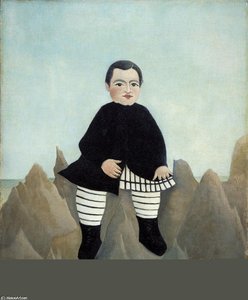
  89. Boy on the Rocks by Henri Rousseau, 1895, National Gallery of Art
    89

    National Gallery of Art, Washington1895Oil on canvas47 × 55 cm

    This technique creates a flattened pictorial space, a hallmark of the Post-Impressionist and Naïve movements, where the emphasis shifts from anatomical perfection to emotional resonance. For the discerning collector or interior designer, Boy on the Rocks offers a unique textural experience.

    Its story

  90. The Fishermen and Biplane by Henri Rousseau, 1908, Musee de l'Orangerie
    90

    Musee de l'Orangerie, Paris1908Oil on canvas46 × 55 cm

    Henri Rousseau's "The Fishermen and the Biplane," painted in 1908, is more than just a charming depiction of rural life; it’s a potent meditation on the collision between tradition and modernity, rendered with the distinctive vision that earned him the moniker “Le Douanier” – the Customs Officer.

    The singular detailrustic scenebiplane

    Its story

  91. The storm tossed vessel by Henri Rousseau, 1899, Musee de l'Orangerie
    91

    Henri RousseauNaive Art / Primitivism

    The storm tossed vessel

    Musee de l'Orangerie, Paris1899Oil on canvas54 × 65 cm

    The Storm Tossed Vessel is a quintessential example of Naive Art, a style characterized by its simplicity, directness, and lack of formal training. This movement, also known as Primitivism, emerged in the late 19th century and emphasized the importance of instinct and intuition in the creative process. The Musée de l'Orangerie in Paris, France, is home to this remarkable painting, which continues to inspire and captivate art lovers to this day.

    Its story

  92. The Flamingoes by Henri Rousseau, 1907
    92

    Henri RousseauNaive Art / Primitivism

    The Flamingoes

    1907Oil on canvas114 × 163 cm

    Its story

  93. An Indian Summer View of the Farm ^ Stock of James C. Cornell by Edward Hicks, 1848, National Gallery of Art
    93

    National Gallery of Art, Washington1848Oil on canvas93.3 × 124.4 cm

    In the quietude of an American autumn, Edward Hicks captures a moment that transcends mere agricultural documentation to become a profound meditation on peace. A magnificent herd of at least fourteen cows, rendered in a rich tapestry of cream, tawny, russet, and deep umber, drifts across the landscape with a gentle, unstoppable momentum.

    Its story

  94. Scout Attacked by a Tiger by Henri Emilien Rousseau, 1904, Barnes Foundation
    94

    Barnes Foundation, Philadelphia1904Oil on canvas162 × 120 cm

    Its story

  95. The Walk in the Forest by Henri Rousseau, 1890, Kunsthaus Zürich
    95

    Kunsthaus Zürich, Zurich1890Oil on canvas60 × 70 cm

    The Naive Art movement emerged in the late 19th century, and it is defined by its lack of formal training and emphasis on simplicity. The Walk in the Forest is an important work in the Naive Art movement, showcasing Rousseau's unique style and technique.

    Its story

  96. View of the Quai d'Ovry by Henri Rousseau, 1907, Artizon Museum
    96

    Artizon Museum, Tokyo1907Oil on canvas46.1 × 55 cm

    A captivating 1907 painting featuring an airship & muted tones, showcasing Rousseau’s unique realism.

    Its story

  97. Seine and Eiffel tower in the sunset by Henri Rousseau, 1910, Pola Museum of Art
    97

    Pola Museum of Art, Hakone1910Oil on canvas49.7 × 65.5 cm

    Its story

  98. Eve by Henri Rousseau, 1907, Hamburger Kunsthalle
    98

    Henri RousseauNaive Art / Primitivism

    Eve

    Hamburger Kunsthalle1907Oil on canvas46 × 61 cm

    Its story

  99. The Pink Candle by Henri Rousseau, 1910, The Phillips Collection
    99

    Henri RousseauNaive Art / Primitivism

    The Pink Candle

    The Phillips Collection, Washington, D.C.1910Oil on canvas16.2 × 22.2 cm

    Its story

  100. Jungle with Lion by Henri Rousseau, 1910, Pola Museum of Art
    100

    Henri RousseauNaive Art / Primitivism

    Jungle with Lion

    Pola Museum of Art, Hakone1910Oil on canvas37 × 45 cm

    Its story

Lineages

The famous Naive Art paintings by lineage

Where they live

The one place you can see each famous Naive Art painting

Paris keeps 5 of these originals; the Kettle's Yard, 3.

The masters

The Naive Art masters our artists look to

Portrait of Pablo Picasso

Pablo Picasso

1881–1973 · Spain · 10

By the age of thirteen, the artist completed advanced entrance exams in Barcelona in a single week, surpassing his instructors' expectations.

13. Big heads, 20. Crying Woman, 21. Portrait of Paulo as Pierrot, 27. Great Still life on pedestal, 29. Man with straw hat, 30. Sleeping woman (Meditation), 77. Untitled, 78. Breakfast, 80. Three Women at a Fountain, 81. The piano (Velazquez)

Portrait of Alfred Wallis

Alfred Wallis

1855–1942 · United Kingdom · 5

Alfred Wallis (1855-1942) was a British naive painter known for his charming depictions of boats, seascapes & Cornish life.

39. Fishing Boat with Two Masts and Yellow Sails, 56. Landscape with Two Large Trees and Houses, 65. Brigantine Sailing Past Green Fields, 71. Voyage to Labrador, 75. String of Boats

Portrait of L. S. Lowry

L. S. Lowry

1887–1976 · United Kingdom · 4

After his mother died in 1939, he began to paint between 10:00 p.m. and 3:00 a.m. to avoid disturbing her while she slept.

10. The Canal Bridge, 55. Still Life, 64. Arden's Farm, Swinton, 73. Seascape

Portrait of Reuven Rubin

Reuven Rubin

1893–1974 · Romania · 4

Reuven Rubin (1893-1974): Romanian-Israeli painter & diplomat.

25. Fisherman with a Large Net, 59. Road to Safed, 67. Crowning of the Torah, 72. Flowers

+32more masters our artists study Naive Art Masters Their stories

In confidence

About these Naive Art paintings

Hover gently over a question to read the answer.

How was this list of Naive Art paintings ranked?

By recognition: Wikipedia articles in the most languages (Wikidata sitelinks), our manual ranking and page visits. Several records of one painting count once; details, copies and studies are excluded.

How the selection is made

We went through every Naive Art painting in our catalogue and placed the best-known first: those Wikipedia describes in the most languages, those our artists and curators rank highest and those most viewed on our pages. Each original appears once — no details or copies.

Other movements that inspire us

The periods that inspire us