The 100 Famous Art Deco Paintings That Inspire Our Artists
1910 – 1950
Selected by OriginalUniqueArt.comUpdated
Ask for the most famous Art Deco paintings and you will hear of Tamara de Lempicka's Self-Portrait in the Green Bugatti (1925), Tamara de Lempicka's La belle Rafaela (1927) and Tamara de Lempicka's In the Green Bugatti (n.d.). Below, all 100 of them — painted from 1910 to 1950 by 55 artists — with their date, their size and the museum that keeps them.
No. 1 · Tamara de LempickaSelf-Portrait in the Green Bugatti1925
100singular works
55masters · Federico Beltrán Masses – Paul Manship
27homes in 20 cities
3kept at the Museum of the Moving Image
Singular works
100 Art Deco paintings that exist only once
Every original here is unique and kept in one place. Its story, its home, and the detail that makes it unmistakable.
This painting exemplifies the artist's signature Art Deco style, characterized by its sleek lines, bold colors, and dynamic compositions. The composition is filled with movement and energy, drawing immediate attention to the artist's confident expression and poised posture.
The singular detaildynamic composition with fluid lines and bold colorssense of movement and energy, capturing speed and modernity
The painting presents a reclining female figure, draped in a pose that is simultaneously relaxed and commanding. The technical execution of La belle Rafaela reveals Lempicka’s unparalleled mastery of form and light.
The painting depicts a woman positioned in the center of the composition, seated behind the wheel of a vibrant green car. The woman's face is turned towards the viewer with a slight smile.
"Adam and Eve" exemplifies her mastery of the Art Deco style, blending classical themes with modern aesthetics. Created in 1932, "Adam and Eve" reflects the artistic and cultural milieu of the interwar period. This juxtaposition highlights Lempicka's ability to merge traditional subjects with contemporary sensibilities.
The singular detailstylized skyscrapers in the backgroundfemale figure holding an apple
Created in 1932, this work emerges as a significant example of the Art Deco movement. Years earlier, the work occupied the walls of the Galerie Ror Volmar in Paris, a space where it remained part of the visual conversation between 1930 and 1960.
Lempicka's distinctive style combines the sleek lines of Cubism with the classical elegance of Renaissance art. The architectural elements surrounding her suggest a private, intimate space, adding depth and intrigue to the composition.
The singular detailmodernist architectural elementssatin sheet and shiny ring
Ivan Yakovlevich Bilibin created Crimea. The work captures the essence of nature through a precise rendering of the landscape. Among his most celebrated theatrical contributions were his designs for Nikolai Rimsky-Korsakov’s The Golden Cockerel.
Yet, beneath this surface of tranquil composition lies the unmistakable tension of Surrealism. The piece possesses a unique ability to anchor a room with its sophisticated color story while simultaneously sparking conversation through its enigmatic subject matter.
Following its sale in 1928, the painting was considered lost to history after the events of World War II. While watching the 1999 film Stuart Little, an art historian recognized the composition appearing as set dressing in the background of a scene.
The work presents a singular, personal glimpse into the artist's private life, focusing on the man who would become her husband, Tadeusz de Lempicki. Around 1928, she produced Portrait of a Man, Unfinished, a work that shares a similar sense of immediacy. This is closely linked to Portrait of a Man (also known as Mr Tadeusz de Lempicki), which dates to about 1928. In 1925, she painted Self-Portrait (Tamara in the Green Bugatti), a work that established her presence within the Art Deco movement.
A man sits at a piano, his hands poised upon the keys, while a woman leans toward him from the left. On the mantle behind them, two vases sit in quiet repose, and a clock hangs upon the wall, marking the passage of time in this suspended moment of intimacy.
The subject is captured in a moment of quiet contemplation, meeting the viewer's gaze with a serious expression. A chair is positioned in the background to the right, grounding the figure within a domestic or studio setting. The portrait, measuring 36 x 31 cm, focuses on the individual's character through precise observation.
A woman stands before a mirror, captured in a quiet moment of grooming. In the background, two figures remain partially visible, adding a sense of lived-in space to the composition.
The scene is populated by several figures moving through the landscape, their presence suggesting a lived-in, communal rhythm. Near the water's edge, a single cat sits in observation, a small, still point amidst the subtle activity of the day.
The oil on canvas depicts King George V, who reigned from 1910 to 1936. The subject possesses a mustache and a beard, which are rendered as prominent facial features. Created in 1935, this portrait was executed during the final year of the King's life.
A woven basket rests upon a surface, heavy with the weight of a simple harvest. There is a stillness here, a moment where the ripeness of the fruit feels almost tangible. The colors remain muted, leaning into earth tones that ground the composition in a sense of calm.
A green mask rests near her, offering a sharp contrast to the softness of her skin. Two white birds flank her, their feathers catching a light that seems to descend from above. The shadows are deep, pushing the figures forward into a shallow space where depth is felt only through the gradation of light.
Created about 1929, the work belongs to a series of studies involving dancers in Germany and on the Acropolis produced between 1923 and 1929. This photograph is held within the collection of the Benaki Museum of Greek Civilization in Athens, Greece. The museum is situated at 138 Pireos St. in Athens.
This piece emerges from the creative mind of Romain de Tirtoff, the man who chose the name Erté to navigate his path through the artistic circles of the twentieth century. He was born in 1892 in Saint Petersburg, Russia, a place that shaped the early sensibilities of a man destined to define an era of style. His life spanned nearly a century, reaching its end in 1990. Specifically, it is identified as studio proof 2/2 from an edition of 300, alongside two other studio proofs.
Evening Night unfolds in a moment of suspended elegance. Two women occupy the center of the frame, their silhouettes elongated and poised as if caught in the soft glow of a twilight gathering. Beside her, a companion wears a blue dress adorned with a white sun, her posture mirroring the grace of the first.
The painting titled Madonna is a significant work by Tamara de Lempicka, executed in 1940. By 1929, her output included both Self-portrait, Tamara in a Green Bugatti and The Musician, works that capture the spirit of an era defined by speed and social independence.
This deliberate use of negative space creates a focused intimacy, making the viewer feel as though they are witnessing a private, fleeting moment of performance. Technically, Little Slave is a triumph of tempera on canvas, showcasing Erté’s legendary precision.
A man sits in a moment of stillness, his hands crossed in a posture of composed reflection. The composition places him at the center of a subtle social landscape, where other figures linger in the background, their presence secondary to his solitary contemplation.
The photograph titled New York World's Fair, Harper's Bazaar was produced by the Hungarian photographer Martin Munkácsi. Martin Munkácsi, born in Cluj-Napoca, Hungary, was a photographer who worked in both Germany and the United States. One specific image, Three Boys at Lake Tanganyika, is noted for its intensity and spontaneity.
The Duke of Connaught and Strathearn occupies the space with a quiet, commanding gravity. The composition uses a large scale to emphasize the stature of the Field Marshal. Painted in 1922, this work emerges from a period where British portraiture began to shift toward a more nuanced psychological realism.
The silhouette is defined by a sense of weight and presence, achieved through a complex assembly of hand-padded elements and meticulous workmanship. One notices the way the leather is worked, particularly the pleated armrest volutes that lead the eye toward the backrest.
The artwork Flowers in a Dark Vase, created in 1929, presents a vibrant floral arrangement set against a somber backdrop. The composition features a collection of blooms held within a black vase, which is positioned upon a table.
Upon its surface, a single boat carries a group of figures, their bodies linked in a shared, rhythmic motion. The scene feels caught between a solemn religious procession and a maritime voyage, where the salt spray meets the heavy silence of a shared fate.
The subject is dressed in black clothing, which stands out against a dark background. The composition is characterized by a sense of elegance and sophistication.
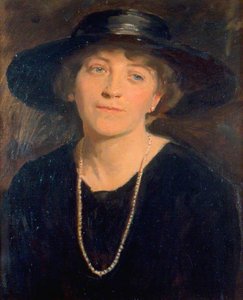
The oil on canvas portrait depicts a woman positioned as the central focus. A black hat, adorned with a bow, rests upon her head. Around her neck, she wears a pearl necklace. Reginald Grenville Eves painted this work during a period when his practice centered on portraiture.
"Fan" is deeply rooted in the artistic currents of its time—specifically, the rise of Art Deco. The scene subtly alludes to themes of courtship and performance, reminiscent of the lavish balls and theatrical productions that defined Parisian society during the early 20th century.
Mount Stewart, Newtownards1924Oil on canvas84.5 × 67.6 cm
John Lavery, born in Belfast, United Kingdom, executed this portrait during a period of social and political transition. The sitter, Sir Charles Stewart Henry Vane-Tempest-Stewart, is rendered in a three-quarter length profile. These technical choices reflect the aesthetic sensibilities of the 1920s, blending the structural sensibilities of Post-Impressionism with a refined, quiet elegance.
In this portrait, Two Women in Coats, the lens captures a quiet moment of elegance from a bygone era. The atmosphere feels still, as if a single moment of 1933 has been held in place. This sense of mystery continues in her 1929 work, Die schöne Unbekannte, which appeared in Uhu magazine.
Created in 1939, the work captures a high mountain lake. In 1938, he turned his gaze toward Everest, capturing the immense scale of the world's highest summit. In 1913, he provided the sets and costumes for the premiere of The Rite of Spring. Nicholas Roerich was born on October 9, 1874, in Saint Petersburg, Russia.
The man, positioned slightly forward on the left, wears attire suggestive of polo or sporting activities, while the woman is dressed in formal, refined clothing. The composition relies on strong vertical lines established by the figures and the architectural elements behind them, creating a balanced, symmetrical arrangement.
The scene is populated by subtle details that ground this ethereal atmosphere in a sense of lived experience. Created in 1925, this work reflects the stylistic sensibilities of the early twentieth century, blending a sense of realism with the soft, expressive brushwork characteristic of the era.
The subject is rendered with a focus on her facial expression and her posture during this private activity. The work, dating from about 1940, focuses on the quietude of the moment, isolating the subject in a state of contemplation.
Other compositions by the artist include Rafaëla sur fond vert and Nu aux voiles. These works demonstrate the artist's continued use of the Art Deco style, characterized by the same polished surfaces and geometric clarity found in her other portraiture.
Fortuny, a true polymath of the decorative arts, managed to weave the spirit of a bygone era into every thread, transforming a functional piece of couture into a sculptural relic of grace and sophistication. By drawing direct inspiration from the Greek tunic, Fortuny invoked the classical virtues of innocence, purity, and idealized femininity.
The textures of the attire are highly detailed, showcasing the intricate, sparkling surfaces of pearls, diamonds, and fine lace. Executed in the style of Academic Realism, the work utilizes oil on canvas with techniques of glazing and impasto to capture the brilliance of gemstones and the luster of the fabric.
The scene unfolds in a dreamlike space where a woman stands poised before a fountain. On either side of her, statues frame the composition, adding a sense of classical weight to the ethereal atmosphere. The lines are precise, reflecting a mastery of form that defines the early 20th-century aesthetic.
1934Silver gelatin print on photographic paper23 × 17 cm
The subject is a woman in a bathing suit, captured in a moment of quiet, poised openness. There is a deliberate tension here between the organic curves of the human body and the rigid, uncompromising lines of the slatted blinds that dominate the foreground.
The portrait presents a woman seated at a slight angle, her body turned toward the viewer in a controlled, upright posture. The figure is rendered with simplified, sculptural forms, emphasizing a clear silhouette against a fragmented background. This backdrop consists of intersecting geometric planes, primarily triangles and rectangles, which create a shallow, layered space.
A single red cloche hat anchors the composition, its sharp angles cutting through the stillness. The subject stares directly forward, her expression a challenge of polished steel. The composition relies on a specific visual vocabulary to build its sense of modernity: Strong, clean contours defining the jawline and the brim of the hat. The work captures a specific moment of the late 1920s, where the human figure began to mirror the precision of the machine age. There is no soft blur here, only the clarity of a well-defined edge.
This subject matter, though rooted in a common domestic scene, is transformed through the artist's specific hand. The scene is stripped of unnecessary surroundings, leaving only the essential elements of the girl and her work. The work is firmly rooted in the Art Deco movement, defined by a polished and refined aesthetic.
In 1925, she produced Self-Portrait in the Green Bugatti. Other compositions from her career include Adam and Eve, which was painted in 1931. In 1953, she executed Mother and Child, a painting that focuses on a woman cradling a small child.
This work, which is also recognized by the title Polish Girl (La Polonaise), captures a specific sense of poise and presence. Tamara de Lempicka approached this piece with the precision that defined her career.
Andromeda is an oil on canvas painting by the artist Tamara de Lempicka. Created in 1929, the work depicts the figure of Andromeda from Greek mythology. The subject is presented as a nude female figure, positioned in a reclining pose that occupies the majority of the frame. In 1925, she produced Model.
The man is seated within a plush armchair or sofa, positioned slightly off-center to create a sense of dynamic visual interest. Likely executed as an oil painting on canvas, the piece utilizes a unique fusion of neoclassical precision and Cubist abstraction.
The artwork titled Seated Nude in Profile is a striking creation by the artist Tamara de Lempicka. Painted about 1923, the work captures a single nude male figure. The subject is positioned in profile, a choice that emphasizes the structural contours of the human form.
Executed by this talented duo, the piece exemplifies the refined aesthetic sensibilities prevalent in late 19th-century Japan, blending meticulous craftsmanship with symbolic richness. The use of black lacquer itself carries significant weight; it symbolizes mourning and spirituality in Japanese culture, often associated with Buddhist temples and rituals. This particular piece offers a tangible connection to a bygone era, showcasing the exceptional skill and artistry of Italian craftsmen working within the rich traditions of Japanese design.
“The Morphinist” is firmly rooted in the artistic currents of its time, most notably Art Deco. The painting’s style echoes the bold lines and vibrant color palettes characteristic of Art Deco posters and fashion magazines of the 1930s.
The painting immediately draws the eye with its vibrant palette dominated by yellows and oranges, skillfully layered to create an atmosphere of warmth and vitality. Furthermore, considering Da Silva's life and career, the turban can be interpreted as a nod to the influence of Art Deco aesthetics, which were gaining popularity during this period.
The central figure, rendered in a strikingly direct manner, is presented in a state of repose, her back turned to the observer. The connection to the Frida Kahlo Museum (Casa Azul) underscores the shared cultural heritage and artistic dialogues that shaped Mexico’s vibrant art scene.
This black-and-white photograph, housed within a serene art studio setting, captures a pivotal moment in Fortuny's career – his innovative approach to textile design and production. This exposure ignited a lifelong fascination with fabrics, culminating in his revolutionary “Delphos” gowns – inspired by ancient Greek drapery and celebrated for their flowing elegance.
The work before us is titled Carnaval, an oil on canvas created by the artist Federico Beltrán Masses. This particular piece dates to about 1925, a period that captures the artist's unique approach to form and light. It resides in Salamanca, Spain, housed inside the Casa Lis.
The aesthetic language of Bretonne is deeply rooted in the Art Deco movement, characterized by its bold, geometric elegance and flattened perspective. This method lends the work a unique, tactile quality, where light is diffused evenly across the surface, eschewing dramatic shadows for a more balanced, graphic clarity.
The image centers around Chaplin and Coogan against a monumental black background —a deliberate choice reflecting the theatrical grandeur of silent films. Steichen’s stylistic choices draw heavily from Pictorialism, a movement that championed photographic artistry as an equivalent to painting, influenced by artists like Alfred Stieglitz who explored tonal richness and atmospheric depth.
Born in 1885, he brings a unique perspective to the canvas, one that bridges the distance between the Caribbean and the sophisticated art circles of Europe. By 1920, the painting finds a grand stage at the Venice Biennale, where it commands attention on an international scale.
Trained under the great Charles Frederick Worth, she brought a structural soul to her designs, yet she possessed the rare ability to reject the suffocating constraints of her time. The emotional impact of the piece is one of nostalgic reverence—a whisper from a bygone era of Parisian glamour.
At the heart of this visual storm stands Rodolph Valentino, portrayed here in formal attire, his direct gaze acting as a magnetic tether between the artwork and the modern observer. While rooted in photographic techniques—a hallmark of Edward Steichen’s career—the execution leans heavily into decorative poster art.
The painting titled Bath was created by the artist Zinaida Serebryakova. This work is categorized within the genre of nude painting (nu). The composition focuses on the human form through a specific arrangement of figures in a private setting. Zinaida Serebryakova was born in 1884 in Neskuchne, Ukraine.
It is this delicate balance of geometry and organic form that epitomizes the Art Deco aesthetic, making the photograph a masterclass in composition and atmospheric depth. The floral motifs dancing across the velvet symbolize a rebirth of beauty—a flourishing of creativity amidst the shifting social landscapes of the early 20th century.
This marriage of organic shapes and precise lines creates a visual harmony that is both soothing and intellectually stimulating, making it an ideal centerpiece for spaces that demand a balance of classical elegance and modern edge. It represents the movement toward the unknown, much like the modernist movement Negreiros helped lead in Portugal.
Painted around 1925, this vibrant illustration captures a serene rural scene —a young woman meticulously braiding her hair alongside a boy pouring water into a pail—offering viewers a glimpse into a bygone era and reflecting Stryjeńska’s artistic vision.
The designs and textures of these objects clearly show distinctive features of the Art Deco style. However, as these articles demonstrate, Art Deco artists did not completely abandon the creation of one-off articles by hand.
A luminous glass painting of St. Christopher by René Jules Lalique captures a divine moment of devotion through exquisite Art Deco craftsmanship, inviting you to bring this timeless masterpiece into your collection.
The aesthetic language of the work is deeply rooted in the Art Deco movement and the golden age of travel posters. The clarinet, a symbol of communal joy and artistic expression, sits in beautiful contrast to the structured, almost rigid architecture of Bilbao, representing the breath of life within the stone city.
Ashcroft is positioned slightly off-center, her gaze turned inward, suggesting a moment of quiet contemplation amidst the artifice of the theater. This stylistic choice, reminiscent of early 20th-century European painting, emphasizes the theatrical nature of the subject.
In this corner of 1925, time pauses during a Good Friday celebration in the town of Santa Anita. A man bends low, his body curved by the weight of a woven basket overflowing with white calla lilies.
Dress model composed of several flags up to the knees and, from there, a long white skirt ending in a light train. On the head, a cap surrounded by stars, with three tufts of ribbons extending over the neck at the top.
This placement situates the piece within one of the most important architectural settings in the United Kingdom. The creation of this mural occurred during a period when Gill was establishing his reputation for large-scale decorative works. Following his training at the Slade School of Fine Art and his time in Rome, the artist applied a sophisticated understanding of monumental form to this historical subject.
This isn’t a realistic portrayal; rather, Douglas employs a flattened perspective and simplified forms characteristic of both Art Deco and Cubism. Douglas translates this ancient narrative into a visual language that speaks directly to the realities of African Americans facing systemic discrimination and segregation in 1930s America.
The linocut print 23rd Enterance presents a structured urban landscape composed of geometric forms and tiered levels. The composition is dominated by a large circular building on the left side, topped with a green roof. Created in 1933, this work reflects the aesthetic preoccupations of the early twentieth century.
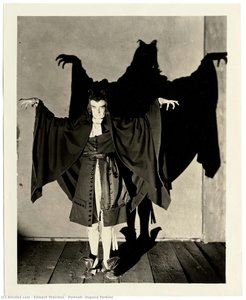
This striking black and white studio portrait captures a moment suspended between life and myth. The subject, dramatically costumed as a vampire, stands in profile, his posture radiating an almost predatory elegance.
Howard Cook's unique style and technique are evident in this piece. The Smithsonian American Art Museum is home to a vast collection of American art, including works by Howard Cook. With its unique style and technique, this painting is a must-see for anyone interested in urban landscapes and printmaking.
It stands instead as a tangible artifact of early modernist design—a whisper from the golden age when fashion dared to challenge convention. The composition itself, isolated against a stark white void, forces an intimate dialogue between the viewer and the curve of the shoe.
Each painting is ranked by how widely it is known: the number of Wikipedia language editions with an article on it (Wikidata sitelinks), its place in our catalogue's manual ranking and the visits its page receives. The same painting catalogued several times counts once, and details, copies and studies are left out.
How the selection is made
We went through every Art Deco painting in our catalogue and placed the best-known first: those Wikipedia describes in the most languages, those our artists and curators rank highest and those most viewed on our pages. Each original appears once — no details or copies.