Ivan Yakovlevich Bilibin: A Life in Art
Early Life and Education
- Born: 1876 in Tarkhovka, a suburb of St. Petersburg, Russia.
- Ivan Bilibin demonstrated an early aptitude for art, nurtured by the vibrant cultural atmosphere of his surroundings.
- He initially studied law at the University of St. Petersburg but soon abandoned it to pursue his artistic passions.
- Bilibin received formal training at Anton Ažbe's School of Art in Munich (1898), where he was exposed to Art Nouveau and German satirical illustration, particularly the journal *Simplicissimus*.
- He further honed his skills under the tutelage of Ilya Repin at the Imperial Academy of Arts in St. Petersburg.
Artistic Development and Influences
- Early Influences: Bilibin’s artistic development was profoundly shaped by his ethnographic expeditions to northern Russia (Vologda, Olonetsk, Arkhangelsk governorates) between 1902-1904.
- These travels sparked a deep fascination with Russian folk art, wooden architecture, and the rich traditions of the peasantry. He documented his findings in *Narodnoye tvorchestvo russkogo severa* (Folk Arts of the Russian North) published in 1904.
- Japanese prints, with their emphasis on line, composition, and narrative storytelling, also exerted a significant influence on his style.
- He embraced a distinctive aesthetic that blended elements of traditional Russian iconography, folk art motifs, and the decorative qualities of Art Nouveau.
Key Works and Artistic Style
- Illustrations of Fairy Tales: Bilibin achieved widespread recognition for his enchanting illustrations of Russian fairy tales, beginning in 1899. Notable works include depictions of *Baba Yaga*, *Vasilisa the Beautiful*, and *Ivan Tsarevich catching the Firebird’s feather*.
- Stage Design: He became a sought-after stage designer, collaborating with Sergei Diaghilev's Ballets Russes. His designs for Nikolai Rimsky-Korsakov’s *The Golden Cockerel* (1909) are particularly celebrated.
- Distinctive Style: Bilibin’s style is characterized by its elegant lines, flattened perspective, symbolic use of color, and meticulous attention to detail. He often incorporated elements of medieval Russian manuscript illumination into his work.
- He also created posters and book illustrations for various publications, including *Dog Rose* and the Moscow Publishing House.
Political Engagement and Later Life
- Revolutionary Period: During the Russian Revolution of 1905, Bilibin created politically charged cartoons for the magazine *Župel*, which was later banned.
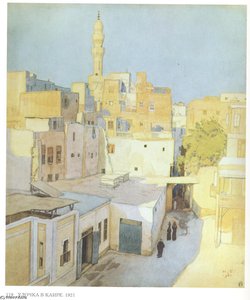
- Exile and Return: Following the October Revolution in 1917, disillusioned with the new regime, he left Russia. He lived in Cairo, Alexandria, and eventually settled in Paris (1925), where he worked as a decorator.
- Despite his initial departure, Bilibin harbored a longing for his homeland and returned to the Soviet Union in 1936 after decorating the Soviet Embassy.
- Tragic End: He died during the Siege of Leningrad in 1942, refusing to evacuate despite the dire conditions.
Legacy and Historical Significance
- Ivan Bilibin is considered one of Russia’s most important illustrators and stage designers.
- Revival of National Identity: His work played a crucial role in reviving interest in Russian folklore and national identity during a period of rapid social and political change.
- Influence on Modern Art: Bilibin’s distinctive style influenced subsequent generations of artists, particularly those interested in exploring the intersection of art, folklore, and national culture.
- His illustrations continue to captivate audiences worldwide with their beauty, imagination, and evocative portrayal of a bygone era.