Marie Laurencin

1883 - 1956

Marie Laurencin (1883–1956) is known above all for The Fan; the catalogue holds 112 of the artist's works.

Essentials

  • Corpus themes:
    • parisian avant-garde
    • feminine aesthetics
    • geometric abstraction
    • cubist portraiture
    • early 20th century
  • Movements: cubism
  • Top-ranked work: Le Bal élégant ou la danse à la campagne (1913)
  • Creative periods: early modern
  • Topics explored:
    • woman
    • portrait
    • portraits
    • female figure
    • pastel palette
  • Copyright status: Public domain
  • Also known as:
    • Marie-Mélanie Laurencin
    • Мари Лорансен
    • マリー・ローランサン
    • მარი ლოურენცინი
    • 마리 로랑생
  • Lifespan: 73 years

A Parisian Muse: The Life and Art of Marie Laurencin

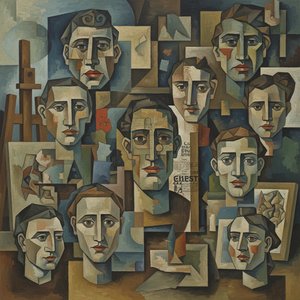
Marie Laurencin emerged from the vibrant artistic landscape of early 20th-century Paris as a distinctive voice, a painter who navigated the complexities of Cubism while forging her own path toward a uniquely feminine aesthetic. Born in 1883, her life was marked by both privilege and independence, shaping an artistic vision that celebrated grace, intimacy, and the subtle power of women. Raised primarily by her mother following her father’s early death, Laurencin received a foundational education in technique at Sèvres porcelain manufactory before gravitating towards oil painting and enrolling at the Académie Humbert. This formal training provided a solid base, but it was her immersion into the Parisian avant-garde that truly ignited her artistic spirit.

Embracing Modernity: Cubism and the Section d’Or

Laurencin quickly found herself drawn to the revolutionary ideas circulating within the circles of Pablo Picasso and Guillaume Apollinaire. She became an integral part of the *Section d’Or*, a collective of artists—including Jean Metzinger, Albert Gleizes, Robert Delaunay, and Henri Le Fauconnier—dedicated to exploring the principles of Cubism. Exhibiting at the Salon des Indépendants and the Salon d'Automne between 1910 and 1912, Laurencin’s early works demonstrate a clear engagement with the fragmented forms and geometric explorations characteristic of the movement. However, even in these initial experiments, hints of her individual style began to emerge. Her romantic relationship with Apollinaire further cemented her position within this influential milieu; he became both a muse and a champion of her work. Simultaneously, she found kinship and inspiration within Natalie Clifford Barney’s salon—a haven for American expatriates and members of the lesbian community—contributing to a network of artistic and intellectual exchange that profoundly shaped her perspective.

A Feminine Vision: Style and Themes

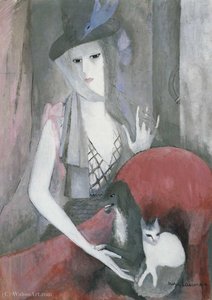
While deeply influenced by Cubism, Laurencin ultimately transcended its rigid structures, developing a style distinctly her own. She softened the harsh angles and stark geometries favored by Picasso and Braque, opting instead for curvilinear forms and a delicate palette of pastel colors. Her canvases are populated primarily by women—often depicted in groups or intimate portraits—radiating an aura of elegance and quiet contemplation. Unlike many of her Cubist contemporaries who focused on industrial subjects or abstract concepts, Laurencin centered her art around themes of beauty, grace, and the feminine experience. She captured a world seen through a woman’s eyes, imbued with sensitivity and emotional nuance. This focus wasn't merely representational; it was a deliberate assertion of a female gaze within a predominantly male-dominated artistic landscape. Her work began to bridge Cubism with emerging movements like Art Deco and Impressionism, creating a unique synthesis of modern styles.

Later Years and Lasting Legacy

The outbreak of World War I disrupted Laurencin’s life and career. She sought refuge in Spain with her husband, Baron Otto von Waëtjen, losing her French citizenship through marriage—a circumstance that underscored the societal constraints placed upon women at the time. Following their divorce in 1920, she returned to Paris and enjoyed a period of considerable success throughout the 1920s and 30s. However, the economic hardships of the Depression impacted her later years, leading her to supplement her income by teaching art. Despite these challenges, Laurencin continued to paint, refining her signature style and exploring new avenues of expression. Today, Marie Laurencin is increasingly recognized as a pivotal figure in early 20th-century art—one of the few female Cubist painters who challenged gender norms and expanded the boundaries of modernism. The Musée Marie Laurencin, established in Nagano Prefecture, Japan, stands as a testament to her enduring legacy, housing over 500 of her works and ensuring that her unique vision continues to inspire generations of artists and art lovers alike. Her paintings remain captivating not only for their aesthetic beauty but also for the subtle yet powerful statement they make about femininity, independence, and the pursuit of artistic freedom.

Quiz

There is only one correct answer for each question.

Question 1:
Marie Laurencin was closely associated with which artistic movement early in her career?
Question 2:
What is a defining characteristic of Laurencin's artistic style, particularly in her portraits?
Question 3:
With whom did Marie Laurencin have a significant romantic relationship that influenced her artistic circle?
Question 4:
During World War I, where did Marie Laurencin live in exile?
Question 5:
What was notable about Marie Laurencin's position within the Parisian art scene of her time?

Questions & Answers

Is Marie Laurencin's work in the public domain?

Yes. Marie Laurencin died in 1956, and the works are in the public domain.

Who taught Marie Laurencin?

Marie Laurencin trained under Madeleine Lemaire.

Is there a study guide for a Marie Laurencin painting?

What aliases or alternate names does Marie Laurencin have?

Marie Laurencin appears under the alternate names Marie-Mélanie Laurencin, Мари Лорансен, マリー・ローランサン, მარი ლოურენცინი, 마리 로랑생.

How long did Marie Laurencin live?

Marie Laurencin lived about 73 years, from 1883 to 1956.

Where can I see Marie Laurencin's artworks in a 3D gallery?

What style did Marie Laurencin paint in?

Marie Laurencin painted in the Cubism style, like the other famous Cubism artists.

What are the birthplace and birth year of Marie Laurencin?

Marie Laurencin was born in 10ᵗʰ arrondissement of Paris in 1883.

Which paintings is Marie Laurencin known for?

Marie Laurencin is known for the works listed in the most famous paintings by Marie Laurencin.