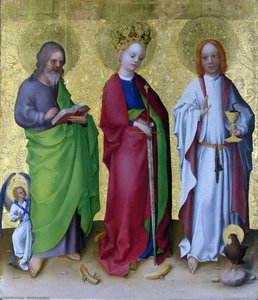
International Gothic, one artist at a time

20 Famous International Gothic Painters Who Shaped the Movement

Simone Martini (1284–1344) is the most famous International Gothic painter, whose singular vision gave us The Annunciation with St. Margaret and St. Ansanus and Christ Discovered in the Temple (The Holy Family), -. Next stand Gentile da Fabriano, Pisanello, Stefan Lochner and Lorenzo Monaco. These 20 painters, from Simone Martini (born 1284) to Stefan Lochner (born 1410), came from 5 countries.

Our selection. Artists whose works our catalogue attaches to International Gothic, in the order of our fame ranking. Artists born after 1955 with no Wikidata identifier stay out until verified. The Wikipedia figure counts our 32 languages with an article on the artist.

  1. The Annunciation with St. Margaret and St. Ansanus by Simone Martini1Simone Martini
  2. Adoration of the Magi Altarpiece, left hand predella panel depicting the Nativity by Gentile da Fabriano2Gentile da Fabriano
  3. Sigismondo Pandolfo Malatesta, Lord of Rimini by Pisanello3Pisanello

In brief

International Gothic in brief

  • 20Artists
  • 1284–1410Years of birth
  • 5Countries of birth
  • 0Women
  • 890Works in our catalogue
Cities with most births
Siena (3), Nijmegen (2), Florence (2), Fabriano (1)

One artist at a time

20 International Gothic Painters and their signature works

1of 20

Simone Martini

Italian Born in Siena International Gothic Wikipedia in 28/32 languages

Simone Martini

By 1315, Simone Martini was already making his mark on the civic life of Siena. Around 1324, he was commissioned to paint the Blessed Agostino Novello Altarpiece. By bringing the Sienese style across the mountains, he helped Sienese painting penetrate French territory, allowing his specific aesthetic to take root in new lands.

Where to see In Siena, the Palazzo Pubblico holds the Maestà fresco, a work that has occupied its space since 1315.

Teacher of Lippo Memmi #8

Signature works · The 100 signature works

2of 20

Gentile da Fabriano

Italian Born in Fabriano International Gothic Wikipedia in 23/32 languages

Gentile da Fabriano

By approximately 1405, Gentile had established himself as a working artist in Venice, a vibrant hub of commerce and cultural exchange.

Signature works · The 100 signature works

3of 20

Pisanello

Italian Born in Pisa Early Renaissance, Int'l Gothic Wikipedia in 28/32 languages

Pisanello

The Madonna of the Quail, signed “Antonius Pisanus,” showcases a harmonious blend of Gentile da Fabriano's refinement and Stefano da Verona’s stylistic nuances. Beyond these celebrated works, his Fresco Annunciation in San Fermo, Verona—created as part of Nicolò di Brenzoni’s funeral monument—demonstrates his skill in narrative composition and devotional imagery. Interestingly, some scholars suggest a possible connection to Paolo Uccello, noting a shared fascination with horses—a motif that appears frequently in Pisanello’s drawings and paintings.

Signature works · The 100 signature works

4of 20

Stefan Lochner

German Born in Meersburg Late Gothic, International Gothic Wikipedia in 19/32 languages

Stefan Lochner

Born around 1410 in the picturesque town of Meersburg, Germany – a location steeped in legend and nestled amongst the stunning Lake Constance – Stephan Lochner’s life was tragically cut short in Cologne around 1451. Its innovative approach to depicting religious narratives – combining Gothic elegance with emerging Renaissance realism – paved the way for future developments in Northern European painting.

Signature works · The 100 signature works

5of 20

Lorenzo Monaco

Italian Born in Siena Gothic, Early Renaissance Wikipedia in 22/32 languages

Lorenzo Monaco

Lorenzo Monaco, born Piero di Giovanni around 1370 in Siena, occupies a fascinating and pivotal position in the transition from the Gothic grace of the Trecento to the burgeoning Renaissance ideals of the Quattrocento. He demonstrated that artistic excellence could flourish within the confines of established conventions, enriching them with individual expression and spiritual depth.

Signature works · The 100 signature works

6of 20

Limbourg Brothers

Dutch Born in Nijmegen International Gothic Wikipedia in 21/32 languages

Limbourg Brothers

The Belles Heures of Jean, Duke of Berry: A testament to their technical evolution, this manuscript reveals a growing sophistication in their use of color and a deeper, more emotive approach to religious storytelling.

Signature works · The 100 signature works

7of 20

Agnolo Gaddi

Italian Born in Florence Gothic, Early Renaissance Wikipedia in 20/32 languages

Agnolo Gaddi

The monumental figures, the emotional resonance, and the narrative clarity that characterized Giotto’s frescoes are all present in Agnolo’s initial paintings. Where Giotto often favored robust simplicity, Gaddi embraced a more refined elegance, incorporating intricate details and a heightened sense of decorative flourish. Agnolo Gaddi, born in Florence around 1350, occupies a fascinating, pivotal position in the history of Italian painting.

Signature works · The 100 signature works

8of 20

Lippo Memmi

Italian Born in Siena International Gothic Wikipedia in 17/32 languages

Lippo Memmi

For many years, Lippo Memmi was overshadowed by the brilliance of Simone Martini. His paintings possess a quiet dignity and emotional resonance that sets them apart. Memmi’s career took an intriguing turn when he followed Simone Martini to the Papal court in Avignon during the mid-14th century.

Pupil of Simone Martini #1

Signature works · The 100 signature works

9of 20

Spinello Aretino

Italian Born in Arezzo Link between Giotto and Sienese School Wikipedia in 16/32 languages

Spinello Aretino

Born into a family of Florentine goldsmiths, his true name was Spinello Di Luca Spinelli, but he became known to history by the moniker "Aretino," signifying his connection to Arezzo.

Signature works · The 100 signature works

10of 20

Bernat Martorell

Italian Born in Sant Celoni International Gothic Wikipedia in 11/32 languages

Bernat Martorell

In the shadowy corridors of art history, where names have been swallowed by the passage of centuries, the Master of the Codex of Saint George remains one of the most captivating enigmas of the fourteenth century. Active approximately between 1320 and 1330, this anonymous creator breathed life into sacred texts, transforming vellum into a window of divine revelation.

Signature works · The 100 signature works

11of 20

Jean Malouel

Netherlandish (Dutch) Born in Nijmegen International Gothic Wikipedia in 16/32 languages

Jean Malouel

This circular composition, with its depiction of the Virgin Mary cradling the body of Christ, blends Northern European and Sienese artistic influences into a harmonious whole. His Virgin and Child (Berlin Gemäldegalerie), believed to be part of a diptych with a portrait of John the Fearless, represents an early example of this increasingly popular format. He played a crucial role in introducing the Limbourg brothers – Herman, Paul, and Johan – to Philip the Bold's service around 1400.

Signature works · The 100 signature works

12of 20

Claus Sluter

Dutch Born in Haarlem Northern Realism

Claus Sluter

This meticulous attention to detail reflects the influence of Florentine sculpture, signaling Sluter’s engagement with humanist ideals and artistic innovation. Each prophet and king embodies a specific Old Testament figure foreshadowing Christ’s sacrifice—a concept central to Christian theology and powerfully conveyed through the sculpture’s spatial arrangement and expressive gestures. Furthermore, Sluter’s nephew, Claus de Werve, continued his artistic lineage, ensuring that Sluter’s legacy persisted within the Burgundian sculptural tradition.

Signature works · The 100 signature works

13of 20

Master Bertram

German Born in Minden International Gothic Wikipedia in 13/32 languages

Master Bertram

It is believed that Bertram was influenced by both French and Netherlandish artistic trends prevalent during his time. The influence of courtly art from France can be observed in the refined elegance of his figures and decorative elements, while the meticulous detail and realism characteristic of Early Netherlandish painting are evident in his depictions of architectural settings and objects.

Signature works · The 100 signature works

14of 20

Paolo Di Giovanni Fei

Italian Born in San Quirico d'Orcia Naturalism, Proto-Renaissance Wikipedia in 10/32 languages

Paolo Di Giovanni Fei

Unlike the predominantly symbolic and flattened perspectives of earlier works, Lorenzetti sought to create a sense of depth and three-dimensionality on canvas. This departure from traditional Byzantine conventions was not merely stylistic; it reflected a deeper philosophical shift towards understanding the world through observation and experience. Similarly, his Beata Umiltà Altarpiece (c. 1340), commissioned for the women’s convent of the Donne di Faenza in Florence, showcases his ability to convey complex emotions through subtle gestures and facial expressions.

Signature works · The 100 signature works

15of 20

Lluís Borrassà

Catalan Born in Girona International Gothic Wikipedia in 8/32 languages

Lluís Borrassà

By successfully introducing and refining the International Gothic style in the Principality, he provided a bridge between the medieval past and the approaching Renaissance.

Signature works · The 100 signature works

16of 20

Michele Giambono

Italian Born in Venice International Gothic Wikipedia in 10/32 languages

Michele Giambono

While the broader Renaissance would eventually move toward the anatomical realism and linear perspective of masters like Bellini, Giambono’s dedication to the International Gothic aesthetic provided the essential foundation of splendor upon which later Venetian art was built.

Signature works · The 100 signature works

17of 20

Giovanni dal Ponte

Italian Born in Florence Late Gothic/Renaissance Wikipedia in 7/32 languages

Giovanni dal Ponte

His work for Illarione dei Bardi in 1422 brought him early recognition, leading to further prestigious commissions from families like the Biliotti and Bardo di Francesco de’ Bardi. Giovanni dal Ponte’s artistic style is characterized by its unique blend of late Gothic sensibilities and nascent Renaissance innovations.

Signature works · The 100 signature works

18of 20

Theodoric of Prague

Czech Born in Italy Gothic Wikipedia in 16/32 languages

Theodoric of Prague

His panels often carry a curiously Sienese character, though he avoids the extreme delicacy found in the works of Siena. In his more schematic works, such as the depictions of Saint Simon, the rendering of faces becomes harder and more simplified.

Where to see This space holds the weight of his most significant decorative program.

Signature works · The 100 signature works

19of 20

Master Of The Osservanza

Italian Late Gothic Wikipedia in 8/32 languages

Master Of The Osservanza

While definitively named only recently thanks to meticulous research by Maria Falcone, this artist—now recognized as Sano di Pietro —left behind a remarkable cycle of eight panels depicting scenes from the life of Saint Anthony Abbot, works that continue to captivate viewers with their haunting beauty and psychological depth. Despite his anonymity for centuries, the Master of the Osservanza's work has exerted a significant influence on subsequent generations of Italian painters.

Signature works · The 100 signature works

20of 20

Master of Heiligenkreuz Abbey

Austrian International Gothic Wikipedia in 5/32 languages

Master of Heiligenkreuz Abbey

The Master’s style is a complex synthesis of influences. However, he also incorporated elements of the International Gothic style, characterized by elongated figures, delicate hands, and an expressive use of color.

Signature works · The 100 signature works

Signature works

Signature International Gothic works

  1. The Annunciation with St. Margaret and St. Ansanus by Simone Martini

    The Annunciation with St. Margaret and St. Ansanus

    Simone Martini

    1333 · Galleria degli Uffizi, Florence

  2. Adoration of the Magi Altarpiece, left hand predella panel depicting the Nativity by Gentile da Fabriano

    Adoration of the Magi Altarpiece, left hand predella panel depicting the Nativity

    Gentile da Fabriano

    1423 · Galleria degli Uffizi, Florence

  3. Sigismondo Pandolfo Malatesta, Lord of Rimini by Pisanello

    Sigismondo Pandolfo Malatesta, Lord of Rimini

    Pisanello

    1445 · Calouste Gulbenkian Foundation, Lisbon

  4. Madonna of the Rose Bush by Stefan Lochner

    Madonna of the Rose Bush

    Stefan Lochner

    1440 · Wallraf-Richartz-Museum, Cologne

  5. The Coronation of the Virgin by Lorenzo Monaco

    The Coronation of the Virgin

    Lorenzo Monaco

    1414 · Galleria degli Uffizi, Florence

  6. The Belles Heures of Jean, Duke of Berry by Limbourg Brothers

    The Belles Heures of Jean, Duke of Berry

    Limbourg Brothers

    1410 · Metropolitan Museum of Art, new york

  7. The Last Supper by Agnolo Gaddi

    The Last Supper

    Agnolo Gaddi

    1395 · Lindenau-Museum, Altengau

  8. The Annunciation and Two Saints by Lippo Memmi

    The Annunciation and Two Saints

    Lippo Memmi

    1333 · Galleria degli Uffizi, Florence

A timeline

International Gothic through its signature works

  1. 1333
  2. 1333
  3. 1383
  4. 1385
  5. 1394
  6. 1395
  7. 1395
  8. 1410
  9. 1410
  10. 1414
  11. 1422
  12. 1423
  13. 1431
  14. 1440

Figures

The figures

Every name

List of 20 famous International Gothic painters, every name

  1. 1Simone MartiniSimone MartiniItalian · 1284–1344
  2. 2Gentile da FabrianoGentile da FabrianoItalian · 1370–1427
  3. 3PisanelloPisanelloItalian · 1395–1455
  4. 4Stefan LochnerStefan LochnerGerman · 1410–1451
  5. 5Lorenzo MonacoLorenzo MonacoItalian · 1370–1425
  6. 6Limbourg BrothersLimbourg BrothersDutch · 1385–1416
  7. 7Agnolo GaddiAgnolo GaddiItalian · 1350–1396
  8. 8Lippo MemmiLippo MemmiItalian · 1291–1356
  9. 9Spinello AretinoSpinello AretinoItalian · 1350–1410
  10. 10Bernat MartorellBernat MartorellItalian · 1390–1452
  11. 11Jean MalouelJean MalouelNetherlandish (Dutch) · 1370–1415
  12. 12Claus SluterClaus SluterDutch · 1355–1406
  13. 13Master BertramMaster BertramGerman · 1345–1415
  14. 14Paolo Di Giovanni FeiPaolo Di Giovanni FeiItalian · 1345–1411
  15. 15Lluís BorrassàLluís BorrassàCatalan · 1360–1425
  16. 16Michele GiambonoMichele GiambonoItalian · 1400–1462
  17. 17Giovanni dal PonteGiovanni dal PonteItalian · 1385–1438
  18. 18Theodoric of PragueTheodoric of PragueCzech ·
  19. 19Master Of The OsservanzaMaster Of The OsservanzaItalian ·
  20. 20Master of Heiligenkreuz AbbeyMaster of Heiligenkreuz AbbeyAustrian ·

Questions

Your questions

  • Which International Gothic painter is the most famous?

    First place goes to Simone Martini (#1); Gentile da Fabriano (#2) and Pisanello (#3) complete the podium.

  • Who are the 5 most famous International Gothic painters?

  • Which techniques define International Gothic art?

    “That year, he painted the Maestà fresco for the Palazzo Pubblico, the seat of the city's government.” — from our biography of Simone Martini (#1).

  • Who was the first International Gothic painter?

    The earliest-born painter in this list is Simone Martini (#1), born in 1284.

  • Who are the most famous International Gothic painters from Italy?

    The highest-ranked painters born in Italy are Simone Martini (#1), Gentile da Fabriano (#2), Pisanello (#3), Lorenzo Monaco (#5) and Agnolo Gaddi (#7).

  • Where are the great works of International Gothic art today?

    The museums holding the most key works of this list are Metropolitan Museum of Art (6), Galleria degli Uffizi (4) and National Gallery of Art (3).

  • Who taught the famous International Gothic painters?

    Simone Martini (#1) taught Lippo Memmi (#8).

  • Where were most International Gothic painters born?

    Italy: 11 of the 20 painters in this list were born there, then Netherlands (3) and Germany (2).

  • Which city was home to the most International Gothic painters?

    Siena: 3 of the painters in this list were born there.

  • In which period did International Gothic art flourish?

    Most painters in this list were born in the 1370s (3 of 20), between 1284 and 1410 overall.

  • Where can I see more works by these painters?

    Our catalogue holds 890 works by these painters.

Read

Stories on OriginalUniqueArt.com

Other movements

Famous artists of other movements

Other periods

Famous artists across the periods

Famous paintings

Masterpieces that inspire us, by movement

Discover more

More artists to discover