Portrait of Stefan Lochner

Stefan Lochner Paintings: The 36 Most Famous, Through a Gallery's Eye

Updated November 2026 · ranked by our popularity score (searches, visits and orders for each work) · 36 works by Stefan Lochner in our catalogue

In short

To the gallery's eye, Stefan Lochner's most famous painting is Madonna of the Rose Bush (1440), whose original hangs in the Wallraf-Richartz-Museum, Cologne. The Last Judgment (1435) and The Crucifixion (1440) complete the trio every eye recognises. Of the 36 works by Stefan Lochner in our catalog, the gallery presents the 36 most famous below, each original with its year, its museum and what makes it unique.

1410 – 1451, Meersburg International gothic Most works: Städel Museum

The gallery's top 10 Stefan Lochner paintings

1
Madonna of the Rose Bush (1440) by Stefan Lochner

Madonna of the Rose Bush

1440 · Oil On Panel · Wallraf-Richartz-Museum, Cologne

Stephan Lochner's Madonna of the Rose Bush, painted around 1440 in Cologne, Germany, isn’t merely a depiction of the Virgin Mary; it’s an immersive experience—a carefully constructed world brimming with symbolism and echoing the profound spirituality of its time. This panel painting transcends simple religious iconography, offering a glimpse into the artistic sensibilities and cultural values of late medieval Europe. Lochner, a prominent figure in Cologne's art scene, masterfully blended…

2
The Last Judgment (1435) by Stefan Lochner

The Last Judgment

1435 · Wallraf-Richartz-Museum, Cologne

Stephan Lochner’s “The Last Judgment,” painted in 1435, isn't merely a depiction of biblical narrative; it’s a profound meditation on mortality, divine justice, and the eternal consequences of earthly actions. Emerging from the late Gothic period in Cologne, Germany, this monumental panel transcends its historical context to resonate with an enduring power—a testament to the artist’s skill and his ability to capture both the drama and the solemnity of humanity's…

3
The Crucifixion (1440) by Stefan Lochner

The Crucifixion

1440 · Oil On Canvas · Germanisches Nationalmuseum, Nuremberg

To stand before this depiction of The Crucifixion by Stephan Lochner is to be enveloped in an atmosphere of profound, almost unbearable solemnity. It is not merely a historical recounting; it is a visceral confrontation with sacrifice. At the heart of the composition, Christ hangs upon the cross, his outstretched arms forming a powerful, tragic geometry against the backdrop of human grief and divine mystery. The scene pulses with narrative…

4
Mary Magdalen (1400) by Stefan Lochner

Mary Magdalen

1400 · Tempera On Panel · Museum Boijmans Van Beuningen, Rotterdam

This painting, titled Mary Magdalen, is a religious work by the German master Stefan Lochner. It offers a quiet study of the saint, rendered with the delicate precision characteristic of the late International Gothic period. The subject is presented in a moment of contemplative grace, her presence defined by a sense of stillness and devotion.

5
The Virgin Crowned by Angels (1450) by Stefan Lochner

The Virgin Crowned by Angels

1450 · Tempera On Panel · Cleveland Museum of Art, Cleveland

In this sacred scene, The Virgin Crowned by Angels emerges from the quietude of the mid-fifteenth century. Painted by Stefan Lochner about 1450, the work presents a moment of profound religious devotion. The Virgin Mary stands as the central figure, cradling the Christ Child in a gesture of maternal grace. This depiction of the Madonna and Child invites the viewer into a space of quiet contemplation and spiritual presence.

6
Mary with the Christ-child next to a plant trough (1440) by Stefan Lochner

Mary with the Christ-child next to a plant trough

The painting titled Mary with the Christ-child next to a plant trough is a work by Stefan Lochner. Created about 1440, this devotional piece captures a quiet moment of divinity. The central figures of the Madonna and Child are framed by a lush, green garden setting. Small flowers emerge from the earth near a plant trough, grounding the celestial scene in a tangible, botanical reality.

7
Sts. Catherine, Hubert and Quirinus (Last-Judgement-Altar) (1445) by Stefan Lochner

Sts. Catherine, Hubert and Quirinus (Last-Judgement-Altar)

1445 · Oil On Panel · Bavarian State Painting Collections, Munich

The presence of Sts. Catherine, Hubert and Quirinus (Last-Judgement-Altar) commands the space, a solemn Late Gothic altarpiece panel that emerges from the shadows of history. Painted by Stefan Lochner, this work carries the weight of a sacred vision. It dates to 1445, capturing a moment of profound spiritual stillness. The figures exist within a realm of deep color and intense devotion, frozen in a state of eternal grace.

8
John the Evangelist (1440) by Stefan Lochner

John the Evangelist

1440 · Tempera On Panel · Museum Boijmans Van Beuningen, Rotterdam

This painting depicts John the Evangelist, a work executed by the artist Stefan Lochner. The subject is rendered in a profile or three-quarter view, oriented toward the right side of the panel. He is shown holding a chalice within his hands. The figure is positioned against a solid gold background that occupies the majority of the space behind the subject.

9
Saints Ambrose, Cecilia and Augustine (1447) by Stefan Lochner

Saints Ambrose, Cecilia and Augustine

1447 · Tempera On Panel · Wallraf-Richartz-Museum, Cologne

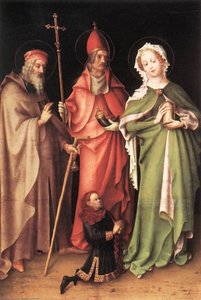
In this late Gothic religious altarpiece panel, the figures of Saints Ambrose, Cecilia and Augustine emerge from a shallow architectural space. Painted by Stefan Lochner, the work captures a moment of divine presence through its formal and symmetrical arrangement. The three saints dominate the frame, their presence felt through the heavy, sculptural folds of their drapery and the steady gaze of their faces. A smaller donor figure kneels in the…

Stefan Lochner paintings, ranked 11 to 36

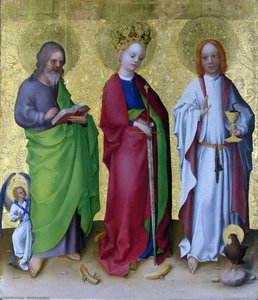
11Sts Anthony the Hermit, Cornelius and Mary Magdalen with a Donor (1445) by Stefan LochnerSts Anthony the Hermit, Cornelius and Mary Magdalen with a Donor1445 · Alte Pinakothek 12Martyrdom of the Twelve Apostles (Altarpiece for the Church of the Holy Apostles in Cologne, left wing) (1435) by Stefan LochnerMartyrdom of the Twelve Apostles (Altarpiece for the Church of the Holy Apostles in Cologne, left wing)1435 · Städel Museum 13Martyrdom of the Apostles: Martyrdom of Saint Thomas by Stefan LochnerMartyrdom of the Apostles: Martyrdom of Saint ThomasStädel Museum 14Martyrdom of the Apostles: Martyrdom of Saint Philip by Stefan LochnerMartyrdom of the Apostles: Martyrdom of Saint PhilipStädel Museum 15Martyrdom of the Apostles: Martyrdom of Saint Peter by Stefan LochnerMartyrdom of the Apostles: Martyrdom of Saint PeterStädel Museum 16Martyrdom of the Apostles: Martyrdom of St Paul by Stefan LochnerMartyrdom of the Apostles: Martyrdom of St PaulStädel Museum 17Martyrdom of the Apostles: Martyrdom of Saint Matthias by Stefan LochnerMartyrdom of the Apostles: Martyrdom of Saint MatthiasStädel Museum 18Martyrdom of the Apostles: Martyrdom of Saint Matthew by Stefan LochnerMartyrdom of the Apostles: Martyrdom of Saint MatthewStädel Museum 19Martyrdom of the Apostles: Martyrdom of Saint James the Younger by Stefan LochnerMartyrdom of the Apostles: Martyrdom of Saint James the YoungerStädel Museum 20Martyrdom of the Apostles: Martyrdom of St James the Elder by Stefan LochnerMartyrdom of the Apostles: Martyrdom of St James the ElderStädel Museum 21Martyrdom of the Apostles: Martyrdom of Saint Bartholomew by Stefan LochnerMartyrdom of the Apostles: Martyrdom of Saint BartholomewStädel Museum 22Martyrdom of the Apostles: Martyrdom of Saint Andrew by Stefan LochnerMartyrdom of the Apostles: Martyrdom of Saint AndrewStädel Museum 23Martyrdom of the Apostles: Martyrdom of Saints Simon and Judas by Stefan LochnerMartyrdom of the Apostles: Martyrdom of Saints Simon and JudasStädel Museum 24Presentation of Christ in the Temple (detail) by Stefan LochnerPresentation of Christ in the Temple (detail) 25Presentation of Christ in the Temple (detail) by Stefan LochnerPresentation of Christ in the Temple (detail) 26Hl. Ursula Mit Gefährten (The Dombild Altarpiece, left wing) (1445) by Stefan LochnerHl. Ursula Mit Gefährten (The Dombild Altarpiece, left wing)1445 27Adoration of the Magi (The Dombild Altarpiece, central part) (1445) by Stefan LochnerAdoration of the Magi (The Dombild Altarpiece, central part)1445 28Altarpiece of the Patron Saints of Cologne by Stefan LochnerAltarpiece of the Patron Saints of Cologne 29Triptych with the Virgin and Child in an Enclosed garden by Stefan LochnerTriptych with the Virgin and Child in an Enclosed garden 30Adoration of the Magi by Stefan LochnerAdoration of the Magi 31Presentation of Christ in the Temple by Stefan LochnerPresentation of Christ in the Temple 32Three saints by Stefan LochnerThree saintsNational Gallery 33St. Jerome in His Study by Stefan LochnerSt. Jerome in His Study 34Annunciation (1440) by Stefan LochnerAnnunciation1440 35Presentation of Christ in the Temple (1445) by Stefan LochnerPresentation of Christ in the Temple1445 · Calouste Gulbenkian Foundation 36Adoration of the Child Jesus (1445) by Stefan LochnerAdoration of the Child Jesus1445 · Alte Pinakothek

Stefan Lochner's famous paintings, period by period

The subjects that held Stefan Lochner's eye

The four subjects that come back most often in these originals, each with its finest example.

The museums that keep Stefan Lochner's originals

The 8 museums that hold the most of the paintings on this page.

Museum City Works by Stefan Lochner Paintings from this list
Städel Museum, FrankfurtStädel Museum Frankfurt 12 Martyrdom of the Twelve Apostles (Altarpiece for the Church of the Holy Apostles in Cologne, left wing), Martyrdom of the Apostles: Martyrdom of Saint Thomas, Martyrdom of the Apostles: Martyrdom of Saint Philip
Wallraf-Richartz-Museum, CologneWallraf-Richartz-Museum Cologne 4 Madonna of the Rose Bush, The Last Judgment, Saints Ambrose, Cecilia and Augustine
Museum Boijmans Van Beuningen, RotterdamMuseum Boijmans Van Beuningen Rotterdam 2 Mary Magdalen, John the Evangelist
Bavarian State Painting Collections, MunichBavarian State Painting Collections Munich 2 Mary with the Christ-child next to a plant trough, Sts. Catherine, Hubert and Quirinus (Last-Judgement-Altar)
Alte Pinakothek, MunichAlte Pinakothek Munich 2 Sts Anthony the Hermit, Cornelius and Mary Magdalen with a Donor, Adoration of the Child Jesus
Germanisches Nationalmuseum, NurembergGermanisches Nationalmuseum Nuremberg 1 The Crucifixion
Cleveland Museum of Art, ClevelandCleveland Museum of Art Cleveland 1 The Virgin Crowned by Angels
National Gallery, LondonNational Gallery London 1 Three saints

Stefan Lochner, one signature painting per decade

Works per decade

Pick a decade to see the original that defines it.

Stefan Lochner's paintings: the gallery answers

Which Stefan Lochner painting is the most famous of all?Reveal the answer

Madonna of the Rose Bush (1440), Wallraf-Richartz-Museum, Cologne. The Last Judgment (1435) and The Crucifixion (1440) come next.

How old was Stefan Lochner on completing Madonna of the Rose Bush?Reveal the answer

30 years old: Madonna of the Rose Bush dates from 1440, and Stefan Lochner was born in 1410.

Which are Stefan Lochner's top 10 paintings?Reveal the answer

Madonna of the Rose Bush, The Last Judgment, The Crucifixion, Mary Magdalen, The Virgin Crowned by Angels, Mary with the Christ-child next to a plant trough, Sts. Catherine, Hubert and Quirinus (Last-Judgement-Altar), John the Evangelist, Saints Ambrose, Cecilia and Augustine and Sts Mark, Barbara and Luke. The ranking above gives each one's year and museum.

How many works did Stefan Lochner create?Reveal the answer

Our catalog holds 36 works by Stefan Lochner, dated from 1435 to 1450.

Where do Stefan Lochner's most famous originals hang?Reveal the answer

Mostly in Städel Museum (Frankfurt), Wallraf-Richartz-Museum (Cologne) and Museum Boijmans Van Beuningen (Rotterdam). The museum table above lists them all.

When did Stefan Lochner create the most famous paintings?Reveal the answer

In 1440s: 13 of the 36 works on this page were made then, Madonna of the Rose Bush among them.

Which are Stefan Lochner's earliest and latest famous works?Reveal the answer

On this page, the earliest is The Last Judgment (1435) and the latest The Virgin Crowned by Angels (1450).

Which subjects did Stefan Lochner return to most?Reveal the answer

Saints (4), Medieval art (3) and Religious art (3), across the 36 works on this page.

Which medium did Stefan Lochner work in most?Reveal the answer

Tempera On Panel, for 5 of the 36 works on this page.

Which movement is Stefan Lochner associated with?Reveal the answer

International gothic and Late gothic, judging by the originals on this page.

Which Stefan Lochner originals does the Städel Museum hold?Reveal the answer

Martyrdom of the Twelve Apostles (Altarpiece for the Church of the Holy Apostles in Cologne, left wing), Martyrdom of the Apostles: Martyrdom of Saint Thomas and Martyrdom of the Apostles: Martyrdom of Saint Philip: the Städel Museum, Frankfurt holds 12 of the works on this page.

Stefan Lochner: the artist

Stephan Lochner: Bridging Gothic Splendor and Northern Renaissance Innovation

Born around 1410 in the picturesque town of Meersburg, Germany – a location steeped in legend and nestled amongst the stunning Lake Constance – Stephan Lochner’s life was tragically cut short in Cologne around 1451. Despite his brief career, this enigmatic painter left an indelible mark on the art world, skillfully blending the opulent traditions of International Gothic with the burgeoning realism and innovative iconography characteristic of the early Northern Renaissance. Lochner's legacy lies not just in the beauty of his individual works but also in his influence on subsequent generations of artists, particularly Rogier van der Weyden and Hans Memling – painters who would carry forward elements of his distinctive style.

Little is definitively known about Lochner’s early life. Art historical consensus suggests he spent a portion of his formative years apprenticed within the Low Countries, an experience that profoundly shaped his artistic sensibilities. Exposure to the vibrant colors, intricate detailing, and evolving iconography prevalent in Flemish painting undoubtedly influenced his approach to composition, color palettes, and the depiction of religious figures. This international exposure is believed to be a key factor in the unique synthesis of styles found throughout his oeuvre.

A Master of Color and Texture: Artistic Style and Notable Works

Lochner’s paintings are immediately recognizable for their arresting use of color, dynamic long lines, and remarkably virtuosic surface textures. He eschewed the muted tones often associated with earlier Gothic art, embracing a brighter, more luminous palette – a characteristic that aligns him firmly within the emerging Renaissance aesthetic. His works frequently feature rich reds, blues, and golds, applied with a masterful understanding of light and shadow to create a sense of depth and drama.

Among his most celebrated pieces is “Madonna of the Rose Bush” (51 x 40 cm, Wallraf-Richartz Museum, Cologne), a masterpiece that exemplifies Lochner’s technical skill and expressive power. The painting showcases his ability to imbue religious subjects with an almost palpable sense of emotion and spirituality. “St. Jerome in His Study” (30 x 39 cm, oil on panel) further demonstrates his capacity for capturing the essence of his subjects – a quiet contemplation rendered with remarkable detail and psychological insight. The “Three Saints,” a complex composition brimming with grace and poise, highlights Lochner’s skill in depicting multiple figures within a single frame, creating a dynamic and engaging visual narrative.

Another significant work is the "Dombild Altarpiece" (or Kölner Dombild), originally commissioned for Cologne Cathedral. This monumental triptych, now housed within the cathedral's Marienkapelle, remains one of the most important examples of his art and a testament to his artistic vision. The altarpiece’s intricate details, vibrant colors, and symbolic imagery continue to fascinate viewers today.

Influence and Legacy: A Bridge Between Styles

Stephan Lochner's influence on subsequent generations of Northern artists was substantial. His distinctive style – characterized by flowing lines, brilliant colors, and a focus on emotional expression – resonated deeply with his contemporaries, inspiring them to incorporate elements of his approach into their own work. Rogier van der Weyden, in particular, is believed to have been profoundly influenced by Lochner’s use of color and composition, while Hans Memling similarly adopted aspects of his style in his devotional panels.

The “Dombild Altarpiece” stands as a particularly compelling example of Lochner's influence. Its innovative approach to depicting religious narratives – combining Gothic elegance with emerging Renaissance realism – paved the way for future developments in Northern European painting. The altarpiece’s intricate details and symbolic imagery served as a model for countless artists who followed, solidifying Lochner’s position as a pivotal figure in the transition from late Gothic to early Renaissance art.

Museum Collections and Continuing Appreciation

Lochner's works are treasured within several prominent museums around the world. The Wallraf-Richartz Museum in Cologne houses “Madonna of the Rose Bush,” offering visitors a direct encounter with this iconic painting. The Städel Museum in Frankfurt displays “The Flémalle Panels” (68 x 160 cm, oak), showcasing Lochner’s mastery of panel painting and his ability to create complex compositions filled with detail and symbolism. Beyond these key institutions, fragments of his work can be found in various collections, ensuring that his artistic legacy continues to be appreciated by art enthusiasts worldwide.

Today, Stephan Lochner's paintings are celebrated for their beauty, technical skill, and profound emotional resonance. His ability to seamlessly blend the traditions of International Gothic with the innovations of the early Northern Renaissance cemented his place as a truly exceptional artist – a master who bridged two distinct artistic eras and left an enduring legacy on the art world.