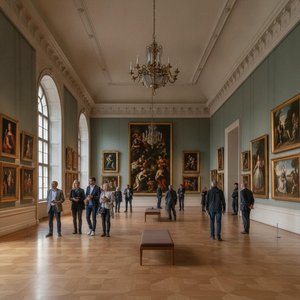
A Neoclassical Monument in Munich
The Alte Pinakothek rises from the Kunstareal with a deliberate, heavy presence. Designed by Leo von Klenze and commissioned by King Ludwig I, the building rejects the cluttered ornamentation of the Gothic Revival style in favor of Neoclassical clarity. Its thick masonry walls and yellow, polished brick facade establish a sense of permanence. The structure is defined by its massive scale, stretching 150 meters in length and reaching heights of 25 meters. Inside, the architecture facilitates a specific kind of light. One of the most significant technical choices during its construction was the integration of skylights, which flood the galleries with natural illumination. This design choice allows the paintings to be viewed under conditions that honor their original textures and colors.
The history of the building is marked by both resilience and renewal. Following the heavy bombing of World War II, the museum underwent a significant reconstruction between 1952 and 1957 under Hans Döllgast. While the walls were repaired, the ornate pre-war interior was not restored to its former state, leaving a more stripped-back, modern atmosphere. Later renovations in the late 1990s updated the climate control systems to protect the delicate oil on canvas works from environmental shifts. The museum remains a central pillar of the Bavarian State Painting Collections, standing alongside the Neue Pinakothek and the Pinakothek der Moderne.
The Spirit of European Painting
The collection spans the fourteenth to the eighteenth centuries, offering a concentrated look at the evolution of European art. Within these halls, the humanism of the Italian Renaissance meets the intense drama of the Baroque era. Visitors encounter works that focus on psychological depth and the manipulation of light. Rembrandt van Rijn’s 1629 Selfportrait at the Age of 27 provides a window into the artist's early experimentation with chiaroscuro, using deep shadows to sculpt his features. The heavy use of impasto and earthy ochres creates a palpable sense of presence on the canvas.
The Flemish and Northern traditions are equally present through the works of masters like Peter Paul Rubens and Albrecht Dürer. Rubens’ Lion Hunt displays an explosive energy, while his Miracles of St. Ignatius demonstrates the monumental scale and religious narrative typical of the Counter-Reformation. In contrast, the gritty realism of Adriaen Brouwer is found in Peasants Fighting, a 1631 work that captures the raw, unvarnished tension of 17th-century life through muted tones and coarse textures. The collection also holds significant pieces by:
- Raphael, including his Madonna mit dem Vorhang
- Albrecht Altdorfer, notably the Alexanderschlacht
- Titian and Frans Hals
- Jan Brueghel the Elder
- Matthias Grünewald, whose The Mocking of Christ presents a visceral Northern Renaissance realism
The museum continues to engage with its surroundings through curated dialogues, such as recent exhibitions that connect selections from the Neue Pinakothek’s collection with the East Wing. These displays highlight the interconnectedness of artistic traditions across different centuries.