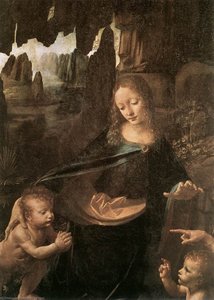
The Boy from Vinci
In the quiet hills near the village of Vinci, a child named Lionardo di ser Piero da Vinci entered a world that would never truly contain his restless mind. Born to a Florentine notary and a peasant woman, his very beginnings were marked by an unconventional path, as his illegitimacy meant he was not destined to follow in his father's legal footsteps. Instead, this freedom allowed him to wander into the workshop of Andrea del Verrocchio in Florence. It was here, amidst the scent of oils and the dust of marble, that a young apprentice learned that seeing was the highest form of understanding. He did not merely study the brush; he studied the way light clings to a curved surface and how shadow dissolves the edges of a limb.
His early years in Florence were defined by this intense observation. He absorbed the technical rigors of metalworking, carpentry, and drawing, building a foundation that merged the physical with the cerebral. While others sought only to replicate what they saw, he sought to understand the mechanics behind it. This period of growth was not marked by a sudden burst of fame, but by a slow, methodical accumulation of knowledge that would later allow him to bridge the gap between the artist's eye and the scientist's inquiry.
The Milanese Years and the Pursuit of Motion
When the winds of political change blew toward Milan, Leonardo followed the service of Ludovico Sforza. This move transformed him from a talented painter into a multifaceted presence within the ducal court. He arrived not merely as an artist, but as an engineer and designer, tasked with creating fortifications and even theatrical stage sets. It was during this long residency in Milan that he began to grapple with the profound drama of human interaction. In the refectory of Santa Maria delle Grazie, he applied his observations of psychology to a large-scale fresco, capturing the precise, heavy moment of betrayal within a group of apostles.
His mind during these years wandered far beyond the walls of the monastery. He filled notebooks with sketches of flying machines, advanced weaponry, and hydraulic systems, driven by a desire to map the hidden laws of nature. Yet, his ambitions often outpaced his ability to finish. A great equestrian statue, intended to honor the Sforza family, remained a dream of clay that was eventually shattered by invading French forces. This pattern of unfinished greatness followed him; he was a man who often found more satisfaction in the discovery of a principle than in the completion of a canvas.
The Final Light in France
A return to Florence brought with it a period of profound refinement. It was here that he worked on the portrait of a woman whose subtle, enigmatic expression would later haunt the halls of history. Through his use of sfumato, a technique where colors and tones blend so softly that they appear like smoke, he removed the harsh outlines of the world, creating an atmosphere that felt alive with breath and movement. His anatomical studies grew more precise during this time as well, fueled by his habit of dissecting cadavers to map the intricate architecture of bone and muscle.
In his final years, under the invitation of King Francis I, Leonardo moved to the Château du Clos Lucé in France. Even as age perhaps slowed his hand, his intellect remained sharp, focused on the study of optics, geology, and botany. He died in 1519, leaving behind a legacy that was never truly finished, much like his many drawings. His life remains a singular example of what can be achieved when the boundaries between art and science are erased, proving that to truly see the world, one must be willing to study every shadow and every muscle within it.
Questions & Answers
How can I see every artwork made by Leonardo da Vinci?
Every work by Leonardo da Vinci on this website can be browsed from the artist's All Artworks page.
Where can I see Leonardo da Vinci's artworks in a 3D gallery?
A virtual visit is possible: the 3D Museum page of Leonardo da Vinci presents the artist's works in a three-dimensional gallery.
Is there a chronological account of Leonardo da Vinci?
The Chronicle of Leonardo da Vinci is a scroll-driven timeline that presents the artist's works in chronological order, grouped into career-period chapters.