The Enduring Appeal of Wood: A Historical Overview of Panel Painting
A panel painting is a painting made on a flat panel of wood, either a single piece or a number of pieces joined together. Until canvas became the more popular support medium in the 16th century, panel painting was the normal method, when not painting...
Before the widespread adoption of canvas, the wooden panel reigned supreme as the foundational support for artistic expression. Its story isn’t merely one of material convenience; it's a narrative interwoven with religious devotion, technical innovation, and the very evolution of painting itself. From the earliest examples – fragments of painted tablets dating back to ancient Greece, though remarkably few survive – wood offered a stability and smoothness that lent itself beautifully to meticulous detail. However, its true ascendancy began in the medieval period, particularly within the Byzantine and Early Netherlandish traditions. These cultures valued permanence and luminosity, qualities readily achievable on carefully prepared wooden surfaces. The inherent grain of the wood wasn’t simply ignored; it was often incorporated into the composition, subtly influencing the depiction of drapery or landscape elements. Consider the iconic altarpieces of Jan van Eyck and Rogier van der Weyden – their profound emotional depth is inextricably linked to the solidity and refined texture of the panels upon which they were rendered.
Preparing the Ground: Techniques in Wooden Support Construction & Priming
T surveys the techniques used in the making of the wooden supports of panel paintings in central Italy between.
The creation of a suitable panel was, and remains, a labor-intensive process. The choice of wood itself was paramount; poplar, oak, lime, and walnut were favored for their stability and fine grain. Multiple planks were often joined together using dovetail joints or battens to create larger surfaces, requiring meticulous craftsmanship to prevent warping or cracking. But the true artistry lay in the preparation of the ground – the layer applied over the wood to provide a receptive surface for paint. Traditionally, this involved multiple layers of gesso, a mixture of gypsum (plaster of Paris) and animal glue. Each coat was painstakingly sanded smooth, creating an almost porcelain-like finish. This process wasn’t merely about achieving a flat surface; it was about isolating the wood from the oil paints, preventing discoloration and ensuring the longevity of the artwork. The Getty Museum's research into panel painting techniques reveals the incredible complexity of this stage, highlighting the subtle variations in gesso recipes and application methods employed by different workshops across central Italy.
Early Masters & Oil’s Rise: From Tempera to Renaissance Innovation
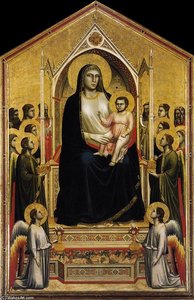 Ognissanti Madonna (Madonna in Maestà)
Explore Giotto’s ‘Ognissanti Madonna,’ a pivotal Renaissance masterpiece! Admire its naturalism & innovative techniques in this iconic 1310 panel painting from Florence.
While oil-based paints existed prior to the 15th century, their widespread adoption marked a pivotal shift in artistic practice. Early applications often involved combining oil with tempera – a technique that offered increased flexibility and luminosity but lacked the full richness of pure oil paint. It was artists like Giotto di Bondone who began to experiment with these possibilities, notably in his groundbreaking ‘Ognissanti Madonna’ (1310). Though not entirely executed in oil, this work demonstrates a move towards greater naturalism and depth – qualities that would become hallmarks of the Renaissance style. The Early Netherlandish painters truly revolutionized the medium, mastering techniques like layering and glazing to create breathtakingly realistic depictions of light, texture, and detail. Jan van Eyck’s meticulous approach, exemplified in works like the Ghent Altarpiece, showcased the unparalleled potential of oil paint on wood. This period saw a gradual transition away from the stylized forms of medieval art towards a more observational and emotionally resonant aesthetic.
Oil Paint's Technical Evolution: Mediums, Layers, and the Pursuit of Realism
 The Entombment
Discover Raphael’s ‘The Entombment,’ a masterpiece of High Renaissance art! Explore its dramatic composition, rich detail & historical significance in the Galleria Borghese.
The power of oil painting lies in its versatility – its ability to be manipulated in countless ways. Artists discovered that by varying the type of oil used (linseed, poppy seed, walnut), they could control drying time, gloss, and even color saturation. The addition of resins like pine resin further enhanced these properties, creating varnishes that protected the paint surface and added depth. A fundamental principle governing oil painting technique is “fat over lean” – meaning each successive layer should contain a higher proportion of oil than the one below. This prevents cracking and ensures the stability of the artwork over time. The layering process itself was often complex, involving multiple underpaintings, glazes (thin transparent layers of color), and scumbling (a technique where paint is applied in broken strokes to create texture). Raphael’s ‘The Entombment,’ for example, demonstrates a masterful command of these techniques, with its dramatic composition, rich detail, and subtle gradations of light and shadow. Botticelli's circular 'Madonna and Child' paintings showcase the delicate blending and luminous quality achievable through careful glazing.
Beyond Canvas: The Continued Relevance of Panel Painting Today
Despite the dominance of canvas for centuries, panel painting has experienced a resurgence in recent years. Contemporary artists are rediscovering the unique qualities of wood – its inherent warmth, stability, and tactile surface. Furthermore, advancements in engineered wood products have addressed some of the traditional challenges associated with using solid wood panels, such as warping and cracking. The enduring appeal lies not only in the historical connection to the Old Masters but also in the potential for creating highly detailed and archival artworks. OriginalUniqueArt.com celebrates this legacy by offering meticulously crafted reproductions on both canvas and panel, allowing art enthusiasts to experience the beauty and craftsmanship of these masterpieces firsthand. Whether you seek a faithful recreation of a Renaissance icon or a custom portrait rendered in the style of your favorite artist, the possibilities are endless. The choice between canvas and panel often comes down to personal preference – but for those who appreciate the solidity, texture, and historical resonance of wood, it remains an unparalleled support for artistic expression. Invest in authentic, museum-quality reproductions with confidence.