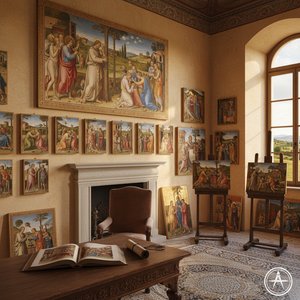
The Legacy of Spinello Aretino
In the vibrant tapestry of fourteenth-century Tuscany, few threads are as intricately woven as those left by Spinello Aretino. Born into a family of Florentine goldsmiths, his true name was Spinello Di Luca Spinelli, but he became known to history by the moniker "Aretino," signifying his connection to Arezzo. His life and career were shaped by the political shifts of his era; his family had sought refuge in Arezzo following the exile of the Ghibelline party from Florence. This blend of Florentine heritage and Arezzo residency allowed him to develop a style that served as a vital bridge between two of the most significant artistic traditions of the period: the structural, grounded school of Giotto and the luminous, decorative brilliance of the Sienese School.
The evolution of his artistry is a journey through the sacred spaces of Tuscany. In his early years, he worked within the bustling workshops of Florence, contributing to monumental works such as frescoes in the church of the Carmine and Santa Maria Novella. His talent for capturing both spiritual gravity and aesthetic grace led him to undertake significant commissions across the region. Between 1360 and 1384, much of his labor was dedicated to the churches and landscapes near Arezzo, though many of these works were tragically lost to time. Following the sack of Arezzo in 1384, he returned to Florence, where he achieved remarkable success, notably decorating the sacristy of San Miniato with scenes from the life of Saint Benedict—works that mirrored the compositional strength of Giotto while embracing a more colorful, decorative elegance.
Mastery of Color and Form
Spinello Aretino’s work is characterized by a profound ability to marry meticulous detail with an evocative sense of presence. His technique often utilized tempera on wood or the enduring medium of fresco to create narratives that felt both eternal and immediate. In masterpieces such as St Nemesius and St John the Baptist, one can observe his mastery of a rich palette where deep blues and greens dance alongside shimmering golds and earthy tones. These were not merely aesthetic choices but deliberate tools used to evoke reverence and solemnity. His figures possess a remarkable realism; the drapery of a saint’s robe cascades with a weight that suggests physical substance, yet there is an underlying spiritual dignity that transcends the material.
Beyond the human form, Aretino utilized architectural elements to craft a sense of spatial depth and grandeur. By integrating Gothic-inspired arches, columns, and intricate moldings into his compositions, he created a stage where the sacred and the earthly met. This use of perspective allowed him to draw the viewer into a three-dimensional world, making the miracles of saints feel tangibly present. Whether painting the Mystic Marriage of Saint Catherine or the monumental frescoes in the Pisan Campo Santo, his ability to balance architectural structure with decorative splendor ensured that his work remained both intellectually engaging and visually captivating.
Historical Significance and Influence
The importance of Spinello Aretino lies in his role as a transitional figure during the late 14th and early 15th centuries. He stood at the crossroads of the Middle Ages and the burgeoning Early Renaissance, acting as a stylistic conduit that helped shape the development of Tuscan painting. His ability to synthesize the monumentalism of the Florentine tradition with the ornamental beauty of Siena provided a template for the generations of artists who followed him.
His achievements are marked by several key contributions to the visual culture of his time:
- Stylistic Synthesis: Creating a unique artistic language that merged Giottesque composition with Sienese color palettes.
- Narrative Depth: Utilizing religious iconography to convey complex spiritual truths through realistic human emotion and dignified movement.
- Architectural Integration: Advancing the use of Gothic architectural settings to create immersive, sacred environments within his paintings.
- Regional Impact: Leaving an indelible mark on the artistic landscapes of Florence, Arezzo, Siena, and Pisa through extensive fresco cycles.
Questions & Answers
In which historical period did Spinello Aretino work?
Spinello Aretino worked in the Late-Medieval period. The period situates the artist's activity in history.
Where can I find statistics about Spinello Aretino's works?
A Stats page exists for Spinello Aretino, presenting statistics about the artist's artworks on this website.
In which movements did Spinello Aretino work?
The movements Spinello Aretino worked in can be seen on the artist's All Movements page, which groups the artworks by movement.