Portrait of Bernat Martorell

The 24 Most Famous Bernat Martorell Paintings, Each One of a Kind

Updated November 2026 · ranked by our popularity score (searches, visits and orders for each work) · 24 works by Bernat Martorell in our catalogue

In short

The Lamentation (1330) is the Bernat Martorell painting that draws the most eyes; the original belongs to the Metropolitan Museum of Art, New York. After it, the eye goes to The Crucifixion (1330) and Saint John the Evangelist poisoned (1430). Among the 24 works of Bernat Martorell in our catalog, these 24 are the most famous, each a unique original presented with its year, its museum and the reason it endures.

1390 – 1452, Sant Celoni International gothic Most works: Museu Nacional d'Art de Catalunya

Top 10 paintings by Bernat Martorell, through the gallery's eye

1
The Lamentation (1330) by Bernat Martorell

The Lamentation

1330 · Tempera On Panel · Metropolitan Museum of Art, New York

To stand before The Lamentation is to be enveloped in an atmosphere of profound, sacred sorrow. This masterpiece, attributed to the enigmatic Master Of The Codex Of Saint George, does not merely depict a biblical event; it captures the very essence of human grief rendered eternal through pigment and panel. Dating back to 1330, this work stands as a breathtaking testament to the emotional zenith of Gothic art. One is…

2
The Crucifixion (1330) by Bernat Martorell

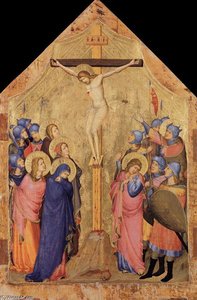
The Crucifixion

1330 · Tempera On Panel · Metropolitan Museum of Art, New York

In The Crucifixion by Bernat Martorell, the central figure of Jesus Christ dominates the scene, nailed to a wooden cross with arms outstretched in a gesture of profound sacrifice. He bears long hair and a beard, his body draped only in a simple loincloth. Around him, a circle of mourners gathers to witness the event. The Virgin Mary and Mary Magdalene move through the crowd, their faces etched with grief.…

3
Saint John the Evangelist poisoned (1430) by Bernat Martorell

Saint John the Evangelist poisoned

1430 · Tempera On Panel · Musée Rolin, Autun

This late medieval religious painting, dating to 1430, captures the dramatic scene of Saint John the Evangelist being poisoned. The composition is densely packed with figures, creating a sense of crowded, dramatic tension within a shallow, stage-like space. The subject matter focuses on the miraculous survival of Saint John, who is shown drinking from a chalice while other figures react with various expressions of concern or observation.

4
Table of Saints John. Central pannel (1430) by Bernat Martorell

Table of Saints John. Central pannel

1430 · Tempera On Panel

In the Table of Saints John. Central pannel by Bernat Martorell, two male figures stand side-by-side within a sacred, vertical arrangement. The figure on the left is draped in a heavy, dark cloak lined with deep red, his garment detailed with intricate gold embroidery. He holds a golden chalice, which is topped by a single, luminous star. Beside him, the second figure wears a simple brown robe cinched by a…

7
Triptych of the Descent from the Cross (1445) by Bernat Martorell

Triptych of the Descent from the Cross

1445 · Tempera On Panel · National Museum of Ancient Art, Lisbon

The Triptych of the Descent from the Cross is a religious painting from 1445, characterized by its intense emotional gravity and intricate Gothic detail. The composition is organized into three vertical panels: a large central panel depicting the Descent from the Cross, flanked by two narrower side panels containing individual saintly figures. In the central scene, Christ is being lowered from the cross, surrounded by figures including Joseph of Arimathea,…

8
Saint Stephen (1450) by Bernat Martorell

Saint Stephen

1450 · Tempera On Panel · Museu Nacional d'Art de Catalunya, Barcelona

The painting titled Saint Stephen by Bernat Martorell is a vertical, narrow panel. The composition is highly elongated and centered, focusing the viewer's attention on the bust and upper torso of the subject. The figure is positioned in a frontal manner, occupying the central axis of the narrow wooden support. This arrangement creates a sense of stillness and directness in the presentation of the saint.

9
Saint Michael, Martyrdom of Saint Eulalia and Saint Catherine (1442) by Bernat Martorell

Saint Michael, Martyrdom of Saint Eulalia and Saint Catherine

1442 · Tempera On Panel · Museu Nacional d'Art de Catalunya, Barcelona

The International Gothic triptych Saint Michael, Martyrdom of Saint Eulalia and Saint Catherine by Bernat Martorell, created about 1442, is organized into three vertical panels. These sections are separated by gilded, twisted columns that frame the narrative. The composition relies on a color palette dominated by gold, deep reds, royal blues, and stark whites. A flat, shimmering gold leaf forms the background across the panels, creating a shallow space for…

10
Martyrdom of Saint Eulalia (1442) by Bernat Martorell

Martyrdom of Saint Eulalia

1442 · Tempera On Panel · Museu Nacional d'Art de Catalunya, Barcelona

The scene unfolds within the Martyrdom of Saint Eulalia, a work that places the viewer directly before a profound moment of religious sacrifice. Painted by Bernat Martorell, this piece captures the intense struggle of a young saint facing her end. The composition functions as an altarpiece to Saint Eulalia, designed to command attention within a sacred space. Every figure in the crowded assembly contributes to the weight of this historical…

Bernat Martorell's famous paintings, numbers 11 to 24

The subjects that held Bernat Martorell's eye

The four subjects that come back most often in these originals, each with its finest example.

The museums that keep Bernat Martorell's originals

The 8 museums that hold the most of the paintings on this page.

Museum City Works by Bernat Martorell Paintings from this list
Museu Nacional d'Art de Catalunya, BarcelonaMuseu Nacional d'Art de Catalunya Barcelona 7 Altarpiece of the Saints John, Saint Stephen, Saint Michael, Martyrdom of Saint Eulalia and Saint Catherine
Metropolitan Museum of Art, New YorkMetropolitan Museum of Art New York 2 The Lamentation, The Crucifixion
Musée Rolin, AutunMusée Rolin Autun 2 Saint John the Evangelist poisoned, Saint John the Baptist preaching to the Levites table
Biblioteca Apostolica, Vatican CityBiblioteca Apostolica Vatican City 2 Codex of St George (Folio 17r), Codex of St George (Folio 85r)
National Museum of Ancient Art, LisbonNational Museum of Ancient Art Lisbon 1 Triptych of the Descent from the Cross
Philadelphia Museum of Art, PhiladelphiaPhiladelphia Museum of Art Philadelphia 1 Enthroned Virgin and Child, with the Cardinal Virtues and Two Figures Holding Scrolls
The Morgan Library & Museum, New York CityThe Morgan Library & Museum New York City 1 Missal (Folio 55)
Art Institute of Chicago, ChicagoArt Institute of Chicago Chicago 1 Saint George and the Dragon

Bernat Martorell across the decades: one unique original for each

Works per decade

Pick a decade to see the original that defines it.

Bernat Martorell's paintings: questions for the gallery

What is the single most famous work of Bernat Martorell?Reveal the answer

The Lamentation (1330), Metropolitan Museum of Art, New York. The Crucifixion (1330) and Saint John the Evangelist poisoned (1430) come next.

Which ten paintings by Bernat Martorell are the most famous?Reveal the answer

The Lamentation, The Crucifixion, Saint John the Evangelist poisoned, Table of Saints John. Central pannel, Altarpiece of the Saints John, Saint John the Baptist preaching to the Levites table, Triptych of the Descent from the Cross, Saint Stephen, Saint Michael, Martyrdom of Saint Eulalia and Saint Catherine and Martyrdom of Saint Eulalia. The ranking above gives each one's year and museum.

How many works by Bernat Martorell are known?Reveal the answer

Our catalog holds 24 works by Bernat Martorell, dated from 1430 to 1450.

Where can the most famous Bernat Martorell originals be seen?Reveal the answer

Mostly in Museu Nacional d'Art de Catalunya (Barcelona), Metropolitan Museum of Art (New York) and Musée Rolin (Autun). The museum table above lists them all.

During which period did Bernat Martorell create the best-known paintings?Reveal the answer

In 1430s: 11 of the 24 works on this page were made then, Saint John the Evangelist poisoned among them.

Which famous Bernat Martorell painting is the earliest, and which the latest?Reveal the answer

On this page, the earliest is Saint John the Evangelist poisoned (1430) and the latest Saint Stephen (1450).

What subjects did Bernat Martorell favour?Reveal the answer

People (8), Gold background (6) and Figures (5), across the 24 works on this page.

What materials did Bernat Martorell paint with most?Reveal the answer

Tempera On Panel, for 17 of the 24 works on this page.

Which movement does the work of Bernat Martorell belong to?Reveal the answer

International gothic, judging by the originals on this page.

What Bernat Martorell originals can I see at the Museu Nacional d'Art de Catalunya?Reveal the answer

Altarpiece of the Saints John, Saint Stephen and Saint Michael, Martyrdom of Saint Eulalia and Saint Catherine: the Museu Nacional d'Art de Catalunya, Barcelona holds 7 of the works on this page.

Bernat Martorell: a portrait of the artist

The Enigma of the Illuminated Page

In the shadowy corridors of art history, where names have been swallowed by the passage of centuries, the Master of the Codex of Saint George remains one of the most captivating enigmas of the fourteenth century. An artist whose true identity is lost to time, this painter is known only through the luminous legacy of their handiutwork. Active approximately between 1320 and 1330, this anonymous creator breathed life into sacred texts, transforming vellum into a window of divine revelation. While biographical details remain elusive, the sheer brilliance of their surviving manuscripts allows us to glimpse a soul deeply attuned to the spiritual and aesthetic currents of the Roman School of Illumination.

The Master’s identity is inextricably linked to a magnificent illuminated missal, a volume that contains not only liturgical texts but also a Vita of Saint George. This singular work, which serves as the artist's namesake, suggests a creator of immense technical skill and profound religious devotion. Though their name has vanished, their presence is felt in every stroke of gold leaf and every carefully layered pigment, marking them as a pivotal figure in the transition toward more emotive and detailed narrative styles within the late Gothic tradition.

A Journey Through Rome and Avignon

The artistic trajectory of the Master suggests a life lived amidst the great centers of ecclesiastical power. Scholars believe this painter was an exponent of the Roman School, likely operating within the vibrant atmosphere of Rome before perhaps finding patronage in Avignon. This latter city, serving as the seat of the papal court from 1309, would have provided a sophisticated stage for an illuminator of such caliber. The influence of the papacy and the presence of high-ranking clergy, such as Cardinal Jacopo Stefaneschi, likely shaped the scale and grandeur of the Master's commissions.

Working in these environments meant engaging with a diverse array of artistic influences. The Master’s style reflects a sophisticated synthesis of traditions, blending the structured elegance of Roman illumination with the burgeoning expressive qualities that would later define International Gothic art. There is a palpable sense of movement and emotional depth in their work, suggesting an artist who was not merely a decorator of texts but a storyteller capable of translating complex theological concepts into visual poetry.

Mastery of Pigment and Devotion

To examine the works attributed to the Master of the Codex of Saint George is to witness a masterclass in medieval technique. Their ability to manipulate light and color creates an atmosphere that is simultaneously regal and intimate. The artist’s repertoire demonstrates an extraordinary command over the precious materials of the era:

  • Lapis Lazuli: Used to create deep, celestial ultramarine blues that anchor the compositions.
  • Gilding: The meticulous application of gold leaf to signify divine light and the sanctity of the figures.
  • Narrative Detail: An uncanny ability to render facial expressions and drapery that convey profound human emotion, such as the sorrow found in The Lamentation.

Beyond the technical brilliance, the historical significance of this artist lies in their contribution to the evolution of religious iconography. Through the decoration of Gospels and Psalters, the Master helped bridge the gap between the rigid, symbolic forms of earlier centuries and the more naturalistic, human-centric approach of the early Renaissance. Even without a biography, the Master’s voice remains clear—a silent, golden whisper from the fourteenth century that continues to inspire awe in all who behold their illuminated wonders.