The 100 Famous Modernism Paintings That Inspire Our Artists
1898 – 1967
Selected by OriginalUniqueArt.comUpdated
Amedeo Modigliani's Nude Sitting on a Divan (1917), Amedeo Modigliani's Reclining Nude (Le Grande Nu) (n.d.) and Edward Hopper's Automat (small) (1927, Des Moines Art Center): these are the most famous Modernism paintings. Below, all 100 of them — painted from 1898 to 1967 by 37 artists — with their date, their size and the museum that keeps them.
No. 1 · Amedeo ModiglianiNude Sitting on a Divan1917
100singular works
37masters · Josep Puig i Cadafalch – João Batista Vilanova Artigas
46homes in 30 cities
5kept at the Georgia O'Keeffe Museum
Singular works
100 Modernism paintings that exist only once
Every original here is unique and kept in one place. Its story, its home, and the detail that makes it unmistakable.
The elongated form of the figure, particularly evident in the neck and limbs, is a hallmark of his work. Executed in oil on canvas (100 x 60 cm), the painting showcases Modigliani’s confident brushwork and skillful handling of color. Paris in the early 20th century was a crucible of artistic innovation.
The singular detailemotional ambiguityintense red background
The reclining position creates a diagonal flow from the upper left to the lower right, drawing the viewer's eye across the painting. The style is reminiscent of early modernism, particularly the work of artists like Amedeo Modigliani, known for their elongated forms and expressive use of color.
The singular detailrough texturesbold use of color
The scene is remarkably unremarkable; a woman in a green coat occupies a table within an “automat” – a popular type of diner prevalent in New York City at the time. “Automat” was created in 1938, a year marked by economic hardship and social unrest in America.
The artwork features a nude woman seated in a contemplative pose, exuding a sense of quiet introspection. The composition is vertically oriented, with the figure occupying most of the space, creating a sense of balance and stability.
The singular detailsimplified formsexpressive brushwork
These imperfections aren't flaws; they are evidence of time, mirroring the themes of decay and remembrance so central to Schiele’s oeuvre. Born in 1890, he endured a childhood marked by illness and loss – his father succumbed to syphilis when he was just fourteen, followed later by the death of his sister Elvira.
Following the success of his earlier, more overtly decorative works—particularly those created during his “Company of Artists” years— Klimt underwent a significant stylistic transformation in the late 1890s and early 1900s. AllPaintingsStore.com offers a unique opportunity to own a piece of Klimt’s legacy, faithfully reproduced with the utmost care and respect for the original artwork.
Brutalist Concrete – The station utilizes exposed concrete extensively, prioritizing raw materiality and geometric forms characteristic of the Brutalist movement. The Dome as Protection – The dome itself symbolizes safeguarding the travelers, representing not only physical shelter but also spiritual resilience—a beacon of hope amid uncertainty.
Clutched tenderly within its beak is a heart, inscribed with the word "amor", serving as a literal and metaphorical anchor for the piece. To understand Amor, one must look toward the transformative era of Brazilian Modernism in which Tarsila do Amaral was a leading light.
Hecht Museum, Haifa1908Oil on canvas80.6 × 50.1 cm
The dominant blue of the background acts as a cool counterpoint to the warmer browns and oranges used for Maude's hair and clothing. While the precise identity of Maude Abrantes remains somewhat shrouded in mystery, it’s widely believed she was a close acquaintance of Modigliani.
“Shell No. 2” was created during a pivotal period in O’Keeffe’s life and artistic development. Following her move to Abiquiú, New Mexico, in 1949, she became increasingly fascinated by the stark beauty of the desert landscape. “Shell No. 2” remains one of Georgia O’Keeffe's most recognizable and beloved works.
Gustav Klimt, a renowned Austrian symbolist painter, is celebrated for his unique style that blended symbolism, eroticism, and decorative elements. Symbolism plays a significant role in this painting, as Klimt often used symbols to convey complex ideas and emotions.
The painting centers on a woman absorbed in her reading within a train compartment. Hopper's paintings often reflected this mood of disillusionment and uncertainty, capturing the loneliness and isolation that many Americans felt despite their increasing connectedness through technological advancements.
University of Minnesota Art Museum1928Oil on canvas
Painted during a period of significant artistic experimentation, “Oriental Poppies” reflects O'Keeffe’s departure from traditional representational art. This approach coincided with the rise of Precisionism, an American art movement characterized by its sharp lines and focus on industrial forms; however, O’Keeffe uniquely applied these principles to natural subjects, forging her own distinct style.
The singular detailmagnified floral depictionvibrant colors
A central figure in the American West Coast photography movement and a member of the legendary Group f/64, Cunningham was instrumental in shifting the photographic aesthetic away from the soft-focus, painterly style of Pictorialism toward a new, sharp-focus Modernism.
National Gallery of Art, Washington D.C.1933Oil on canvas90 × 70 cm
To truly appreciate Man Smoking, one must consider the historical and personal context of its creator. Born in Latvia as Markus Rothkowitz, Rothko’s early life was shaped by the anxieties of displacement and the cultural upheavities of a Jewish family navigating the Pale of Settlement.
Amrita Sher-Gil completed Hill Women in 1935. The work gained international exposure when it was exhibited at the Paris Salon in 1936. The painting's cultural significance was further recognized in 1978, when it appeared on an Indian postage stamp.
At first glance, the viewer is met with a rhythmic dance of typography, where the very letters of the Knoll identity are subjected to a playful yet disciplined transformation. Through the use of overlapping transparent four-color process type, Vignelli creates a visual depth that feels both architectural and fluid.
The singular detailoverlapping transparent colorsline drawings
“Standing Woman in a Patterned Blouse” was created during a pivotal period in Viennese art history. The painting’s creation coincided with a time of social upheaval in Austria-Hungary, marked by political instability and growing anxieties about the future – factors that undoubtedly informed Schiele's preoccupation with themes of death and decay.
It was described by Alfred Stieglitz as "the greatest picture in the world," a sentiment he reinforced by stating to S. Louise Bourgeois found a connection to this way of working, as did Yayoi Kusama and Tracey Emin. More recently, the work of Loie Hollowell reflects a similar engagement with the power of organic abstraction.
O'Keeffe’s approach to this subject was revolutionary for its time. This technique was heavily influenced by Arthur Wesley Dow’s teachings on color theory and personal expression, which encouraged artists to prioritize feeling over strict representation. Regardless of the specific interpretation, “Red Cannas” speaks powerfully to themes of sensuality, beauty, and the artist’s intimate relationship with nature. Created during a period of intense artistic experimentation, “Red Cannas” reflects O'Keeffe’s growing independence as an artist. Executed in oil on canvas, “Red Cannas” measures 36 1/8 x 30 1/8 inches.
The painting titled Naked Young Man (B. The figure of the young man, modeled by Boris Snezhkovsky, is rendered with a focus on the delicate interplay of light and shadow. There is a stillness in the way they occupy the space, a sense of suspended motion within the private confines of the bed.
The Trapper is an oil on canvas painted by Rockwell Kent. The physical presence of the piece measures 34 1/8 × 44 1/8 in. The mountain landscape is preserved under the stewardship of the State University of New York.
This chromatic boldness was a defining feature of Fauvism, a movement Matisse co-founded alongside André Derain and Maurice de Vlaminck. WahooArt offers meticulously crafted hand-painted reproductions of Henri Matisse’s “Still Life,” ensuring the preservation of the artist's original vision.
This painting, existing in multiple versions throughout his career, isn’t a grand narrative drama but rather a carefully constructed tableau of quiet contemplation and sensual beauty. The myth of Leda and the Swan is a complex one, often interpreted as a tale of seduction and transgression.
The composition is structured with a strong vertical orientation, drawing the viewer's eye upward from the base to the top of the skull. During this period, O'Keeffe spent significant time in New Mexico, where she found inspiration in the stark beauty of the desert and its inhabitants.
The singular detailbold colorsvertical composition
The painting immediately draws the viewer in with its muted palette – dominated by deep browns, ochres, and subtle hints of grey – creating an atmosphere of quiet introspection. It's not a vibrant explosion of color, but rather a carefully considered restraint that amplifies the emotional weight of the subject.
Created in 1926, this piece exemplifies modernist abstraction with influences from Impressionism and Color Field painting. The 1920s was a time of experimentation and exploration in art, with artists seeking to capture the intangible qualities of nature and human emotion.
The singular detailminimalist compositionfluid forms
This vibrant canvas, brimming with bold colors – fiery reds, sunny yellows, cool blues, delicate pinks, and verdant greens – immediately draws the eye to its central subject: a canine figure adorned with a prominent horn protruding from its forehead. Early influences, particularly Arthur Wesley Dow's teachings emphasizing personal expression through color and line, liberated her from strict realism. “Series I, No. 12” exemplifies this approach; O’Keeffe wasn’t interested in replicating a dog's appearance but rather conveying its essence through color and form.
Les Fétiches is a painting by the artist Lois Mailou Jones. Within the museum's cataloging system, the object is identified by the number 1990.56. The work is part of the museum's official holdings, having been accessioned into the collection in 1990.
Seated with a quiet, contemplative poise, Hepworth is framed by her own monumental creations—the plaster of Figure for Landscape and a bronze cast of Figure (Archaean).
In the foreground, several rocks sit amidst the terrain, their surfaces textured against the surrounding elements. Scattered throughout the scene are trees, many of which are bare, lacking leaves to reveal their skeletal structures against the sky. Created in 1931, this work reflects a modernist approach to landscape painting.
The painting’s history is itself remarkable, forming part of a collection carefully selected by the Roerichs for Latvia in 1937, only to face decades of uncertainty during political upheaval before finding its current place within the Latvian National Museum of Art.
However, Munch wasn't simply fulfilling a request; he was using Esche as a vehicle for exploring universal themes of human vulnerability and the shadow self. “Portrait of Herbert Esche” is a quintessential example of Expressionist technique.
Puig i Cadafalch skillfully blended influences from medieval Catalan Gothic architecture with the burgeoning geometric dynamism of Art Nouveau. The stepped pyramid form symbolizes stability and aspiration, mirroring the Catalan quest for independence from Spain.
Gustave Coquiot was no mere sitter; he was a prominent French art critic and writer who became an early and ardent supporter of Picasso’s burgeoning talent. Coquiot recognized the spark within the young artist, providing crucial encouragement and helping to establish Picasso's presence in the Parisian art scene.
The singular detailmuted green background with paintingsdetailed depiction of subject
On the other, Sergeant Kennedy appears almost spectral, propped against the landscape like a puppet caught in the gears of destiny. The technique employed by Nolan reflects his unique position as a modernist mythmaker.
Born in Lewiston, Maine, he spent his early years traveling around New England before moving to New York City in 1899. There, he studied at the Art Students League of New York and began his career as a painter. "Madawaska-Acadian Light-Heavy" is one of Hartley's later works, created in 1940 during his return to Maine.
The artwork titled Portrait of Professor António de Oliveira Salazar is an oil painting created by the artist Eduardo José De Sousa Malta. This specific piece dates to 1933. In addition to these works, the artist produced the Portrait of Amália Rodrigues about 1949.
The figure sits upon the ground, draped in the oversized, pale folds of a Pierrot costume. There is a stillness here, a moment caught in the soft light of 1911. The interplay between the theatrical costume and the domestic setting creates a tension between the public mask and the private self.
This portrait, titled Werner Baer, was executed by the Australian modernist photographer Maxwell Spencer Dupain Ac Obe. Captured in 1947, the work presents a medium distance depiction of the subject. The image focuses on the sitter, Werner Baer, in a moment of quiet contemplation.
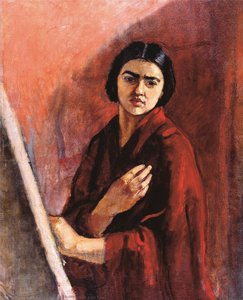
The painting captures a moment of stillness, yet it vibrates with the creative tension of an artist defining herself. Standing before a soft, pink-hued wall, the subject—a reflection of the artist herself—commands the space with a gaze that is at once vulnerable and unyielding.
By utilizing a bold, primary-adjacent palette, Vignelli transformed a commercial brochure into a lasting icon of 20th-century aesthetics. Whether placed in a minimalist gallery setting or used to add a pop of curated color to a professional design studio, Heller The Rainbow Group remains eternally relevant.
More than simply a builder of structures, Artigas was a visionary who sought to imbue his designs with social responsibility and artistic expression, ultimately becoming the founding father of the Paulista School. The post-war era witnessed significant social upheaval in Brazil, marked by rapid urbanization and growing concerns about social justice.
As she gazes out from the canvas, her expression is one of haunting seriousness, a stillness that commands the viewer to pause and reflect. There is no narrative action here, only the weight of being.
From 1948 onwards, Artigas spearheaded the establishment of São Paulo’s Architecture and Urbanism Faculty, transforming it into a crucible for architectural reform that reverberated across Brazil. The International Union of Architects awarded him twice for his contributions—the Jean Tschumi Award (1972) and Auguste Perret Award (posthumously)—recognizing his unwavering dedication to architectural excellence and humanist ideals.
The image, rendered with Hopper’s signature meticulous realism and subtly melancholic palette, captures a moment of focused labor – a man, clad in practical overalls, confronting a large nail with unwavering determination. The image’s symbolism is inextricably linked to the context of World War I.
Executed during a period of rapid industrialization and urbanization, this large-scale canvas captures a moment of quiet contemplation amidst the relentless march of progress – a theme that would become a hallmark of Hopper's oeuvre. “The Bridge of Art” reflects the anxieties and uncertainties of the era in which it was created.
This arresting work, measuring a modest 81 x 116 cm, resides within the heart of Expressionism, a movement defined by its raw emotionality and rejection of traditional artistic conventions. " Nude on Sofa (Almaisa)" was created during a turbulent period in Modigliani’s life.
A tall clock tower punctuates the skyline, a symbol of time’s relentless march and perhaps, the anxieties associated with its passage. In “House at San Mateo,” this is evident in the house’s architecture and the arrangement of the figures, contributing to the painting's overall stability despite its underlying themes of loneliness.
This painting exemplifies Modigliani’s signature style – a poignant blend of Post-Impressionism and early Cubism, filtered through his intensely personal vision. The influence of African sculpture is subtly present in the simplified forms and the emphasis on line, reflecting Modigliani’s fascination with non- Western art.
“Approaching the City” is rich in symbolic meaning, reflecting Hopper’s broader concerns about the changing nature of American life during this period. Hopper’s choice of subject matter – a busy city street – is particularly significant given the rapid urbanization sweeping across America in the early 20th century.
It’s a portrait not of physical beauty as traditionally defined, but of a soul at rest, yet subtly aware. The painting's creation coincided with a period of intense experimentation in European art, marked by the rise of Cubism, Futurism, and Expressionism —movements that challenged conventional notions of perspective, space, and representation.
It was created at a time when she was beginning to move away from strict realism, embracing a more subjective approach influenced by Arthur Wesley Dow’s teachings, prioritizing personal expression over photographic accuracy. Furthermore, “Untitled (Purple Petunia)” reflects the broader cultural context of the 1920s, a period of significant social and artistic change.
This influence is palpable in "Blue--A," where the undulating curves of the watercolor wash subtly guide the viewer’s eye across the canvas—a deliberate gesture reflecting Dow's belief that art should communicate feeling directly. Like Monet's landscapes, it eschews photographic accuracy in favor of conveying atmosphere and emotion.
This work features Faina Shevchenko as the model. Shevchenko was a twenty-one-year-old actress associated with the Moscow Art Theatre at the time of the painting's creation. The painting is currently held in the Tretyakov Gallery.
Painted in 1917, during a period marked by both creative fervor and personal struggle for the artist, the work immediately draws the viewer into a world of melancholic beauty and quiet contemplation.
The elongated features of “Antonia,” particularly the neck and nose, are reminiscent of African masks – a deliberate homage that reflects Modigliani's fascination with non- Western art forms.
The subject, Jeanne Hébuterne, was not only his lifelong companion but also his most frequent model, appearing in over 100 of his paintings and drawings. Tragically, Jeanne died by suicide shortly after Modigliani’s death in 1920, a devastating loss that casts a poignant shadow over all of his portraits of her.
The singular detailportrait of Jeanne Hebuterneelongated forms
Tate Gallery, London1914Oil on canvas112.4 × 152.4 cm
The provenance of this work traces back to its early public appearances, including an exhibition at the New English Art Club in London during the summer of 1914. By 1924, the work had been acquired by the Contemporary Art Society, which subsequently presented it to the Tate Gallery later that same year.
Painted during a period of significant socio-political change in India, this artwork reflects Sher-Gil’s fascination with and empathy for the lives of ordinary people. Sher-Gil’s work challenged conventional representations of Indian life, offering instead a nuanced and deeply personal perspective.
The singular detailtraditional clothingred scarves
This intimate portrait, now residing within the National Gallery of Art’s collection, immediately draws the viewer in with its deceptively simple composition: a nude figure bathed in muted tones, resting against a soft blue cushion. Modigliani’s signature style is powerfully evident in the subject's form. Created during a period of significant artistic upheaval—the early 20th century —“Nude on a Blue Cushion” reflects the burgeoning influence of Cubism, Fauvism, and Expressionism.
Metropolitan Museum of Art, New York1921–1922Pastel on paper, mounted on illustration board46.4 × 61.9 cm
The work captures a dramatic scene featuring lightning over a lake and the reflection of the Moon. The composition is characterized by a large, dark, cloud-like mass at the top, from which a jagged, lightning-bolt shape descends into a deep blue triangular void.
Like Expressionists, he prioritizes conveying emotion over objective observation—a principle evident in Hébuterne’s gaze, which conveys a palpable sadness. However, unlike Cubist fragmentation, Modigliani maintains a harmonious balance between form and line, resulting in an image that is both stylized and emotionally evocative.
It's a work deeply rooted in Modigliani’s personal experiences, reflecting his own struggles with illness, loneliness, and the transient nature of relationships. Born in Livorno, Italy, in 1884, Modigliani’s life was marked by hardship and illness from an early age.
Painted in 1917, the oil on canvas captures the likeness of Madame Jeanne Hébuterne. The subject, Madame Jeanne Hébuterne, remains the central focus of this 1917 creation. In 2002, it was featured in the exhibition Modigliani & the Artists of Montparnasse, appearing as number 16.
The canvas pulses with movement, drawing the viewer immediately into a sun-drenched field where humanity and animal power converge. While the subject matter nods toward the dramatic intensity associated with the corrida, Souza-Cardoso softens the edge with this depiction of outdoor camaraderie.
A goat occupies the center of the canvas, its surface painted with a thick, tactile weight. This animal was a common presence in the streets of Vitebsk, Belarus, where the artist spent his earliest years. The scale of the creature feels large, seen through the eyes of a small child.
To fully appreciate “Clown on Horse,” it’s crucial to understand Souza-Cardoso’s position within the broader artistic landscape of early 20th-century Portugal. Lisbon at this time was experiencing a period of rapid change, with influences from Paris – particularly Impressionism and Post-Impressionism – rapidly permeating the local artistic scene.
The oil painting Red and Orange Streak consists of large, arcing shapes that move from the bottom left toward the upper right corner of the canvas. A horizontal band of saturated red occupies the mid-ground, positioned against a background of deep blacks, dark greens, and earthy browns.
The painting immediately draws the viewer into its somber atmosphere thanks to its dominant palette of dark blues and greens, hues that subtly convey introspection and sorrow. Modigliani’s compositional choices are strikingly simple yet purposeful. The elongated face and stylized gaze are hallmarks of Modigliani's signature style, reflecting his fascination with capturing the essence of human emotion through abstraction. “Femme au col blanc” firmly establishes itself within the context of Modernism, specifically influenced by Cubist principles.
To fully appreciate “Nude with Necklace,” one must understand the artist’s personal circumstances. Painted in 1917, during a period marked by illness and emotional turmoil, the work reflects the pervasive sense of melancholy that defined Modigliani's artistic output.
To understand “An Island with Clouds,” it's crucial to consider O’Keeffe’s relationship with her husband, Alfred Stieglitz. “An Island with Clouds” can be seen as a direct response to Stieglitz's work, a continuation of his exploration of the sublime through color and shape.
Completed in 1953, this watercolor captures a fleeting scene – two young men, likely brothers, engaged in a simple act of tending to a deer near a small stream. Lee Jung-Seob (1916-1956) was a pivotal figure in the development of Korean modernism, tragically cut short by his untimely death.
41 of these 100 paintings are available hand-painted in oil, from $200, and 41 as a canvas print, from $58.
How was this list of Modernism paintings ranked?
Read
By recognition: Wikipedia articles in the most languages (Wikidata sitelinks), our manual ranking and page visits. Several records of one painting count once; details, copies and studies are excluded.
One of a kind
41 of the 100, painted for you alone
41 of these works can be painted by hand for a single owner, from $200.
We went through every Modernism painting in our catalogue and placed the best-known first: those Wikipedia describes in the most languages, those our artists and curators rank highest and those most viewed on our pages. Each original appears once — no details or copies.