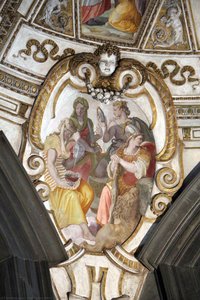
Portrait of Alessandro Allori

The 92 Most Famous Alessandro Allori Paintings, Each One of a Kind

Updated November 2026 · ranked by our popularity score (searches, visits and orders for each work) · 98 works by Alessandro Allori in our catalogue

In short

Portrait of a Young Man is the Alessandro Allori painting that draws the most eyes; the original belongs to the Hermitage Museum, Saint Petersburg. After it, the eye goes to Portrait of a young Man (1560) and Portrait of a Lady (1560). Among the 98 works of Alessandro Allori in our catalog, these 92 are the most famous, each a unique original presented with its year, its museum and the reason it endures.

1535 – 1607, Florence Mannerism Most works: Santa Maria Novella

Top 10 paintings by Alessandro Allori, through the gallery's eye

1
Portrait of a Young Man by Alessandro Allori

Portrait of a Young Man

Oil On Canvas · Hermitage Museum, Saint Petersburg

Alessandro Allori's “Portrait of a Young Man,” painted circa 1560-65, is more than just a likeness; it’s a carefully constructed meditation on status, contemplation, and the burgeoning spirit of the Italian Renaissance. This arresting portrait, currently residing in the Ashmolean Museum in Oxford, immediately draws the viewer into a world of restrained elegance and subtle psychological depth – a testament to Allori's mastery of capturing not just appearance but also…

2
Portrait of a young Man (1560) by Alessandro Allori

Portrait of a young Man

1560 · Oil On Canvas · The Ashmolean Museum of Art And Archaeology, Oxford

Alessandro Allori's “Portrait of a Young Man,” painted around 1560, is more than just a depiction of an individual; it’s a carefully constructed window into the artistic sensibilities of late Mannerism and the burgeoning Renaissance spirit. This oil-on-canvas masterpiece, currently residing in the Ashmolean Museum in Oxford, immediately draws the viewer in with its serene composure and subtle yet profound details. It's a painting that whispers stories of status, contemplation,…

3
Portrait of a Lady (1560) by Alessandro Allori

Portrait of a Lady

1560 · Oil On Canvas · Hermitage Museum, Saint Petersburg

A young woman occupies the center of this medium close-up, her presence commanding a quiet, dignified space against a dark, indistinct background. She is positioned slightly off-center, her gaze meeting the viewer with an air of poise and introspection. The light, soft and directional from the upper left, traces the gentle contours of her face and catches the subtle sheen of her attire. Her skin appears smooth, almost marble-like, a…

4
Portrait of Grand Duchess Bianca Capello de Medici with Her Son (1597) by Alessandro Allori

Portrait of Grand Duchess Bianca Capello de Medici with Her Son

1597 · Oil On Canvas · Dallas Museum of Art, Dallas

The Portrait of Grand Duchess Bianca Capello de Medici with Her Son brings us into the intimate presence of a noblewoman and her child. Alessandro Allori captures the likeness of Bianca Cappello alongside her son, Antonio de' Medici, who lived from 1576 to 1621. The scene holds a quiet, maternal gravity, freezing a moment of familial connection within the high-stakes atmosphere of the Medici court. Through his brush, Allori renders…

5
Allegorical Portrait of a Young Man in the Guise of Mercury Slaying Argus (1577) by Alessandro Allori

Allegorical Portrait of a Young Man in the Guise of Mercury Slaying Argus

1577 · Oil On Canvas · Harvard Art Museums, Cambridge

A young man hangs suspended in the air, caught in a moment of divine transition. He is Mercury, his skin possessing the cool, polished sheen of white marble against a backdrop of soft, rolling clouds. In his raised left hand, he holds a wooden flute, while his right hand grips a staff entwined by two snakes. His feet, tipped with small wings, suggest a weightless descent. Below him, the earth…

6
Portrait of a Young Man (1537) by Alessandro Allori

Portrait of a Young Man

1537 · Oil On Canvas · Bode Museum, Berlin

The young man sits in a quiet, heavy stillness, his presence filling the space with a sense of dignified reserve. Light spills from an unseen source above and to the left, carving the contours of his face and catching the subtle textures of his skin. He holds a small object with a precision that suggests both status and a quiet, internal contemplation. There is a certain weight to his gaze,…

8
Descent from the Cross (1560) by Alessandro Allori

Descent from the Cross

1560 · Oil On Copper · Museo del Prado, Madrid

The painting titled Descent from the Cross by Alessandro Allori captures a heavy, silent moment of transition. It is a piece of religious art centered upon the figure of Jesus Christ. The scene focuses on the physical weight of the body as it is lowered from the wood.

10
Allegory of the Christian Church (1601) by Alessandro Allori

Allegory of the Christian Church

1601 · Oil On Canvas · Hermitage Museum, Saint Petersburg

The composition centers on a Madonna and Child, rendered with the polished, sculptural quality characteristic of the late Mannerist school. A woman with flowing reddish-blonde hair, crowned with delicate petals, cradles a young child. Her heavy drapery, a deep ultramarine blue, contrasts sharply against a crimson bodice. These saturated primary colors anchor the figures against a soft, muted landscape of distant hills and trees. The lighting, descending from the upper…

Alessandro Allori's famous paintings, numbers 11 to 92

11Birth of the Virgin (1602) by Alessandro AlloriBirth of the Virgin1602 · Santissima Annunziata 12Portrait of a Woman (1590) by Alessandro AlloriPortrait of a Woman1590 · Harvard Art Museums 13Cosimo I Medici, Grand Duke of Tuscany (1519-1574) (1560) by Alessandro AlloriCosimo I Medici, Grand Duke of Tuscany (1519-1574)1560 · Kunsthistorisches Museum 14Christ and the Adulteress (1577) by Alessandro AlloriChrist and the Adulteress1577 · Santo Spirito 15Charity (1560) by Alessandro AlloriCharity1560 · Minneapolis Institute of Art 16Portrait of a Young Man Writing (1562) by Alessandro AlloriPortrait of a Young Man Writing1562 · Museum of Fine Arts 17Portrait of Ortensia de Bardi di Montauto, formerly identified as Giulia de' Medici (1559) by Alessandro AlloriPortrait of Ortensia de Bardi di Montauto, formerly identified as Giulia de' Medici1559 18Portrait of a Couple (1560) by Alessandro AlloriPortrait of a Couple1560 · Musée Des Beaux 19Fresco decoration (detail) (1560) by Alessandro AlloriFresco decoration (detail)1560 20Portrait of a Lady, probably Camilla Martelli de’Medici (1570) by Alessandro AlloriPortrait of a Lady, probably Camilla Martelli de’Medici1570 · Saint Louis Art Museum 21Portrait of Francesco I de' Medici (1570) by Alessandro AlloriPortrait of Francesco I de' Medici1570 · Museum Mayer van den Bergh 22The Holy Family of Cardinal Fernando de’ Medici (1584) by Alessandro AlloriThe Holy Family of Cardinal Fernando de’ Medici1584 · Museo del Prado 23The Abduction of Proserpine (1570) by Alessandro AlloriThe Abduction of Proserpine1570 · J. Paul Getty Museum 24Odysseus and Ino (1580) by Alessandro AlloriOdysseus and Ino1580 25Portrait of Eleanora of Toledo (1600) by Alessandro AlloriPortrait of Eleanora of Toledo1600 · Gemäldegalerie 26The Penitent Saint Jerome (1606) by Alessandro AlloriThe Penitent Saint Jerome1606 27Rest on the Flight to Egypt (1602) by Alessandro AlloriRest on the Flight to Egypt1602 · National Museum of Ancient Art 28Stories of St. Jerome (1577) by Alessandro AlloriStories of St. Jerome1577 · Santa Maria Novella 29Portrait of a Woman (1570) by Alessandro AlloriPortrait of a Woman1570 · Galleria degli Uffizi 30Madonna with Little Saint John (1606) by Alessandro AlloriMadonna with Little Saint John1606 · Royal Museum of Fine Arts Antwerp 31Portrait of a Young Man (1565) by Alessandro AlloriPortrait of a Young Man1565 32Stories of St. Jerome (1577) by Alessandro AlloriStories of St. Jerome1577 · Santa Maria Novella 33Stories of St. Jerome (1577) by Alessandro AlloriStories of St. Jerome1577 · Santa Maria Novella 34Stories of St. Jerome (1577) by Alessandro AlloriStories of St. Jerome1577 · Santa Maria Novella 35Stories of St. Jerome (1577) by Alessandro AlloriStories of St. Jerome1577 · Santa Maria Novella 36Stories of St. Jerome (1577) by Alessandro AlloriStories of St. Jerome1577 · Santa Maria Novella 37Fresco decoration (detail) (1560) by Alessandro AlloriFresco decoration (detail)1560 38Portrait of Joan of Austria, wife of Francesco I de 'Medici (1570) by Alessandro AlloriPortrait of Joan of Austria, wife of Francesco I de 'Medici1570 39Portrait of Francesco I De' Medici (1580) by Alessandro AlloriPortrait of Francesco I De' Medici1580 40Last Supper (Carmine, Florence) (1582) by Alessandro AlloriLast Supper (Carmine, Florence)1582 41Women on a Terrace (1589) by Alessandro AlloriWomen on a Terrace1589 42Virgin and Child with Saints Francis and Lucy (1583) by Alessandro AlloriVirgin and Child with Saints Francis and Lucy1583 43The Preaching of St John the Baptist (1601) by Alessandro AlloriThe Preaching of St John the Baptist1601 44Stories of St. Jerome (1577) by Alessandro AlloriStories of St. Jerome1577 · Santa Maria Novella 45Portrait of Bianca Cappello, Second Wife of Francesco I de' Medici (1580) by Alessandro AlloriPortrait of Bianca Cappello, Second Wife of Francesco I de' Medici1580 · Galleria degli Uffizi 46The Body of Christ with Two Angels (1600) by Alessandro AlloriThe Body of Christ with Two Angels1600 · Szépművészeti Múzeum 47The Body of Christ with Two Angels (1590) by Alessandro AlloriThe Body of Christ with Two Angels1590 · Szépművészeti Múzeum 48Allegory of Human Life (1570) by Alessandro AlloriAllegory of Human Life1570 · Galleria degli Uffizi 49Stories of St. Jerome (1577) by Alessandro AlloriStories of St. Jerome1577 · Santa Maria Novella 50Stories of St. Jerome (1577) by Alessandro AlloriStories of St. Jerome1577 · Santa Maria Novella 51Portrait of a Man by Alessandro AlloriPortrait of a Man 52The Temptation of St Benedict (1587) by Alessandro AlloriThe Temptation of St Benedict1587 · Fitzwilliam College 53The Madonna and Child with Saint Catherine of Alexandria and Saint Francis of Assisi (1590) by Alessandro AlloriThe Madonna and Child with Saint Catherine of Alexandria and Saint Francis of Assisi1590 · National Trust 54Portrait of a florentine lady by Alessandro AlloriPortrait of a florentine ladyThe Ema Klabin House Museum 55Trinity by Alessandro AlloriTrinitySantissima Annunziata 56The Virgin and Child with a Floral Wreath and a Crown of Thorns by Alessandro AlloriThe Virgin and Child with a Floral Wreath and a Crown of ThornsMuseum of Fine Arts Ghent (MSK) 57Portrait of Isabella De’ Medici by Alessandro AlloriPortrait of Isabella De’ Medici 58Ritratto di giovane uomo by Alessandro AlloriRitratto di giovane uomoHermitage Museum 59Portrait of Bianca Cappello by Alessandro AlloriPortrait of Bianca Cappello 60Ritratto Di Nobildonna by Alessandro AlloriRitratto Di Nobildonna 61Porträt Isabella De' Medici by Alessandro AlloriPorträt Isabella De' Medici 62Portrait of Francesco De' Medici by Alessandro AlloriPortrait of Francesco De' MediciWawel Royal Castle 63Portrait of An Unknown Young Man by Alessandro AlloriPortrait of An Unknown Young Man 64Francesco De' Medici by Alessandro AlloriFrancesco De' MediciArt Institute of Chicago 65Portrait of Eleonora Di Toledo by Alessandro AlloriPortrait of Eleonora Di ToledoGemäldegalerie 66VIERGE A L'ENFANT AVEC SAINTE ELISABETH by Alessandro AlloriVIERGE A L'ENFANT AVEC SAINTE ELISABETHCondé Museum 67Portrait of Isabella De' Medici by Alessandro AlloriPortrait of Isabella De' MediciGalleria Palatina 68Self-Portrait by Alessandro AlloriSelf-Portrait 69Stories of St. Jerome (1577) by Alessandro AlloriStories of St. Jerome1577 · Santa Maria Novella 70The Penitent Magdalen in the Wilderness by Alessandro AlloriThe Penitent Magdalen in the WildernessNational Trust 71Pearl Fishers (1570) by Alessandro AlloriPearl Fishers1570 · Palazzo Vecchio 72Stories of St. Jerome (1577) by Alessandro AlloriStories of St. Jerome1577 · Santa Maria Novella 73St Peter Walking on the Water (1590) by Alessandro AlloriSt Peter Walking on the Water1590 · Galleria degli Uffizi 74Stories of St. Jerome (1577) by Alessandro AlloriStories of St. Jerome1577 · Santa Maria Novella 75Portrait of Cosimo I De Medici by Alessandro AlloriPortrait of Cosimo I De Medici 76Untitled (726) by Alessandro AlloriUntitled (726) 77Portrait of Francesco I De' Medici by Alessandro AlloriPortrait of Francesco I De' Medici 78Portrait of Maria De' Medici (or Eleonora Di Garzia Di Toledo) by Alessandro AlloriPortrait of Maria De' Medici (or Eleonora Di Garzia Di Toledo)Kunsthistorisches Museum 79Untitled (545) by Alessandro AlloriUntitled (545) 80Vnus et l'Amour by Alessandro AlloriVnus et l'Amour 81Il corpo di Cristo con due angeli by Alessandro AlloriIl corpo di Cristo con due angeli 82Venus and Cupid by Alessandro AlloriVenus and CupidMusée Fabre 83UN ANGE MONTRE A SAINT FRANCOIS D'ASSISE LE CHRIST DETACHE DE LA CROIX by Alessandro AlloriUN ANGE MONTRE A SAINT FRANCOIS D'ASSISE LE CHRIST DETACHE DE LA CROIX 84Isabella Medices Ursina (1542–1576) by Alessandro AlloriIsabella Medices Ursina (1542–1576)Touchstones Rochdale 85Dead christ attended by two angels by Alessandro AlloriDead christ attended by two angels 86Portrait of Francesco I de by Alessandro AlloriPortrait of Francesco I deLegion of Honor 87Christus Bei Martha Und Maria by Alessandro AlloriChristus Bei Martha Und MariaKunsthistorisches Museum 88The Last Supper (1582) by Alessandro AlloriThe Last Supper1582 89Susanna and The Elders by Alessandro AlloriSusanna and The EldersMusée Magnin 90Stories of St. Jerome (1577) by Alessandro AlloriStories of St. Jerome1577 · Santa Maria Novella 91Sacrifice of Isaac by Alessandro AlloriSacrifice of Isaac 92Annunciation (1603) by Alessandro AlloriAnnunciation1603 · Galleria dell'Accademia di Firenze

Alessandro Allori's famous paintings, period by period

The subjects that held Alessandro Allori's eye

The four subjects that come back most often in these originals, each with its finest example.

The museums that keep Alessandro Allori's originals

The 8 museums that hold the most of the paintings on this page.

Museum City Works by Alessandro Allori Paintings from this list
Santa Maria Novella, FlorenceSanta Maria Novella Florence 13 Stories of St. Jerome, Stories of St. Jerome, Stories of St. Jerome
Hermitage Museum, Saint PetersburgHermitage Museum Saint Petersburg 4 Portrait of a Young Man, Portrait of a Lady, Allegory of the Christian Church
Galleria degli Uffizi, FlorenceGalleria degli Uffizi Florence 4 Portrait of a Woman, Portrait of Bianca Cappello, Second Wife of Francesco I de' Medici, Allegory of Human Life
Kunsthistorisches Museum, ViennaKunsthistorisches Museum Vienna 3 Cosimo I Medici, Grand Duke of Tuscany (1519-1574), Portrait of Maria De' Medici (or Eleonora Di Garzia Di Toledo), Christus Bei Martha Und Maria
Harvard Art Museums, CambridgeHarvard Art Museums Cambridge 2 Allegorical Portrait of a Young Man in the Guise of Mercury Slaying Argus, Portrait of a Woman
Condé Museum, ChantillyCondé Museum Chantilly 2 An Angel Shows Saint Francis of Assisi Christ Detached from the Cross, VIERGE A L'ENFANT AVEC SAINTE ELISABETH
Museo del Prado, MadridMuseo del Prado Madrid 2 Descent from the Cross, The Holy Family of Cardinal Fernando de’ Medici
Santissima Annunziata, FlorenceSantissima Annunziata Florence 2 Birth of the Virgin, Trinity

Alessandro Allori across the decades: one unique original for each

Works per decade

Pick a decade to see the original that defines it.

Alessandro Allori's paintings: questions for the gallery

What is the single most famous work of Alessandro Allori?Reveal the answer

Portrait of a Young Man, Hermitage Museum, Saint Petersburg. Portrait of a young Man (1560) and Portrait of a Lady (1560) come next.

Which ten paintings by Alessandro Allori are the most famous?Reveal the answer

Portrait of a Young Man, Portrait of a young Man, Portrait of a Lady, Portrait of Grand Duchess Bianca Capello de Medici with Her Son, Allegorical Portrait of a Young Man in the Guise of Mercury Slaying Argus, Portrait of a Young Man, An Angel Shows Saint Francis of Assisi Christ Detached from the Cross, Descent from the Cross, Portrait of a Lady in Black and White and Allegory of the Christian Church. The ranking above gives each one's year and museum.

How many works by Alessandro Allori are known?Reveal the answer

Our catalog holds 98 works by Alessandro Allori, dated from 1559 to 1606.

Where can the most famous Alessandro Allori originals be seen?Reveal the answer

Mostly in Santa Maria Novella (Florence), Hermitage Museum (Saint Petersburg) and Galleria degli Uffizi (Florence). The museum table above lists them all.

During which period did Alessandro Allori create the best-known paintings?Reveal the answer

In 1570s: 22 of the 92 works on this page were made then, Allegorical Portrait of a Young Man in the Guise of Mercury Slaying Argus among them.

Which famous Alessandro Allori painting is the earliest, and which the latest?Reveal the answer

On this page, the earliest is Portrait of Ortensia de Bardi di Montauto, formerly identified as Giulia de' Medici (1559) and the latest The Penitent Saint Jerome (1606).

What subjects did Alessandro Allori favour?Reveal the answer

Woman (23), Renaissance (20) and Man (18), across the 92 works on this page.

What materials did Alessandro Allori paint with most?Reveal the answer

Oil On Canvas, for 25 of the 92 works on this page.

Which movement does the work of Alessandro Allori belong to?Reveal the answer

Mannerism, judging by the originals on this page.

What Alessandro Allori originals can I see at the Santa Maria Novella?Reveal the answer

Stories of St. Jerome, Stories of St. Jerome and Stories of St. Jerome: the Santa Maria Novella, Florence holds 13 of the works on this page.

Alessandro Allori: a portrait of the artist

A Florentine Legacy: The Life and Art of Alessandro Allori

Alessandro Allori, born in Florence on May 31st, 1535, stands as a compelling figure within the late Mannerist school. His artistic journey was profoundly shaped by circumstance; orphaned at a young age, he found an unlikely father figure and mentor in Agnolo Bronzino, one of Florence’s most celebrated painters. This adoption wasn't merely familial—it was an immersion into a world of refined technique, intellectual rigor, and the distinctive aesthetic principles that would come to define Allori’s own style. Bronzino instilled within him not only technical mastery but also a particular sensibility: a preference for polished surfaces, elongated forms, and a cool, almost sculptural quality in his figures. This influence became the cornerstone of Allori's artistic identity, though it often drew criticism for its perceived derivativeness throughout his career. He supplemented this foundational training with anatomical studies – even undertaking dissections at the Hospital of Santa Maria Nuova – demonstrating a commitment to understanding the human form that underpinned his stylized representations.

The Echoes of Mannerism and Artistic Development

Allori’s work is deeply rooted in the Mannerist tradition, an artistic movement characterized by its artificiality, elegance, and emphasis on stylistic sophistication over naturalistic representation. However, he wasn't a revolutionary; rather, he was a skilled interpreter and developer of existing forms. Critics often noted his tendency to draw heavily from pre-existing art, refining and reinterpreting the works of masters like Michelangelo and Raphael through the lens of Bronzino’s aesthetic. This isn’t necessarily a detraction—it speaks to Allori's role as a crucial link in the transmission of artistic knowledge within Florentine circles. His paintings are marked by an almost unsettling smoothness, figures possessing a marble-like quality that lends them a two-dimensional, statue-esque appearance. This effect wasn’t simply a matter of technique; it was a deliberate aesthetic choice, reflecting the Mannerist desire to elevate art above nature, to create images of idealized beauty and intellectual complexity. He headed one of Florence's most important workshops alongside Santi di Tito, and his pupils included notable artists like Cristoforo del Altissimo, Cesare Dandini, Aurelio Lomi, and his own son, Cristofano Allori, ensuring the continuation of this artistic lineage.

Major Works and Patronage

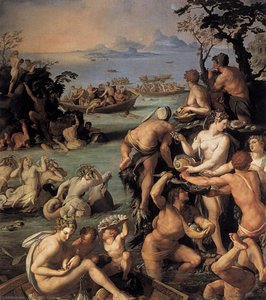
Allori’s career flourished under the patronage of prominent Florentine families, most notably the Medici. He contributed significantly to several important decorative projects for them, including his work on the Studiolo of Francesco I in the Palazzo Vecchio. His *Pearl Fishers*, part of this elaborate chamber, exemplifies his ability to create complex allegorical scenes filled with graceful figures and intricate detail. He also expanded upon frescoes begun by earlier masters like Andrea del Sarto and Franciabigio within the Villa di Poggio a Caiano, demonstrating both his technical skill and his willingness to engage with the artistic legacy of Florence. Beyond these grand commissions, Allori produced numerous portraits, religious paintings, and altarpieces that showcase his mastery of composition, color, and form. A notable example is “Allegory of Human Life,” housed in the Uffizi Gallery, which encapsulates the Renaissance humanist ideals prevalent during his time. His "Stories of St. Jerome" fresco further demonstrates his skill in narrative painting and illusionistic space.

Legacy and Historical Significance

Alessandro Allori died in Florence on September 22nd, 1607, leaving behind a body of work that continues to fascinate and challenge art historians. While often overshadowed by the more innovative artists of his time, his significance lies in his role as a key figure in the late Mannerist movement and as a transmitter of artistic tradition. He wasn’t an innovator in the same vein as Michelangelo or Leonardo da Vinci, but he was a supremely skilled craftsman who refined and developed existing styles, ensuring their survival for future generations. The story of a painting – possibly a portrait of Eleonora di Toledo de' Medici – returned to the Gemäldegalerie in Berlin after decades lost adds an intriguing layer to his legacy. His influence extended through his numerous pupils, most notably his son Cristofano Allori, who continued the family’s artistic tradition. Allori’s paintings remain valuable testaments to the elegance and intellectual complexity of Florentine Mannerism, offering a glimpse into a world where art was not merely about representation but about the pursuit of idealized beauty and refined expression. He remains an important figure for understanding the transition from Renaissance artistry towards the Baroque period.

Exploring Allori’s World Today

  • Museum Collections: Discover Alessandro Allori's masterpieces in institutions like the Uffizi Gallery, the Gemäldegalerie in Berlin, and various other museums worldwide.
  • Notable Works: Explore iconic paintings such as “Allegory of Human Life,” “Stories of St. Jerome,” and his contributions to the Studiolo of Francesco I.
  • Further Research: Delve deeper into Allori’s life and art through resources like Wikipedia, Getty Museum archives, and scholarly articles on Florentine Mannerism.