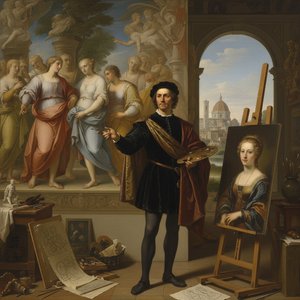
Early Life, Family and Training
Andrea del Sarto was born Andrea d'Agnolo di Francesco di Luca on July 16, 1486, in Florence, Italy. His father worked as a tailor, a trade that eventually led to the artist being known by the name del Sarto. This connection to the needle and thread remained a part of his identity even as he moved toward the visual arts. By 1494, at the age of eight, he began his training as an apprentice to a goldsmith.
His path shifted from metalwork to the study of form and pigment. He spent time training under Gian Barile, a painter and wood sculptor, until 1498. These early years in Florentine workshops provided the foundation for his later work in color and composition. After his time with Barile, he moved on to study under Piero di Cosimo and Raffaellino del Garbo (Carli). These apprenticeships shaped the way he approached the physical reality of his subjects.
Technique and Artistic Style
His hand moved with a specific kind of precision, whether working in fresco, oil, or chalk. He had a way of handling color that felt warmer and more vivid than the sfumato used by Leonardo da Vinci. Instead of the hazy, smoky transitions often seen in earlier works, his palette brought a sense of life to the skin and fabric of his subjects. This skill as a colorist allowed him to bridge the gap between the balanced compositions of the High Renaissance and the more complex, shifting energy of Mannerism. His figures possess a natural poise, moving with a grace that feels lived-in rather than staged.
There is a particular weight to his draughtsmanship. He used chalk to describe the warmth of breathing flesh, often employing red chalk to capture subtle tonal shifts. His compositions rely on a sense of harmony, yet they avoid being static. He was as comfortable decorating large-scale walls as he was painting intimate portraits or altarpieces. In his drawings, the soft, supple contour lines suggest a deep understanding of how light settles on a surface. This technical control allowed him to maintain a sense of quiet dignity even in crowded scenes.
- Noli Me Tangere, 1510
- Madonna and Child with St Elisabeth, the Infant St John, and Two Angels, 1515
- Charity, 1518
- The Sacrifice of Abraham, 1527
Notable Commissions and Works
His hands were often occupied with the walls of Florence. Between 1519 and 1527, he worked on the Last Supper at San Salvi, a large fresco that now resides in the Museo del Cenacolo di Andrea del Sarto. This work captures the quiet, heavy moments of the apostles' reactions. Nearby, in the Scalzo, he completed the Nativity of the Baptist in 1526. These large-scale projects required a steady hand and a deep understanding of how light settles on a surface.
Private commissions brought his brush to more intimate settings. Zanobi Strozzi requested The Holy Family for a chapel at his villa of Rovezzano. This piece focuses on the quiet dignity of a domestic scene. Later, around 1528, he painted the Holy Family (Barberini), which shows a different approach to the same subject. He moved between these grand religious scenes and smaller, more personal studies with a consistent focus on how figures occupy space.
- Noli Me Tangere, 1510
- Portrait of a Lady with a Book, 1514
- Madonna and Child with St Elisabeth, 1515
- Charity, 1518
- St John the Baptist, 1523
Legacy and Historical Influence
Andrea del Sarto held a central place in the Florentine art scene during the early 16th century. He occupied a space between the Early Renaissance and the rise of Mannerism, acting as a bridge between these two eras. While his name was often overshadowed by the massive presence of Leonardo da Vinci, Michelangelo, and Raphael, his influence remained deeply felt. His approach to color and composition helped shape the direction of the Mannerist style that followed.
His work shows a specific way of handling light and human form that moved away from the rigid structures of the previous generation. By introducing a warmer and more vivid range of colors, he altered the tonal possibilities available to those who came after him. This shift in palette and the way he organized his figures provided a foundation for the stylistic changes seen in later Florentine art. He was a painter who focused on the quiet details of anatomy and the subtle shifts in hue that define a specific moment in history.
- Last Supper (study)
- Charity
- Holy Family (Barberini)
Where to See His Works Today
To see his hand in person, one often begins in Florence. The Galleria degli Uffizi holds twelve of his works, including the 1517 Madonna of the Harpies. Nearby, the Santissima Annunziata contains five pieces, such as the 1514 Birth of the Virgin. For those seeking his larger-scale religious works, the Museo del Cenacolo di Andrea del Sarto in Florence houses his Last Supper, a fresco completed between 1519 and 1527.
His presence extends well beyond the streets of Florence. In Vienna, the Kunsthistorisches Museum keeps four of his paintings, including the 1520 Lamentation of Christ. The Louvre in Paris holds three works, such as the 1515 Madonna and Child with St Elisabeth, the Infant St John, and Two Angels. In Berlin, the Kupferstichkabinett preserves three pieces, including the 1517 Portrait of a Young Man.
- 1528 Holy Family (Barberini) - Galleria Nazionale d'Arte Antica, Rome
- 1523 Portrait of Pope Leo X with Two Cardinals - Museo di Capodimonte, Naples
- 1513 Portrait of the Artist's Wife - Museo del Prado, Madrid
Questions & Answers
What are the birth city and country of Andrea del Sarto?
Andrea del Sarto was born in Florence, in Italy.
In which historical period did Andrea del Sarto work?
Andrea del Sarto worked in the Renaissance period. The period situates the artist's activity in history.
Which artworks by Andrea del Sarto are the most viewed?
Statistics about Andrea del Sarto's works are available on the artist's Stats page.