


A Florentine Jewel: The Divine Spirit of Santissima Annunziata
In the beating heart of Florence, where the shadows of the Renaissance dance upon ancient cobblestones, stands the Basilica della Santissima Annunziata —a sanctuary that transcends the boundaries between the earthly and the divine. To step across its threshold is to enter a living chronicle of Florentine devotion, a place where the air itself feels heavy with the whispers of centuries of prayer. Founded in 1250 by seven Servite monks, the basilica was born from a profound spiritual yearning, a quest for solace that would eventually manifest in one of Italy’s most breathtaking architectural and artistic achievements. The very foundation of this sacred space is rooted in legend; it is said that when Friar Bartolomeo struggled to capture the serene grace of the Virgin Mary on canvas, angelic hands descended to complete the Annunciation fresco, an event that transformed this site into a legendary shrine of miraculous intervention.
The architectural journey through Santissima Annunziata is a masterclass in the evolution of Florentine genius. Visitors are immediately drawn to the awe-inspiring Rotunda, a circular tribune designed by the legendary Leon Battista Alberti . This space serves as a physical embodiment of Renaissance ideals, where geometric perfection and mathematical harmony meet spiritual transcendence. Alberti’s vision of radial symmetry and balanced proportions creates a sense of cosmic order, a deliberate departure from the verticality of the Gothic era toward a more humanistic, centered existence. As light filters through the structure, it illuminates a space that feels both infinitely vast and intimately protective, inviting the observer into a state of quiet contemplation.
A Gallery of Masters and Mannerist Splendor
Beyond its structural brilliance, the basilica serves as an unparalleled gallery for the masters of the Florentine school. The walls are adorned with frescoes that pulse with life and emotion, offering a profound look at the shifting tides of Italian art history. Within these sacred walls, one can encounter the dramatic tension and psychological depth characteristic of Mannerism, most notably in the works of Pontormo , where elongated forms and expressive gestures pull at the viewer's heartstrings. Conversely, the frescoes of Andrea del Sarto offer a luminous window into the High Renaissance, showcasing a meticulous attention to human anatomy and a palette of colors so vibrant they seem to glow from within.
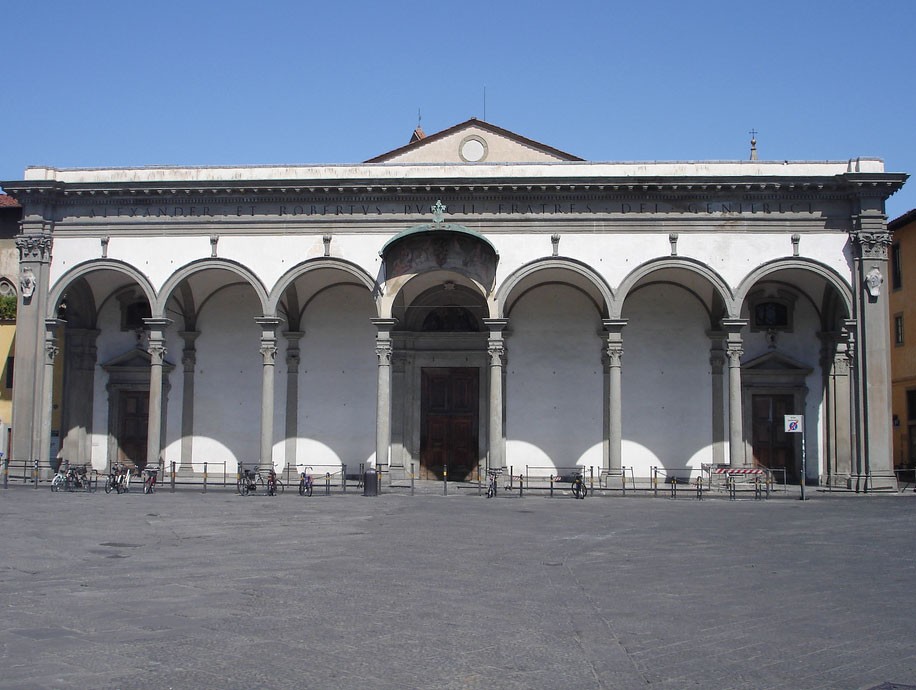
The grandeur of the basilica is further enriched by layers of historical ornamentation, particularly the opulent Baroque flourishes that arrived in later centuries. The addition of gilded ceilings, elaborate stuccoes, and heavy, dramatic draperies transformed the interior into a theater of splendor, reflecting the era's love for theatricality and divine majesty. Even the exterior participates in this architectural dialogue; the façade, designed by Giovanni Battista Caccini , echoes the elegant lines of Brunelleschi’s nearby Foundling Hospital, creating a seamless aesthetic continuity within the Piazza Santissima Annunziata. For the art lover, the interior designer, or the historian, the basilica remains an inexhaustible source of inspiration—a place where the legacy of faith and the pinnacle of human artistry are eternally entwined.


