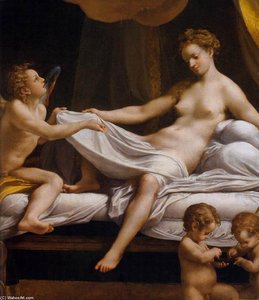
Portrait of Antonio da Correggio

The 100 Most Famous Antonio da Correggio Paintings, Each One of a Kind

Updated November 2026 · ranked by our popularity score (searches, visits and orders for each work) · 206 works by Antonio da Correggio in our catalogue

In short

Jupiter and Io (1531) is the Antonio da Correggio painting that draws the most eyes; the original belongs to the Kunsthistorisches Museum, Vienna. After it, the eye goes to Nativity (Holy Night) (1528) and Leda with the Swan (1531). Among the 206 works of Antonio da Correggio in our catalog, these 100 are the most famous, each a unique original presented with its year, its museum and the reason it endures.

1489 – 1534, Correggio High renaissance Most works: Bavarian State Painting Collections

Top 10 paintings by Antonio da Correggio, through the gallery's eye

1
Jupiter and Io (1531) by Antonio da Correggio

Jupiter and Io

1531 · Oil On Canvas · Kunsthistorisches Museum, Vienna

Captivating Mythological Subject and Rich Symbolism Immerse yourself in the timeless allure of this masterful painting, which vividly depicts a mythological scene inspired by classical stories. The composition centers on a nude female figure, reclining gracefully amidst a lush natural setting, embodying themes of beauty, transformation, and divine interaction. The artwork’s subject invites viewers to explore the depths of myth and legend, evoking a sense of wonder and introspection. Subtle…

2
Nativity (Holy Night) (1528) by Antonio da Correggio

Nativity (Holy Night)

1528 · Acrylic On Canvas · Gemäldegalerie, Dresden

Antonio Allegri da Correggio’s “Nativity (Holy Night),” painted in 1528, isn’t merely a depiction of the birth of Christ; it’s an immersive experience, a carefully constructed stage for a profound theological drama. Emerging from the vibrant artistic milieu of Renaissance Parma, Correggio masterfully blends classical influences with a burgeoning dynamism that foreshadowed the Baroque era. This painting transcends simple narrative, offering a glimpse into the artist's innovative approach to perspective…

3
Leda with the Swan (1531) by Antonio da Correggio

Leda with the Swan

1531 · Oil On Canvas · Staatliche Museen zu Berlin, Berlin

Captivating Mythological Subject Immerse yourself in the enchanting world of classical mythology with this exquisite depiction of the legendary scene where Leda, the Queen of Sparta, is seduced by the divine swan. This timeless subject, rooted in ancient Greek legends, symbolizes themes of transformation, purity, and divine intervention. The scene captures a moment of serene intimacy, blending human beauty with mythic symbolism, inviting viewers to explore the depths of classical…

4
Danaë (1530) by Antonio da Correggio

Danaë

1530 · Acrylic On Canvas · Galleria Borghese, Rome

A Vision of Mythological Grace: Antonio Allegri da Correggio’s Danaë Antonio Allegri da Correggio, a Parma Master: The Life and Legacy of Antonio da Correggio – his name itself whispers of artistic brilliance born from the fertile soil of Renaissance Italy. Born in 1489, Correggio's tragically brief life nonetheless cemented his place as one of the most influential painters of his era, skillfully bridging the monumental grandeur of Michelangelo with…

5
Noli Me Tangere (1525) by Antonio da Correggio

Noli Me Tangere

1525 · Fresco · Museo del Prado, Madrid

In the quietude of a sun-drenched landscape, a profound moment of spiritual revelation unfolds within Antonio Allegri da Correggio’s Noli Me Tangere. This masterpiece, painted around 1525, captures the delicate, breathless instant when the resurrected Jesus Christ encounters Mary Magdalene. It is not merely a depiction of a biblical event, but an intimate study of transition—the movement from grief to recognition, and from the earthly to the divine. As the…

7
Madonna with St. Francis (1514) by Antonio da Correggio

Madonna with St. Francis

1514 · Oil · Gemäldegalerie, Dresden

In the hallowed halls of Dresden’s Gemäldegalerie Alte Meister, there exists a window into the divine, a luminous masterpiece that transcends the boundaries of mere oil and pigment. Antonio Allegri da Correggio’s Madonna with St. Francis, completed around 1514–1515, is not simply a painting; it is a profound spiritual encounter. At first glance, the viewer is struck by a monumental sense of grandeur, as the massive scale of the work—measuring…

8
Pietà (1525) by Antonio da Correggio

Pietà

1525 · Oil On Panel · Courtauld Gallery, London

The composition centers on the intimate, pyramidal arrangement of the Virgin Mary cradling the lifeless body of Jesus Christ. A diagonal line, formed by the weight of Christ's form, directs the viewer's gaze across the canvas. The scene is set against a dark, shadowy background suggesting a nocturnal or wooded environment, which provides a sense of atmospheric depth. Through the use of chiaroscuro, a gentle light source illuminates the faces…

9
Madonna and Child in Glory (1510) by Antonio da Correggio

Madonna and Child in Glory

1510 · Oil On Canvas · Galleria degli Uffizi, Florence

In the quiet intimacy of Madonna and Child in Glory, Antonio Allegri da Correggio invites the viewer into a realm where the boundaries between the earthly and the divine dissolve. This exquisite masterpiece, dating from approximately 1510, captures a moment of profound tenderness and celestial splendor. At its heart, the Virgin Mary cradles the infant Jesus, her form embodying the High Renaissance ideal of grace and maternal devotion. Surrounding them…

10
Madonna della Scala (1523) by Antonio da Correggio

Madonna della Scala

1523 · Fresco · Galleria Nazionale, Parma

In the heart of Parma, within the hallowed halls of the Museo Costantiniano, resides a masterpiece that captures the very zenith of High Renaissance achievement. Antonio Allegri da Correggio’s Madonna della Scala is far more than a mere religious depiction; it is a profound exploration of light, shadow, and the eternal. Completed in 1523, this monumental fresco invites the viewer into a sacred space where the boundaries between the earthly…

Antonio da Correggio's famous paintings, numbers 11 to 100

11Leda and the Swan (1532) by Antonio da CorreggioLeda and the Swan1532 · Gemäldegalerie 12Deposition (1525) by Antonio da CorreggioDeposition1525 13Ganymede (1531) by Antonio da CorreggioGanymede1531 · Kunsthistorisches Museum 14Danaë (detail) (1530) by Antonio da CorreggioDanaë (detail)1530 · Galleria Borghese 15Venus with Mercury and Cupid (The School of Love) (1525) by Antonio da CorreggioVenus with Mercury and Cupid (The School of Love)1525 · National Gallery 16Venus and Cupid with a Satyr (1528) by Antonio da CorreggioVenus and Cupid with a Satyr1528 · The Louvre 17Virgin and Child with an Angel (detail) by Antonio da CorreggioVirgin and Child with an Angel (detail)Szépművészeti Múzeum 18Head of an Angel (1522) by Antonio da CorreggioHead of an Angel1522 · National Gallery 19Four Saints (from left St. Peter, St. Martha, St. Mary Magdalene, St. Leonard) (1517) by Antonio da CorreggioFour Saints (from left St. Peter, St. Martha, St. Mary Magdalene, St. Leonard)1517 · Metropolitan Museum of Art 20Die Mystische Hochzeit der Hl. Katharina von Alexandrien by Antonio da CorreggioDie Mystische Hochzeit der Hl. Katharina von Alexandrien 21Reading Cupid (1520) by Antonio da CorreggioReading Cupid1520 · Bavarian State Painting Collections 22Mary with Child and Saints (1511) by Antonio da CorreggioMary with Child and Saints1511 · Bavarian State Painting Collections 23Madonna and Child (1515) by Antonio da CorreggioMadonna and Child1515 · Detroit Institute of Arts 24Abduction of Ganymede (1511) by Antonio da CorreggioAbduction of Ganymede1511 · Bavarian State Painting Collections 25English Head (1511) by Antonio da CorreggioEnglish Head1511 · Bavarian State Painting Collections 26Head of Christ (1520) by Antonio da CorreggioHead of Christ1520 · National Museum in Warsaw 27The Mystic Marriage of Saint Catherine with Saint Sebastian (1522) by Antonio da CorreggioThe Mystic Marriage of Saint Catherine with Saint Sebastian1522 · The Hepworth Wakefield 28Passing away of St John (1520) by Antonio da CorreggioPassing away of St John1520 29The Assumption of the Virgin (1530) by Antonio da CorreggioThe Assumption of the Virgin1530 30Assumption of the Virgin (1526) by Antonio da CorreggioAssumption of the Virgin1526 · Duomo 31The Betrothal of Saint Catharine (1519) by Antonio da CorreggioThe Betrothal of Saint Catharine1519 · Statens Museum For Kunst 32Madonna and Child with the Infant Saint John (1522) by Antonio da CorreggioMadonna and Child with the Infant Saint John1522 · Städel Museum 33The Education of Love by Mercury (1750) by Antonio da CorreggioThe Education of Love by Mercury1750 34Adoration of the Shepherds (The Holy Night) (1530) by Antonio da CorreggioAdoration of the Shepherds (The Holy Night)1530 · Gemäldegalerie 35An Allegory of Virtue (unfinished) by Antonio da CorreggioAn Allegory of Virtue (unfinished)Scottish National Gallery 36Camera di San Paolo (1518) by Antonio da CorreggioCamera di San Paolo1518 · Camera di San Paolo 37Adoration of the Magi (1517) by Antonio da CorreggioAdoration of the Magi1517 38Ceiling decoration (partial view) (1518) by Antonio da CorreggioCeiling decoration (partial view)1518 · Camera di San Paolo 39Ceiling decoration (1518) by Antonio da CorreggioCeiling decoration1518 · Camera di San Paolo 40Madonna with Child (called the “Gypsy”) (1515) by Antonio da CorreggioMadonna with Child (called the “Gypsy”)1515 · Museo di Capodimonte 41St. John the Evangelist (1524) by Antonio da CorreggioSt. John the Evangelist1524 42John the Evangelist (1520) by Antonio da CorreggioJohn the Evangelist1520 43The Assumption of the Virgin (detail) (1525) by Antonio da CorreggioThe Assumption of the Virgin (detail)1525 44Vision of St. John the Evangelist (1520) by Antonio da CorreggioVision of St. John the Evangelist1520 45Saint Marc (1520) by Antonio da CorreggioSaint Marc1520 46The Apostles Peter and Paul (1524) by Antonio da CorreggioThe Apostles Peter and Paul1524 47Assumption of the Virgin (detail) (1526) by Antonio da CorreggioAssumption of the Virgin (detail)1526 · Duomo 48The Assumption of the Virgin (detail) (1530) by Antonio da CorreggioThe Assumption of the Virgin (detail)1530 49Madonna Of St. Jerome by Antonio da CorreggioMadonna Of St. Jerome 50Christ on the Mount of Olives by Antonio da CorreggioChrist on the Mount of OlivesBavarian State Painting Collections 51Madonna with St. Jerome (The Day) (1522) by Antonio da CorreggioMadonna with St. Jerome (The Day)1522 · Staatliche Kunstsammlungen Dresden 52Virgen de San Giorgio by Antonio da CorreggioVirgen de San Giorgio 53Madonna of the Basket (1524) by Antonio da CorreggioMadonna of the Basket1524 · National Gallery 54An episode of Christ by Antonio da CorreggioAn episode of ChristPinacoteca Stuard 55The Head of Saint Catherine the Martyr by Antonio da CorreggioThe Head of Saint Catherine the MartyrNational Gallery of Ireland 56Head of a Cherub by Antonio da CorreggioHead of a CherubMuseum of Fine Arts 57The Mystic Marriage of Saint Catherine by Antonio da CorreggioThe Mystic Marriage of Saint CatherineMuseum of Fine Arts 58Penitent Magdalene by Antonio da CorreggioPenitent Magdalene 59Study for a prophet by Antonio da CorreggioStudy for a prophet 60Adam plucking the forbidden fruit by Antonio da CorreggioAdam plucking the forbidden fruit 61The Virgin and Child with the Infant Baptist by Antonio da CorreggioThe Virgin and Child with the Infant Baptist 62A prophetess holding a tabla, an angel beside her by Antonio da CorreggioA prophetess holding a tabla, an angel beside her 63Saint Joseph by Antonio da CorreggioSaint Joseph 64The Madonna and Child with Saint John the Baptist by Antonio da CorreggioThe Madonna and Child with Saint John the Baptist 65Virgin and Child by Antonio da CorreggioVirgin and Child 66Antonio Allegri da Correggio by Antonio da CorreggioAntonio Allegri da Correggio 67The Magdalen in the act of embracing the feet of Crist by Antonio da CorreggioThe Magdalen in the act of embracing the feet of Crist 68Four ephebes by Antonio da CorreggioFour ephebes 69Io by Antonio da CorreggioIo 70Saint Matthew and Saint Jerome by Antonio da CorreggioSaint Matthew and Saint Jerome 71Three Graces by Antonio da CorreggioThree Graces 72Camera di San Paolo by Antonio da CorreggioCamera di San Paolo 73Lunette with St. John the Evangelist by Antonio da CorreggioLunette with St. John the Evangelist 74jupiter and io by Antonio da Correggiojupiter and io 75Mythological subject by Antonio da CorreggioMythological subject 76Idem by Antonio da CorreggioIdem 77Diana by Antonio da CorreggioDiana 78Woman kneeling before another standing by Antonio da CorreggioWoman kneeling before another standing 79Los santos Pedro, Marta, Maria Magdalena y Leonardo by Antonio da CorreggioLos santos Pedro, Marta, Maria Magdalena y Leonardo 80Group of angels from Corrège by Antonio da CorreggioGroup of angels from CorrègeMusée des beaux-arts de Chambéry 81Danaë by Antonio da CorreggioDanaë 82The Vision of St. John in Patmos by Antonio da CorreggioThe Vision of St. John in Patmos 83The Mystic Marriage of St. Catherine (1520) by Antonio da CorreggioThe Mystic Marriage of St. Catherine1520 · The Louvre 84Madonna (1512) by Antonio da CorreggioMadonna1512 · Castello Sforzesco 85Penitent Magdalene, Reading a Book by Antonio da CorreggioPenitent Magdalene, Reading a BookBavarian State Painting Collections 86The Mystic Marriage of Saint Catherine (1515) by Antonio da CorreggioThe Mystic Marriage of Saint Catherine1515 87Saints Peter, Martha, Mary Magdalen, and Leonard (1515) by Antonio da CorreggioSaints Peter, Martha, Mary Magdalen, and Leonard1515 · Metropolitan Museum of Art 88Portrait of a Gentlewoman (1519) by Antonio da CorreggioPortrait of a Gentlewoman1519 89Martyrdom of Four Saints (1520) by Antonio da CorreggioMartyrdom of Four Saints1520 90Christ on the Mount of Olives by Antonio da CorreggioChrist on the Mount of OlivesGemäldegalerie 91Rapto de Ganímedes by Antonio da CorreggioRapto de Ganímedes 92Study for a decoration of grotesques by Antonio da CorreggioStudy for a decoration of grotesques 93Study for an apostle 1 by Antonio da CorreggioStudy for an apostle 1 94Assumption Of The Virgin, detail of Angelic Musicians by Antonio da CorreggioAssumption Of The Virgin, detail of Angelic Musicians 95Study for the parapet of the dome of Parma Cathedral by Antonio da CorreggioStudy for the parapet of the dome of Parma Cathedral 96Christ arrested by Antonio da CorreggioChrist arrested 97The holy family with saints by Antonio da CorreggioThe holy family with saints 98Architectural study by Antonio da CorreggioArchitectural study 99Plan of a building by Antonio da CorreggioPlan of a building 100Putto with garland and love trumphant by Antonio da CorreggioPutto with garland and love trumphant

Antonio da Correggio's famous paintings, period by period

The subjects that held Antonio da Correggio's eye

The four subjects that come back most often in these originals, each with its finest example.

The museums that keep Antonio da Correggio's originals

The 8 museums that hold the most of the paintings on this page.

Museum City Works by Antonio da Correggio Paintings from this list
Bavarian State Painting Collections, MunichBavarian State Painting Collections Munich 6 Reading Cupid, Mary with Child and Saints, Abduction of Ganymede
National Gallery, LondonNational Gallery London 6 Venus with Mercury and Cupid (The School of Love), Head of an Angel, Madonna of the Basket
Gemäldegalerie, BerlinGemäldegalerie Berlin 3 Leda and the Swan, Adoration of the Shepherds (The Holy Night), Christ on the Mount of Olives
Camera di San Paolo, ParmaCamera di San Paolo Parma 3 Camera di San Paolo, Ceiling decoration (partial view), Ceiling decoration
Kunsthistorisches Museum, ViennaKunsthistorisches Museum Vienna 3 Jupiter and Io, Ganymede
The Louvre, ParisThe Louvre Paris 3 Venus and Cupid with a Satyr, The Mystic Marriage of St. Catherine
Gemäldegalerie, DresdenGemäldegalerie Dresden 2 Nativity (Holy Night), Madonna with St. Francis
Galleria Borghese, RomeGalleria Borghese Rome 2 Danaë, Danaë (detail)

Antonio da Correggio across the decades: one unique original for each

Works per decade

Pick a decade to see the original that defines it.

Antonio da Correggio's paintings: questions for the gallery

What is the single most famous work of Antonio da Correggio?Reveal the answer

Jupiter and Io (1531), Kunsthistorisches Museum, Vienna. Nativity (Holy Night) (1528) and Leda with the Swan (1531) come next.

At what age did Antonio da Correggio create Jupiter and Io?Reveal the answer

42 years old: Jupiter and Io dates from 1531, and Antonio da Correggio was born in 1489.

Which ten paintings by Antonio da Correggio are the most famous?Reveal the answer

Jupiter and Io, Nativity (Holy Night), Leda with the Swan, Danaë, Noli Me Tangere, Madonna and Child with infant St John the Baptist, Madonna with St. Francis, Pietà, Madonna and Child in Glory and Madonna della Scala. The ranking above gives each one's year and museum.

How many works by Antonio da Correggio are known?Reveal the answer

Our catalog holds 206 works by Antonio da Correggio, dated from 1510 to 1532.

Where can the most famous Antonio da Correggio originals be seen?Reveal the answer

Mostly in Bavarian State Painting Collections (Munich), National Gallery (London) and Gemäldegalerie (Berlin). The museum table above lists them all.

During which period did Antonio da Correggio create the best-known paintings?Reveal the answer

In 1520s: 25 of the 100 works on this page were made then, Nativity (Holy Night) among them.

Which famous Antonio da Correggio painting is the earliest, and which the latest?Reveal the answer

On this page, the earliest is Madonna and Child in Glory (1510) and the latest Leda and the Swan (1532).

What subjects did Antonio da Correggio favour?Reveal the answer

Woman (17), Child (14) and Man (13), across the 100 works on this page.

What materials did Antonio da Correggio paint with most?Reveal the answer

Oil On Canvas, for 18 of the 100 works on this page.

Which movement does the work of Antonio da Correggio belong to?Reveal the answer

High renaissance, judging by the originals on this page.

What Antonio da Correggio originals can I see at the Bavarian State Painting Collections?Reveal the answer

Reading Cupid, Mary with Child and Saints and Abduction of Ganymede: the Bavarian State Painting Collections, Munich holds 6 of the works on this page.

Antonio da Correggio: a portrait of the artist

A Parma Master: The Life and Legacy of Antonio da Correggio

Antonio Allegri da Correggio, a name that resonates with the very essence of High Renaissance artistry, emerged from the small Italian city bearing his adopted moniker in 1489. His life, though tragically curtailed at just forty-four years old, left an indelible mark on the artistic landscape, bridging the classical ideals of Raphael and Michelangelo with the dramatic dynamism that would foreshadow the Baroque era. Details surrounding Correggio’s early life remain somewhat elusive; however, it is believed he received initial training from his uncle, Lorenzo Allegri, a local painter, before venturing to Modena and then Mantua in pursuit of artistic refinement. These formative experiences exposed him to the influences of artists like Andrea Mantegna, whose mastery of perspective and classical themes resonated deeply within Correggio’s developing style. He absorbed these lessons, yet quickly began forging his own path—one characterized by a uniquely graceful lyricism and an innovative approach to illusionistic space. Correggio wasn't merely replicating beauty; he was transforming it through a lens of profound emotional depth and technical brilliance.

Innovation in Paint: Style and Technique

Correggio’s artistic genius lay not simply in replication, but in transformation. His paintings are immediately recognizable for their vibrant color palettes, often employing rich reds, blues, and golds to create an atmosphere of both earthly delight and divine transcendence. He was a master of chiaroscuro, the dramatic interplay of light and shadow, using it not simply to model form but to evoke mood and heighten emotional impact. This technique is particularly evident in his mythological scenes, where figures emerge from darkness as if illuminated by an inner radiance. Beyond color and light, Correggio’s mastery of perspective was revolutionary. He didn't just create the illusion of depth; he manipulated it to draw the viewer into the scene, blurring the boundaries between reality and representation. This is spectacularly demonstrated in his frescoes for the dome of Parma Cathedral, where the swirling figures seem to ascend towards heaven, creating a breathtaking sense of spatial expansion. His use of di sotto in su, or “from below,” foreshortening—a technique that presents objects as if viewed from directly beneath—further enhanced this illusionistic effect, anticipating the theatricality of Baroque ceiling paintings. He possessed an uncanny ability to imbue his figures with a sense of movement and life, making them appear almost tangible despite being rendered on a flat surface.

Myth and Devotion: Key Works and Themes

The breadth of Correggio’s oeuvre encompasses both religious and mythological subjects, each treated with equal sensitivity and innovation. His altarpieces, such as The Adoration of the Shepherds (known as “The Night”), are imbued with a tender piety and a remarkable naturalism that invites contemplation. The figures aren't idealized saints but rather relatable human beings experiencing moments of profound spiritual connection. However, it is perhaps in his mythological paintings that Correggio’s sensuality truly blossoms. Leda and the Swan, now housed in Berlin, exemplifies this perfectly—a depiction of the classical myth rendered with an exquisite delicacy and a subtle eroticism that was both daring and captivating for its time. Similarly, Jupiter and Io showcases his ability to portray complex narratives with grace and fluidity, while Danaë, residing in Rome’s Borghese Gallery, is a testament to his mastery of depicting the human form bathed in ethereal light. These works weren't simply illustrations of ancient tales; they were explorations of love, desire, and the power of myth itself. He seamlessly blended pagan mythology with Christian iconography, creating a unique artistic language that reflected the intellectual ferment of the Renaissance.

A Lasting Influence: Correggio’s Legacy

Despite his relatively short career, Antonio da Correggio exerted a profound influence on subsequent generations of artists. His innovative use of perspective, dramatic lighting, and sensuous forms paved the way for the Baroque masters—artists like Peter Paul Rubens and Giovanni Battista Tiepolo—who embraced his theatricality and emotional intensity. He also anticipated elements of Rococo art, with its emphasis on grace, elegance, and playful eroticism. Correggio’s impact wasn't limited to painting; his frescoes inspired architects and decorators to create increasingly elaborate and illusionistic interiors. The Parma school, which he founded, continued to flourish for decades after his death, perpetuating his artistic principles and techniques. Even today, Correggio remains a celebrated figure in art history—a testament to the enduring power of his vision and the timeless beauty of his creations. His work serves as a reminder that true artistry lies not just in technical skill but in the ability to evoke emotion, inspire wonder, and connect with the deepest aspects of the human experience. His influence can be seen in countless works throughout European art history, solidifying his place as a pivotal figure in the transition from Renaissance to Baroque aesthetics.

Notable Works