Portrait of François de Troy

François de Troy Paintings: The 77 Most Famous, Through a Gallery's Eye

Updated October 2026 · ranked by our popularity score (searches, visits and orders for each work) · 77 works by François de Troy in our catalogue

In short

To the gallery's eye, François de Troy's most famous painting is The Triumph of Mordecai (1736), whose original hangs in the Metropolitan Museum of Art, New York. Portrait of Louis XV of France and Maria Anna Victoria of Spain (1723) and Lot with his Daughters (1721) complete the trio every eye recognises. Of the 77 works by François de Troy in our catalog, the gallery presents the 77 most famous below, each original with its year, its museum and what makes it unique.

1645 – 1730, Toulouse Rococo Most works: National Gallery

The gallery's top 10 François de Troy paintings

1
The Triumph of Mordecai (1736) by François de Troy

The Triumph of Mordecai

1736 · Oil On Canvas · Metropolitan Museum of Art, New York

Jean-François de Troy: A Master of Rococo Elegance Jean-François de Troy (1645–1730) stands as a pivotal figure bridging the Baroque and Rococo artistic movements in France, embodying the refined sensibilities of his era. Born into a family steeped in artistic tradition in Toulouse, he benefited from an early education fostered by his father, François de Troy – himself a celebrated portraitist – who instilled within him a meticulous technique and…

2
Portrait of Louis XV of France and Maria Anna Victoria of Spain (1723) by François de Troy

Portrait of Louis XV of France and Maria Anna Victoria of Spain

1723 · Oil On Canvas

The Portrait of Louis XV of France and Maria Anna Victoria of Spain by François de Troy captures a moment of profound royal significance. Created in 1723, the work presents a scene of high-ranking nobility through the eyes of a skilled observer. We find ourselves looking upon the young Louis XV of France as a child, his presence marked by the weight of his future station. Beside him, Mariana Victoria…

3
Lot with his Daughters (1721) by François de Troy

Lot with his Daughters

1721 · Oil On Canvas · Hermitage Museum, Saint Petersburg

In the grand tapestry of eighteenth-century French painting, few works capture the tension between classical narrative and burgeoning Rococo elegance as poignantly as Jean-François de Troy’s “Lot with his Daughters.” This monumental canvas, a breathtaking display of scale and emotional depth, invites the viewer into a world where biblical gravity meets an intimate, almost voyeuristic, domesticity. As one gazes upon the composition, the eye is immediately drawn to the interplay…

4
The Declaration of Love (1724) by François de Troy

The Declaration of Love

1724 · Oil On Canvas · Metropolitan Museum of Art, New York

A Window Into Rococo Sensuality Jean-François de Troy’s “The Declaration of Love,” completed in 1724, stands as a quintessential example of the tableau vivant, or ‘living picture,’—a genre that flourished during the Rococo period and captured the very heartbeat of aristocratic Parisian society. More than just a portrait, it is an exquisitely crafted tableau designed to convey not only visual beauty but also social status and emotional nuance. Housed in…

5
Nils Bielke, Count, Field Marshal, Ambassador (1679) by François de Troy

Nils Bielke, Count, Field Marshal, Ambassador

1679 · Oil · Nationalmuseum, Stockholm

The portrait titled Nils Bielke, Count, Field Marshal, Ambassador captures a man of high station and military weight. This work is attributed to the French artist François de Troy. The subject, Nils Bielke, lived from 1644 to 1716, a life defined by the rigid structures of the Swedish nobility and the complexities of European diplomacy. He moved through the halls of power as a soldier and a statesman, a figure…

6
Angelo Constantini in the role of Mezetin (1687) by François de Troy

Angelo Constantini in the role of Mezetin

1687 · Oil On Canvas · Condé Museum, Chantilly

In this oil on canvas, we find ourselves in the presence of Angelo Constantini, captured in the midst of a theatrical transformation. He is portrayed in the role of Mezetin, a character that demands a certain physical presence and expressive energy. The composition is vertical, drawing the eye upward through the subject's animated gesture. He leans slightly toward the right, his gaze directed upward as if responding to a cue…

7
Louis Auguste I. de Bourbon, Duke of Maine (1670-1736) (1716) by François de Troy

Louis Auguste I. de Bourbon, Duke of Maine (1670-1736)

1716 · Oil On Canvas · Staatliche Kunstsammlungen Dresden, Dresden

The young man sits with a quiet, composed stillness, his gaze meeting the viewer with an air of effortless authority. This is Louis Auguste I. de Bourbon, Duke of Maine, captured in a moment of poised elegance. He is draped in a heavy, dark mantle, the weight of the fabric suggested by deep shadows and the soft, white texture of ermine fur lining the collar. The light falls from the…

8
The Capture of the Golden Fleece (1742) by François de Troy

The Capture of the Golden Fleece

1742 · Oil On Canvas · National Gallery, London

The Capture of the Golden Fleece by François de Troy captures a singular moment of mythic tension. Created about 1742, this oil on canvas serves as the third in a sequence of seven illustrations detailing the saga of Jason. The narrative finds its roots in the verses of the Roman poet Ovid, specifically within the episodes of his Metamorphoses. Here, the hero’s quest reaches a fever pitch as the prize…

10
Portrait de Marie Anne de Bourbon, princesse de Conti by François de Troy

Portrait de Marie Anne de Bourbon, princesse de Conti

Oil On Canvas · Musée des Augustins, Toulouse

Portrait de Marie Anne de Bourbon, princesse de Conti, is an oil on canvas painted by François de Troy in 1690. The sitter is Marie Anne de Bourbon, Princess of Conti, who lived from 2 October 1666 to 3 May 1739. As the daughter of Louis XIV and Louise de La Vallière, her lineage places her at the center of the French courtly circle during the late seventeenth century.

François de Troy paintings, ranked 11 to 77

11PORTRAIT D'HOMME by François de TroyPORTRAIT D'HOMMEThe Louvre 12Mercury and Sleeping Argus (1670) by François de TroyMercury and Sleeping Argus1670 13Marie-Anne de Bourbon, Princess of Conti (1666-1739) (1680) by François de TroyMarie-Anne de Bourbon, Princess of Conti (1666-1739)1680 · Opera House 14Portrait of Teresa Kunegunda Sobieska as a bride (1695) by François de TroyPortrait of Teresa Kunegunda Sobieska as a bride1695 15Portrait of Anne-Louise-Bénédicte de Bourbon-Condé, duchesse du Maine (1694) by François de TroyPortrait of Anne-Louise-Bénédicte de Bourbon-Condé, duchesse du Maine1694 · Musee des Beaux-Arts 16Lady Mary Herbert (1659–1744 1745), Viscountess Montagu (1696) by François de TroyLady Mary Herbert (1659–1744 1745), Viscountess Montagu1696 · Powys Castle Museum 17Miniature of Jakub Ludwik Sobieski. (1700) by François de TroyMiniature of Jakub Ludwik Sobieski.1700 · National Museum in Warsaw 18Self-Portrait (1704) by François de TroySelf-Portrait1704 · Museum of Fine Arts 19Half-length portrait of Princess Louisa Stuart as a young girl (1700) by François de TroyHalf-length portrait of Princess Louisa Stuart as a young girl1700 20Portrait d'un homme au manteau bleu tenant un livre - François de Troy - Musée des Beaux-Arts de Gaillac (1700) by François de TroyPortrait d'un homme au manteau bleu tenant un livre - François de Troy - Musée des Beaux-Arts de Gaillac1700 · Gaillac Museum of Fine Arts 21La Duchesse de La Ferté with the Duc de Bretagne and the Duc d’Anjou (1712) by François de TroyLa Duchesse de La Ferté with the Duc de Bretagne and the Duc d’Anjou1712 · Leeds Art Gallery 22William Herbert, Lord Herbert, later 2nd Marquis of Powis (c. 1665 - 1745) (1714) by François de TroyWilliam Herbert, Lord Herbert, later 2nd Marquis of Powis (c. 1665 - 1745)1714 · Coughton Court 23Portrait of Countess of Cosel with son as Cupido. (1712) by François de TroyPortrait of Countess of Cosel with son as Cupido.1712 · Museum of John Paul II Collection 24Louise Hippolyte Grimaldi when Duchess of Valentinois (Future Princess of Monaco) (1715) by François de TroyLouise Hippolyte Grimaldi when Duchess of Valentinois (Future Princess of Monaco)1715 · Opera House 25The Rearing of Bacchus (1717) by François de TroyThe Rearing of Bacchus1717 · Gemäldegalerie 26Woman at a Spring (1723) by François de TroyWoman at a Spring1723 · Opera House 27Portrait of Jean Hébert, alderman of the city of Paris (1726) by François de TroyPortrait of Jean Hébert, alderman of the city of Paris1726 · Carnavalet Museum 28Portrait of an Alderman (1726) by François de TroyPortrait of an Alderman1726 · Carnavalet Museum 29Young Woman Drinking Coffee (1723) by François de TroyYoung Woman Drinking Coffee1723 · Gemäldegalerie 30Bathsheba at her Bath (1750) by François de TroyBathsheba at her Bath1750 · Philbrook Museum of Art 31Time unveiling Truth (1733) by François de TroyTime unveiling Truth1733 32Kristian I, 1623-1692, Ludvig I hertig av Mecklenburg-Schwerin by François de TroyKristian I, 1623-1692, Ludvig I hertig av Mecklenburg-SchwerinNationalmuseum 33Portrait of the Marquis of Marigny (1750) by François de TroyPortrait of the Marquis of Marigny1750 · Château de Versailles 34A Hunt Breakfast (1737) by François de TroyA Hunt Breakfast1737 · Wallace Collection 35An Allegory of Time Unveiling Truth (detail) (1733) by François de TroyAn Allegory of Time Unveiling Truth (detail)1733 · National Gallery 36Lot and His Daughters (1745) by François de TroyLot and His Daughters1745 · Museo de Arte de Ponce 37Lady Lucy Herbert (1668–1744), Later Prioress of the English Austin Canonesses at Bruges, as a Vestal Virgin (1693) by François de TroyLady Lucy Herbert (1668–1744), Later Prioress of the English Austin Canonesses at Bruges, as a Vestal Virgin1693 · Powys Castle Museum 38Lady Mary Herbert (1659–1744 1745), Viscountess Montagu, Previously the Honourable Lady Richard Molyneux, and Later Lady Maxwell, as Diana (1688) by François de TroyLady Mary Herbert (1659–1744 1745), Viscountess Montagu, Previously the Honourable Lady Richard Molyneux, and Later Lady Maxwell, as Diana1688 · Coughton Court 39Queen Mary of Modena, Princess Maria Beatrice d'Este (1658–1718) (1698) by François de TroyQueen Mary of Modena, Princess Maria Beatrice d'Este (1658–1718)1698 40Prince James Francis Edward (1688–1766) (1698) by François de TroyPrince James Francis Edward (1688–1766)1698 · Traquair House 41Prince James Francis Edward Stuart (1688–1766), Son of James VII and II (1701) by François de TroyPrince James Francis Edward Stuart (1688–1766), Son of James VII and II1701 · Scottish National Portrait Gallery 42Woman Reading a letter (1723) by François de TroyWoman Reading a letter1723 · Gemäldegalerie 43A Hunting Meal (1737) by François de TroyA Hunting Meal1737 · The Louvre 44Jason Taming the Bulls of Aeëtes (1742) by François de TroyJason Taming the Bulls of Aeëtes1742 · The Barber Institute of Fine Arts 45The Judgement of Paris (1734) by François de TroyThe Judgement of Paris1734 46CHARLES MOUTON by François de TroyCHARLES MOUTONThe Louvre 47Bacchus and Ariadne (1717) by François de TroyBacchus and Ariadne1717 · Staatliche Museen zu Berlin 48Duck Shooting in a Wood (1730) by François de TroyDuck Shooting in a Wood1730 · Fitzwilliam College 49Portrait of Louis Alexandre de Bourbon (1678-1737), legitimized son of France, Count of Toulouse by François de TroyPortrait of Louis Alexandre de Bourbon (1678-1737), legitimized son of France, Count of Toulouse 50Portrait of Madame de Lude by François de TroyPortrait of Madame de LudeHerzog Anton Ulrich Museum 51Portrait of Catherine de La Boissière by François de TroyPortrait of Catherine de La BoissièreThe Ema Klabin House Museum 52Louis François Lefèvre de Caumartin by François de TroyLouis François Lefèvre de Caumartin 53JULES HARDOUIN MANSART (1645 1708) by François de TroyJULES HARDOUIN MANSART (1645 1708)Opera House 54Portrait de femme en Vénus désarmant l'Amour by François de TroyPortrait de femme en Vénus désarmant l'Amour 55La duchesse du Maine en Cléopâtre by François de TroyLa duchesse du Maine en Cléopâtre 56Portrait de Madame Jean de Jullienne by François de TroyPortrait de Madame Jean de Jullienne 57Portrait de M. Le Prestre by François de TroyPortrait de M. Le Prestre 58Madame de Miramion by François de TroyMadame de Miramion 59JEUX DANS UNE COUR DE FERME by François de TroyJEUX DANS UNE COUR DE FERME 60Anne Marie de Beuzelin de Bosmelet, Duchesse de La Force by François de TroyAnne Marie de Beuzelin de Bosmelet, Duchesse de La ForceMuseum of Fine Arts 61PORTRAIT D'HOMME EN CUIRASSE by François de TroyPORTRAIT D'HOMME EN CUIRASSE 62Portrait de Jean de Jullienne by François de TroyPortrait de Jean de Jullienne 63ELISABETH CHARLOTTE DE BAVIERE, DUCHESSE D'ORLEANS, DITE LA PALATINE (1652 1722) by François de TroyELISABETH CHARLOTTE DE BAVIERE, DUCHESSE D'ORLEANS, DITE LA PALATINE (1652 1722)Château de Versailles 64Portrait de femme avec son enfant et une nourrice Portrait de la duchesse de Bourgogne, mère de Louis XV Portrait d'une femme tenant son enfant sur ses genoux (Ancien titre) by François de TroyPortrait de femme avec son enfant et une nourrice Portrait de la duchesse de Bourgogne, mère de Louis XV Portrait d'une femme tenant son enfant sur ses genoux (Ancien titre) 65James Francis Edward Stuart ('Old Pretender') by François de TroyJames Francis Edward Stuart ('Old Pretender')Fairfax House 66The Death of a Stag (1737) by François de TroyThe Death of a Stag1737 · Wallace Collection 67Die Liebeserklärung (1731) by François de TroyDie Liebeserklärung1731 · Sanssouci Palace 68DOUBLE PORTRAIT ALLEGORIQUE LE JUGEMENT DE PARIS DIT AUTREFOIS MADEMOISELLE DE BLOIS ET LE COMTE DE TOULOUSE EN VERTUMNE ET POMONE by François de TroyDOUBLE PORTRAIT ALLEGORIQUE LE JUGEMENT DE PARIS DIT AUTREFOIS MADEMOISELLE DE BLOIS ET LE COMTE DE TOULOUSE EN VERTUMNE ET POMONEThe Louvre 69Scene in the Park (1750) by François de TroyScene in the Park1750 · Hermitage Museum 70The Alarm, or the Gouvernante Fidèle (1723) by François de TroyThe Alarm, or the Gouvernante Fidèle1723 · Victoria and Albert Museum 71Portrait of Jean de Jullienne by François de TroyPortrait of Jean de Jullienne 72Portrait de Mme Le Prestre by François de TroyPortrait de Mme Le PrestreSchorr Collection 73Sir William Herbert (1626–1696), 3rd Baron and 1st Earl and 1st Marquess Duke of Powis, in Garter Robes by François de TroySir William Herbert (1626–1696), 3rd Baron and 1st Earl and 1st Marquess Duke of Powis, in Garter Robes 74The Alarm (1723) by François de TroyThe Alarm1723 · Victoria and Albert Museum 75The Garter (1724) by François de TroyThe Garter1724 · Metropolitan Museum of Art 76Jason swearing Eternal Affection to Medea (1742) by François de TroyJason swearing Eternal Affection to Medea1742 · National Gallery 77An Allegory of Time Unveiling Truth (1733) by François de TroyAn Allegory of Time Unveiling Truth1733 · National Gallery

François de Troy's famous paintings, period by period

The subjects that held François de Troy's eye

The four subjects that come back most often in these originals, each with its finest example.

The museums that keep François de Troy's originals

The 8 museums that hold the most of the paintings on this page.

Museum City Works by François de Troy Paintings from this list
National Gallery, LondonNational Gallery London 4 The Capture of the Golden Fleece, An Allegory of Time Unveiling Truth (detail), Jason swearing Eternal Affection to Medea
The Louvre, ParisThe Louvre Paris 4 PORTRAIT D'HOMME, A Hunting Meal, CHARLES MOUTON
Opera House, VersaillesOpera House Versailles 4 Marie-Anne de Bourbon, Princess of Conti (1666-1739), Louise Hippolyte Grimaldi when Duchess of Valentinois (Future Princess of Monaco), Woman at a Spring
Metropolitan Museum of Art, New YorkMetropolitan Museum of Art New York 3 The Triumph of Mordecai, The Declaration of Love, The Garter
Gemäldegalerie, BerlinGemäldegalerie Berlin 3 The Rearing of Bacchus, Young Woman Drinking Coffee, Woman Reading a letter
Hermitage Museum, Saint PetersburgHermitage Museum Saint Petersburg 2 Lot with his Daughters, Scene in the Park
Nationalmuseum, StockholmNationalmuseum Stockholm 2 Nils Bielke, Count, Field Marshal, Ambassador, Kristian I, 1623-1692, Ludvig I hertig av Mecklenburg-Schwerin
Powys Castle Museum 2 Lady Mary Herbert (1659–1744 1745), Viscountess Montagu, Lady Lucy Herbert (1668–1744), Later Prioress of the English Austin Canonesses at Bruges, as a Vestal Virgin

François de Troy, one signature painting per decade

Works per decade

Pick a decade to see the original that defines it.

François de Troy's paintings: the gallery answers

Which François de Troy painting is the most famous of all?Reveal the answer

The Triumph of Mordecai (1736), Metropolitan Museum of Art, New York. Portrait of Louis XV of France and Maria Anna Victoria of Spain (1723) and Lot with his Daughters (1721) come next.

Which are François de Troy's top 10 paintings?Reveal the answer

The Triumph of Mordecai, Portrait of Louis XV of France and Maria Anna Victoria of Spain, Lot with his Daughters, The Declaration of Love, Nils Bielke, Count, Field Marshal, Ambassador, Angelo Constantini in the role of Mezetin, Louis Auguste I. de Bourbon, Duke of Maine (1670-1736), The Capture of the Golden Fleece, Portrait of Louise Françoise de Bourbon, mademoiselle de Nantes and Portrait de Marie Anne de Bourbon, princesse de Conti. The ranking above gives each one's year and museum.

How many works did François de Troy create?Reveal the answer

Our catalog holds 77 works by François de Troy, dated from 1670 to 1730.

Where do François de Troy's most famous originals hang?Reveal the answer

Mostly in National Gallery (London), The Louvre (Paris) and Opera House (Versailles). The museum table above lists them all.

When did François de Troy create the most famous paintings?Reveal the answer

In 1720s: 11 of the 77 works on this page were made then, Portrait of Louis XV of France and Maria Anna Victoria of Spain among them.

Which are François de Troy's earliest and latest famous works?Reveal the answer

On this page, the earliest is Mercury and Sleeping Argus (1670) and the latest Duck Shooting in a Wood (1730).

Which subjects did François de Troy return to most?Reveal the answer

Man (15), Woman (14) and Lace (11), across the 77 works on this page.

Which medium did François de Troy work in most?Reveal the answer

Oil On Canvas, for 40 of the 77 works on this page.

Which movement is François de Troy associated with?Reveal the answer

Rococo and Baroque, judging by the originals on this page.

Which François de Troy originals does the National Gallery hold?Reveal the answer

The Capture of the Golden Fleece, An Allegory of Time Unveiling Truth (detail) and Jason swearing Eternal Affection to Medea: the National Gallery, London holds 4 of the works on this page.

François de Troy: the artist

A Life Immersed in Aristocratic Splendor

Jean-François de Troy, born into a family steeped in artistic tradition in Toulouse, France, in 1645, emerged as a pivotal figure bridging the Baroque and Rococo periods. His father, Antoine de Troy, was a painter of some renown, providing young Jean-François with his initial grounding in the fundamentals of art. This early exposure, coupled with subsequent studies under Claude Lefèbvre and Nicolas-Pierre Loir in Paris, laid the foundation for a career that would see him become not only a celebrated portraitist but also a favored artist among European royalty. The influence of his father and masters instilled within him a meticulous technique and an appreciation for capturing both physical likeness and the nuances of character – skills he honed throughout his life. He married Jeanne Cotelle, sister-in-law to Loir, further solidifying his position within the Parisian art world.

From Royal Commissions to Exiled Courts

De Troy’s early successes stemmed from a combination of talent and astute networking. He quickly gained favor with prominent figures like Madame de Montespan, Louis XIV's celebrated mistress, undertaking tapestry designs and paintings that showcased his burgeoning skill. His ability to portray both religious and mythological subjects with grace and precision established him as a versatile artist capable of tackling diverse themes. However, it was his mastery of portraiture – particularly the depiction of fashionable society – that truly propelled him to prominence. He became *the* painter of choice for the aristocracy, immortalizing their elegance and status on canvas. This period saw him create portraits of Louis Auguste, Duke of Maine, and his wife Louise Bénédicte de Bourbon, cementing his reputation as a chronicler of aristocratic life. A dramatic turn in his career arrived with the exile of King James II to Saint-Germain-en-Laye. De Troy was appointed principal painter to the exiled court, a position that not only provided financial security but also placed him at the heart of European political intrigue and artistic patronage.

The ‘Tableaux de Mode’ and Artistic Innovation

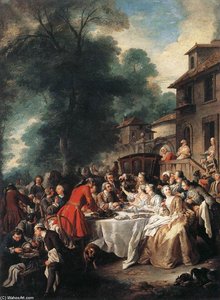
While adept at traditional portraiture, Jean-François de Troy is perhaps best remembered for his innovative *tableaux de mode* – “pictures of fashion.” These weren't simply portraits; they were vibrant snapshots of contemporary life, capturing the leisure activities, social customs, and opulent surroundings of the French upper class. Works like ‘Hunt Breakfast’ (1737) and ‘Luncheon with Oysters’ (1735) are prime examples, depicting scenes of refined indulgence and leisurely pursuits. These paintings weren't merely decorative; they offered a glimpse into the values and aspirations of the aristocracy, becoming highly sought-after status symbols in themselves. This unique genre allowed de Troy to showcase his skill in rendering textures – silks, satins, porcelain, and silver gleam with remarkable realism – and his ability to create dynamic compositions filled with subtle narrative details. He wasn’t simply painting people; he was painting a lifestyle.

Legacy and Enduring Influence

De Troy's influence extended beyond his own artistic output. As Director of the French Academy in Rome from 1738, he played a role in shaping the next generation of artists, though his tenure was marked by some controversy due to his personal indulgences. He trained numerous students, including his son, Jean-François de Troy (the younger), as well as André Bouys and John Closterman, passing on his technical expertise and artistic sensibilities. His work continued to be admired throughout the 18th century, influencing portraiture and genre painting across Europe. Though he faced some setbacks later in life – a recall from Rome due to personal conflicts – his contribution to French art remains significant. He died in Paris in 1730 at the age of eighty-five, leaving behind a legacy of elegant portraits, captivating *tableaux de mode*, and a lasting impact on the artistic landscape of his time. His paintings continue to be celebrated for their technical brilliance, insightful social commentary, and enduring beauty – testaments to a life dedicated to capturing the splendor of an era. His work offers a fascinating window into the world of the French aristocracy, revealing not only how they looked but also how they lived.