Portrait of Wassily Kandinsky

The 100 Most Famous Wassily Kandinsky Paintings, a Gallery Selection

Updated November 2026 · ranked by our popularity score (searches, visits and orders for each work) · 729 works by Wassily Kandinsky in our catalogue

In short

Of all the originals Wassily Kandinsky left, the most famous is Composition VII (1913), in the collection of the Tretyakov Gallery, Moscow. Close behind it come The blue horseman and Yellow, Red, Blue (1925). Our catalog holds 729 works by Wassily Kandinsky; the gallery has kept the 100 the world admires most, each shown with its date, its museum and its story.

1866 – 1944, Moscow Expressionism Most works: Centre Pompidou

Wassily Kandinsky's top 10 paintings: the gallery's choice

1
Composition VII (1913) by Wassily Kandinsky

Composition VII

1913 · Oil On Canvas · Tretyakov Gallery, Moscow

Painted in 1913, this iconic work represents a pivotal moment in the evolution of abstract art and stands as Wassily Kandinsky’s most ambitious compositional statement before his return to Russia. Far from being merely a colorful arrangement, it is a deeply considered exploration of spiritual resonance and emotional power, embodying Kandinsky's belief that painting could – and should – express “inner necessity.” This large-scale canvas transcends representational form, inviting viewers…

2
The blue horseman by Wassily Kandinsky

The blue horseman

Oil On Canvas

A Pastoral Vision: Decoding Kandinsky’s ‘The Blue Horseman’ Wassily Kandinsky's *The Blue Horseman* is a captivating example of early Expressionism, bridging the gap between representational imagery and the burgeoning abstract style that would define much of his later work. This oil painting isn’t merely a depiction of a landscape; it’s an evocation of feeling, a glimpse into a spiritual realm filtered through the lens of nature. Subject & Composition: A…

3
Yellow, Red, Blue (1925) by Wassily Kandinsky

Yellow, Red, Blue

1925 · Oil On Canvas · Centre Pompidou, Paris

Dynamic Abstraction: A Masterpiece of Color and Form Wassily Kandinsky's "Yellow, Red, Blue" (1925) is a vibrant testament to the power of abstract art. This dynamic composition captures the essence of modernism through its bold use of color, geometric shapes, and expressive lines. As one of Kandinsky's most celebrated works, it embodies his pioneering spirit in abstract painting and remains a cornerstone of 20th-century art. Exploring Abstract Expression Kandinsky's "Yellow,…

4
Composition VIII (1923) by Wassily Kandinsky

Composition VIII

1923 · Oil On Canvas · Solomon R. Guggenheim Museum, New York City

“Composition VIII” (1923) by Wassily Kandinsky is a landmark achievement in abstract art, radiating an energetic dynamism that continues to captivate viewers nearly a century after its creation. Measuring 140 x 201 cm, this large-scale canvas isn’t merely a painting; it's a visual exploration of inner necessity – Kandinsky’s belief that art should spring from the artist’s spiritual and emotional core.

5
Improvisation. Gorge (1914) by Wassily Kandinsky

Improvisation. Gorge

1914 · Oil On Canvas · Stadtische Galerie in Lenbach, Munich

“Improvisation. Gorge” (1914) by Wassily Kandinsky is a seminal work representing a pivotal moment in the evolution of abstract art. This dynamic composition, bursting with energy and emotion, transcends mere representation to become a powerful expression of inner experience. Currently housed at the Städtische Galerie im Lenbachhaus, Munich, this painting exemplifies Kandinsky’s groundbreaking theories connecting color and spirituality.

6
On White II (1923) by Wassily Kandinsky

On White II

1923 · Oil On Canvas · Centre Pompidou, Paris

“On White II” (1923) by Wassily Kandinsky is a pivotal work in the evolution of abstract art, representing a mature expression of his lifelong exploration into the spiritual power of color and form. This dynamic composition, measuring 105 x 98 cm, isn’t about depicting the visible world; it's an invitation to experience pure feeling through visual language.

7
Composition X by Wassily Kandinsky

Composition X

Oil On Canvas · Kunstsammlung Nordrhein-Westfalen, Duesseldorf

"Composition X" is a vibrant and dynamic abstract composition that exudes energy and movement. This captivating artwork showcases Wassily Kandinsky's mastery of color, form, and line, inviting viewers into a world of pure abstraction where emotions and spirituality intertwine.

8
First Abstract Watercolor, Collection of Mad (1910) by Wassily Kandinsky

First Abstract Watercolor, Collection of Mad

1910 · Watercolor

Vibrant Abstraction: A Pioneering Work of Modern Art Wassily Kandinsky's *First Abstract Watercolor* is a landmark piece in the history of modern art, marking his transition into pure abstraction. Created in 1910, this dynamic composition embodies the artist's revolutionary approach to color and form, capturing the essence of his avant-garde vision. Style and Technique: A Dance of Color and Form This abstract watercolor is characterized by its loose, free-form composition…

9
Composition IX (1936) by Wassily Kandinsky

Composition IX

1936 · Oil On Canvas · Centre Pompidou, Paris

The Essence of Abstraction Wassily Kandinsky's *Composition IX* (1936) is a masterpiece of abstract art that captures the essence of pure visual expression. This vibrant and dynamic composition exudes energy and movement, making it a captivating addition to any modern art collection or contemporary interior. A Symphony of Color and Form Kandinsky's *Composition IX* is a riot of color and form, featuring a bold palette of yellows, reds, blues, greens,…

10
Improvisation 28 (second version) by Wassily Kandinsky

Improvisation 28 (second version)

Oil On Canvas · Solomon R. Guggenheim Museum, New York

Vibrant Abstraction: A Dance of Color and Form Immerse yourself in the electrifying world of abstract expressionism with this captivating artwork by Wassily Kandinsky. Bursting with vibrant hues and dynamic forms, this piece is a testament to Kandinsky's pioneering spirit and his ability to evoke emotion through pure abstraction. Style and Technique: The Birth of Abstract Expressionism Kandinsky, a pioneer of abstract art, created this masterpiece during a period of…

The Wassily Kandinsky selection continues, 11 to 100

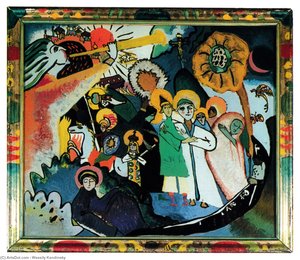
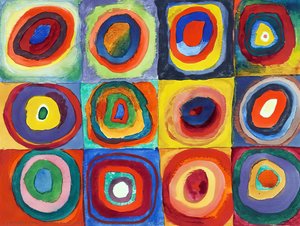
11All Saints day I (1911) by Wassily KandinskyAll Saints day I1911 12Arabs I (Cemetery) (1909) by Wassily KandinskyArabs I (Cemetery)1909 · Hamburger Kunsthalle 13Interior (My dining room) (1909) by Wassily KandinskyInterior (My dining room)1909 14Glass Painting with the Sun (Small Pleasures) (1910) by Wassily KandinskyGlass Painting with the Sun (Small Pleasures)1910 15Gabriele Münter painting in Kallmunz (1903) by Wassily KandinskyGabriele Münter painting in Kallmunz1903 · Lenbachhaus 16Several Circles, Solomon R. G (1926) by Wassily KandinskySeveral Circles, Solomon R. G1926 · Solomon R. Guggenheim Museum 17Softened Construction by Wassily KandinskySoftened Construction 18Street in Murnau with Women by Wassily KandinskyStreet in Murnau with Women 19Study for the Cover of Der Blaue Reiter Almanach (1911) by Wassily KandinskyStudy for the Cover of Der Blaue Reiter Almanach1911 · Centre Pompidou 20Study for ''Composition VII'' (1913) by Wassily KandinskyStudy for ''Composition VII''1913 21White Black Arch by Wassily KandinskyWhite Black Arch 22Winter Landscape (1909) by Wassily KandinskyWinter Landscape1909 · Hermitage Museum 23La Calleja Grün en Murnau by Wassily KandinskyLa Calleja Grün en Murnau 24Composition VI (1913) by Wassily KandinskyComposition VI1913 25Akhtyrka. A Datcha close to the pond (1917) by Wassily KandinskyAkhtyrka. A Datcha close to the pond1917 · Centre Pompidou 2607 riding couple by Wassily Kandinsky07 riding couple 27Composition X (1939) by Wassily KandinskyComposition X1939 28Drawing for Point and Line to Plane (1925) by Wassily KandinskyDrawing for Point and Line to Plane1925 · Centre Pompidou 29Abschied (small version) (Goodbye) (1903) by Wassily KandinskyAbschied (small version) (Goodbye)1903 · Centre Pompidou 30Murnau with Rainbow, , Gabriele Münter Founda (1909) by Wassily KandinskyMurnau with Rainbow, , Gabriele Münter Founda1909 31Color Study of Squares and Circles (1913) by Wassily KandinskyColor Study of Squares and Circles1913 · City Gallery in Lenbachhous 32The blue rider, Ernst Bührle Collection, Zür (1903) by Wassily KandinskyThe blue rider, Ernst Bührle Collection, Zür1903 33Tunis, Strasse (Tunis, Street) (1905) by Wassily KandinskyTunis, Strasse (Tunis, Street)1905 · Centre Pompidou 34Orange-Violet (1935) by Wassily KandinskyOrange-Violet1935 · Solomon R. Guggenheim Museum 35Improvisation (Dreamy) (1913) by Wassily KandinskyImprovisation (Dreamy)1913 · Bavarian State Painting Collections 36An Intimate Party (1942) by Wassily KandinskyAn Intimate Party1942 · Centre Pompidou 37A mountain (1909) by Wassily KandinskyA mountain1909 38Murnau with a church by Wassily KandinskyMurnau with a churchLenbachhaus 39Small dream in red (1925) by Wassily KandinskySmall dream in red1925 40Orientalisches (Oriental) (1911) by Wassily KandinskyOrientalisches (Oriental)1911 · Centre Pompidou 41Vögel (Birds) (1916) by Wassily KandinskyVögel (Birds)1916 · Centre Pompidou 42Nine Elements of Chromatique Circle (1928) by Wassily KandinskyNine Elements of Chromatique Circle1928 · Centre Pompidou 43Kochel - Waterfall II (1902) by Wassily KandinskyKochel - Waterfall II1902 44Ludwigkirche in Murnau (1908) by Wassily KandinskyLudwigkirche in Murnau1908 · Thyssen-Bornemisza Museum 45München, Nördlicher Friedhof (Munich, The Northern Cemetary) (1903) by Wassily KandinskyMünchen, Nördlicher Friedhof (Munich, The Northern Cemetary)1903 · Centre Pompidou 46Last watercolour (1944) by Wassily KandinskyLast watercolour1944 47Munich - English Garden (also known as English Garden in Munich) (1901) by Wassily KandinskyMunich - English Garden (also known as English Garden in Munich)1901 · Lenbachhaus 48Several Circles (1926) by Wassily KandinskySeveral Circles1926 49Improvisation. Klamm Ravine by Wassily KandinskyImprovisation. Klamm Ravine 50Autumn in Bavaria by Wassily KandinskyAutumn in BavariaCentre Pompidou 51Study for Im Schwarzen Viereck (1923) by Wassily KandinskyStudy for Im Schwarzen Viereck1923 · Centre Pompidou 52Houses at Murnau (1909) by Wassily KandinskyHouses at Murnau1909 53Park von Saint-Cloud, Waldlichtung (Saint-Cloud Park, clearing) (1907) by Wassily KandinskyPark von Saint-Cloud, Waldlichtung (Saint-Cloud Park, clearing)1907 · Centre Pompidou 54Painting with Troika (1911) by Wassily KandinskyPainting with Troika1911 · Art Institute of Chicago 55Lyrical (Lyrics) (1911) by Wassily KandinskyLyrical (Lyrics)1911 56Black Triangle (1925) by Wassily KandinskyBlack Triangle1925 · Museum Boijmans Van Beuningen 57Red Oval (1920) by Wassily KandinskyRed Oval1920 58Two green dots by Wassily KandinskyTwo green dots 59Hard in soft (1927) by Wassily KandinskyHard in soft1927 · Sezon Museum of Modern Art 60Study for Chacun pour soi (1934) by Wassily KandinskyStudy for Chacun pour soi1934 · Centre Pompidou 61Ravine Improvisation by Wassily KandinskyRavine Improvisation 62Improvisation No. 20 (1911) by Wassily KandinskyImprovisation No. 201911 · Pushkin State Museum 63Painting with White Form (1913) by Wassily KandinskyPainting with White Form1913 · Kunstmuseum Den Haag 64Image with a White Shape (1913) by Wassily KandinskyImage with a White Shape1913 · Kunstmuseum Den Haag 65Study for ''Circles on Black'' (1921) by Wassily KandinskyStudy for ''Circles on Black''1921 66Unfinished Painting (1944) by Wassily KandinskyUnfinished Painting1944 · Centre Pompidou 67Horses (1909) by Wassily KandinskyHorses1909 68Kochel, Mountain Meadow (1902) by Wassily KandinskyKochel, Mountain Meadow1902 · Centre Pompidou 69Color triangle (1933) by Wassily KandinskyColor triangle1933 · Getty Research Institute 70Improvisation No. 2 Funeral March (study) (1909) by Wassily KandinskyImprovisation No. 2 Funeral March (study)1909 · Lenbachhaus 71Kochel - Straight road (1909) by Wassily KandinskyKochel - Straight road1909 · Lenbachhaus 72View of Murnau (1908) by Wassily KandinskyView of Murnau1908 · Hermitage Museum 73Abstract Interpretation (1925) by Wassily KandinskyAbstract Interpretation1925 · Yale University Art Gallery 74Landscape with Two Poplars (1912) by Wassily KandinskyLandscape with Two Poplars1912 · Art Institute of Chicago 75Bild II. Gnomus (Painting II. Gnomus) (1928) by Wassily KandinskyBild II. Gnomus (Painting II. Gnomus)1928 · Centre Pompidou 76Isolated Sounds (1927) by Wassily KandinskyIsolated Sounds1927 · Centre Pompidou 77First Study for Einige Kreise (1926) by Wassily KandinskyFirst Study for Einige Kreise1926 · Centre Pompidou 78St. George and the dragon by Wassily KandinskySt. George and the dragon 79Improvisation 19a (1911) by Wassily KandinskyImprovisation 19a1911 · Lenbachhaus 80Improvisation No. 7 (Storm) (1910) by Wassily KandinskyImprovisation No. 7 (Storm)1910 · Yale University Art Gallery 81Untitled Improvisation III (1914) by Wassily KandinskyUntitled Improvisation III1914 · Los Angeles County Museum of Art 82Murnau Landscape by Wassily KandinskyMurnau Landscape 83Kochel - Gabriele Münter (1902) by Wassily KandinskyKochel - Gabriele Münter1902 84Rainy landscape by Wassily KandinskyRainy landscapeSolomon R. Guggenheim Museum 85Decisive Pink (1932) by Wassily KandinskyDecisive Pink1932 · Solomon R. Guggenheim Museum 86Pequeños mundos VI by Wassily KandinskyPequeños mundos VI 87Storeys, oil on cardboard, Solomon R. Guggen (1929) by Wassily KandinskyStoreys, oil on cardboard, Solomon R. Guggen1929 88Impression VI (Sunday) (1911) by Wassily KandinskyImpression VI (Sunday)1911 · Lenbachhaus 89Conglomerat (1943) by Wassily KandinskyConglomerat1943 · Centre Pompidou 90Pink Compensation (1933) by Wassily KandinskyPink Compensation1933 · Centre Pompidou 91Two Squares (1930) by Wassily KandinskyTwo Squares1930 · Centre Pompidou 92Improvisation 5 by Wassily KandinskyImprovisation 5 93Study for Composition VII by Wassily KandinskyStudy for Composition VII 94Landscape with red spots (1913) by Wassily KandinskyLandscape with red spots1913 95Study for Auf Weiss II (1922) by Wassily KandinskyStudy for Auf Weiss II1922 · Centre Pompidou 96Akhtyrka, Landscape with Red Church (1917) by Wassily KandinskyAkhtyrka, Landscape with Red Church1917 · Centre Pompidou 97St. Georg III (1911) by Wassily KandinskySt. Georg III1911 · Lenbachhaus 98Sign (1925) by Wassily KandinskySign1925 · Los Angeles County Museum of Art 99Little Painting with Yellow (Improvisation) (1914) by Wassily KandinskyLittle Painting with Yellow (Improvisation)1914 · Philadelphia Museum of Art 100White Sharpness (1930) by Wassily KandinskyWhite Sharpness1930 · Museum Boijmans Van Beuningen

Wassily Kandinsky's famous paintings, period by period

The subjects that held Wassily Kandinsky's eye

The four subjects that come back most often in these originals, each with its finest example.

The museums that keep Wassily Kandinsky's originals

The 8 museums that hold the most of the paintings on this page.

Museum City Works by Wassily Kandinsky Paintings from this list
Centre Pompidou, ParisCentre Pompidou Paris 176 Yellow, Red, Blue, On White II, Composition IX
Lenbachhaus, MunichLenbachhaus Munich 57 Gabriele Münter painting in Kallmunz, Murnau with a church, Munich - English Garden (also known as English Garden in Munich)
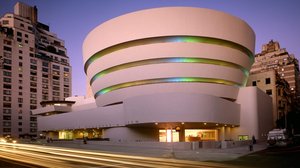
Solomon R. Guggenheim Museum, New YorkSolomon R. Guggenheim Museum New York 50 Improvisation 28 (second version), Orange-Violet, Rainy landscape
Museum Boijmans Van Beuningen, RotterdamMuseum Boijmans Van Beuningen Rotterdam 11 Black Triangle, White Sharpness
Hermitage Museum, Saint PetersburgHermitage Museum Saint Petersburg 5 Winter Landscape, View of Murnau
Art Institute of Chicago, ChicagoArt Institute of Chicago Chicago 5 Painting with Troika, Landscape with Two Poplars
Kunstmuseum Den Haag, The HagueKunstmuseum Den Haag The Hague 5 Painting with White Form, Image with a White Shape
Yale University Art Gallery, New HavenYale University Art Gallery New Haven 4 Abstract Interpretation, Improvisation No. 7 (Storm)

Wassily Kandinsky decade by decade: the original that defines each

Works per decade

Pick a decade to see the original that defines it.

Collectors' questions about Wassily Kandinsky's paintings

Which work is Wassily Kandinsky most famous for?Reveal the answer

Composition VII (1913), Tretyakov Gallery, Moscow. The blue horseman and Yellow, Red, Blue (1925) come next.

What age was Wassily Kandinsky when Composition VII was made?Reveal the answer

47 years old: Composition VII dates from 1913, and Wassily Kandinsky was born in 1866.

What are the ten most famous Wassily Kandinsky paintings?Reveal the answer

Composition VII, The blue horseman, Yellow, Red, Blue, Composition VIII, Improvisation. Gorge, On White II, Composition X, First Abstract Watercolor, Collection of Mad, Composition IX and Improvisation 28 (second version). The ranking above gives each one's year and museum.

How many paintings did Wassily Kandinsky leave?Reveal the answer

Our catalog holds 729 works by Wassily Kandinsky, dated from 1901 to 1944.

In which museums do Wassily Kandinsky's masterpieces hang?Reveal the answer

Mostly in Centre Pompidou (Paris), Lenbachhaus (Munich) and Solomon R. Guggenheim Museum (New York). The museum table above lists them all.

In which years did Wassily Kandinsky paint the most famous works?Reveal the answer

In 1910s: 27 of the 100 works on this page were made then, Composition VII among them.

What are the first and the last famous originals of Wassily Kandinsky?Reveal the answer

On this page, the earliest is Munich - English Garden (also known as English Garden in Munich) (1901) and the latest Last watercolour (1944).

Which subjects did Wassily Kandinsky choose most often?Reveal the answer

Geometric shapes (25), Landscape (20) and Spirituality (17), across the 100 works on this page.

Which technique did Wassily Kandinsky use most?Reveal the answer

Oil On Canvas, for 53 of the 100 works on this page.

To which art movement does Wassily Kandinsky belong?Reveal the answer

Expressionism, judging by the originals on this page.

Which Wassily Kandinsky works hang at the Centre Pompidou?Reveal the answer

Yellow, Red, Blue, On White II and Composition IX: the Centre Pompidou, Paris holds 27 of the works on this page.

Wassily Kandinsky: life and work

Early Life and Academic Training

Wassily Wassilyevich Kandinsky was born in Moscow to Lidia Ticheeva and Vassily Silvestrovich Kandinsky. His early years were shaped by the sounds of music, as he spent time studying the piano and the cello. These early lessons in rhythm and sound would stay with him long after he left his childhood home.

His path did not lead immediately to a canvas. Instead, he pursued a formal education at the University of Moscow, where he focused on law, economics, and ethnography. He eventually took a position as a lecturer after graduating. It was not until he reached the age of 30 that he began his formal painting studies, shifting his focus from the study of social and legal structures to the physical act of drawing and sketching.

This shift brought him to Munich. There, he sought out more rigorous training at the Anton Ažbe School and the Academy of Fine Arts. He spent his time there learning the mechanics of form and the way light interacts with objects, moving away from his previous academic life to settle into the life of a student of art.

The Transition to Artistic Life

The shift began in 1896 during an exhibition in Moscow. Seeing Claude Monet’s “Haystacks” changed the way he perceived light and color. This encounter with Impressionism sparked a deep, persistent pull toward painting. It was a quiet redirection of a life once focused on the structured world of law and economics. The pull of the canvas proved stronger than the stability of his academic path.

He eventually left his position as a professor of law at Dorpat University to follow this new impulse. By about 1896, he had moved to Munich to begin formal studies in art. He sought out the Anton Ažbe School and the Academy of Fine Arts to learn the mechanics of his chosen craft. The transition was a move from the lecture hall to the studio, trading legal theory for the study of form and pigment.

The Murnau Period and Expressionism

In 1901, Kandinsky met the artist Gabriele Münter. Their connection grew as they shared a focus on the expressive power of color. By 1909, they had bought a house in Murnau. This setting provided the backdrop for a landscape series, where the shapes of the natural world began to shift. The works from this time carry the weight of his earlier studies, particularly the influence of Russian folk art. He used bright colors against dark backgrounds, a habit that spoke of his roots in the traditions of his youth.

The landscapes of Murnau were not mere copies of the scenery. He looked at the hills and the houses through a lens that favored emotional intensity over literal accuracy. The colors became more assertive, moving away from the quietude of traditional representation. He sought a way to make the canvas pulse with a sense of life, using the landscape as a starting point for something more internal. The brushstrokes grew broader, and the boundaries between objects began to soften.

  • Murnau. Landscape with Green House (1909)

The Blue Rider and Abstraction

In Munich, the focus shifted toward a new way of seeing. Kandinsky co-founded the Der Blaue Reiter (The Blue Rider) group, a circle that sought to move beyond the surface of things. This period saw him closely linked with the Expressionism movement, where the goal was to find a visual language for the internal spirit. He began to move away from the recognizable shapes of the landscape, favoring a style that prioritized the emotional weight of color and form. This was a departure from the literal world, leaning instead into the non-objective.

His work became a study in how a line or a hue could act like a musical note. He was a pioneer of the abstract art movement, stripping away the need for a subject to be a recognizable object. Instead, he focused on the interplay of shapes and the way they could communicate without a direct reference to nature. This development of non-representational painting was not a sudden break but a steady movement toward the essence of feeling. The canvas became a space for pure composition, where the arrangement of elements spoke directly to the viewer's intuition.

Teaching and the Bauhaus Years

After his time in Russia, where he served as the first director of the Institute of Artistic Culture in Moscow, Kandinsky moved toward the academic circles of Germany. In 1921, he was invited to attend the Bauhaus in Weimar. This period marked a shift toward a more structured exploration of how color and form interact on the canvas. He spent much of his time there, teaching at the Bauhaus school of art and architecture from 1922 until 1933.

His presence in the classroom was defined by a focus on the mechanics of visual language. He looked at the way a circle or a line could carry weight and meaning without needing to resemble a physical object. This was a time of experimentation with geometry and the psychological impact of specific hues. The work from these years often carries a sense of precision, moving away from the fluid, organic shapes of his earlier years toward a more calculated arrangement of elements.

The era of his teaching came to an abrupt end when the Nazi regime closed the Bauhaus in 1933. This forced a departure from the structured environment of the school and led him toward a new chapter in France. His time in Germany had been a period of deep theoretical development, where the abstract became a way to map the internal landscape of the mind.

Later Years and Final Residence

The closure of the Bauhaus in 1933 prompted a move toward France. He settled there and remained in the country from 1933/1934 until his death. During this time, his connection to his adopted home deepened, and he became a French citizen in 1939.

His final years were spent in this French landscape, continuing to work with the layered impasto techniques that gave his canvases a physical, textured presence. One such piece from this period is An Intimate Party (1942). He passed away on 13 December 1944.

Key Works and Artistic Milestones

Looking closely at his early output, one finds the roots of his shift toward abstraction. In 1903, he painted The Blue Rider, a work where a dark-blue cloaked figure rides a horse through a sparse, verdant landscape. This piece captures a moment of transition, where the recognizable forms of the world begin to lose their grip to the pull of color. His brushwork during this time often used broad strokes, hinting at the non-objective directions his work would eventually take.

As his focus moved toward geometric precision and the interplay of form, his compositions became more structured. In 1923, he produced Composition VIII, a work defined by the interaction of circles and lines. By 1925, his palette had shifted again in Yellow, Red, Blue, where the colors themselves became the primary subject. These years show a steady movement away from the landscapes of his youth toward a language of pure shape and hue. Even in his later years, the experimentation continued; Composition X was created about 1939, showing the continued evolution of his visual vocabulary.

Where to See His Works Today

His canvases are scattered across several major institutions, inviting a close look at how his use of color and form evolved. In Paris, the Centre Pompidou holds many of his paintings, offering a chance to see his shift toward non-objective compositions. The Solomon R. Guggenheim Museum in New York City also maintains a collection of his works, including pieces from his more geometric phases.

In Munich, the Lenbachhaus contains a significant selection of his paintings, reflecting his time with the Blue Rider group. For those looking to see his large-scale, complex arrangements, the Tretyakov Gallery in Moscow houses his monumental "Composition VII." These locations provide different perspectives on his development, from his early expressive landscapes to his later, more structured abstractions.