Switch to Print
 Read More







































 For artworks or reproductions larger than 105 cm (approximately 41 inches) on any side, the frame will be shipped as a kit, disassembled. This method ensures safe delivery and prevents damage during transport.


A Symphony of Form and Color: Exploring Kandinsky’s 1923 Masterpiece
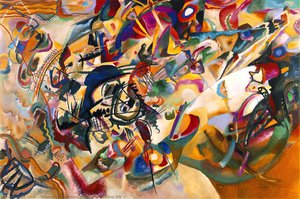
“Composition VIII” (1923) by Wassily Kandinsky is a landmark achievement in abstract art, radiating an energetic dynamism that continues to captivate viewers nearly a century after its creation. Measuring 140 x 201 cm, this large-scale canvas isn’t merely a painting; it's a visual exploration of inner necessity – Kandinsky’s belief that art should spring from the artist’s spiritual and emotional core.
The Birth of Non-Objective Painting
Created during Kandinsky’s influential tenure at the Bauhaus school, “Composition VIII” exemplifies his mature style. Having pioneered abstract art alongside artists like Piet Mondrian, Kandinsky moved away from representational imagery entirely, believing that pure form and color could evoke emotions and spiritual truths directly. This work is a pivotal example of non-objective painting – an artwork devoid of recognizable objects or scenes, existing solely as an arrangement of visual elements.
Deconstructing the Visual Language
The canvas pulsates with a complex interplay of geometric shapes: circles, triangles, squares, and lines dance across a pale background. These aren’t rigid forms; they appear to float and interact, creating a sense of movement and depth despite the absence of traditional perspective. Kandinsky masterfully employs contrasting colors – fiery reds and yellows juxtaposed against cool blues and greens – enhancing the painting's visual energy. Notice the subtle textures within some shapes, hinting at brushwork and adding nuance to the otherwise flat planes.
Musicality and Spiritual Resonance
Kandinsky famously sought to translate musical principles into visual terms. He believed colors possessed inherent emotional qualities akin to musical notes, and “Composition VIII” embodies this synesthetic approach. The arrangement of shapes and colors can be perceived as a visual score, evoking a sense of rhythm, harmony, and even dissonance. Beyond the purely aesthetic, many interpret the work as an exploration of spiritual themes – a search for underlying order within apparent chaos.
Technique and Materials
Executed in oil on canvas, “Composition VIII” showcases Kandinsky’s meticulous technique. He layered colors with precision, avoiding blending or softening edges to maintain sharp contrasts and clarity between forms. This deliberate approach contributes to the painting's vibrant intensity and sense of controlled energy. The absence of traditional modeling further emphasizes the flatness of the picture plane, reinforcing its abstract nature.
A Statement Piece for Modern Interiors
“Composition VIII” is more than just a historical artifact; it’s a powerful statement piece that can transform any interior space. Its bold colors and dynamic composition inject energy and sophistication into modern living rooms, offices, or art collections. A high-quality reproduction allows you to experience the emotional impact of this groundbreaking artwork firsthand, bringing a touch of artistic innovation and spiritual depth into your environment.
Historical Context & Legacy
Painted in 1923, “Composition VIII” reflects the post-World War I era’s search for new forms of expression. Kandinsky's work profoundly influenced subsequent generations of artists, solidifying his place as a central figure in the development of abstract art and modernism. Today, it resides in the State Tretyakov Gallery in Moscow, continuing to inspire and challenge viewers worldwide.
Questions & Answers
What is the color identity of "Composition VIII" by Wassily Wassilyevich Kandinsky?
"Composition VIII" by Wassily Wassilyevich Kandinsky uses a neutrals palette, with putty (#e8e3da) as the dominant color.
What luminance does "Composition VIII" by Wassily Wassilyevich Kandinsky have?
The luminance recorded for "Composition VIII" by Wassily Wassilyevich Kandinsky is luminous.
Where does "Composition VIII" fall in Wassily Wassilyevich Kandinsky's career?
"Composition VIII" represents the Mature Period of Wassily Wassilyevich Kandinsky.
More about this painting
 Preview
 Send
Send Share
Share
 Details
 Guide
Guide

 Download
 Similars
 X-Ray
X-Ray Diaporama
 Q&A
Q&A Stats
Stats Top100