Introduction
Imagine a world stripped bare to its essential forms – lines, colors, and shapes resonating with an almost mathematical purity. This is the realm of Geometric Abstraction, a movement that dared to abandon representational art in favor of a visual language rooted in structure and feeling. These weren’t artists rejecting reality; they were seeking a deeper truth within it, a universal order expressed through the elegant simplicity of geometry.
Emerging in the early 20th century – particularly after World War I – Geometric Abstraction arose from a confluence of factors. The horrors of war shattered traditional notions of beauty and representation, prompting artists to explore new ways of expressing themselves. Simultaneously, advancements in science and mathematics revealed hidden patterns and structures within the universe, inspiring a fascination with order and logic. Piet Mondrian, Kazimir Malevich, and others began dismantling recognizable forms, reducing their subjects to fundamental geometric elements. This wasn’t merely an aesthetic choice; it was a philosophical one – a belief that art could transcend the particular and connect with something eternal.
The cultural landscape of the time—with its burgeoning industrialization, technological innovation, and spiritual questioning—fueled this artistic revolution. Artists sought to create a new visual vocabulary that reflected the modern age, free from the constraints of tradition. They believed that abstract forms could evoke emotions and ideas with greater intensity than representational imagery, speaking directly to the subconscious mind.
But why do these works continue to captivate us today? Beyond their historical significance, these masterpieces offer a sanctuary from chaos—a space for contemplation and emotional resonance. They remind us of the power of simplicity, the beauty of balance, and the enduring human quest for meaning in an increasingly complex world. The clean lines and bold colors can feel both calming and invigorating, inviting us to find our own interpretations within their structured compositions.
Over the following pages, we’ll embark on a journey through ten defining works of Geometric Abstraction—each a testament to the movement's enduring legacy. Prepare to be transported into a world where form is feeling, and abstraction is liberation."
"Composition (no. III) blanc-jaune / Composition with Red, Yellow, and Blue - Piet Mondrian
 Composition (no. III) blanc-jaune / Composition with Red, Yellow, and Blue - Piet Mondrian
Amidst the chaos of wartime New York City, while many artists grappled with despair, Piet Mondrian meticulously constructed a universe of order – Composition with Red, Yellow, and Blue (1942). This wasn’t merely painting; it was an act of defiant creation, a belief in harmony amidst global conflict.
The artwork embodies the core principles of De Stijl, Mondrian's revolutionary movement. He stripped away all representational elements, reducing his visual vocabulary to straight lines and squares of primary color. The resulting grid isn’t random; it’s a carefully calibrated balance – yellow anchoring the left side, blue providing counterweight on the right, with strategically placed red punctuating the composition. This asymmetrical arrangement achieves a remarkable sense of serenity despite its stark simplicity.
Mondrian's technique was as deliberate as his design. Thin layers of oil paint were applied to primed canvas, creating matte surfaces that emphasize form over texture. He wasn’t interested in expressive brushwork; he sought pure abstraction – a visual language free from subjective emotion. For Mondrian, these weren’t just colors and shapes; they held symbolic weight, representing spiritual energy and the underlying order of the universe.
Imagine this artwork gracing your home office or study. Its clean lines and balanced composition foster focus and clarity – a visual reminder to approach challenges with structure and intention. Composition with Red, Yellow, and Blue isn’t just a masterpiece of Geometric Abstraction; it's an invitation to cultivate a productive, sophisticated atmosphere, inspired by the enduring power of pure form."
"Passionflower - Piet Mondrian
 Passionflower - Piet Mondrian
To gaze upon these ten masterpieces is to enter a world stripped bare, yet brimming with profound emotion. It’s a realm where color and form reign supreme, liberated from the constraints of representation – a testament to the power of pure abstraction. These works aren't simply paintings ; they are visual poems, coded languages spoken through the precise angles of lines, the vibrant clash of hues, and the delicate balance of space.
Geometric Abstraction emerged in the early 20th century, a radical departure from centuries of artistic tradition. Born from the fervor of post-WWI disillusionment and fueled by the utopian ideals of artists seeking a universal visual language, it rejected the imitation of nature in favor of exploring fundamental geometric shapes – squares, circles, triangles, lines – as vehicles for expressing deeper truths. Influenced by movements like Cubism and Futurism, but ultimately forging its own path, Geometric Abstraction flourished across Europe, particularly in Russia with artists like Kazimir Malevich and Piet Mondrian, and later found fertile ground in the United States.
The cultural context was one of rapid change – technological advancements, philosophical shifts, and a growing desire to break free from established norms. Artists felt compelled to create something entirely new, reflecting the dynamism and fragmentation of modern life. They believed that these abstract forms could transcend individual experience and tap into universal principles of order and harmony.
But why do these works continue to resonate with us today? In a world saturated with imagery, they offer a moment of quiet contemplation, a space for the eye – and the mind – to wander. They challenge our perceptions, prompting us to look beyond surface appearances and engage with the underlying structure of reality. The enduring power of Geometric Abstraction lies in its ability to evoke emotion without relying on narrative or recognizable forms; it speaks directly to our senses, bypassing the intellect and connecting us to something primal and essential.
Over the following pages, we will embark on a journey through ten pivotal artworks that defined this groundbreaking movement. Prepare to be captivated by their bold simplicity, their subtle complexities, and their enduring legacy – a testament to the transformative power of art itself.
Arabian Princess - Paul Klee
 Arabian Princess - Paul Klee
Imagine stepping into a world stripped bare—a realm where color and form reign supreme, divorced from the familiar comforts of representation. This is the captivating universe of Geometric Abstraction, an art movement that irrevocably altered our perception of painting and sculpture. These weren't attempts to *depict* reality; they were explorations of reality’s underlying structure, its fundamental building blocks.
Born in the early 20th century—a period of rapid industrialization, scientific discovery, and profound social upheaval—Geometric Abstraction arose from a desire to move beyond the subjective emotionalism of earlier styles. Artists like Piet Mondrian and Kazimir Malevich sought a universal visual language, one rooted in pure abstraction, mathematical precision, and spiritual resonance. The horrors of World War I fueled this quest for order and clarity; artists believed that by focusing on essential forms, they could create a more harmonious world.
Influenced by Cubism’s fragmentation of form and the burgeoning field of non-objective art, Geometric Abstraction quickly evolved into a diverse range of approaches. From Mondrian’s iconic grids to Malevich’s stark Suprematist compositions, these artists challenged conventional notions of beauty, representation, and even what constituted ‘art’ itself.
But why do these seemingly austere works continue to resonate so powerfully today? Because they tap into something deeply human—our innate desire for order, balance, and meaning. They invite us to slow down, to contemplate the interplay of color and shape, and to experience art not as a reflection of the external world, but as an internal journey. The clean lines and bold colors offer a sense of calm amidst chaos, while their intellectual rigor sparks curiosity and invites endless interpretation.
Over the next few moments, we’ll embark on a visual exploration of ten masterpieces that defined this groundbreaking movement. Each artwork represents a pivotal moment in the evolution of Geometric Abstraction—a testament to the power of pure form and its enduring legacy. Prepare to be captivated by a world where less truly is more.
Study for the - Fernand Léger
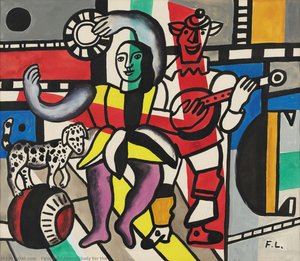 Study for the - Fernand Léger
Imagine stepping back from the representational world—from landscapes brimming with detail, portraits capturing fleeting emotion—and entering a realm of pure form and color. This is the invitation extended by Geometric Abstraction, an art movement that dared to distill reality into its most essential components: lines, shapes, and hues. These weren’t paintings *about* something; they were something – self-contained universes built on mathematical principles and a profound belief in the expressive power of abstraction.
Born in the early decades of the 20th century, Geometric Abstraction arose from a confluence of factors. The rapid industrialization of Europe, coupled with advancements in science and technology, prompted artists to question traditional modes of representation. Cubism, with its fractured perspectives, laid crucial groundwork, but where Cubism still clung to recognizable subject matter, Geometric Abstraction sought complete non-objectivity. Artists like Piet Mondrian and Kazimir Malevich, reacting against the perceived chaos of a changing world, believed that art could achieve a higher spiritual order through pure geometric forms – a visual language free from the constraints of narrative and illusion.
The movement flourished across Europe—in Russia with Suprematism, in the Netherlands with De Stijl, and in France with Orphism—each iteration possessing its own unique character. But at their core, these diverse strands shared a common ambition: to create art that resonated not through imitation, but through inherent visual qualities. Think of the cool precision of Mondrian’s grids, the dynamic energy of Malevich’s squares, or the vibrant interplay of Sonia Delaunay's colorful discs. These weren't simply aesthetic choices; they were explorations of rhythm, balance, and the very nature of perception.
Today, these masterpieces continue to captivate because they speak to something fundamental within us—a desire for order amidst complexity, a fascination with underlying structures, and an appreciation for beauty in its most distilled form. They remind us that art doesn’t need to depict the world to reflect it; it can become a world unto itself. Over the following pages, we will journey through ten pivotal works that defined Geometric Abstraction, each a testament to the enduring power of shape and color to move, inspire, and transform our understanding of what art can be.
Homage to the Square: Soft Spoken - Josef Albers
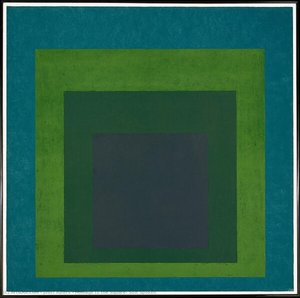 Homage to the Square: Soft Spoken - Josef Albers
To gaze upon these ten masterpieces is to enter a world stripped bare—a realm where form transcends representation, and color vibrates with pure energy. The Geometric Abstraction movement wasn’t merely a style; it was a profound philosophical shift, a visual echo of the burgeoning modern age's fascination with technology, mathematics, and the underlying structures of reality.
Born in the early 20th century, largely as a reaction against the subjective emotionalism of movements like Impressionism and Expressionism, Geometric Abstraction sought to distill art down to its essential elements: lines, shapes, and colors. Artists felt that by removing recognizable objects, they could tap into universal truths and create works that spoke directly to the intellect and spirit. The early pioneers—Kandinsky, Mondrian, Malevich—were not simply painting pretty pictures; they were constructing visual languages, exploring new dimensions of perception.
The historical context is crucial. This was an era defined by rapid industrialization, scientific breakthroughs (think Einstein’s theory of relativity), and a growing sense of fragmentation in the wake of World War I. Traditional values were being questioned, and artists responded by dismantling conventional forms and seeking new ways to represent a world that felt increasingly complex and abstract. The rise of photography also played a role; with cameras capable of realistically capturing images, painting no longer *needed* to be representational.
But why do these works continue to resonate today? In our own age of information overload and technological saturation, the clarity and precision of Geometric Abstraction offer a welcome respite. They remind us that beauty can be found in simplicity, order in chaos, and meaning beyond the visible world. These paintings aren’t about *what* they depict; they are about *how* they make you feel—the subtle interplay of colors, the dynamic tension between forms, the sense of harmony or discord they evoke.
Over the following pages, we will embark on a journey through ten pivotal artworks that defined this groundbreaking movement. Prepare to be challenged, inspired, and perhaps even transformed by the power of pure abstraction—a testament to the enduring human desire to find order, beauty, and meaning in the universe around us.
Blossoming - Paul Klee
 Blossoming - Paul Klee
To gaze upon these ten masterpieces is to enter a world stripped bare – a realm where color, form, and line reign supreme. The Geometric Abstraction movement, born from the fervent spirit of early 20th-century innovation, wasn’t merely a stylistic shift; it was a profound questioning of representation itself. Artists sought not to depict *what* they saw, but *how* they saw – reducing reality to its essential geometric components and exploring the pure, emotive power of abstraction.
Emerging in the aftermath of World War I, a period marked by societal upheaval and a rejection of traditional values, Geometric Abstraction found fertile ground in Russia with artists like Kazimir Malevich and his Suprematism, and quickly spread across Europe. The movement was deeply intertwined with broader cultural currents – the rise of industrialization, the fascination with technology, and a burgeoning interest in spirituality and non-objective art. Think of bustling cityscapes, the precision of machines, and the desire to create a universal visual language that transcended national boundaries.
These weren’t simply exercises in aesthetics; they were attempts to forge new ways of understanding the world, to express inner states of being through pure form. The sharp angles of Mondrian evoke a sense of order and balance, while Delaunay's vibrant color fields pulse with energy. Each canvas is a carefully constructed universe, inviting contemplation and offering a glimpse into the artist’s unique vision.
Today, these works continue to resonate because they tap into something fundamental about human perception – our innate ability to find beauty in simplicity, order in chaos, and meaning beyond representation. They challenge us to look closer, to feel more deeply, and to question the very nature of art itself. Prepare to embark on a journey through ten iconic paintings that not only defined a movement but continue to shape our understanding of modern art – and perhaps, even how we see the world around us.
Harmony in Blue = Orange - Paul Klee
 Harmony in Blue = Orange - Paul Klee
To gaze upon these ten masterpieces is to enter a realm where emotion finds form not in representation, but in the pure language of shape and color. The Geometric Abstraction movement, born from the fervor of early 20th-century experimentation, wasn’t merely a rejection of realism; it was a profound quest for a universal visual vocabulary – one that transcended cultural boundaries and spoke directly to the human spirit.
Emerging in the wake of World War I and fueled by advancements in mathematics and physics, artists like Piet Mondrian, Kazimir Malevich, and others sought to distill art down to its essential elements. The world was changing at an unprecedented pace; traditional notions of beauty and representation felt inadequate. In response, they turned inward, exploring the inherent power of lines, angles, and planes. This wasn’t about depicting *what* things looked like, but rather *how* we perceive them – the underlying structures that govern our visual experience.
The early pioneers, influenced by Cubism and Futurism, gradually shed recognizable forms, embracing pure abstraction. Their canvases became laboratories for exploring relationships between color, space, and composition. The movement flourished across Europe, evolving into distinct yet interconnected styles – from Mondrian’s rigorously ordered Neo-Plasticism to the dynamic Suprematism of Malevich. These artists weren't simply creating aesthetically pleasing arrangements; they were attempting to express spiritual truths, philosophical ideas, and a new understanding of reality itself.
But why do these works continue to resonate so powerfully today? In an age saturated with images, Geometric Abstraction offers a refreshing clarity – a moment of stillness amidst the chaos. The simplicity is deceptive; beneath the surface lies a complex interplay of forces, inviting contemplation and personal interpretation. These paintings aren’t static objects; they are portals to another dimension, capable of evoking a wide range of emotions and sparking profound insights.
Over the following pages, we will embark on a journey through ten pivotal artworks that defined this transformative movement. Prepare to be captivated by the elegance of form, the vibrancy of color, and the enduring power of pure abstraction – a testament to the human capacity for innovation and the boundless possibilities of artistic expression.
Composition London - Piet Mondrian
 Composition London - Piet Mondrian
To gaze upon these ten masterpieces is to enter a world stripped bare—a realm where color, form, and line reign supreme. The Geometric Abstraction movement wasn’t merely a style; it was a profound philosophical shift in how artists perceived reality itself. Emerging from the tumultuous currents of the early 20th century, born from the ashes of representational art and fueled by rapid industrialization and groundbreaking scientific discoveries, these works sought to distill the essence of experience into its purest visual components.
The early decades of the last century witnessed a rejection of traditional artistic conventions. Artists like Mondrian and Malevich questioned the very purpose of depicting the external world, believing that true meaning resided not in what was painted, but in how it was painted—in the fundamental elements of art itself. This wasn’t about abandoning beauty; rather, it was a quest for a new kind of beauty: one rooted in order, harmony, and universal principles.
Influenced by Cubism's fragmentation of form and a growing fascination with mathematics and spirituality, Geometric Abstraction sought to create artworks that were not windows onto another world, but self-contained realities—autonomous objects possessing their own internal logic and emotional resonance. The movement flourished across Europe, particularly in the Netherlands, Russia, and France, each region imbuing it with its unique character.
But why do these paintings continue to captivate us today? In a world saturated with imagery, they offer a sanctuary of clarity—a space for contemplation and introspection. They remind us that beauty can be found in simplicity, that order can emerge from chaos, and that art has the power to transcend the limitations of language and culture. They are not simply historical artifacts; they are living embodiments of a radical vision, continuing to challenge our perceptions and inspire new generations.
Over the following pages, we will embark on a journey through ten pivotal works that defined Geometric Abstraction—each a testament to the enduring power of form, color, and the human spirit. Prepare to be immersed in a world where lines dance, colors vibrate, and the very foundations of art are reimagined.
Eros - Paul Klee
 Eros - Paul Klee
To gaze upon these ten canvases is to enter a world stripped bare—a realm where color and form reign supreme, liberated from the constraints of representation. These are not windows onto another reality, but realities unto themselves, born from an audacious quest for pure visual expression. The masterpieces that define Geometric Abstraction represent a radical departure in art history, a turning away from depicting *what* we see towards exploring *how* we see.
Emerging in the early 20th century—a period of unprecedented technological advancement and societal upheaval—Geometric Abstraction arose as both a response to and reflection of its time. The fracturing of traditional perspectives brought about by Einstein’s theory of relativity, the dynamism of industrialization, and the spiritual search for underlying order all coalesced in the hands of artists like Piet Mondrian, Kazimir Malevich, and Josef Albers. They sought to distill art down to its essential elements: lines, shapes, colors—a visual language of universal resonance.
The movement wasn’t monolithic; it blossomed across Europe, taking distinct forms in Russia (Suprematism), the Netherlands (De Stijl), and France (Orphism). Yet, a common thread united these diverse approaches: a belief in the power of abstraction to transcend the material world and connect with something deeper—a spiritual or intellectual truth. These artists weren’t merely rejecting figuration; they were building a new visual vocabulary, one that prioritized harmony, balance, and the inherent qualities of form itself.
But why do these works continue to captivate us today? In an age saturated with images, their simplicity feels remarkably fresh—a quiet rebellion against noise and complexity. They invite contemplation, demanding that we slow down and engage with color and shape on a purely sensory level. More than just aesthetically pleasing compositions, they are testaments to the human spirit’s enduring desire for order, meaning, and beauty in an increasingly chaotic world.
Over the following pages, we will embark on a journey through ten pivotal works that illuminate the evolution of Geometric Abstraction—each canvas a landmark in this groundbreaking movement. Prepare to be challenged, inspired, and perhaps even transformed by the power of pure form.
The column - Paul Klee
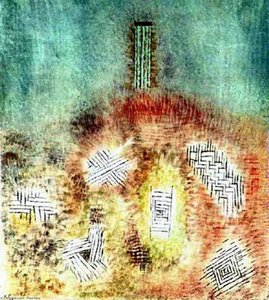 The column - Paul Klee
To gaze upon these ten masterpieces is to enter a world stripped bare—a realm where form transcends representation, and color vibrates with pure energy. The Geometric Abstraction movement wasn’t merely a style; it was a profound philosophical shift in how artists perceived reality itself. Emerging from the fertile ground of early 20th-century experimentation – Cubism's fractured planes, Futurism's dynamism, and Mondrian’s spiritual quest for harmony – these works sought to distill experience into its most essential components: lines, shapes, and hues.
Born in an era defined by rapid industrialization, technological advancement, and the looming shadow of global conflict, Geometric Abstraction reflected a desire for order and universality. Artists felt compelled to move beyond depicting the visible world, believing that true meaning lay not in imitation but in the inherent qualities of art itself. They sought a visual language that could bypass cultural barriers and speak directly to the intellect and emotions.
These weren’t cold, calculated exercises, however. Beneath the precise geometry lies a surprising depth of feeling—a yearning for spiritual connection, an exploration of psychological states, and a celebration of the very act of creation. Each canvas pulses with the artist's hand, their unique vision imprinted upon every surface.
Today, these works continue to resonate because they tap into something fundamental within us: our innate attraction to pattern, balance, and the power of pure form. They challenge us to see beyond the familiar, to question our assumptions about art and reality, and to find beauty in abstraction. Prepare to be captivated by a journey through ten defining moments—ten windows into a world where less is truly more.
Over the following pages, we’ll explore these pivotal artworks, delving into their historical context, artistic techniques, and enduring legacy. We invite you to slow down, observe closely, and allow yourself to be transported by the power of Geometric Abstraction.
Conclusion
To gaze upon these ten works is to witness not merely paintings, but the very unfolding of a new visual language. The story of Geometric Abstraction isn't one of imitation, but of liberation – a bold severing from representation and an embrace of pure form, color, and line.
Born in the early 20th century, amidst a world reeling from rapid industrialization and societal upheaval, this movement sought to distill art down to its essential elements. Artists like Mondrian, Malevich, and Kandinsky felt that traditional artistic conventions could no longer adequately express the complexities of modern life, or the spiritual yearning beneath it. They turned inward, exploring the power of abstraction as a means of communicating universal truths—a visual equivalent of music, free from the constraints of narrative.
The early decades saw a flourishing of experimentation, fueled by philosophical inquiries into perception and the nature of reality. From the Russian Constructivists’ utopian visions to the De Stijl movement's pursuit of harmonious order, Geometric Abstraction manifested in diverse yet interconnected forms. These artists weren’t simply rejecting the past; they were building something entirely new—a visual vocabulary that prioritized clarity, balance, and emotional resonance.
What makes these masterpieces endure is their remarkable ability to transcend time and context. They invite us to slow down, to look beyond the surface, and to engage with art on a purely sensory level. The interplay of shapes, the vibrancy of color, the subtle nuances of composition—these are not arbitrary choices, but carefully considered elements designed to evoke feeling, provoke thought, and awaken our inner vision.
As we embark on this journey through ten defining works, prepare to encounter a world where lines dance, colors sing, and form itself becomes the subject. These paintings aren’t just objects to be admired; they are portals—invitations to explore the boundless possibilities of abstraction and the enduring power of human creativity.