Portrait of Quinten Metsys

The 100 Most Famous Quinten Metsys Paintings, a Gallery Selection

Updated November 2026 · ranked by our popularity score (searches, visits and orders for each work) · 147 works by Quinten Metsys in our catalogue

In short

Of all the originals Quinten Metsys left, the most famous is The Moneylender and his Wife (1514). Close behind it come Portrait of Erasmus of Rotterdam (1517) and The Virgin Enthroned (1525). Our catalog holds 147 works by Quinten Metsys; the gallery has kept the 100 the world admires most, each shown with its date, its museum and its story.

1466 – 1530, Leuven Northern renaissance Most works: Gemäldegalerie

Quinten Metsys's top 10 paintings: the gallery's choice

1
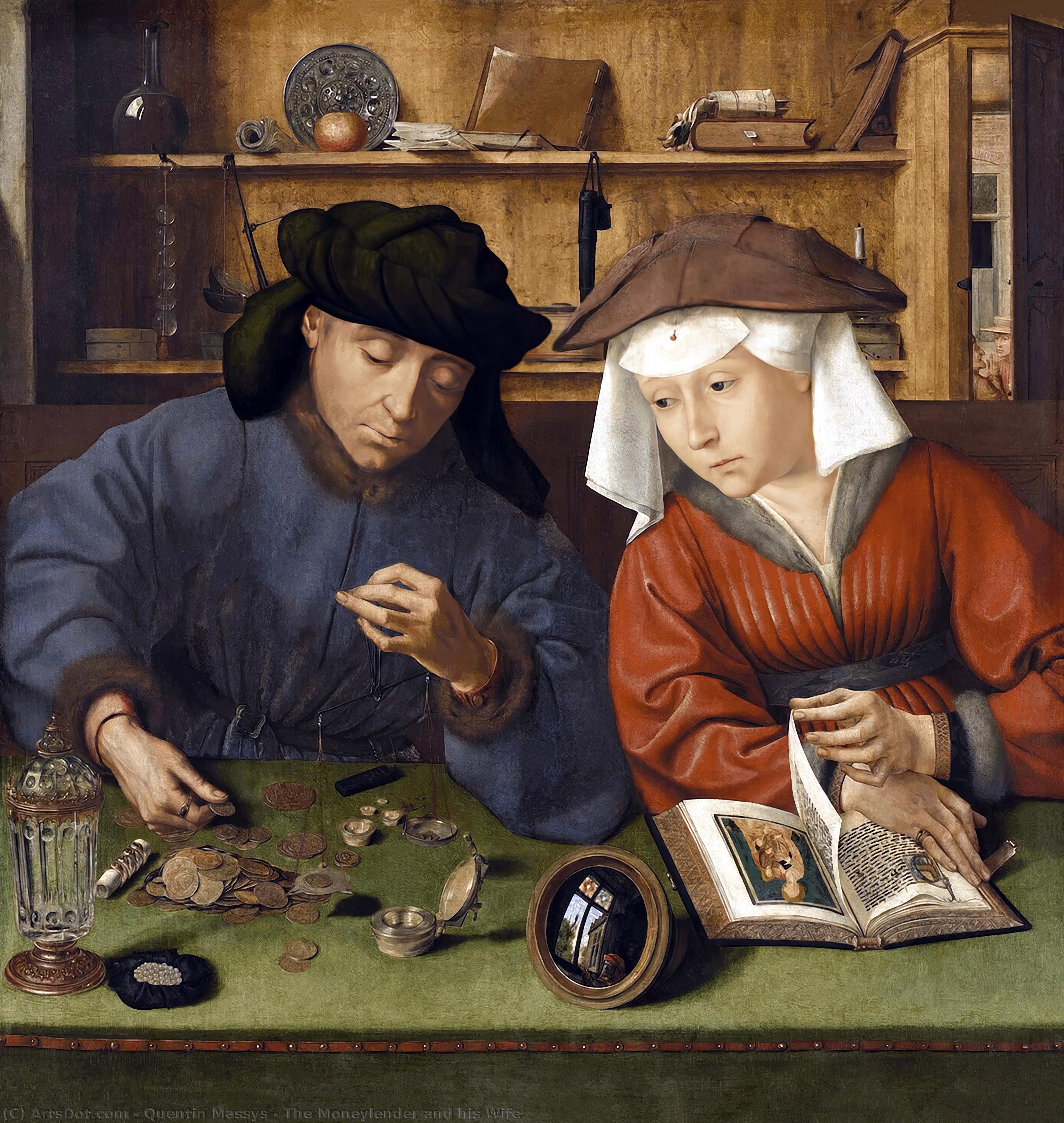
The Moneylender and his Wife (1514) by Quinten Metsys

The Moneylender and his Wife

1514 · Oil On Panel

In the quiet intimacy of Quentin Massys’s 1514 masterpiece, The Moneylender and his Wife, we are invited to step across the threshold of time and into a world of profound domesticity and silent narrative. This oil on panel work, currently preserved in the hallowed halls of the Musée du Sobornik in the Louvre, serves as a breathtaking exemplar of the Antwerp School’s mastery. At first glance, the scene presents a…

2
Portrait of Erasmus of Rotterdam (1517) by Quinten Metsys

Portrait of Erasmus of Rotterdam

1517 · Oil On Canvas · Galleria Nazional d Art Antica, Rome

To stand before this portrait is to step directly into the vibrant intellectual currents of the early sixteenth century. Quentin Massys has captured not merely a likeness, but an entire state of being—the profound concentration of a Renaissance mind at work. The subject, Erasmus of Rotterdam, radiates the quiet authority of scholarship. Dressed in the somber black attire typical of learned men of his era, he is seated amidst the…

3
The Virgin Enthroned (1525) by Quinten Metsys

The Virgin Enthroned

1525 · Oil On Panel · Staatliche Museen zu Berlin, Berlin

In the quiet, hallowed atmosphere of the Staatliche Museen Berlin, there exists a window into the spiritual heart of the sixteenth century. Quentin Massys’ “The Virgin Enthroned,” completed around 1525, is far more than a mere religious portrait; it is a profound meditation on grace and the intersection of the earthly and the divine. As a cornerstone of the Antwerp School, this masterpiece captures a pivotal moment in art history…

4
Christ as Salvator Mundi (1505) by Quinten Metsys

Christ as Salvator Mundi

1505 · Oil · Royal Museum of Fine Arts Antwerp, Antwerp

The portrait presents a frontal, bust-length view of Christ, positioned centrally against a dark, undifferentiated background. The subject's face is illuminated by a soft, diffused light that defines the contours of the nose, the jawline, and the orbital sockets. A golden halo, composed of fine, radiating lines, emanates from behind the head, creating a sharp contrast with the deep tones of the backdrop. The hair is rendered in long, wavy…

5
The Moneylender and his Wife (detail) (1514) by Quinten Metsys

The Moneylender and his Wife (detail)

1514 · Oil On Panel · The Louvre, Paris

To gaze upon this exquisite detail from Quentin Massys’s 1514 masterpiece, The Moneylender and His Wife, is to be invited across the threshold of a meticulously preserved moment in time. It is not merely a fragment of paint on panel; it is a concentrated jewel box of Northern Renaissance life, rich with unspoken narratives and dazzling technical mastery. The scene, captured from the legendary work housed at the Musée du…

6
The Moneylender and his Wife (detail) (1514) by Quinten Metsys

The Moneylender and his Wife (detail)

1514 · Oil On Canvas · The Louvre, Paris

To gaze upon this detail from Quentin Massys's The Moneylender and his Wife is to be invited across the threshold of a meticulously preserved moment in time. It is not merely a fragment of paint on panel; it is a concentrated jewel box of Northern Renaissance life, rich with unspoken narratives and dazzling technical mastery. The scene, captured from the masterpiece housed in the Musée du Louvre, draws the eye…

7
The Adoration of the Magi (1526) by Quinten Metsys

The Adoration of the Magi

1526 · Tempera On Panel · Metropolitan Museum of Art, New York

To gaze upon this depiction of The Adoration of the Magi is to step directly into a moment suspended in time—a tableau vivant brimming with piety, wonder, and profound human connection. Quentin Massys has masterfully captured not merely an event from sacred scripture, but the very essence of devotion itself. Mary cradles the divine infant Jesus, the focal point around which all gazes converge. The composition is richly populated; a…

8
St Anne Altarpiece (detail) (1507) by Quinten Metsys

St Anne Altarpiece (detail)

1507 · Oil On Panel · Musées Royaux des Beaux-Arts, Brussels

The St Anne Altarpiece (detail) is a fragment of a larger narrative painted by Quinten Metsys. This specific section emerged from a work created in 1507. It captures a quiet moment within a sacred lineage, rendered with the precision of a hand accustomed to the weight of iron and the glint of metal.

9
St Anne Altarpiece (left wing) (1507) by Quinten Metsys

St Anne Altarpiece (left wing)

1507 · Oil On Panel · Musées Royaux des Beaux-Arts, Brussels

In the quiet, contemplative corner of the St Anne Altarpiece, specifically its left wing, we encounter a moment of profound spiritual intimacy that has captivated viewers for over five centuries. Painted in 1507 by the Flemish master Quentin Massys, this work serves as a breathtaking window into the soul of the Northern Renaissance. The scene is anchored by the figure of St Anne, depicted with a poignant realism that eschews…

10
The Moneylender and his Wife (detail) (1514) by Quinten Metsys

The Moneylender and his Wife (detail)

1514 · Oil On Panel · The Louvre, Paris

To gaze upon this exquisite detail from Quentin Massys's 1514 masterpiece, The Moneylender and his Wife, is to be invited across the threshold of a meticulously preserved moment in time. It is not merely a fragment of paint on panel; it is a concentrated jewel box of Northern Renaissance life, rich with unspoken narratives and dazzling technical mastery. In this intimate glimpse, we find ourselves seated at a table laden…

The Quinten Metsys selection continues, 11 to 100

11St Anne Altarpiece (1507) by Quinten MetsysSt Anne Altarpiece1507 · Musées Royaux des Beaux-Arts 12St Anne Altarpiece (central panel) (1507) by Quinten MetsysSt Anne Altarpiece (central panel)1507 · Musées Royaux des Beaux-Arts 13Diptych - Christ and the Virgin by Quinten MetsysDiptych - Christ and the Virgin 14Saint Mary Magdalene (1515) by Quinten MetsysSaint Mary Magdalene1515 · Philadelphia Museum of Art 15Saint John the Baptist (1511) by Quinten MetsysSaint John the Baptist1511 · Royal Museum of Fine Arts Antwerp 16Christ (1529) by Quinten MetsysChrist1529 · Metropolitan Museum of Art 17The Deathbed of Saint Anne (1509) by Quinten MetsysThe Deathbed of Saint Anne1509 · Royal Museums of Fine Arts of Belgium 18Saint Mary of Egypt (1515) by Quinten MetsysSaint Mary of Egypt1515 · Philadelphia Museum of Art 19Jacob Obrecht (1496) by Quinten MetsysJacob Obrecht1496 · Kimbell Art Museum 20A Bagpiper (1513) by Quinten MetsysA Bagpiper1513 · Yale University Art Gallery 21Christ the Saviour (1529) by Quinten MetsysChrist the Saviour1529 · Museo del Prado 22Madonna and Child (1530) by Quinten MetsysMadonna and Child1530 · Mauritshuis 23Virgin with the Child by Quinten MetsysVirgin with the ChildRockox House 24Mary with Child (Copy after a lost original) (1512) by Quinten MetsysMary with Child (Copy after a lost original)1512 · Bavarian State Painting Collections 25The Refusal of the Offering of Joachim (1509) by Quinten MetsysThe Refusal of the Offering of Joachim1509 · Royal Museums of Fine Arts of Belgium 26Jesus Among the Doctors (1509) by Quinten MetsysJesus Among the Doctors1509 · National Museum of Ancient Art 27Portrait of a man (1517) by Quinten MetsysPortrait of a man1517 · Staatliche Kunsthalle Karlsruhe 28Saint John and the Women at the Tomb of Christ (1509) by Quinten MetsysSaint John and the Women at the Tomb of Christ1509 · National Museum of Ancient Art 29Virgin and Child (1520) by Quinten MetsysVirgin and Child1520 · Museum Boijmans Van Beuningen 30Madonna and Child (1490) by Quinten MetsysMadonna and Child1490 · National Museum in Warsaw 31Portrait of Pieter Gillis (1517) by Quinten MetsysPortrait of Pieter Gillis1517 · Galleria Nazional d Art Antica 32Lamentation of Christ (1501) by Quinten MetsysLamentation of Christ1501 · National Museum in Warsaw 33Saint Jerome (1512) by Quinten MetsysSaint Jerome1512 · Philadelphia Museum of Art 34The Virgin in prayer (1529) by Quinten MetsysThe Virgin in prayer1529 · Museo del Prado 35Saint John (1511) by Quinten MetsysSaint John1511 · Royal Museum of Fine Arts Antwerp 36Head of a Mourning Woman (1500) by Quinten MetsysHead of a Mourning Woman1500 · Gemäldegalerie 37Head of a Mourning Woman (1500) by Quinten MetsysHead of a Mourning Woman1500 · Gemäldegalerie 38Man of Sorrows (1500) by Quinten MetsysMan of Sorrows1500 · Bavarian State Painting Collections 39Virgin and Child Enthroned (1490) by Quinten MetsysVirgin and Child Enthroned1490 · Kunsthandel P. de Boer 40Salome is given the head of John the Baptist (1511) by Quinten MetsysSalome is given the head of John the Baptist1511 · Royal Museum of Fine Arts Antwerp 41The Seven Sorrows of the Virgin (1500) by Quinten MetsysThe Seven Sorrows of the Virgin1500 · Royal Museums of Fine Arts of Belgium 42Rem Altar: Saint Roch with the Angel (Reverse: Saint Anne Selbdritt) (1518) by Quinten MetsysRem Altar: Saint Roch with the Angel (Reverse: Saint Anne Selbdritt)1518 · Bavarian State Painting Collections 43Rem Altar: Holy Trinity ("Throne of Grace") (1518) by Quinten MetsysRem Altar: Holy Trinity ("Throne of Grace")1518 · Bavarian State Painting Collections 44Rem Altarpiece: Martyrdom of Saint Sebastian (Reverse: Saint Luke) (1518) by Quinten MetsysRem Altarpiece: Martyrdom of Saint Sebastian (Reverse: Saint Luke)1518 · Bavarian State Painting Collections 45Two Old Men in Prayer (1515) by Quinten MetsysTwo Old Men in Prayer1515 46Presentation at the Temple (1509) by Quinten MetsysPresentation at the Temple1509 · National Museum of Ancient Art 47The Lamentation (1510) by Quinten MetsysThe Lamentation1510 · National Gallery of Canada 48Salvator Mundi (Christ Blessing) (1512) by Quinten MetsysSalvator Mundi (Christ Blessing)1512 · Szépművészeti Múzeum 49Dead Christ (1530) by Quinten MetsysDead Christ1530 · Yale University Art Gallery 50The Rest on the Flight into Egypt (1513) by Quinten MetsysThe Rest on the Flight into Egypt1513 · Worcester Art Museum 51Desiderius Erasmus (1466-1536) (1517) by Quinten MetsysDesiderius Erasmus (1466-1536)1517 · Royal Collection 52The Virgin and Child (1512) by Quinten MetsysThe Virgin and Child1512 · Museum of Fine Arts Ghent (MSK) 53Christ Salvator Mundi and Mary at Prayer (1505) by Quinten MetsysChrist Salvator Mundi and Mary at Prayer1505 · Royal Museum of Fine Arts Antwerp 54Portrait of an old woman (1510) by Quinten MetsysPortrait of an old woman1510 55Portrait of Petrus Aegidius (1486-1533) (1514) by Quinten MetsysPortrait of Petrus Aegidius (1486-1533)1514 56The Lamentation (1512) by Quinten MetsysThe Lamentation1512 · Onze-Lieve Vrouwekathedraal 57Portrait of a man (1508) by Quinten MetsysPortrait of a man1508 · Kunsthandel P. de Boer 58St Anne Altarpiece (1507) by Quinten MetsysSt Anne Altarpiece1507 · Royal Museums of Fine Arts of Belgium 59The purchase agreement (1510) by Quinten MetsysThe purchase agreement1510 · Gemäldegalerie 60Madonna and Child with the lamb. (1513) by Quinten MetsysMadonna and Child with the lamb.1513 · The National Museum in Poznań 61Portrait of a Humanist (1512) by Quinten MetsysPortrait of a Humanist1512 · Musée Des Beaux 62Saint Elizabeth of Portugal (1524) by Quinten MetsysSaint Elizabeth of Portugal1524 · Gemäldegalerie 63Portrait of Don Manuel de Menens (1530) by Quinten MetsysPortrait of Don Manuel de Menens1530 64Saint Jerome in his cell (1524) by Quinten MetsysSaint Jerome in his cell1524 · Kunsthistorisches Museum 65Christ Driving the Money-changers from the Temple (1520) by Quinten MetsysChrist Driving the Money-changers from the Temple1520 · Royal Museum of Fine Arts Antwerp 66Portrait of een geestelijke (twijfelachtig geïdentificeerd als Jean Carondelet) (1525) by Quinten MetsysPortrait of een geestelijke (twijfelachtig geïdentificeerd als Jean Carondelet)1525 · Barber Institute of Fine Arts 67An Allegory of Folly (1528) by Quinten MetsysAn Allegory of Folly1528 68The Two Tax Collectors (1530) by Quinten MetsysThe Two Tax Collectors1530 · Gemäldegalerie 69Mourning Woman from a Lamentation (1520) by Quinten MetsysMourning Woman from a Lamentation1520 · Gemäldegalerie 70Portrait of a man with a letter in his hand (1520) by Quinten MetsysPortrait of a man with a letter in his hand1520 · Gemäldegalerie 71Virgin and Child with Saints Elizabeth and John the Baptist (1522) by Quinten MetsysVirgin and Child with Saints Elizabeth and John the Baptist1522 72Portrait of An Old Man (1524) by Quinten MetsysPortrait of An Old Man1524 73Crucifixion (1520) by Quinten MetsysCrucifixion1520 · National Gallery of Canada 74Christ carrying the cross (1505) by Quinten MetsysChrist carrying the cross1505 · National Museum of Ancient Art 75Calvary (1505) by Quinten MetsysCalvary1505 · National Museum of Ancient Art 76Madonna and Child (1520) by Quinten MetsysMadonna and Child1520 · Detroit Institute of Arts 77Portrait of a Canon (1510) by Quinten MetsysPortrait of a Canon1510 · Liechtenstein Museum 78Man with Glasses (1523) by Quinten MetsysMan with Glasses1523 · Städelsche Kunstinstitut Und Städtische Galerie 79Anne and Joachim Present Their Goods to the Temple (1509) by Quinten MetsysAnne and Joachim Present Their Goods to the Temple1509 · Royal Museums of Fine Arts of Belgium 80Mary Magdalene (1505) by Quinten MetsysMary Magdalene1505 · Detroit Institute of Arts 81John the Baptist and St Agnes (1520) by Quinten MetsysJohn the Baptist and St Agnes1520 · Wallraf-Richartz-Museum 82Ecce Homo (detail) (1526) by Quinten MetsysEcce Homo (detail)1526 · Doge's Palace 83The Crucifixion (1515) by Quinten MetsysThe Crucifixion1515 · National Gallery 84Ecce Homo (detail) (1526) by Quinten MetsysEcce Homo (detail)1526 · Doge's Palace 85Ecce Homo (1526) by Quinten MetsysEcce Homo1526 · Doge's Palace 86Workshop of ) (1500) by Quinten MetsysWorkshop of )1500 87Our Lady of Sorrows (1500) by Quinten MetsysOur Lady of Sorrows1500 · National Museum of Ancient Art 88St John Altarpiece (detail) (1507) by Quinten MetsysSt John Altarpiece (detail)1507 · Koninklijk Museum voor Schone Kunsten 89St John Altarpiece (right wing) (1507) by Quinten MetsysSt John Altarpiece (right wing)1507 · Koninklijk Museum voor Schone Kunsten 90St John Altarpiece (left wing) (1507) by Quinten MetsysSt John Altarpiece (left wing)1507 · Koninklijk Museum voor Schone Kunsten 91Portrait of Cornelia Sandrin (1514) by Quinten MetsysPortrait of Cornelia Sandrin1514 · Oldenburg State Museum for Art and Cultural History 92Christ on the Cross with Donors (detail) (1520) by Quinten MetsysChrist on the Cross with Donors (detail)1520 · Museum Mayer van den Bergh 93Portrait of a Woman (1520) by Quinten MetsysPortrait of a Woman1520 · Metropolitan Museum of Art 94Portrait Medal of Erasmus (1519) by Quinten MetsysPortrait Medal of Erasmus1519 · Fitzwilliam College 95Madonna of the Cherries (1525) by Quinten MetsysMadonna of the Cherries1525 96St Anne Altarpiece (closed) (1507) by Quinten MetsysSt Anne Altarpiece (closed)1507 · Musées Royaux des Beaux-Arts 97Triptych of the Passion of Christ (1500) by Quinten MetsysTriptych of the Passion of Christ1500 · Machado de Castro National Museum 98Desiderius Erasmus by Quinten MetsysDesiderius Erasmus 99St Anne Altarpiece (right wing, detail) (1507) by Quinten MetsysSt Anne Altarpiece (right wing, detail)1507 · Musées Royaux des Beaux-Arts 100Christ on the Cross with Donors (1520) by Quinten MetsysChrist on the Cross with Donors1520 · Museum Mayer van den Bergh

Quinten Metsys's famous paintings, period by period

The subjects that held Quinten Metsys's eye

The four subjects that come back most often in these originals, each with its finest example.

The museums that keep Quinten Metsys's originals

The 8 museums that hold the most of the paintings on this page.

Museum City Works by Quinten Metsys Paintings from this list
Gemäldegalerie, BerlinGemäldegalerie Berlin 8 Head of a Mourning Woman, Head of a Mourning Woman, The purchase agreement
Royal Museum of Fine Arts Antwerp, AntwerpRoyal Museum of Fine Arts Antwerp Antwerp 7 Christ as Salvator Mundi, Saint John the Baptist, Saint John
Musées Royaux des Beaux-Arts, BrusselsMusées Royaux des Beaux-Arts Brussels 6 St Anne Altarpiece (detail), St Anne Altarpiece (left wing), St Anne Altarpiece
National Museum of Ancient Art, LisbonNational Museum of Ancient Art Lisbon 6 Jesus Among the Doctors, Saint John and the Women at the Tomb of Christ, Presentation at the Temple
Royal Museums of Fine Arts of Belgium, BrusselsRoyal Museums of Fine Arts of Belgium Brussels 6 The Deathbed of Saint Anne, The Refusal of the Offering of Joachim, The Seven Sorrows of the Virgin
Bavarian State Painting Collections, MunichBavarian State Painting Collections Munich 6 Mary with Child (Copy after a lost original), Man of Sorrows, Rem Altar: Saint Roch with the Angel (Reverse: Saint Anne Selbdritt)
Koninklijk Museum voor Schone Kunsten, AntwerpKoninklijk Museum voor Schone Kunsten Antwerp 7 St John Altarpiece (detail), St John Altarpiece (right wing), St John Altarpiece (left wing)
The Louvre, ParisThe Louvre Paris 4 The Moneylender and his Wife (detail), The Moneylender and his Wife (detail), The Moneylender and his Wife (detail)

Quinten Metsys decade by decade: the original that defines each

Works per decade

Pick a decade to see the original that defines it.

Collectors' questions about Quinten Metsys's paintings

Which work is Quinten Metsys most famous for?Reveal the answer

The Moneylender and his Wife (1514). Portrait of Erasmus of Rotterdam (1517) and The Virgin Enthroned (1525) come next.

What age was Quinten Metsys when The Moneylender and his Wife was made?Reveal the answer

48 years old: The Moneylender and his Wife dates from 1514, and Quinten Metsys was born in 1466.

What are the ten most famous Quinten Metsys paintings?Reveal the answer

The Moneylender and his Wife, Portrait of Erasmus of Rotterdam, The Virgin Enthroned, Christ as Salvator Mundi, The Moneylender and his Wife (detail), The Moneylender and his Wife (detail), The Adoration of the Magi, St Anne Altarpiece (detail), St Anne Altarpiece (left wing) and The Moneylender and his Wife (detail). The ranking above gives each one's year and museum.

How many paintings did Quinten Metsys leave?Reveal the answer

Our catalog holds 147 works by Quinten Metsys, dated from 1490 to 1530.

In which museums do Quinten Metsys's masterpieces hang?Reveal the answer

Mostly in Gemäldegalerie (Berlin), Royal Museum of Fine Arts Antwerp (Antwerp) and Musées Royaux des Beaux-Arts (Brussels). The museum table above lists them all.

In which years did Quinten Metsys paint the most famous works?Reveal the answer

In 1510s: 34 of the 100 works on this page were made then, The Moneylender and his Wife among them.

What are the first and the last famous originals of Quinten Metsys?Reveal the answer

On this page, the earliest is Madonna and Child (1490) and the latest Madonna and Child (1530).

Which subjects did Quinten Metsys choose most often?Reveal the answer

Man (38), Woman (37) and Child (16), across the 100 works on this page.

Which technique did Quinten Metsys use most?Reveal the answer

Oil On Panel, for 58 of the 100 works on this page.

To which art movement does Quinten Metsys belong?Reveal the answer

Northern renaissance, judging by the originals on this page.

Which Quinten Metsys works hang at the Gemäldegalerie?Reveal the answer

Head of a Mourning Woman, Head of a Mourning Woman and The purchase agreement: the Gemäldegalerie, Berlin holds 7 of the works on this page.

Quinten Metsys: life and work

The Architect of the Antwerp School

In the vibrant, burgeoning landscape of the sixteenth-century Low Countries, few names resonate with as much foundational importance as Quentin Massys. Often heralded as the pioneer of the Antwerp School, Massys was a painter who bridged the gap between the meticulous, spiritual devotion of the Early Netherlandish tradition and the burgeoning humanism of the Northern Renaissance. Born around 1466 in Leuven, Belgium, his early life remains a tapestry of legend and historical fragments. It is widely whispered in art history that before he ever grasped a fine brush, he was trained as an ironsmith—a detail that lends a profound, tactile weight to his later mastery of texture and material. This background in metalworking likely instilled in him a unique reverence for the physical world, allowing him to render the sheen of silk, the cold glint of coin, and the weathered skin of humanity with unparalleled precision.

As he transitioned from the academic atmosphere of Leuven to the bustling commercial hub of Antwerp around 1490, Massys began to weave his own distinct thread into the fabric of Flemish art. His early training, potentially under the guidance of Dirk Bouts, connected him to the lineage of masters like Hans Memling and Rogier van der Weyden. From these predecessors, he inherited a devotion to verisimilitude—the pursuit of truth in representation. Yet, Massys was far from a mere imitator. While he maintained the exquisite detail characteristic of his ancestors, he infused his work with a new, burgeoning vitality and a willingness to explore the complexities of the human condition through both religious solemnity and biting social commentary.

A Mastery of Devotion and Satire

The brilliance of Massys lies in his remarkable ability to navigate two seemingly disparate worlds: the sacred and the profane. On one hand, his religious compositions serve as profound meditations on faith. In works such as Christ on the Cross with Donors, he captures the raw, emotional gravity of the crucifixion, utilizing a High Renaissance sensibility to present a scene that is both deeply moving and technically flawless. His ability to depict the divine through the lens of human suffering allowed his religious subjects to resonate with a visceral intimacy, making the spiritual palpable to the viewer.

Conversely, Massys was a master of the satirical genre, using his brush to hold a mirror up to the shifting social morals of his era. He possessed a keen eye for the foibles of humanity, often creating scenes that blended realism with a subtle, mocking wit. This duality is perhaps most evident in his approach to portraiture and genre painting, where he could pivot from the serene beauty of a Virgin and Child to the more complex, morally layered depictions of contemporary life. His work often explored themes of greed, vanity, and the tension between material wealth and spiritual purity, making him a precursor to the great genre painters who would follow in the centuries to come.

Legacy and Artistic Significance

The historical significance of Quentin Massys cannot be overstated; he was the catalyst for an artistic revolution in Antwerp. By introducing new motifs and techniques while remaining anchored in the rich traditions of his homeland, he provided the blueprint for a school of painting that would dominate Flanders throughout the sixteenth century. His influence can be traced through the evolution of Northern European art, as he paved the way for a more expressive, observational style that embraced the complexities of the modernizing world.

Today, we remember Massys not just as a craftsman, but as a storyteller who captured the soul of an era. His legacy is preserved in the enduring power of his imagery:

  • Technical Innovation: The seamless integration of metalworking-inspired precision with the fluid grace of Renaissance oil painting.
  • The Antwerp School: Establishing a lasting artistic movement that prioritized both realism and moral narrative.
  • Humanist Perspective: A unique ability to blend the profound sanctity of religious icons with the sharp, observational wit of social satire.
Through his hands, the spiritual and the earthly were brought into a singular, breathtaking dialogue, ensuring his place as one of the true masters of the Northern Renaissance.