Portrait of Peter Paul Rubens

The 100 Most Famous Peter Paul Rubens Paintings, Each One of a Kind

Updated November 2026 · ranked by our popularity score (searches, visits and orders for each work) · 1,641 works by Peter Paul Rubens in our catalogue

In short

Raising of the Cross (1610) is the Peter Paul Rubens painting that draws the most eyes; the original belongs to the Onze-Lieve Vrouwekathedraal, Antwerp. After it, the eye goes to Castor and Pollux Abduct the Daughters of Leukyppos and The Descent from the Cross (1612). Among the 1,641 works of Peter Paul Rubens in our catalog, these 100 are the most famous, each a unique original presented with its year, its museum and the reason it endures.

1577 – 1640, Siegen Baroque Most works: Bavarian State Painting Collections

Top 10 paintings by Peter Paul Rubens, through the gallery's eye

1
Raising of the Cross (1610) by Peter Paul Rubens

Raising of the Cross

1610 · Oil On Panel · Onze-Lieve Vrouwekathedraal, Antwerp

In this monumental triptych, we find ourselves at the precise, agonizing instant of the crucifixion. The central panel captures the physical strain of the lifting, as Jesus Christ is hoisted upward by angels. There is a profound sense of gravity here, both literal and spiritual. While the divine figures exert their strength from above, the earthly realm reacts with a chaotic, muscular energy. Horses appear in the background, their forms…

2
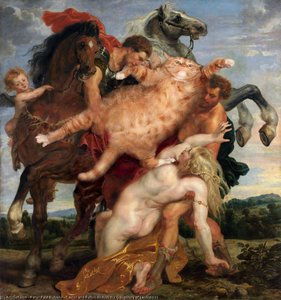
Castor and Pollux Abduct the Daughters of Leukyppos by Peter Paul Rubens

Castor and Pollux Abduct the Daughters of Leukyppos

Oil On Canvas · Bavarian State Painting Collections, Munich

Castor and Pollux Abduct the Daughters of Leukyppos: A Baroque Triumph The painting Castor and Pollux Abduct the Daughters of Leukyppos stands as a cornerstone of Baroque art—a dramatic distillation of myth into visual splendor executed by Peter Paul Rubens. Created around 1618, this monumental canvas housed at the Staatliche Museen zu Berlin isn’t merely a depiction of legend; it's a masterful demonstration of artistic innovation and emotional resonance that…

3
The Descent from the Cross (1612) by Peter Paul Rubens

The Descent from the Cross

1612 · Oil On Panel · Courtauld Gallery, London

A heavy, pale body descends through a diagonal of straining limbs. The skin of Christ catches a sharp, theatrical light, pulling it from a dark, murky background. Muscles pull against the gravity of the moment. Deep shadows pool in the hollows of ribs and arms, creating a sense of immense physical weight. A crimson robe cuts through the earthy tones of ochre and sienna, marking the movement of the figures…

4
The three graces, prado by Peter Paul Rubens

The three graces, prado

Oil On Canvas · Museo del Prado, Madrid

In the grand tapestry of the seventeenth century, few images capture the essence of vitality and grace as profoundly as Sir Peter Paul Rubens’ The Three Graces. This monumental masterpiece, executed during the height of his prolific career around 1635-36, serves as a breathtaking window into the heart of the Baroque era. As one gazes upon this canvas, the boundaries between the viewer and the painted world begin to dissolve,…

5
Saturn (1637) by Peter Paul Rubens

Saturn

1637 · Oil On Canvas · Museo del Prado, Madrid

The composition centers on the massive, muscular figure of Saturn, whose body creates a diagonal movement from the upper left toward the lower right. He is caught in the act of consuming his offspring, a scene drawn from the Greek myth of the Titan Cronus. The flesh of the infant appears pale against the darker, earthy tones of the titan's skin. Deep shadows and dark, stormy grays dominate the background,…

6
The Fall of the Damned (1620) by Peter Paul Rubens

The Fall of the Damned

1620 · Oil On Canvas · Alte Pinakothek, Munich

“The Fall of the Damned,” painted by Sir Peter Paul Rubens around 1620, stands as one of the most arresting and ambitious achievements of the Baroque period. More than just a depiction of biblical narrative—the expulsion of Lucifer and his rebellious angels from Heaven—it’s an immersive experience for the viewer, transporting them into the terrifying grandeur of God's wrath.

7
Samson and Delilah (1610) by Peter Paul Rubens

Samson and Delilah

1610 · Oil On Canvas · National Gallery, London

In the quiet, tension-filled shadows of a darkened chamber, Peter Paul Rubens captures one of the most harrowing moments in biblical history. Samson and Delilah is not merely a depiction of a story from the Book of Judges; it is a visceral exploration of vulnerability, deceit, and the heavy cost of misplaced trust. As Samson lies in a deep, unsuspecting slumber, his powerful frame slumped against the lap of Delilah,…

8
The Origin of the Milky Way (1637) by Peter Paul Rubens

The Origin of the Milky Way

1637 · Oil On Canvas · Museo del Prado, Madrid

The composition centers on a female figure, Hera, seated upon a cloud within a dark, nocturnal sky. Her skin appears pale against the deep blues and blacks of the surrounding atmosphere. She wears a white veil, a pearl necklace, and jeweled bracelets. To her left, an infant, Hercules, reaches toward her breast. A stream of white milk gushes from her left breast, arching across the dark expanse to form the…

9
The Head of Medusa (1617) by Peter Paul Rubens

The Head of Medusa

1617 · Oil On Panel · Kunsthistorisches Museum, Vienna

In the 1617 work titled The Head of Medusa, the artist Peter Paul Rubens presents the severed head of the mythological figure. The subject is depicted in the immediate aftermath of her death, positioned as if she has just been slain. The head lies within a pool of blood, which spreads across the surface beneath her. The composition focuses on the physical state of the Gorgon, capturing the specific moment…

10
Rubens and Isabella Brant in the Bower of Honeysuckle by Peter Paul Rubens

Rubens and Isabella Brant in the Bower of Honeysuckle

Oil On Canvas

Introduction Peter Paul Rubens (1577-1640) was a renowned Flemish artist, known for his exceptional skills in painting and printmaking. Among his most famous works is the captivating double portrait Rubens and Isabella Brant in the Bower of Honeysuckle, which showcases the couple's love and devotion in a beautifully rendered garden setting. Background and Context Created around 1609-1610, this masterpiece is an oil on canvas painting measuring 178 x 136.5 cm…

Peter Paul Rubens's famous paintings, numbers 11 to 100

11The Consequences of War (1638) by Peter Paul RubensThe Consequences of War1638 · Galleria Palatina 12The Garden of Love c.1630-32, Prado by Peter Paul RubensThe Garden of Love c.1630-32, PradoMuseo del Prado 13Prometheus Bound (1611) by Peter Paul RubensPrometheus Bound1611 · Philadelphia Museum of Art 14The Fall of Phaeton by Peter Paul RubensThe Fall of PhaetonNational Gallery of Art 15Massacre of the Innocents (1637) by Peter Paul RubensMassacre of the Innocents1637 · Alte Pinakothek 16The Lion Hunt (1621) by Peter Paul RubensThe Lion Hunt1621 · Alte Pinakothek 17The Drunken Hercules (1611) by Peter Paul RubensThe Drunken Hercules1611 · Staatliche Kunstsammlungen 18St. Augustine (1638) by Peter Paul RubensSt. Augustine1638 · National Gallery 19The Feast of Venus d (1637) by Peter Paul RubensThe Feast of Venus d1637 · Kunsthistorisches Museum 20Miracle of St. Ignatius of Loyola (1618) by Peter Paul RubensMiracle of St. Ignatius of Loyola1618 · Kunsthistorisches Museum 21The Landing of Marie de Medici at Marseilles (1625) by Peter Paul RubensThe Landing of Marie de Medici at Marseilles1625 · The Louvre 22Mercury and Argus by Peter Paul RubensMercury and ArgusMuseo del Prado 23Two Satyrs (1608) by Peter Paul RubensTwo Satyrs1608 · Alte Pinakothek 24The Last Judgement (1617) by Peter Paul RubensThe Last Judgement1617 · Alte Pinakothek 25The Battle of the Amazons (1618) by Peter Paul RubensThe Battle of the Amazons1618 · Alte Pinakothek 26Ildefonso Altar (1632) by Peter Paul RubensIldefonso Altar1632 · Kunsthistorisches Museum 27Stormy Landscape (1625) by Peter Paul RubensStormy Landscape1625 · Kunsthistorisches Museum 28Susanna Fourment (1625) by Peter Paul RubensSusanna Fourment1625 · National Gallery 29Romulus and Remus (1616) by Peter Paul RubensRomulus and Remus1616 · Capitoline Museums 30Daniel in the Lion's Den (1615) by Peter Paul RubensDaniel in the Lion's Den1615 · National Gallery of Art 31Rape of the Daughters of Leucippus (1618) by Peter Paul RubensRape of the Daughters of Leucippus1618 · Alte Pinakothek 32The Felicity of the Regency of Marie de' Medici (1625) by Peter Paul RubensThe Felicity of the Regency of Marie de' Medici1625 33Assumption of the Virgin (1626) by Peter Paul RubensAssumption of the Virgin1626 · Onze-Lieve Vrouwekathedraal 34The Abduction of Ganymede (1612) by Peter Paul RubensThe Abduction of Ganymede1612 35Venus at her Toilet (1608) by Peter Paul RubensVenus at her Toilet1608 · Thyssen-Bornemisza Museum 36The Judgment of Paris (1636) by Peter Paul RubensThe Judgment of Paris1636 · National Gallery 37The Triumph of Truth (1625) by Peter Paul RubensThe Triumph of Truth1625 · The Louvre 38Hygeia, Goddess of Health (1615) by Peter Paul RubensHygeia, Goddess of Health1615 · National Gallery Prague 39Christ on the Cross (1627) by Peter Paul RubensChrist on the Cross1627 40Holy Trinity by Peter Paul RubensHoly TrinityRoyal Museum of Fine Arts Antwerp 41The Four Parts of the World by Peter Paul RubensThe Four Parts of the World 42Diana Cazadora (1620) by Peter Paul RubensDiana Cazadora1620 · Museo del Prado 43The Education of Marie, Louvre (1625) by Peter Paul RubensThe Education of Marie, Louvre1625 44The Elevation of the Cross (1610) by Peter Paul RubensThe Elevation of the Cross1610 45Gregorio with Mauro and Papia (1608) by Peter Paul RubensGregorio with Mauro and Papia1608 · Santa Maria in Vallicella 46Duke of Lerma (1603) by Peter Paul RubensDuke of Lerma1603 · The Louvre 47Portrait of Maria de' Medici (1575-1642), Queen mother of France (1640) by Peter Paul RubensPortrait of Maria de' Medici (1575-1642), Queen mother of France1640 48The Council of the Gods (1624) by Peter Paul RubensThe Council of the Gods1624 · The Louvre 49Allegory on the blessings of peace NG London (1630) by Peter Paul RubensAllegory on the blessings of peace NG London1630 50The Capture of Samson (1609) by Peter Paul RubensThe Capture of Samson1609 · Art Institute of Chicago 51Christ on the Sea of Galilee (1611) by Peter Paul RubensChrist on the Sea of Galilee1611 · Gemäldegalerie Alte Meister 52Mucius Scaevola before Lars Porsenna (1617) by Peter Paul RubensMucius Scaevola before Lars Porsenna1617 · Pushkin State Museum 53The Rape of Europe (1636) by Peter Paul RubensThe Rape of Europe1636 · Museo del Prado 54Agrippina and Germanicus (1614) by Peter Paul RubensAgrippina and Germanicus1614 55The Judgment of Paris by Peter Paul RubensThe Judgment of Paris 56St. George and a Dragon (1610) by Peter Paul RubensSt. George and a Dragon1610 57The Coronation of the Hero of Virtue (1613) by Peter Paul RubensThe Coronation of the Hero of Virtue1613 · Bavarian State Painting Collections 58Venus, Mars and Cupid (1635) by Peter Paul RubensVenus, Mars and Cupid1635 · Dulwich Picture Gallery 59The Feast of Acheloüs (1615) by Peter Paul RubensThe Feast of Acheloüs1615 · Metropolitan Museum of Art 60Portrait of Peter Pecquius (1562-1625), chancellor of Brabant (1615) by Peter Paul RubensPortrait of Peter Pecquius (1562-1625), chancellor of Brabant1615 · Royal Museums of Fine Arts of Belgium 61Portrait of Anne of Austria (1623) by Peter Paul RubensPortrait of Anne of Austria1623 · Norton Simon Museum 62The Four Evangelists (1625) by Peter Paul RubensThe Four Evangelists1625 · John and Mable Ringling Museum of Art 63Philip IV of Spain (1629) by Peter Paul RubensPhilip IV of Spain1629 · Carnegie Museum of Art 64The Triumph of Divine Love (1625) by Peter Paul RubensThe Triumph of Divine Love1625 · Museo del Prado 65Saint Michael striking down the rebellious angels (1635) by Peter Paul RubensSaint Michael striking down the rebellious angels1635 · Thyssen-Bornemisza Museum 66The Assumption of the Virgin by Peter Paul RubensThe Assumption of the Virgin 67The Assumption of Mary (1622) by Peter Paul RubensThe Assumption of Mary1622 68Sermon by St Ignatius of Loyola (1608) by Peter Paul RubensSermon by St Ignatius of Loyola1608 · Bavarian State Painting Collections 69Coronation of the Virgin Mary (1625) by Peter Paul RubensCoronation of the Virgin Mary1625 · Royal Museums of Fine Arts of Belgium 70The Reconciliation of Romans and Sabines, before or up to 1620s (1625) by Peter Paul RubensThe Reconciliation of Romans and Sabines, before or up to 1620s1625 · Bavarian State Painting Collections 71Leda and the Swan (1600) by Peter Paul RubensLeda and the Swan1600 72The Assumption of the Virgin (1636) by Peter Paul RubensThe Assumption of the Virgin1636 · Yale University Art Gallery 73The Miracles of St. Benedict (1630) by Peter Paul RubensThe Miracles of St. Benedict1630 · Royal Museums of Fine Arts of Belgium 74The Union of Earth and Water (1618) by Peter Paul RubensThe Union of Earth and Water1618 · Hermitage Museum 75The Judgement of Paris (1606) by Peter Paul RubensThe Judgement of Paris1606 · Museo del Prado 76Saint Jerome (1615) by Peter Paul RubensSaint Jerome1615 · Staatliche Kunstsammlungen Dresden 77Archduke Ferdinand on a horse (1608) by Peter Paul RubensArchduke Ferdinand on a horse1608 · Bavarian State Painting Collections 78The Drunken Satyr (1611) by Peter Paul RubensThe Drunken Satyr1611 · Academy of Fine Arts Vienna 79The Gathering of the Manna (1625) by Peter Paul RubensThe Gathering of the Manna1625 · John and Mable Ringling Museum of Art 80The Rape of the Daughters of Levkippos (1610) by Peter Paul RubensThe Rape of the Daughters of Levkippos1610 · National Museum of Art, Architecture and Design 81Portrait of Elizabeth of Bourbon, Queen of Spain (1628) by Peter Paul RubensPortrait of Elizabeth of Bourbon, Queen of Spain1628 · Hermitage Museum 82Portrait of Johanna of Austria, mother of Maria de' Medici (1623) by Peter Paul RubensPortrait of Johanna of Austria, mother of Maria de' Medici1623 83Christ Triumphant over Sin and Death (1617) by Peter Paul RubensChrist Triumphant over Sin and Death1617 · Columbus Museum of Art 84The Holy Family with Saint Elizabeth and Saint John the Baptist (1620) by Peter Paul RubensThe Holy Family with Saint Elizabeth and Saint John the Baptist1620 · Blenheim Palace 85"The Battle of Anghiari  " (The fight for the standard). (1605) by Peter Paul Rubens"The Battle of Anghiari " (The fight for the standard).1605 · Academy of Fine Arts Vienna 86Infanta Isabella, the ruler of the Netherlands (1625) by Peter Paul RubensInfanta Isabella, the ruler of the Netherlands1625 87The Sacrifice of the Old Covenant (1626) by Peter Paul RubensThe Sacrifice of the Old Covenant1626 · Museum of Fine Arts 88The raising of Lazarus (copy) (1700) by Peter Paul RubensThe raising of Lazarus (copy)1700 · Rijksmuseum 89Adoration of the Magi (1620) by Peter Paul RubensAdoration of the Magi1620 · Gothenburg Museum of Art 90The Drunken Silenus (1608) by Peter Paul RubensThe Drunken Silenus1608 · Bavarian State Painting Collections 91Samson and Delilah (1609) by Peter Paul RubensSamson and Delilah1609 · Cincinnati Art Museum 92Madonna and Child (copy after left wing of Antwerp triptych) (1608) by Peter Paul RubensMadonna and Child (copy after left wing of Antwerp triptych)1608 · Bavarian State Painting Collections 93Portrait of John, Duke of Braganza. (1628) by Peter Paul RubensPortrait of John, Duke of Braganza.1628 · Royal Castle 94The Martyrdom of Saint Lawrence (1600) by Peter Paul RubensThe Martyrdom of Saint Lawrence1600 · Slovak National Gallery 95The Israelites Gathering Manna in the Desert (1626) by Peter Paul RubensThe Israelites Gathering Manna in the Desert1626 · Los Angeles County Museum of Art 96The Virgin as the Woman of the Apocalypse (1624) by Peter Paul RubensThe Virgin as the Woman of the Apocalypse1624 · J. Paul Getty Museum 97Rubens with his Family in Garden (1640) by Peter Paul RubensRubens with his Family in Garden1640 · Metropolitan Museum of Art 98Perseus and Andromeda (1608) by Peter Paul RubensPerseus and Andromeda1608 · Bavarian State Painting Collections 99Portrait of Helena Fourment (1617-1673) (1608) by Peter Paul RubensPortrait of Helena Fourment (1617-1673)1608 · Bavarian State Painting Collections 100Susanna and the Elders (1637) by Peter Paul RubensSusanna and the Elders1637 · Bavarian State Painting Collections

Peter Paul Rubens's famous paintings, period by period

The subjects that held Peter Paul Rubens's eye

The four subjects that come back most often in these originals, each with its finest example.

The museums that keep Peter Paul Rubens's originals

The 8 museums that hold the most of the paintings on this page.

Museum City Works by Peter Paul Rubens Paintings from this list
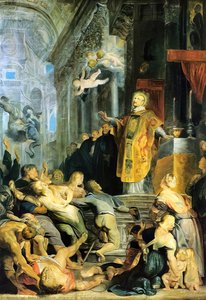
Bavarian State Painting Collections, MunichBavarian State Painting Collections Munich 100 Castor and Pollux Abduct the Daughters of Leukyppos, The Coronation of the Hero of Virtue, Sermon by St Ignatius of Loyola
Museo del Prado, MadridMuseo del Prado Madrid 76 The three graces, prado, Saturn, The Origin of the Milky Way
Alte Pinakothek, MunichAlte Pinakothek Munich 21 The Fall of the Damned, Massacre of the Innocents, The Lion Hunt
Kunsthistorisches Museum, ViennaKunsthistorisches Museum Vienna 35 The Head of Medusa, The Feast of Venus d, Miracle of St. Ignatius of Loyola
The Louvre, ParisThe Louvre Paris 22 The Landing of Marie de Medici at Marseilles, The Triumph of Truth, Duke of Lerma
Royal Museums of Fine Arts of Belgium, BrusselsRoyal Museums of Fine Arts of Belgium Brussels 35 Portrait of Peter Pecquius (1562-1625), chancellor of Brabant, Coronation of the Virgin Mary, The Miracles of St. Benedict
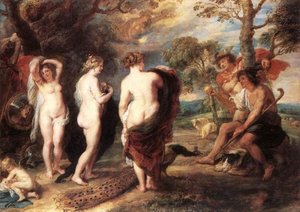
National Gallery, LondonNational Gallery London 26 Samson and Delilah, Susanna Fourment, The Judgment of Paris
Hermitage Museum, Saint PetersburgHermitage Museum Saint Petersburg 42 The Union of Earth and Water, Portrait of Elizabeth of Bourbon, Queen of Spain

Peter Paul Rubens across the decades: one unique original for each

Works per decade

Pick a decade to see the original that defines it.

Peter Paul Rubens's paintings: questions for the gallery

What is the single most famous work of Peter Paul Rubens?Reveal the answer

Raising of the Cross (1610), Onze-Lieve Vrouwekathedraal, Antwerp. Castor and Pollux Abduct the Daughters of Leukyppos and The Descent from the Cross (1612) come next.

At what age did Peter Paul Rubens create Raising of the Cross?Reveal the answer

33 years old: Raising of the Cross dates from 1610, and Peter Paul Rubens was born in 1577.

Which ten paintings by Peter Paul Rubens are the most famous?Reveal the answer

Raising of the Cross, Castor and Pollux Abduct the Daughters of Leukyppos, The Descent from the Cross, The three graces, prado, Saturn, The Fall of the Damned, Samson and Delilah, The Origin of the Milky Way, The Head of Medusa and Rubens and Isabella Brant in the Bower of Honeysuckle. The ranking above gives each one's year and museum.

How many works by Peter Paul Rubens are known?Reveal the answer

Our catalog holds 1,641 works by Peter Paul Rubens, dated from 1600 to 1640.

Where can the most famous Peter Paul Rubens originals be seen?Reveal the answer

Mostly in Bavarian State Painting Collections (Munich), Museo del Prado (Madrid) and Alte Pinakothek (Munich). The museum table above lists them all.

During which period did Peter Paul Rubens create the best-known paintings?Reveal the answer

In 1620s: 29 of the 100 works on this page were made then, The Fall of the Damned among them.

Which famous Peter Paul Rubens painting is the earliest, and which the latest?Reveal the answer

On this page, the earliest is Leda and the Swan (1600) and the latest Portrait of Maria de' Medici (1575-1642), Queen mother of France (1640).

What subjects did Peter Paul Rubens favour?Reveal the answer

Woman (23), Man (22) and Mythology (19), across the 100 works on this page.

What materials did Peter Paul Rubens paint with most?Reveal the answer

Oil On Canvas, for 67 of the 100 works on this page.

Which movement does the work of Peter Paul Rubens belong to?Reveal the answer

Baroque, judging by the originals on this page.

What Peter Paul Rubens originals can I see at the Bavarian State Painting Collections?Reveal the answer

Castor and Pollux Abduct the Daughters of Leukyppos, The Coronation of the Hero of Virtue and Sermon by St Ignatius of Loyola: the Bavarian State Painting Collections, Munich holds 10 of the works on this page.

Peter Paul Rubens: a portrait of the artist

Early Life, Family and Training

To understand the scale of Peter Paul Rubens, one must look at the displacement that defined his beginnings. Born on 28 June 1577 in Siegen, Germany, his early years were shaped by the religious instability of the era. His father, Jan Rubens, was a lawyer who fled religious persecution, a move that forced the family to navigate the shifting political landscapes of the time. This background of movement and survival provided a practical resilience that would later underpin his complex professional life. He was the son of Jan Rubens and Maria Pypelincks, and his upbringing was rooted in the social realities of the Southern Netherlands.

His technical foundation was built through a series of disciplined apprenticeships that moved him from basic landscape studies toward the complex iconography of history painting. In 1592, he began his training under Tobias Verhaecht, a landscape painter who provided the essential groundwork in composition. This was followed by a four-year apprenticeship with Adam van Noort, a specialist in portraiture and mythological scenes. These years were not merely about learning to hold a brush; they were about absorbing the structural mechanics of the Flemish tradition. By the time he began working with Otto van Veen between 1594 and 1598, Rubens had already acquired the technical vocabulary necessary to move beyond simple representation into the realm of sophisticated narrative art.

The Italian Awakening and Artistic Synthesis

In 1600, Rubens left the Low Countries for Italy, a move that fundamentally altered his visual language. He did not merely observe the Italian tradition; he absorbed it through eight years of direct engagement with the works of Michelangelo, Raphael, and Titian. This period was not a passive study. By serving the Duke of Mantua, he gained access to the high-stakes environment of Italian courtly art, where the demands of patronage required a sophisticated command of form and narrative. He took the anatomical precision of Michelangelo and the coloristic depth of Titian, stripping away the static qualities of the High Renaissance to create something more muscular and immediate.

The result was a synthesis that moved beyond imitation. Rubens took the classical ideals he encountered in Italy and infused them with a Flemish sense of vitality. He understood that movement required more than just depicted action; it required a specific tension in the human figure and a command of light that felt physical rather than merely decorative. When he returned to Antwerp in 1608, he brought back a style that was ready to dominate the European market. He had successfully merged the intellectual rigor of Italian humanism with a raw, energetic approach to composition.

A Master of Many Forms

Rubens’s output was defined by a refusal to remain within a single genre. He operated with a versatility that allowed him to command the production of altarpieces, portraits, landscapes, and history paintings. This breadth was not a sign of scattered focus but a calculated expansion of his visual influence. He moved between the sacred and the secular with ease, applying his command of composition to everything from religious narratives to the intimate details of a sitter's likeness.

His reach extended into the commercial and decorative sectors of the seventeenth-century market. He was a prolific designer of cartoons for Flemish tapestry workshops, translating complex narratives into patterns for weavers. Beyond the canvas, his graphic work was essential to the publishing industry in Antwerp, where he designed frontispieces for local publishers. This ability to scale his vision from massive church commissions to small-scale printed works ensured his aesthetic presence was felt across different media.

Technique and Style

Rubens’s visual language is defined by a relentless sense of motion. He rejected static imagery in favor of energetic and dramatic arrangements that force the viewer to engage with the scene. This dynamism is not merely a compositional choice but a structural necessity in his work. By utilizing chiaroscuro, he sculpted human forms with a precision that emphasized musculature and physical presence. This interplay of light and shadow provides the weight necessary to ground his often swirling, high-energy subjects.

His approach to color and texture relies on a sophisticated layering process. He employed glazing, applying thin, translucent layers of pigment over thicker undercoats to achieve a depth of color that feels internal rather than surface-level. This technique allowed him to capture the specific luminosity of skin tones and the heavy weight of fabric. His style prioritized a sense of sensuality and physical vitality, ensuring that every figure possessed a palpable, breathing quality. He did not merely depict bodies; he engineered them through light and pigment to command attention.

Patrons, Workshop and Commissions

Rubens operated with the precision of a high-stakes businessman, building one of the most successful artistic enterprises in European history. By 1610, he had opened his own studio in Antwerp, a move that transformed his practice from individual creation into a massive production engine. This was not a mere collection of assistants; it was a sophisticated operation designed to meet the relentless demands of his international clientele. He functioned as a central hub for talent, coordinating complex projects that required specialized skills to achieve his specific visual standards.

His professional status was cemented by his position as court painter to the Archduke and Archduchess in Brussels. This role provided more than just steady work; it placed him at the center of political and social power. To manage the sheer volume of his commissions, Rubens relied on a network of skilled collaborators. He integrated the talents of other significant artists into his workflow, including Frans Snyders, Paul de Vos, Jacob Jordaens, and Jan Brueghel the Elder. This collaborative model allowed him to execute massive, multi-layered compositions that a single hand could not have completed in a lifetime.

Later Years and Death

By 1630, Rubens had integrated his private life with his professional status through his marriage to Hélène Fourment. This union provided a steady presence in his Antwerp studio during a period when his responsibilities extended far beyond the canvas. He was not merely a painter but a high-stakes diplomat, navigating the complex political currents of Europe through missions to England, France, and Spain. These diplomatic endeavors required a level of intellectual agility and social maneuvering that matched his technical command of oil and pigment.

His productivity remained high even as his political duties intensified. He continued to paint prolifically, maintaining a massive output that sustained his reputation across the continent. The sheer volume of his work in these final years reflects a man who managed a vast artistic enterprise while simultaneously acting as a cultural intermediary for the Southern Netherlands. He remained active in the artistic and political life of Antwerp until his death on 30 May 1640.

Legacy and Influence

Rubens remains the most influential figure in the Flemish Baroque tradition. His work functioned as a bridge between the divine and the human, translating complex religious and mythological narratives into a visual language of physical presence. He did not merely paint scenes; he engineered spectacles of visual grandeur. This ability to command space and movement ensured his influence reached far beyond the borders of the Southern Netherlands.

The impact of his method on subsequent generations of artists is immeasurable. He established a standard for high-energy dynamism that later painters had to either adopt or react against. His studio functioned as a massive engine of production, setting a precedent for how large-scale artistic enterprises could operate across Europe. By synthesizing the classical grace of the Renaissance with a raw, muscular energy, he redefined the expressive potential of oil on canvas.