Portrait of Paul Ranson

Paul Ranson Paintings: The 34 Most Famous, Through a Gallery's Eye

Updated October 2026 · ranked by our popularity score (searches, visits and orders for each work) · 34 works by Paul Ranson in our catalogue

In short

To the gallery's eye, Paul Ranson's most famous painting is Cinq femmes à la récolte (1895). Christ and Buddha (1890) and Digitales (1899) complete the trio every eye recognises. Of the 34 works by Paul Ranson in our catalog, the gallery presents the 34 most famous below, each original with its year, its museum and what makes it unique.

1861 – 1909, Limoges Post-impressionism Most works: Musée d'Orsay

The gallery's top 10 Paul Ranson paintings

1
Cinq femmes à la récolte (1895) by Paul Ranson

Cinq femmes à la récolte

1895 · Tempera

The painting titled Cinq femmes à la récolte was created in 1895. The artist responsible for this work is Paul Ranson. He was born in Limoges, France, on March 29, 1861. This specific piece belongs to the period of the late nineteenth century when artistic movements were shifting away from naturalism.

2
Christ and Buddha (1890) by Paul Ranson

Christ and Buddha

1890 · Oil On Canvas · Kunstmuseum Den Haag, The Hague

In this 1890 oil on canvas, the boundaries between Eastern and Western spiritual traditions dissolve into a singular, flattened plane. The composition juxtaposes the figure of Jesus Christ on the cross with the meditative presence of Buddha. In the foreground, a dark green Buddha sits in a lotus position, while a large, partially cropped blue face looms from the right, suggesting a scale that transcends the physical. Above, a luminous…

3
Digitales (1899) by Paul Ranson

Digitales

A Glimpse into Art Nouveau's Enchanting World: Paul Elie Ranson’s "Digitales" Step into a realm of dreamlike beauty and intricate detail with Paul Elie Ranson’s “Digitales,” painted in 1899. This captivating artwork exemplifies the essence of Art Nouveau, transporting viewers to a fantastical natural setting where a young woman finds herself immersed within an abundance of lush foliage and delicate floral elements. The composition is dense yet harmonious, creating a…

4
Lustral (1891) by Paul Ranson

Lustral

1891

The painting Lustral by Paul Elie Ranson is a fascinating work of art that showcases the artist's unique style and technique. Created in 1891, this tempera on canvas piece is a prime example of Post-Impressionism and is currently housed at the Musée d'Orsay in France. Artistic Style and Composition The painting features a female nude at her toilette, surrounded by various objects such as a sponge, soap, and an ornate…

6
The Visitation (1894) by Paul Ranson

The Visitation

1894 · Oil On Canvas

In the quiet, evocative depths of Paul Elie Ranson’s 1894 masterpiece, The Visitation, viewers are transported into a moment of profound spiritual intimacy. This oil on canvas painting captures the biblical meeting between Mary and Elizabeth, yet it transcends mere religious illustration to become a mesmerizing study of Post-Impressionist emotion. The composition centers on the two women standing face-to-face, their presence anchored in a serene, natural landscape that feels both…

7
The Vanity of Mice (1885) by Paul Ranson

The Vanity of Mice

1885 · Oil On Canvas · Musee des Beaux-Arts, Limoges

Paul Elie Ranson’s “The Vanity of Mice,” painted in 1885, is more than just a still life; it's a hauntingly beautiful and profoundly unsettling exploration of human existence. Created during the height of the Post-Impressionist movement, this work exemplifies the era’s shift away from purely observational art towards one driven by emotion, symbolism, and a deliberate rejection of traditional artistic norms. Ranson, a key figure within the influential Nabi collective,…

Paul Ranson paintings, ranked 11 to 34

The subjects that held Paul Ranson's eye

The four subjects that come back most often in these originals, each with its finest example.

The museums that keep Paul Ranson's originals

The 7 museums that hold the most of the paintings on this page.

Museum City Works by Paul Ranson Paintings from this list
Musée d'Orsay, ParisMusée d'Orsay Paris 2 Les Servantes ou Les Éplucheuses de pommes de terre, Witch and Cat (also known as Crows)
Kunstmuseum Den Haag, The HagueKunstmuseum Den Haag The Hague 1 Christ and Buddha
National Museum of Western Art, TokyoNational Museum of Western Art Tokyo 1 Digitales
Musee des Beaux-Arts, LimogesMusee des Beaux-Arts Limoges 1 The Vanity of Mice
Metropolitan Museum of Art, New YorkMetropolitan Museum of Art New York 1 Woman Standing Beside Railing with Poodle
Museum of Fine Arts, HoustonMuseum of Fine Arts Houston 1 Apple Tree with Red Fruit
Musee Departmental du Prieure, Saint-Germain-en-LayeMusee Departmental du Prieure Saint-Germain-en-Laye 1 Witches around the Fire

Paul Ranson, one signature painting per decade

Works per decade

Pick a decade to see the original that defines it.

Paul Ranson's paintings: the gallery answers

Which Paul Ranson painting is the most famous of all?Reveal the answer

Cinq femmes à la récolte (1895). Christ and Buddha (1890) and Digitales (1899) come next.

How old was Paul Ranson on completing Cinq femmes à la récolte?Reveal the answer

34 years old: Cinq femmes à la récolte dates from 1895, and Paul Ranson was born in 1861.

Which are Paul Ranson's top 10 paintings?Reveal the answer

Cinq femmes à la récolte, Christ and Buddha, Digitales, Lustral, Japanese Style Landscape, The Visitation, The Vanity of Mice, Suzanne et les vieillards, Rocks in Eskual Heria and Hippogriff. The ranking above gives each one's year and museum.

How many works did Paul Ranson create?Reveal the answer

Our catalog holds 34 works by Paul Ranson, dated from 1885 to 1905.

Where do Paul Ranson's most famous originals hang?Reveal the answer

Mostly in Musée d'Orsay (Paris), Kunstmuseum Den Haag (The Hague) and National Museum of Western Art (Tokyo). The museum table above lists them all.

When did Paul Ranson create the most famous paintings?Reveal the answer

In 1890s: 24 of the 34 works on this page were made then, Cinq femmes à la récolte among them.

Which are Paul Ranson's earliest and latest famous works?Reveal the answer

On this page, the earliest is The Vanity of Mice (1885) and the latest Three Beeches (1905).

Which subjects did Paul Ranson return to most?Reveal the answer

Women (4), Landscape (4) and Decorative (3), across the 34 works on this page.

Which medium did Paul Ranson work in most?Reveal the answer

Oil On Canvas, for 4 of the 34 works on this page.

Which movement is Paul Ranson associated with?Reveal the answer

Post-impressionism, judging by the originals on this page.

Which Paul Ranson originals does the Musée d'Orsay hold?Reveal the answer

Les Servantes ou Les Éplucheuses de pommes de terre and Witch and Cat (also known as Crows): the Musée d'Orsay, Paris holds 2 of the works on this page.

Paul Ranson: the artist

The Visionary Spirit of Paul Elie Ranson

Born in the historic French city of Limoges in 1861, Paul Elie Ranson emerged as a transformative force within the late nineteenth-century avant-garde. His artistic journey was not merely a pursuit of aesthetic beauty but a profound quest to capture the unseen dimensions of human experience. As a central figure in the Les Nabis movement, Ranson moved beyond the fleeting impressions of light that defined his predecessors, seeking instead to weave a tapestry of symbolism and spiritual depth. His life and work represent a bridge between the observational realism of the past and the expressive abstraction of modernism, marked by an unwavering commitment to the emotive power of color and form.

The foundations of Ranson’s style were laid amidst the intellectual ferment of Paris, where the revolutionary shadows of Cézanne and Gauguin loomed large. From Cézanne, he inherited a respect for geometric simplification and the structural integrity of the canvas; from Gauguin, he drew an inspiration for primal emotion and the use of flattened, decorative planes. These influences coalesced into a unique visual language that rejected the rigid academic conventions of his era. Rather than striving for photographic accuracy, Ranson embraced a deliberate departure from traditional perspective, utilizing flat forms and bold, often muted color palettes to emphasize the surface texture and the symbolic weight of his subjects.

The Mystic Language of Les Nabis

Ranson’s most significant historical contribution lies in his role within the Société Nationale des Beaux-Arts, more famously known as Les Nabis. Alongside contemporaries such as Henri Matisse, Ranson helped cultivate a movement that prioritized the internal landscape of the soul over the external reality of the world. This group of "prophets"—as they were sometimes called—sought to infuse painting with the essence of dreams, myths, and spiritual mysteries. The Nabi aesthetic was characterized by a seamless fusion of Symbolism and Impressionism, where every brushstroke and pattern served as a vessel for deeper meaning.

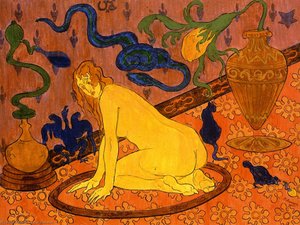
In his most evocative works, Ranson explored themes that bordered on the occult and the mystical. His fascination with witchcraft and supernatural narratives allowed him to experiment with surreal night scenes and enigmatic figures. This is perhaps most strikingly realized in masterpieces such as:

Legacy and Artistic Significance

The legacy of Paul Elie Ranson extends far beyond the boundaries of the Nabi movement. By championing the idea that art should be an expression of inner truth rather than a mirror of nature, he paved the way for the radical shifts in 20th-century modernism. His ability to blend decorative elegance with profound psychological depth left an indelible mark on the development of Fauvism and much of the subsequent abstraction movement. Even as his work remains rooted in the late nineteenth-century fascination with the mystical, his technical innovations—specifically his use of bold color palettes and expressive, flattened forms—continue to resonate with contemporary viewers seeking the emotional resonance of the symbolic.

Ranson’s death in 1909 marked the end of a transformative era, yet his influence persists in every painting that seeks to find the extraordinary within the ordinary. Through his sensitive depictions of landscapes and still lifes, as well as his hauntingly beautiful explorations of the human psyche, he remains a cornerstone of Post-Impressionist history, reminding us that the true purpose of art is to illuminate the mysteries of the human spirit.