Portrait of Lucas Cranach the Elder

The 100 Most Famous Lucas Cranach the Elder Paintings, a Gallery Selection

Updated November 2026 · ranked by our popularity score (searches, visits and orders for each work) · 1,060 works by Lucas Cranach the Elder in our catalogue

In short

Of all the originals Lucas Cranach the Elder left, the most famous is The Fountain of Youth (1546), in the collection of the Gemäldegalerie, Berlin. Close behind it come Adam and Eve (1531) and Judith with the head of Holofernes (1530). Our catalog holds 1,060 works by Lucas Cranach the Elder; the gallery has kept the 100 the world admires most, each shown with its date, its museum and its story.

1472 – 1553, Kronach Northern renaissance Most works: Bavarian State Painting Collections

Lucas Cranach the Elder's top 10 paintings: the gallery's choice

1
The Fountain of Youth (1546) by Lucas Cranach the Elder

The Fountain of Youth

1546 · Oil On Panel · Gemäldegalerie, Berlin

Lucas Cranach the Elder’s “The Fountain of Youth,” painted in 1546, is more than just a beautiful depiction of a fantastical scene; it’s a profound meditation on human desire – specifically, the yearning for immortality and the seductive promise of youth. This oil-on-panel masterpiece, currently residing within the Gemäldegalerie museum in Berlin, offers a captivating glimpse into the anxieties and aspirations of 16th-century Germany, a period marked by religious reformation…

2
Adam and Eve (1531) by Lucas Cranach the Elder

Adam and Eve

1531 · Oil On Panel

Lucas Cranach the Elder's "Adam and Eve" is a masterpiece that captures the essence of the Northern Renaissance, blending meticulous detail with profound symbolism. This iconic painting invites viewers into the Garden of Eden, offering a glimpse into the origins of humanity as depicted through Cranach's distinctive style.

3
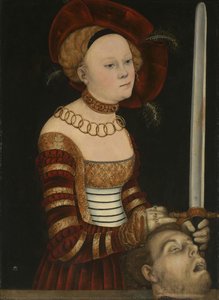
Judith with the head of Holofernes (1530) by Lucas Cranach the Elder

Judith with the head of Holofernes

1530 · Oil On Panel · Kunsthistorisches Museum, Vienna

Lucas Cranach the Elder's depiction of *Judith with the Head of Holofernes* is a powerful and psychologically complex work, far exceeding a simple illustration of a biblical narrative. This painting invites viewers to contemplate themes of bravery, sacrifice, divine justice, and the evolving role of women during the Renaissance – all rendered with the meticulous detail characteristic of the Northern Renaissance style.

4
Stag Hunt of Elector Friedrich III the Wise (1529) by Lucas Cranach the Elder

Stag Hunt of Elector Friedrich III the Wise

1529 · Oil On Canvas · Kunsthistorisches Museum, Vienna

Captivating Subject and Dynamic Composition Immerse yourself in a vibrant and meticulously detailed depiction of a noble hunting expedition, a scene that captures the grandeur and aristocratic tradition of the Renaissance era. The artwork vividly portrays hunters on horseback, accompanied by loyal dogs, pursuing a variety of game animals such as deer and boars. The composition is carefully balanced yet lively, drawing the viewer’s eye across the landscape—from the tranquil…

5
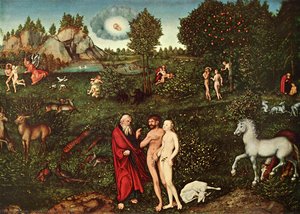
Adam and Eve in the Garden of Eden (1530) by Lucas Cranach the Elder

Adam and Eve in the Garden of Eden

1530 · Oil On Panel · Kunsthistorisches Museum, Vienna

Captivating Biblical Narrative and Rich Symbolism This exquisite artwork vividly captures the pivotal moment from the biblical story of Adam and Eve in the Garden of Eden. Created by the renowned German Renaissance master Lucas Cranach the Elder, it presents a highly detailed and symbolic tableau that invites viewers into a world of divine innocence, temptation, and human fallibility. The scene is alive with lush foliage, vibrant animals, and expressive…

6
Allegory of Justice (1537) by Lucas Cranach the Elder

Allegory of Justice

1537 · Oil On Panel · Ostrobothnian Museum, Vaasa

To stand before Lucas Cranach the Elder's Allegory of Justice is to encounter not merely paint on panel, but a profound meditation on cosmic balance. This arresting depiction captures justice in its purest, most idealized form—a figure embodying the very concept of impartial judgment. The composition immediately draws the eye to the central figure: a woman whose nudity suggests a timeless, universal principle rather than mere flesh. She stands poised…

7
Adam and Eve (1528) by Lucas Cranach the Elder

Adam and Eve

1528 · Oil On Canvas

Lucas Cranach the Elder's “Adam and Eve,” painted in 1528, is more than just a depiction of a biblical narrative; it’s a profound meditation on human fallibility, temptation, and the very essence of our relationship with nature. Executed during a period of intense religious and social transformation – the early years of the Reformation – this oil painting embodies the spirit of the Northern Renaissance, showcasing Cranach's mastery of color,…

8
The Last Supper (1547) by Lucas Cranach the Elder

The Last Supper

1547 · Oil On Panel

In this 1547 painting by Lucas Cranach the Elder, the solemnity of the Last Supper is captured through a scene of profound intimacy. Jesus sits at the center of a large dining table draped in a white tablecloth, surrounded by his twelve apostles. The setting is a stately room where the group is seated around an oval stone bench, while Christ himself occupies a separate square block at the right…

9
Christ as Savior with Martin Luther (1552) by Lucas Cranach the Elder

Christ as Savior with Martin Luther

1552 · Oil On Panel

The air feels heavy with the weight of sacrifice as we gaze upon the cross. Christ hangs suspended, his body illuminated by a singular, powerful light that cuts through the somber atmosphere. Below this central figure, Martin Luther kneels in profound reverence, his presence anchored to the foot of the wood. A striking, visceral detail draws the eye: blood flows directly from the wounds of Christ, descending to touch the…

10
Adam and Eve (1533) by Lucas Cranach the Elder

Adam and Eve

1533 · Oil On Panel · Gemäldegalerie, Berlin

In this painting, Adam and Eve are depicted at the fateful moment when they disobey God and commit the first sin. The scene unfolds in the Garden of Eden, where the man and woman stand close to each other. The woman holds an apple in her hand. They appear naked, as they were before the fall from grace.

The Lucas Cranach the Elder selection continues, 11 to 100

11Cupid complaining to Venus. (1525) by Lucas Cranach the ElderCupid complaining to Venus.1525 · National Gallery 12Portrait of Martin Luther (1543) by Lucas Cranach the ElderPortrait of Martin Luther1543 · Germanisches Nationalmuseum 13Venus and Cupid (1540) by Lucas Cranach the ElderVenus and Cupid1540 · Alte Pinakothek 14Judith with the Head of Holofernes (1530) by Lucas Cranach the ElderJudith with the Head of Holofernes1530 · Metropolitan Museum of Art 15The death of Holofernes (1531) by Lucas Cranach the ElderThe death of Holofernes1531 · Friedenstein Castle 16Adam and Eve (1510) by Lucas Cranach the ElderAdam and Eve1510 · Alte Pinakothek 17Venus with Cupid the Honey Thief (1549) by Lucas Cranach the ElderVenus with Cupid the Honey Thief1549 · Bavarian State Painting Collections 18Judith with the Head of Holofernes (1530) by Lucas Cranach the ElderJudith with the Head of Holofernes1530 · Burrell Collection 19Portrait of Martin Luther (1532) by Lucas Cranach the ElderPortrait of Martin Luther1532 · Hermitage Museum 20Katharina von Bora (1527) by Lucas Cranach the ElderKatharina von Bora1527 · Nationalmuseum 21Judith (1530) by Lucas Cranach the ElderJudith1530 · National Museum of Western Art 22Adam and Eve (1528) by Lucas Cranach the ElderAdam and Eve1528 · Detroit Institute of Arts 23Venus and Cupid stealing honey (1529) by Lucas Cranach the ElderVenus and Cupid stealing honey1529 · National Gallery 24Madonna and Child (1529) by Lucas Cranach the ElderMadonna and Child1529 · Kunstmuseum Basel 25The Paradise (1530) by Lucas Cranach the ElderThe Paradise1530 · Kunsthistorisches Museum 26the judgements of Paris (1528) by Lucas Cranach the Elderthe judgements of Paris1528 · Kunstmuseum Basel 27Head of Christ Crowned with Thorns (1510) by Lucas Cranach the ElderHead of Christ Crowned with Thorns1510 28The Crucifixion (1509) by Lucas Cranach the ElderThe Crucifixion1509 · Städel Museum 29Venus (1530) by Lucas Cranach the ElderVenus1530 · Herzog Anton Ulrich Museum 30Portrait of Philipp Melanchton (1532) by Lucas Cranach the ElderPortrait of Philipp Melanchton1532 · Hermitage Museum 31Portrait of Desiderius Erasmus (1530) by Lucas Cranach the ElderPortrait of Desiderius Erasmus1530 · Museum Boijmans Van Beuningen 32Portrait of Martin Luther (1528) by Lucas Cranach the ElderPortrait of Martin Luther1528 · Veste Coburg 33Portrait of Martin Luther (1526) by Lucas Cranach the ElderPortrait of Martin Luther1526 34Portrait Martin Luther (1529) by Lucas Cranach the ElderPortrait Martin Luther1529 · Böttcherstraße Museums 35Torgau Altarpiece: Saint Anne (1509) by Lucas Cranach the ElderTorgau Altarpiece: Saint Anne1509 · Städel Museum 36Christ and the Woman taken in Adultery (1520) by Lucas Cranach the ElderChrist and the Woman taken in Adultery1520 · Bavarian State Painting Collections 37Adam (1531) by Lucas Cranach the ElderAdam1531 · Staatliche Kunstsammlungen Dresden 38Martin Luther (1526) by Lucas Cranach the ElderMartin Luther1526 · Nationalmuseum 39Portr. of Martin Luther (1526) by Lucas Cranach the ElderPortr. of Martin Luther1526 · Westfälishes Landesmuseum 40Eve (1533) by Lucas Cranach the ElderEve1533 · Museum der bildenden Künste 41Eve (1549) by Lucas Cranach the ElderEve1549 · Norton Simon Museum 42Adam (1530) by Lucas Cranach the ElderAdam1530 · Norton Simon Museum 43Venus with Cupid the Honey Thief (1537) by Lucas Cranach the ElderVenus with Cupid the Honey Thief1537 · Germanisches Nationalmuseum 44Adam and Eve (1512) by Lucas Cranach the ElderAdam and Eve1512 · Veste Coburg 45Adam (1533) by Lucas Cranach the ElderAdam1533 · Art Institute of Chicago 46Venus (1531) by Lucas Cranach the ElderVenus1531 · Liechtenstein Museum 47The Judgment of Paris (1527) by Lucas Cranach the ElderThe Judgment of Paris1527 48Portrait of Martin Luther (1532) by Lucas Cranach the ElderPortrait of Martin Luther1532 · Statens Museum For Kunst 49The Judgment of Paris (1542) by Lucas Cranach the ElderThe Judgment of Paris1542 · Jagdschloss Grunewald 50Eve (1531) by Lucas Cranach the ElderEve1531 · Staatliche Kunstsammlungen Dresden 51Martin Luther (1533) by Lucas Cranach the ElderMartin Luther1533 · Herzog Anton Ulrich Museum 52The Ill-Matched Couple (1522) by Lucas Cranach the ElderThe Ill-Matched Couple1522 · Szépművészeti Múzeum 53The Judgment of Paris (1517) by Lucas Cranach the ElderThe Judgment of Paris1517 · Art Museum 54Adam and Eve (1530) by Lucas Cranach the ElderAdam and Eve1530 · Isabella Stewart Gardner Museum 55The Garden of Eden (1530) by Lucas Cranach the ElderThe Garden of Eden1530 · Staatliche Kunstsammlungen Dresden 56Adam and Eve (1529) by Lucas Cranach the ElderAdam and Eve1529 · Royal Museum of Fine Arts Antwerp 57Portraits of Martin Luther and Philipp Melanchthon (1543) by Lucas Cranach the ElderPortraits of Martin Luther and Philipp Melanchthon1543 · Galleria degli Uffizi 58Portrait of Martin Luther (1529) by Lucas Cranach the ElderPortrait of Martin Luther1529 · Friedenstein Castle 59Allegory of Law and Mercy: Crucifixion of Jesus (1540) by Lucas Cranach the ElderAllegory of Law and Mercy: Crucifixion of Jesus1540 · Bavarian State Painting Collections 60Eve (1518) by Lucas Cranach the ElderEve1518 · Herzog Anton Ulrich Museum 61Eve (1529) by Lucas Cranach the ElderEve1529 · Royal Museum of Fine Arts Antwerp 62Eve (1530) by Lucas Cranach the ElderEve1530 · Art Institute of Chicago 63Martin Luther (1532) by Lucas Cranach the ElderMartin Luther1532 · Bavarian State Painting Collections 64Adam and Eve in paradise (The Fall) (1531) by Lucas Cranach the ElderAdam and Eve in paradise (The Fall)1531 · Gemäldegalerie 65Portrait of Martin Luther (1525) by Lucas Cranach the ElderPortrait of Martin Luther1525 · Bristol Museum - Art Gallery 66Madonna and Child (1535) by Lucas Cranach the ElderMadonna and Child1535 · National Gallery of Art 67Virgin and Child (1525) by Lucas Cranach the ElderVirgin and Child1525 68The Three Graces (1531) by Lucas Cranach the ElderThe Three Graces1531 69Venus and Cupid (1531) by Lucas Cranach the ElderVenus and Cupid1531 70Martin Luther as Junker Jörg (1522) by Lucas Cranach the ElderMartin Luther as Junker Jörg1522 71Trinity (1515) by Lucas Cranach the ElderTrinity1515 72Martin Luther as an Augustinian Monk (1546) by Lucas Cranach the ElderMartin Luther as an Augustinian Monk1546 · Germanisches Nationalmuseum 73Portraits of Martin Luther and Catherine Bore (1529) by Lucas Cranach the ElderPortraits of Martin Luther and Catherine Bore1529 · Galleria degli Uffizi 74Cupid complaining to Venus (1525) by Lucas Cranach the ElderCupid complaining to Venus1525 · National Gallery 75The Golden Age (1530) by Lucas Cranach the ElderThe Golden Age1530 · Alte Pinakothek 76Portrait of Johann the Steadfast (1509) by Lucas Cranach the ElderPortrait of Johann the Steadfast1509 · National Gallery 77The Stag Hunt of the Elector Frederic the Wise (1463-1525) of Saxony (1529) by Lucas Cranach the ElderThe Stag Hunt of the Elector Frederic the Wise (1463-1525) of Saxony1529 · National Gallery of Denmark 78The Judgment of Paris (1512) by Lucas Cranach the ElderThe Judgment of Paris1512 · Kimbell Art Museum 79Portrait of a Lady of the Saxon Court as Judith with the Head of Holofernes by Lucas Cranach the ElderPortrait of a Lady of the Saxon Court as Judith with the Head of HolofernesLegion of Honor 80Saint Jerome by Lucas Cranach the ElderSaint Jerome 81Christ and the Adulteress (1532) by Lucas Cranach the ElderChrist and the Adulteress1532 · Szépművészeti Múzeum 82Venus with amor the honey thief by Lucas Cranach the ElderVenus with amor the honey thiefKröller-Müller Museum 83A Prince of Saxony (1517) by Lucas Cranach the ElderA Prince of Saxony1517 · National Gallery of Art 84Lucretia (1533) by Lucas Cranach the ElderLucretia1533 85Prague Altarpiece [right panel, fragment]: Saint Christina (1520) by Lucas Cranach the ElderPrague Altarpiece [right panel, fragment]: Saint Christina1520 · National Gallery Prague 86The Crucifixion (1520) by Lucas Cranach the ElderThe Crucifixion1520 · National Gallery of Denmark 87Virgin and Child with St. Anne (1520) by Lucas Cranach the ElderVirgin and Child with St. Anne1520 · Bavarian State Painting Collections 88The Fall of Men: Eve (1515) by Lucas Cranach the ElderThe Fall of Men: Eve1515 · Kunsthistorisches Museum 89Portrait of Johann Friedrich the Magnanimous (1509) by Lucas Cranach the ElderPortrait of Johann Friedrich the Magnanimous1509 · National Gallery 90Eve by Lucas Cranach the ElderEveRoyal Museums of Fine Arts of Belgium 91Portrait of a Man (1522) by Lucas Cranach the ElderPortrait of a Man1522 · National Gallery of Art 92Johann I (1468–1532), the Constant, Elector of Saxony (1536) by Lucas Cranach the ElderJohann I (1468–1532), the Constant, Elector of Saxony1536 · Friedenstein Castle 93Johann I (1468–1532), the Constant, Elector of Saxony (1532) by Lucas Cranach the ElderJohann I (1468–1532), the Constant, Elector of Saxony1532 · Metropolitan Museum of Art 94Saint Stephen, King of Hungary (1510) by Lucas Cranach the ElderSaint Stephen, King of Hungary1510 · Germanisches Nationalmuseum 95David and Goliath (Elector Joachim II's exemplum panels) (1542) by Lucas Cranach the ElderDavid and Goliath (Elector Joachim II's exemplum panels)1542 · Jagdschloss Grunewald 96Saint Barbara (1516) by Lucas Cranach the ElderSaint Barbara1516 · Staatliche Kunstsammlungen Dresden 97The Suicide of Lucretia (1545) by Lucas Cranach the ElderThe Suicide of Lucretia1545 · Veste Coburg 98Lucretia (1531) by Lucas Cranach the ElderLucretia1531 · Brooklyn Museum 99Portrait of Cardinal Albert of Brandenburg (1526) by Lucas Cranach the ElderPortrait of Cardinal Albert of Brandenburg1526 · Hermitage Museum 100Saint Anne with the Duchess Barbara of Saxony as Donor (interior right wing) (1514) by Lucas Cranach the ElderSaint Anne with the Duchess Barbara of Saxony as Donor (interior right wing)1514 · Thyssen-Bornemisza Museum

Lucas Cranach the Elder's famous paintings, period by period

The subjects that held Lucas Cranach the Elder's eye

The four subjects that come back most often in these originals, each with its finest example.

The museums that keep Lucas Cranach the Elder's originals

The 8 museums that hold the most of the paintings on this page.

Museum City Works by Lucas Cranach the Elder Paintings from this list
Bavarian State Painting Collections, MunichBavarian State Painting Collections Munich 61 Venus with Cupid the Honey Thief, Christ and the Woman taken in Adultery, Allegory of Law and Mercy: Crucifixion of Jesus
Kunsthistorisches Museum, ViennaKunsthistorisches Museum Vienna 24 Judith with the head of Holofernes, Stag Hunt of Elector Friedrich III the Wise, Adam and Eve in the Garden of Eden
National Gallery, LondonNational Gallery London 11 Cupid complaining to Venus., Venus and Cupid stealing honey, Cupid complaining to Venus
Staatliche Kunstsammlungen Dresden, DresdenStaatliche Kunstsammlungen Dresden Dresden 19 Adam, Eve, The Garden of Eden
Germanisches Nationalmuseum, NurembergGermanisches Nationalmuseum Nuremberg 15 Portrait of Martin Luther, Venus with Cupid the Honey Thief, Martin Luther as an Augustinian Monk
Gemäldegalerie, BerlinGemäldegalerie Berlin 29 The Fountain of Youth, Adam and Eve, Adam and Eve in paradise (The Fall)
Veste Coburg, CoburgVeste Coburg Coburg 18 Portrait of Martin Luther, Adam and Eve, The Suicide of Lucretia
Friedenstein Castle, GothaFriedenstein Castle Gotha 13 The death of Holofernes, Portrait of Martin Luther, Johann I (1468–1532), the Constant, Elector of Saxony

Lucas Cranach the Elder decade by decade: the original that defines each

Works per decade

Pick a decade to see the original that defines it.

Collectors' questions about Lucas Cranach the Elder's paintings

Which work is Lucas Cranach the Elder most famous for?Reveal the answer

The Fountain of Youth (1546), Gemäldegalerie, Berlin. Adam and Eve (1531) and Judith with the head of Holofernes (1530) come next.

What age was Lucas Cranach the Elder when The Fountain of Youth was made?Reveal the answer

74 years old: The Fountain of Youth dates from 1546, and Lucas Cranach the Elder was born in 1472.

What are the ten most famous Lucas Cranach the Elder paintings?Reveal the answer

The Fountain of Youth, Adam and Eve, Judith with the head of Holofernes, Stag Hunt of Elector Friedrich III the Wise, Adam and Eve in the Garden of Eden, Allegory of Justice, Adam and Eve, The Last Supper, Christ as Savior with Martin Luther and Adam and Eve. The ranking above gives each one's year and museum.

How many paintings did Lucas Cranach the Elder leave?Reveal the answer

Our catalog holds 1,060 works by Lucas Cranach the Elder, dated from 1509 to 1552.

In which museums do Lucas Cranach the Elder's masterpieces hang?Reveal the answer

Mostly in Bavarian State Painting Collections (Munich), Kunsthistorisches Museum (Vienna) and National Gallery (London). The museum table above lists them all.

In which years did Lucas Cranach the Elder paint the most famous works?Reveal the answer

In 1530s: 37 of the 100 works on this page were made then, Adam and Eve among them.

What are the first and the last famous originals of Lucas Cranach the Elder?Reveal the answer

On this page, the earliest is The Crucifixion (1509) and the latest Christ as Savior with Martin Luther (1552).

Which subjects did Lucas Cranach the Elder choose most often?Reveal the answer

Woman (31), Man (29) and Tree (19), across the 100 works on this page.

Which technique did Lucas Cranach the Elder use most?Reveal the answer

Oil On Panel, for 76 of the 100 works on this page.

To which art movement does Lucas Cranach the Elder belong?Reveal the answer

Northern renaissance, judging by the originals on this page.

Which Lucas Cranach the Elder works hang at the Bavarian State Painting Collections?Reveal the answer

Venus with Cupid the Honey Thief, Christ and the Woman taken in Adultery and Allegory of Law and Mercy: Crucifixion of Jesus: the Bavarian State Painting Collections, Munich holds 5 of the works on this page.

Lucas Cranach the Elder: life and work

The Visual Architect of the Reformation

To understand the German Renaissance, one must look past the abstract theology and toward the sharp, decisive lines of Lucas Cranach the Elder. He was not merely a painter; he was a visual strategist. While the Protestant Reformation fractured Europe, Cranach provided the imagery that defined the new order. His association with Martin Luther was not a matter of mere friendship, but a functional partnership that transformed religious thought into tangible, reproducible art. He moved beyond the traditional Catholic iconography of his predecessors, opting instead for a style that emphasized direct engagement with scripture. This was a calculated shift. By producing woodcuts and engravings, he ensured that Reformation ideas could travel far beyond the walls of a single church, reaching a broad, literate, and increasingly restless public.

His workshop in Wittenberg operated with the efficiency of a modern enterprise. This was not a solitary endeavor. Cranach managed a massive output through a system of assistants and apprentices, including his son, Lucas Cranach the Younger. This collaborative model allowed him to dominate the market for both high-end oil paintings and affordable prints. His technical precision was matched by a keen understanding of patronage. By securing the service of Frederick III, Elector of Saxony, in 1504, he gained the stability and political access necessary to shape the visual narrative of an entire era. He was as much a shrewd businessman as he was a craftsman.

Portraiture and the Construction of Identity

Cranach’s portraits do more than record a face; they construct a persona. His depictions of Martin Luther are particularly significant. He produced eleven different versions of the reformer, each one a deliberate tool of communication. These were not simple likenesses. They were carefully composed images designed to project authority, piety, and intellectual strength. In an age of religious upheaval, these portraits functioned as political and theological statements. He understood that to change a belief system, one had to change the image of the man leading it.

This mastery of identity extended to the secular and the mythological. His portraits of German princes and noblewomen utilized a specific aesthetic: elongated proportions, meticulous detail, and a refined execution that emphasized status. Whether he was painting a high-ranking official or a mythological figure like Venus, Cranach maintained a consistent focus on psychological depth. He avoided the purely decorative, opting instead for a realism that captured the essence of his subjects. His work in this period demonstrates a sophisticated use of light and shadow to create depth, pulling the viewer into the immediate presence of the sitter.

Technical Precision and Stylistic Legacy

The Cranach style is unmistakable. It is characterized by a specific tension between elegance and realism. His figures often possess a graceful, almost stretched quality, yet the textures of velvet, gold, and skin are rendered with exacting detail. This duality allowed his work to function in various contexts, from the solemnity of an altarpiece to the more sensual themes of classical mythology. His ability to navigate these different subject matters—from the religious to the profane—is a primary reason for his enduring presence in museums from Vienna to New York.

His technical repertoire was diverse, spanning several mediums:

  • Oil on panel: Used for his most significant commissions and portraits.
  • Woodcut and Engraving: The engines of his widespread influence, allowing for the mass dissemination of his designs.
  • Collaborative Workshop Production: A method that ensured his stylistic hallmarks were perpetuated by his successors.

Cranach died in 1553, but the visual language he helped establish remained the standard for much of the Northern Renaissance. He did not just observe the changes of his time; he provided the tools to visualize them. His legacy is found in the way he bridged the gap between the medieval tradition and the modern, individualistic focus of the Reformation. He remains a central figure because his art was never static; it was a functional, evolving response to a world in flux.