

The Rise of Humanism and its Impact on German Art
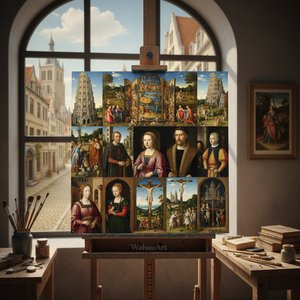 Northern Renaissance Masters: 10 Artworks That Shaped History |
Journey through the Northern Renaissance! Explore 10 iconic paintings by Jan van Eyck, Dürer & Bosch. Discover their stories, techniques & lasting impact. Find museum-quality art reproductions & elevate your home decor on .
The German Renaissance, unfolding across the 15th and 16th centuries, wasn’t a simple mirroring of Italian artistic triumphs. It was a distinct flowering, deeply rooted in Northern European traditions yet profoundly shaped by the burgeoning humanist movement sweeping across the continent. Unlike Italy's focus on classical antiquity as a direct source of inspiration, German humanism often intertwined with religious reform and a fascination with the natural world. This unique blend fostered an art that was both intensely detailed and spiritually charged, grappling with questions of faith, morality, and the individual’s place in the cosmos. Scholars like Konrad Celtis and Johann Reuchlin played pivotal roles, introducing classical texts and ideas to German intellectuals, but their impact wasn't merely academic; it permeated artistic circles, encouraging a new focus on observation, realism, and the dignity of humankind.
This shift is visible in the works that began to emerge. Artists moved beyond purely devotional imagery, incorporating secular subjects, portraiture with psychological depth, and landscapes imbued with symbolic meaning. The emphasis wasn’t solely on idealized beauty but on capturing the essence of lived experience – the wrinkles of age, the textures of everyday life, the raw emotion etched onto human faces. This burgeoning interest in the individual would become a defining characteristic of Northern Renaissance art.
Albrecht Dürer: A Master of Printmaking and Self-Portraiture
 Peasant Couple Dancing
Explore Albrecht Dürer’s ‘Peasant Couple Dancing’ – a stunning 1514 engraving showcasing Northern Renaissance realism & dynamic movement. A masterpiece of detail!
No discussion of the German Renaissance is complete without acknowledging Albrecht Dürer (1471–1528). Born in Nuremberg, he quickly transcended his origins to become arguably the most influential artist north of the Alps. While proficient in painting, it was his mastery of printmaking – particularly woodcut and engraving – that truly revolutionized art dissemination. Before Dürer, prints were often considered lesser forms; he elevated them to a level comparable with painting and sculpture.
Study of the Christ Child (1495), a delicate pen drawing, exemplifies his meticulous observation and anatomical precision even in early works. But it was his engravings like Three Peasants in Conversation and Peasant Couple Dancing (1514) that captured the public imagination. These weren’t idealized depictions of nobility; they were portraits of ordinary people, rendered with remarkable realism and dynamic energy. Dürer didn't merely reproduce images; he imbued them with narrative power and psychological insight.
Dürer was also a pioneer in self-portraiture. His numerous self-portraits aren’t simply records of his appearance but profound explorations of identity, aging, and the artist’s role in society. He consciously crafted an image of himself as a learned intellectual and skilled craftsman, challenging traditional hierarchies and asserting the dignity of artistic labor. His engagement with Italian Renaissance masters like Raphael and Leonardo da Vinci further broadened his artistic horizons, though he always maintained a distinctly Northern sensibility.
Beyond Dürer: Exploring the Danube School and Regional Styles
 Albrecht Altdorfer
Albrecht Altdorfer (1480-1538): Pioneer of German Renaissance landscape painting & key figure of the Danube School. Explore his engravings, religious works & innovative art.
While Dürer stands as a towering figure, the German Renaissance was far from a one-man show. The Danube School, centered in cities along the Danube River – particularly Augsburg and Passau – developed a unique style characterized by its atmospheric landscapes and mystical religious themes. Albrecht Altdorfer (1480–1538) emerged as a leading figure, renowned for his evocative depictions of forests, mountains, and dramatic skies. His works often blended observation with imaginative symbolism, creating scenes that were both visually stunning and deeply spiritual.
Other regional centers also fostered distinct artistic traditions. Hans Baldung (1485–1545), known as “Hans Holbein the Younger’s brother,” developed a highly expressive style marked by elongated figures, allegorical imagery, and often unsettling depictions of witchcraft and mythology. His work reflects the anxieties and uncertainties of the Reformation era. The diversity of styles across Germany demonstrates that the Renaissance wasn't a monolithic movement but a complex interplay of local traditions, individual artistic visions, and broader cultural forces.
Religious Reformation and Artistic Expression in Northern Germany
The Protestant Reformation, initiated by Martin Luther in 1517, profoundly impacted German art. The rejection of papal authority and the emphasis on direct access to scripture led to a shift away from elaborate religious iconography towards simpler, more didactic imagery. Artists like Lucas Cranach the Elder (1472–1553), a close friend and supporter of Luther, produced woodcuts and paintings that promoted Reformation ideals.
However, the relationship between art and the Reformation was complex. While some artists embraced Protestant themes, others struggled to reconcile their artistic sensibilities with the new religious climate. Matthias Grünewald’s (c. 1470–1536) Isenheim Altarpiece, a masterpiece of emotional intensity, exemplifies this tension. Though deeply religious, its graphic depictions of suffering and sacrifice challenged conventional notions of beauty and decorum. The Reformation also spurred the development of new genres, such as portraiture of Protestant reformers and illustrations for vernacular Bibles.
Techniques and Materials: Innovation in Painting, Woodcut, and Engraving
German Renaissance artists were not only innovative in their subject matter but also in their techniques and materials. Oil painting gained prominence, allowing for greater realism and detail than traditional tempera methods. The development of printing techniques – particularly woodcut and engraving – revolutionized art production and dissemination. Woodcuts involved carving an image into a block of wood, while engravings required etching lines onto a metal plate.
Dürer’s meticulous approach to both painting and printmaking set new standards for technical skill. He experimented with perspective, anatomy, and chiaroscuro (the use of light and shadow) to create works that were both visually compelling and intellectually rigorous. The goldsmithing tradition in cities like Augsburg also influenced artistic production, resulting in exquisite metalwork and intricate decorative objects. This emphasis on craftsmanship and attention to detail became a hallmark of German Renaissance art.
The Legacy of the German Renaissance: Influence on Subsequent Art Movements
The German Renaissance, though relatively short-lived, left an indelible mark on Western art history. Dürer’s prints circulated widely across Europe, influencing artists in Italy and beyond. The emphasis on realism, psychological depth, and emotional intensity resonated with subsequent generations of painters and engravers. The Danube School's atmospheric landscapes foreshadowed the Romantic movement, while the expressive style of Baldung anticipated aspects of Mannerism.
The German Renaissance also laid the groundwork for later developments in art theory and criticism. Dürer’s writings on perspective and proportion helped to establish a scientific approach to artistic practice. Today, the works of Dürer, Altdorfer, Cranach, and their contemporaries continue to captivate audiences with their beauty, complexity, and enduring relevance. Explore these masterpieces – available as museum-quality reproductions at OriginalUniqueArt, allowing you to bring the spirit of the Northern Renaissance into your own home.



