The Legacy of Palma Vecchio: Foundations of a Venetian Style
 jacopo palma the elder
Discover Jacopo Palma the Elder: Venetian Renaissance painter known for captivating portraits & mythologies. Explore his works at museums in Italy!
Jacopo Palma il Giovane did not emerge from a vacuum; his artistic lineage is inextricably linked to the formidable presence of his great-uncle, Jacopo Negretti, known as Palma Vecchio. To understand the younger Palma’s brilliance, one must first appreciate the foundations laid by this earlier master. Palma Vecchio, active in the early 16th century, established a distinctive Venetian style characterized by robust figures, rich color palettes, and a captivating blend of mythological and religious subject matter. He possessed an exceptional talent for portraiture, imbuing his subjects with both dignity and psychological depth – qualities that would later resonate in the work of his nephew. Vecchio’s influence wasn't merely stylistic; he maintained a successful workshop, providing a crucial training ground for aspiring artists, including Antonio Nigreti, Palma il Giovane’s father. This familial connection ensured a direct transmission of artistic principles and techniques, forming the bedrock upon which the younger Palma would build his own celebrated career.
While Vecchio's work often displayed a certain monumental quality, it was also marked by a subtle sensuality and an appreciation for the beauty of the human form. This emphasis on physicality, coupled with a masterful use of color, became hallmarks of Venetian painting – traits that Palma il Giovane would inherit and refine, ultimately contributing to the enduring allure of the school.
Early Influences & Roman Sojourns: Shaping Palma il Giovane’s Artistic Vision
 Lucretia
Discover Palma Giovane’s charcoal sketch of Lucretia – a Renaissance portrait study showcasing dynamic lines & subtle shading. Explore this unique artwork's beauty & technique.
Born in Venice around 1548/50, Jacopo Negretti received his initial artistic education within his father's workshop. However, recognizing the burgeoning talent of his son, Antonio sent him to Rome around 1567. This period proved pivotal in shaping Palma il Giovane’s evolving aesthetic. Rome at this time was a crucible of artistic innovation, dominated by the stylistic currents of Mannerism. While initially absorbing these influences – evident in some of his early compositions – Palma did not fully embrace its often-elongated forms and complex allegories. Instead, he embarked on a journey of synthesis, seeking to reconcile the Roman emphasis on intellectual complexity with the more direct emotionality and vibrant colorism inherent in the Venetian tradition.
His time in Rome exposed him to a broader range of artistic precedents, including the works of Raphael and Michelangelo. Upon his return to Venice, Palma began to integrate these influences into his own unique style, moving away from the more rigid conventions of Mannerism towards a greater naturalism and expressive power. This period marked a crucial turning point, setting the stage for his emergence as a leading figure in the Venetian art world.
A Synthesis of Titian and Tintoretto: Defining Characteristics of Palma's Mature Work
 jacopo palma the younger
Discover Jacopo Palma il Giovane’s Venetian masterpieces! Explore his vibrant paintings, influenced by Tintoretto & Titian, capturing religious scenes & mythology. A key figure in Venice's art history.
The death of Tintoretto in 1594 created a void at the heart of Venetian painting. It was into this space that Jacopo Palma il Giovane stepped, rapidly establishing himself as the dominant artist in the city. However, to characterize his style simply as filling a vacancy would be a gross oversimplification. Palma wasn’t merely an imitator; he possessed a remarkable ability to synthesize the strengths of his predecessors, most notably Titian and Tintoretto. From Titian, he inherited a mastery of color, light, and texture – a capacity to create luminous surfaces that seem to radiate warmth and life. He absorbed Titian's loose brushwork and his ability to convey emotion through subtle gradations of tone.
From Tintoretto, Palma adopted a dynamic compositional energy and a flair for dramatic narrative. He skillfully incorporated Tintoretto’s use of diagonal lines and bold foreshortening, creating compositions that are both visually arresting and emotionally charged. Yet, Palma tempered these influences with his own sensibility, resulting in a style that is characterized by a remarkable balance between grandeur and intimacy, drama and serenity. His figures possess a solidity and weight reminiscent of Titian, while their emotional intensity often echoes the fervor of Tintoretto.
Religious Paintings & Mythological Narratives: Exploring Key Themes and Masterpieces
 Judas Cyriacus
Explore 'Judas Cyriacus' by Palma Giovane (1593). A masterful Venetian oil painting showcasing Renaissance realism & rich color palettes. Discover a key work by this influential artist.
Palma il Giovane’s oeuvre is remarkably diverse, encompassing both religious paintings and mythological narratives. His religious works, such as depictions of the Virgin Mary and various saints, are characterized by a profound sense of piety and emotional depth. Consider his ‘Doge Pietro Loredan Beseeching The Virgin,’ a stunning example of Venetian opulence and divine grace. The dramatic chiaroscuro, masterful composition, and exquisite detail showcase Palma’s technical prowess and his ability to convey spiritual fervor.
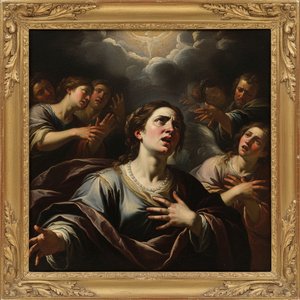
His mythological paintings, meanwhile, often explore themes of love, loss, and transformation. Works like ‘Judas Cyriacus’ (1593) demonstrate a keen understanding of human psychology and a remarkable ability to depict complex emotions with subtlety and nuance. Even in his charcoal sketches – such as the study of ‘Lucretia’ – one can discern Palma's exceptional draftsmanship and his sensitivity to form and expression. These works, though often preliminary studies, reveal a profound artistic intelligence and a commitment to capturing the essence of his subjects.
Patronage, Commissions & International Recognition: The Reach of Palma’s Influence
Palma il Giovane enjoyed an exceptionally successful career, attracting commissions from prominent Venetian families, the Counter-Reformation clergy, and patrons throughout Italy and Central Europe. His ability to cater to diverse tastes while maintaining his own distinctive style contributed to his widespread popularity. He received numerous commissions in the area of Bergamo, then part of the Venetian Domini di Terraferma, demonstrating the reach of his artistic reputation beyond the confines of Venice itself.
Perhaps most significantly, Palma garnered the attention of Emperor Rudolph II in Prague, who commissioned several works from him. This patronage solidified his international recognition and cemented his position as one of the leading artists of his time. His influence extended far beyond his own lifetime, inspiring generations of Venetian painters and contributing to the enduring legacy of the Venetian School. The harmonious blend of Titian’s colorism and Tintoretto’s dynamism, coupled with his own innate talent for emotional expression, ensures that Jacopo Palma il Giovane remains a pivotal figure in the history of Italian art – a master whose works continue to captivate and inspire.
Discover Jacopo Palma il Giovane’s Venetian masterpieces at OriginalUniqueArt.com, where you can explore his vibrant paintings, influenced by Tintoretto & Titian, capturing religious scenes & mythology. A key figure in Venice's art history.