Early Life & Apprenticeship: Forging a Venetian Style
Sebastiano Ricci, born in the picturesque town of Belluno in 1659, emerged from a Venice steeped in artistic tradition yet yearning for renewal. His early life, however, was far from idyllic. While his parentage – Andreana and Livio Ricci – provided a foundation, it was an apprenticeship under Federico Cervelli that initially charted his course as a painter. Some accounts suggest Sebastiano Mazzoni also played a formative role during these nascent years, though the precise details remain somewhat obscured by time. This period wasn’t merely about mastering brushstrokes; it was about absorbing the very essence of Venetian artistry – a tradition prioritizing color and atmosphere over rigid draftsmanship. Yet, even in his youth, Ricci displayed a restless spirit, one that would lead him into both artistic triumphs and personal turmoil. A youthful indiscretion in 1678 resulted in imprisonment—a stark interruption to his training—and foreshadowed a life marked by both brilliance and controversy.
Ricci’s Roman Period: Dramatic Frescoes and Artistic Trials
 The Last Supper
Explore Sebastiano Ricci’s ‘The Last Supper’! A lavish Baroque feast, dramatic lighting & rich detail. Discover this captivating Renaissance masterpiece – a unique art investment.
Following his release, Ricci embarked on a period of intense travel and artistic exploration. Bologna became a temporary haven, where he found himself influenced by the work of Giovanni Gioseffo dal Sole. However, it was Rome that truly tested and refined his abilities. Commissioned to paint a “Decapitation of John the Baptist” for the Fraternity of Saint John of Florence in 1682, Ricci began to establish a reputation for dramatic compositions and skillful execution. This initial success led to further opportunities, including work for the Count of San Secondo near Parma, culminating in the decoration of the *Oratorio della Beata Vergine del Serraglio* by 1687. Yet, his personal life continued to be fraught with challenges. A hasty departure from Bologna—fueled by scandal and a new relationship with Magdalen, the daughter of painter Giovanni Peruzzini—led to another imprisonment, narrowly avoiding execution thanks to the intervention of powerful patrons. This tumultuous period underscores a key aspect of Ricci’s character: an undeniable talent coupled with a penchant for risk.
The Flourishing Years in Venice: A Synthesis of Baroque Grandeur
 Wikipedia: Sebastiano Ricci
Sebastiano Ricci (1 August 1659 – 15 May 1734) was an Italian Baroque painter of the late Baroque period in Venetian painting. About the same age as Piazzetta, and an elder contemporary of Tiepolo, he represents a late version of the vigorous and lum...
Ricci's eventual return to Venice in 1696 marked the beginning of his most prolific and celebrated phase. He swiftly integrated himself into the city’s artistic fabric, securing a steady stream of commissions that allowed him to fully develop his distinctive style. This wasn’t simply a continuation of earlier trends; Ricci synthesized the grandeur of Paolo Veronese with a newfound clarity and luminosity. His paintings began to radiate an emotional intensity, characterized by rich color palettes, expressive brushwork, and a dynamic sense of movement. Works from this period demonstrate a mastery of both religious subjects and classical mythology, showcasing his versatility and ability to captivate audiences with scenes brimming with life and drama. He wasn’t merely replicating the past; he was reinterpreting it through a uniquely Venetian lens.
Master of Illusionistic Ceiling Painting: Techniques and Notable Commissions
Illusionistic ceiling painting, which includes the techniques of perspective di sotto in sù and quadratura, is the tradition in Renaissance, Baroque and Rococo art in which trompe-l'œil, perspective tools such as foreshortening, and other spatial eff...
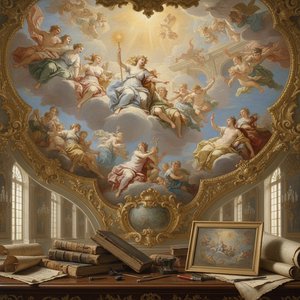
Perhaps Ricci's most enduring legacy lies in his breathtaking illusionistic ceiling paintings. He became a pioneer in *quadratura*, employing perspective techniques to create the impression of vast, open spaces above the viewer—often depicting scenes that seamlessly blended architecture with celestial realms. This mastery was particularly evident in commissions for palaces and churches throughout Italy. The Palazzo Colonna in Rome stands as a testament to his skill, featuring allegorical frescoes celebrating Marcantonio Colonna’s victory at Lepanto. Similarly, the Sala della Giovinezza al Bivio within Palazzo Marucelli Fenzi in Florence showcases his ability to create immersive environments filled with mythological figures and symbolic narratives. These weren't simply decorative flourishes; they were carefully constructed illusions designed to inspire awe and convey complex messages through visual storytelling. The theatrical lighting and dynamic compositions further enhanced the sense of drama, drawing viewers into a world where reality and artifice blurred.
Legacy and Influence: Paving the Way for Tiepolo & Rococo Art
Sebastiano Ricci’s impact on Venetian painting extended far beyond his own lifetime. He is widely recognized as a pivotal figure in the revival of the school during the 18th century, bridging the gap between the late Baroque and the emerging Rococo style. His emphasis on clarity, coloristic beauty, and expressive brushwork paved the way for artists like Giambattista Tiepolo, who would carry his legacy forward with even greater scale and ambition. Ricci’s influence wasn't limited to technique; he also fostered a spirit of international collaboration, attracting commissions from across Europe—including a significant period working in England at Burlington House. His ability to adapt and innovate, coupled with his undeniable talent, ensured that his work continued to inspire generations of artists. Today, Sebastiano Ricci stands as a testament to the enduring power of Venetian artistry – a master of illusionism whose paintings continue to captivate and delight.