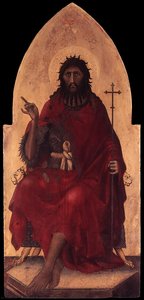
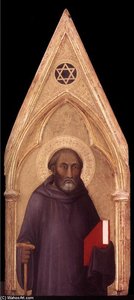
Portrait of Lippo Memmi

Lippo Memmi Paintings: The 27 Most Famous, Through a Gallery's Eye

Updated November 2026 · ranked by our popularity score (searches, visits and orders for each work) · 28 works by Lippo Memmi in our catalogue

In short

To the gallery's eye, Lippo Memmi's most famous painting is Triumph of St Thomas Aquinas (1340), whose original hangs in the Santa Caterina, Pisa. The Annunciation and Two Saints (1333) and Saint John the Evangelist (1330) complete the trio every eye recognises. Of the 28 works by Lippo Memmi in our catalog, the gallery presents the 27 most famous below, each original with its year, its museum and what makes it unique.

1291 – 1356, Siena International gothic Most works: Gemäldegalerie

The gallery's top 10 Lippo Memmi paintings

1
Triumph of St Thomas Aquinas (1340) by Lippo Memmi

Triumph of St Thomas Aquinas

1340 · Fresco · Santa Caterina, Pisa

To stand before this magnificent fresco is to step directly into the intellectual fervor of the early Quattrocento. Depicting the Triumph of St Thomas Aquinas, this work transcends mere portraiture; it is a vibrant theological statement rendered in pigment and plaster. At its heart stands St. Thomas Aquinas, the towering patron saint of universities, portrayed not just as a man, but as an embodiment of divine reason made manifest through…

2
The Annunciation and Two Saints (1333) by Lippo Memmi

The Annunciation and Two Saints

1333 · Galleria degli Uffizi, Florence

Within the hallowed halls of the Galleria degli Uffizi in Florence resides “The Annunciation and Two Saints,” a painting that transcends mere religious depiction, blossoming into a profound meditation on grace, divine communication, and the burgeoning beauty of the International Gothic style. Attributed primarily to Lippo Memmi, yet undeniably shaped by his brother-in-law Simone Martini’s influence, this tempera-on-wood artwork from 1333 offers a captivating glimpse into the artistic heart of…

3
Saint John the Evangelist (1330) by Lippo Memmi

Saint John the Evangelist

1330 · Tempera On Panel · Yale University Art Gallery, New Haven

In this vertical portrait, we encounter Saint John the Evangelist in a moment of profound stillness. He is presented from the waist up, framed by a delicate architectural arch that focuses our attention entirely on his contemplative presence. The figure is draped in a tunic of cerulean blue, partially covered by a heavy vermilion red cloak that falls in rhythmic, tactile folds across his shoulder. There is a certain weight…

4
The Assumption of Mary (1340) by Lippo Memmi

The Assumption of Mary

1340 · Tempera On Panel · Bavarian State Painting Collections, Munich

Step closer to this vertical panel, and you will feel the weight of the divine through its sheer, luminous structure. Painted around 1340, this work by Lippo Memmi captures a moment of profound spiritual transition. The composition is organized into three distinct tiers within a pointed, gabled frame, drawing the eye upward through a hierarchy of sacred events. At the very top, a small triangular section depicts the Coronation of…

5
Saint Clare (1330) by Lippo Memmi

Saint Clare

1330 · Tempera On Panel · Metropolitan Museum of Art, New York

Within a pointed, gilded architectural frame, Saint Clare rests in a moment of quiet, eternal contemplation. The scene is bathed in the luminous glow of gold leaf, which fills the background and creates an atmosphere of divine light. She sits centered in an ornate niche, her figure defined by the deep black of her wimple and mantle, which contrasts sharply against the warm, earthy brown of her habit. A single…

6
Maestà (1317) by Lippo Memmi

Maestà

1317 · Fresco · Palazzo Pubblico, Siena

The Maestà is a signed fresco executed by Lippo Memmi in 1317. This work depicts the Virgin Mary enthroned with the Child, a composition that reflects the spiritual and civic priorities of the period. It was commissioned for the Palazzo Pubblico’s Civic Hall in San Gimignano, Tuscany, serving as a significant visual presence within the local government's seat of power.

7
Mary with Child (1340) by Lippo Memmi

Mary with Child

1340 · Tempera On Panel · Gemäldegalerie, Berlin

Mary with Child is a devotional panel painting by the Sienese artist Lippo Memmi. Created about 1340, the work belongs to the fourteenth-century tradition of Italian Gothic art. It functions as a religious icon, presenting the Virgin Mary and the Christ Child in a formal, hierarchical arrangement.

8
The Annunciation to Mary and Six Saints (1340) by Lippo Memmi

The Annunciation to Mary and Six Saints

1340 · Tempera On Panel · Gemäldegalerie, Berlin

The Annunciation to Mary and Six Saints is a religious panel painting by Lippo Memmi. Created about 1340, this work functions as an altar wing. It captures a moment of divine intersection, where the celestial meets the terrestrial through the presence of the Archangel Gabriel and the Virgin Mary.

9
Mary with Child (1333) by Lippo Memmi

Mary with Child

1333 · Tempera On Panel · Gemäldegalerie, Berlin

The gold leaf background does not recede; it pushes forward, a heavy, textured wall of divine light. Against this granular radiance, the Virgin Mary sits in a vertical, hierarchical stillness. Her mantle is a deep ultramarine blue, a color pulled from the earth to represent the heavens. Beneath it, the red of her undergarment provides a sharp, warm contrast. She holds the Christ Child with a quiet, steady gravity. The…

10
Mary Magdalene (1330) by Lippo Memmi

Mary Magdalene

1330 · Tempera On Panel · Rhode Island School of Design Museum of Art, Providence

In this solemn religious portrait, Mary Magdalene emerges from a luminous gold background. The figure of Mary Magdalene, rendered by the Sienese artist Lippo Memmi, gazes forward with a quiet, steady presence. She occupies the center of the composition, her form framed by the sharp, architectural lines of a gilded, pointed frame. The portrait captures a moment of stillness, as if the subject is suspended in a state of perpetual…

Lippo Memmi paintings, ranked 11 to 27

The subjects that held Lippo Memmi's eye

The four subjects that come back most often in these originals, each with its finest example.

The museums that keep Lippo Memmi's originals

The 8 museums that hold the most of the paintings on this page.

Museum City Works by Lippo Memmi Paintings from this list
Gemäldegalerie, BerlinGemäldegalerie Berlin 4 Mary with Child, The Annunciation to Mary and Six Saints, Mary with Child
Lindenau-Museum, AltengauLindenau-Museum Altengau 4 Virgin and Child, St John the Baptist, Vallombrosan Saint
Metropolitan Museum of Art, New YorkMetropolitan Museum of Art New York 3 Saint Clare, Madonna and Child with Saints and Angels, Saint Paul
National Gallery of Art, WashingtonNational Gallery of Art Washington 2 Madonna and Child with Donor, Saint John the Baptist
Santa Caterina, PisaSanta Caterina Pisa 1 Triumph of St Thomas Aquinas
Galleria degli Uffizi, FlorenceGalleria degli Uffizi Florence 1 The Annunciation and Two Saints
Yale University Art Gallery, New HavenYale University Art Gallery New Haven 1 Saint John the Evangelist
Bavarian State Painting Collections, MunichBavarian State Painting Collections Munich 1 The Assumption of Mary

Lippo Memmi, one signature painting per decade

Works per decade

Pick a decade to see the original that defines it.

Lippo Memmi's paintings: the gallery answers

Which Lippo Memmi painting is the most famous of all?Reveal the answer

Triumph of St Thomas Aquinas (1340), Santa Caterina, Pisa. The Annunciation and Two Saints (1333) and Saint John the Evangelist (1330) come next.

How old was Lippo Memmi on completing Triumph of St Thomas Aquinas?Reveal the answer

49 years old: Triumph of St Thomas Aquinas dates from 1340, and Lippo Memmi was born in 1291.

Which are Lippo Memmi's top 10 paintings?Reveal the answer

Triumph of St Thomas Aquinas, The Annunciation and Two Saints, Saint John the Evangelist, The Assumption of Mary, Saint Clare, Maestà, Mary with Child, The Annunciation to Mary and Six Saints, Mary with Child and Mary Magdalene. The ranking above gives each one's year and museum.

How many works did Lippo Memmi create?Reveal the answer

Our catalog holds 28 works by Lippo Memmi, dated from 1317 to 1350.

Where do Lippo Memmi's most famous originals hang?Reveal the answer

Mostly in Gemäldegalerie (Berlin), Lindenau-Museum (Altengau) and Metropolitan Museum of Art (New York). The museum table above lists them all.

When did Lippo Memmi create the most famous paintings?Reveal the answer

In 1330s: 8 of the 27 works on this page were made then, The Annunciation and Two Saints among them.

Which are Lippo Memmi's earliest and latest famous works?Reveal the answer

On this page, the earliest is Maestà (1317) and the latest Madonna and Child (1350).

Which subjects did Lippo Memmi return to most?Reveal the answer

Gold background (9), Woman (8) and Saints (6), across the 27 works on this page.

Which medium did Lippo Memmi work in most?Reveal the answer

Tempera On Panel, for 15 of the 27 works on this page.

Which movement is Lippo Memmi associated with?Reveal the answer

International gothic, judging by the originals on this page.

Which Lippo Memmi originals does the Gemäldegalerie hold?Reveal the answer

Mary with Child, The Annunciation to Mary and Six Saints and Mary with Child: the Gemäldegalerie, Berlin holds 4 of the works on this page.

Lippo Memmi: the artist

A Sienese Master of Grace and Devotion

Lippo Memmi, born around 1291 in the heart of Siena, Italy, stands as a pivotal figure in the transition from the Byzantine-rooted traditions of medieval painting towards the burgeoning elegance of the International Gothic style. Though often discussed in relation to his celebrated brother-in-law and mentor, Simone Martini, recent scholarship increasingly recognizes Memmi’s distinct artistic voice and significant contributions to 14th-century Sienese art. His early life was steeped in artistry; as the son of Memmo di Filippuccio, a painter himself, Lippo likely received his initial training within his father's workshop, gaining foundational skills that would later be refined under Martini’s guidance. This familial and professional connection proved crucial, shaping not only his technique but also his artistic sensibility. The close relationship fostered a collaborative spirit evident in some of their most renowned works, yet Memmi ultimately forged a path marked by a unique blend of inherited tradition and personal innovation.

Embracing the International Gothic

Memmi’s art is deeply embedded within the aesthetic principles of the International Gothic style that flourished across Europe during his lifetime. This movement prioritized elegance, refined detail, and a decorative approach to painting—a departure from the more austere styles of earlier periods. However, Memmi didn't simply adopt these new trends; he synthesized them with the enduring influence of Byzantine art, which remained strong in Siena. His figures often retain a certain formality and frontality reminiscent of Byzantine icons, yet they are imbued with a newfound grace and emotional depth. A hallmark of his technique is the meticulous rendering of fabrics, adorned with intricate patterns, and the distinctive use of stamped tin halos embellished with radiating gold leaf—details that showcase both technical skill and an appreciation for luxurious ornamentation. He was also a master miniaturist, employing sgraffito techniques to achieve delicate effects in his smaller works, demonstrating a remarkable attention to detail and a refined artistic sensibility.

Collaborations and Commissions

Throughout his career, Memmi undertook numerous significant commissions that attest to his growing reputation. Perhaps the most celebrated of these is the Annunciation with St. Margaret and St. Ansanus (1333), created in collaboration with Simone Martini for the Uffizi Gallery. This masterpiece exemplifies the International Gothic style, showcasing their combined mastery of line, composition, and color. Beyond this collaborative effort, Memmi received independent commissions that allowed him to further develop his individual style. The Virgin of Mercy, also known as the “Madonna dei Raccomandati,” commissioned for Orvieto Cathedral, demonstrates his ability to create deeply devotional images resonating with contemporary audiences. La Madonna della Febbre, a particularly revered icon, received a papal coronation in 1631 and is now enshrined within Saint Peter’s Basilica in Rome—a testament to its enduring spiritual significance and miraculous reputation. Furthermore, the frescoes attributed to him (formerly credited to Barna) in the Collegiate Church of San Gimignano represent a substantial body of work revealing his narrative skills and artistic vision.

From Avignon to Lasting Legacy

Memmi’s career took an intriguing turn when he followed Simone Martini to the Papal court in Avignon during the mid-14th century. This period exposed him to new patrons, artistic influences, and a broader European context. While in Avignon, he continued to refine his style and expand his repertoire. Upon returning to Siena, he remained active until his death in 1356, continuing to produce works that reflected both the traditions of Sienese painting and the innovations of the International Gothic movement. Over time, Memmi’s style evolved, becoming characterized by softer qualities and a tranquil spirit compared to earlier Duecento masters. He is now recognized as the foremost follower of Simone Martini, playing a crucial role in shaping Sienese art during a period of significant artistic change. His contribution to the development and dissemination of the International Gothic style remains undeniable, and his influence extended to subsequent generations of artists, particularly those working in Siena after the devastation of the Black Death. Recent scholarship has moved beyond viewing him solely as Martini’s follower, celebrating his unique contributions and solidifying his place as a significant artist in his own right.

A Reassessment of Artistic Merit

For many years, Lippo Memmi was overshadowed by the brilliance of Simone Martini. However, contemporary art historians are increasingly recognizing the subtlety and sophistication of his work. His paintings possess a quiet dignity and emotional resonance that sets them apart. The delicate modeling of faces, the graceful drapery, and the luminous use of color all contribute to an atmosphere of serene beauty. Memmi’s ability to blend Byzantine formality with Gothic elegance created a distinctive style that influenced artists for decades after his death. His legacy is not merely one of imitation or continuation but of thoughtful adaptation and artistic innovation—a testament to his skill, vision, and enduring contribution to the rich tapestry of Italian art history.